Subaru's 2026 Hybrid Lineup: What's Actually Available
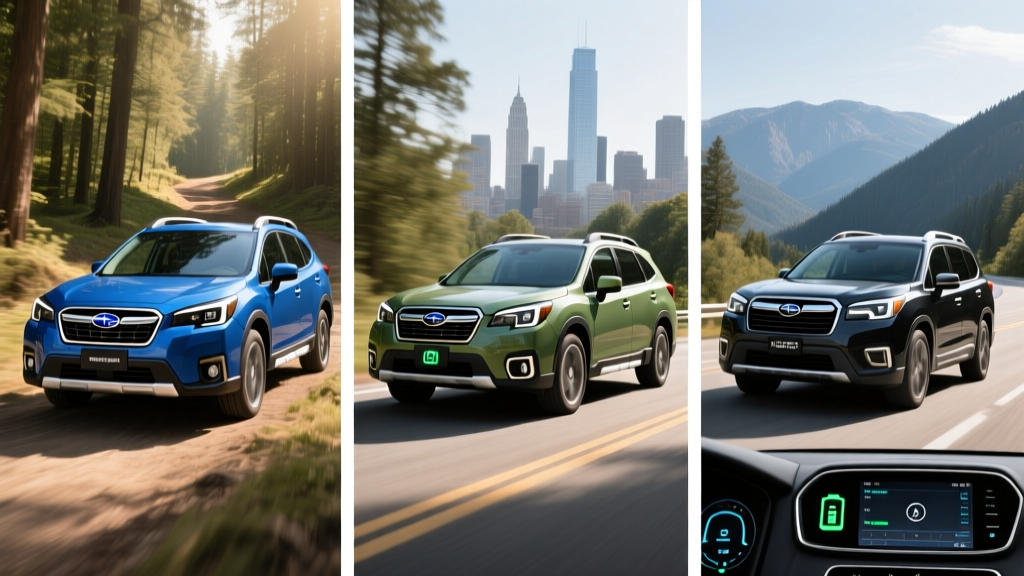
Subaru has historically been cautious about electrification, but the 2026 model year marks a meaningful expansion. The automaker now offers the Crosstrek Hybrid as a conventional hybrid (HEV) across multiple trims, the redesigned Forester Hybrid returning after a brief hiatus, and continues to lean on its partnership with Toyota for hybrid powertrain architecture. For buyers who want standard all-wheel drive, proven boxer-engine durability, and better fuel economy without plugging in, Subaru's 2026 hybrid lineup deserves a serious look.
This guide breaks down every 2026 Subaru hybrid and plug-in hybrid option with exact EPA figures, real-world expectations, pricing, and whether any qualify for federal tax incentives. If you're cross-shopping a RAV4 Hybrid or CR-V Hybrid, the data below will help you decide where Subaru fits.
HEV vs PHEV: Understanding Subaru's Hybrid Options
Conventional Hybrid (HEV)
A conventional hybrid like the 2026 Crosstrek Hybrid uses a small battery (typically 1-2 kWh) charged entirely by the gasoline engine and regenerative braking. You never plug it in. The electric motor assists the engine during acceleration and can propel the car at low speeds for brief distances. The result: significantly better city MPG than a gas-only model with zero behavior change required from the driver.
Plug-In Hybrid (PHEV)
A plug-in hybrid carries a larger battery (typically 13-20 kWh) that you charge from a wall outlet or public charger. It delivers 20-40 miles of pure electric driving before the gasoline engine kicks in. Subaru does not currently offer a PHEV in the U.S. for 2026. The previous Crosstrek PHEV (based on the Toyota Prius Prime powertrain) was discontinued after the 2023 model year. Subaru has signaled a next-generation PHEV is in development, but as of the 2026 model year, all Subaru hybrids sold in the U.S. are conventional HEVs.
This distinction matters for your wallet and your expectations. An HEV saves fuel passively; a PHEV rewards you for plugging in but costs more upfront and requires charging access to realize its advantage.
2026 Subaru Crosstrek Hybrid: MPG, Specs, and Real-World Efficiency
The 2026 Crosstrek Hybrid is the volume player in Subaru's electrified lineup. Built on the same Subaru Global Platform as the gas Crosstrek, it pairs a 2.0-liter BOXER four-cylinder engine with an electric motor integrated into the Lineartronic CVT. Symmetrical All-Wheel Drive is standard, as it is on every Subaru sold in the U.S.
| Specification | Value |
|---|---|
| Powertrain | 2.0L BOXER-4 + electric motor, CVT |
| Combined Horsepower | 194 hp (net system) |
| Drivetrain | Symmetrical AWD (standard) |
| Battery Type | Lithium-ion, ~1.1 kWh (HEV, not plug-in) |
| EPA MPG (City / Highway / Combined) | 36 / 34 / 35 MPG |
| 0–60 mph | ~8.2 seconds |
| Starting MSRP | $30,995 (Premium trim) |
| Battery Warranty | 8 years / 100,000 miles |
How Many MPG Does the Crosstrek Hybrid Actually Get?
The EPA rates the 2026 Crosstrek Hybrid at 36 city / 34 highway / 35 combined MPG. That's a meaningful improvement over the gas-only Crosstrek 2.0L, which returns 28/33/30 MPG on the same cycle, according to fueleconomy.gov.
In real-world driving, Subaru's hybrid system behaves similarly to Toyota's: the electric motor does its heaviest lifting in stop-and-go city traffic, where regenerative braking recaptures energy constantly. Expect to match or slightly exceed the EPA city figure in urban driving — owners of the previous-gen Crosstrek Hybrid routinely reported 37-38 MPG in city-heavy commutes. On sustained highway drives at 75+ mph, expect closer to 31-33 MPG, as the electric motor contributes less and aerodynamic drag dominates.
In cold weather (below 30°F), plan for a 5-8% efficiency reduction. The engine runs longer to heat the cabin and bring the catalytic converter to operating temperature, reducing the hybrid system's electric-assist time.
2026 Subaru Forester Hybrid: The Family-Friendly Option
After a gap in hybrid availability, the Forester Hybrid returns for 2026 with the same 2.0L BOXER hybrid architecture found in the Crosstrek Hybrid, tuned for the Forester's larger footprint. It targets buyers who need more cargo room and rear-seat space than the Crosstrek provides but don't want to step up to the three-row Ascent.
| Driving Condition | EPA Estimate | Real-World Expectation |
|---|---|---|
| City | 35 MPG | 35-37 MPG (hybrids often exceed EPA city) |
| Highway | 33 MPG | 30-32 MPG (at 70-75 mph sustained) |
| Combined | 34 MPG | 33-35 MPG (mixed driving) |
The Forester Hybrid produces 194 hp combined through the same engine-motor pairing. The 0-60 time sits around 8.6 seconds — adequate for merging and passing, if not sporty. Starting MSRP is approximately $35,495 for the Premium trim with standard EyeSight driver-assistance technology.
The Forester Hybrid's advantage over competitors like the Honda CR-V Hybrid and Toyota RAV4 Hybrid is standard AWD with genuine off-road credibility — 8.7 inches of ground clearance and Subaru's X-MODE traction management. The trade-off is slightly lower combined MPG than the RAV4 Hybrid's EPA-rated 39-41 MPG combined, depending on trim.
Hybrid Battery Warranty, Reliability, and Replacement Costs
Subaru Hybrid Battery Warranty
Subaru covers the hybrid battery pack and related hybrid-system components for 8 years or 100,000 miles, whichever comes first. In states that follow California Air Resources Board (CARB) emissions warranty requirements — including California, New York, Massachusetts, and several others — hybrid battery coverage extends to 10 years or 150,000 miles.
This is consistent with industry norms. Toyota, Honda, and Hyundai offer comparable 8-10 year hybrid battery warranties.
Is the Subaru Hybrid System Reliable?
Subaru's hybrid system is derived from Toyota's proven Hybrid Synergy Drive architecture through the companies' longstanding partnership. The 2.0L BOXER engine itself has been in production for years with a strong reliability record. The electric motor and power-control electronics have few wear components.
The most common concern among hybrid buyers is eventual battery replacement cost. Based on current industry data and Toyota-derived system pricing, a Subaru hybrid battery replacement outside of warranty typically costs between $2,500 and $4,000 including labor. However, hybrid battery failures before 150,000 miles are uncommon. Most degradation manifests as a gradual loss of 5-10% capacity over 10+ years — reducing electric-assist capability slightly but not rendering the vehicle inoperable.
Individual battery modules can sometimes be replaced rather than the entire pack, reducing cost to $800-$1,500 at a specialist shop.
Does Any 2026 Subaru Hybrid Qualify for a Federal Tax Credit?
This is where the HEV vs. PHEV distinction becomes critical for your budget.
- Conventional hybrids (HEV): The 2026 Crosstrek Hybrid and Forester Hybrid do not qualify for the federal §30D Clean Vehicle Credit. That credit is available only for plug-in electric vehicles (BEVs and PHEVs) with a minimum 7 kWh battery capacity and external charging capability.
- PHEVs: Subaru currently does not sell a PHEV in the U.S. for 2026, so there is no Subaru model eligible for the credit this year.
- State incentives: Some states offer rebates or tax credits for conventional hybrids, though these are less common than EV/PHEV incentives. Check your state's energy office or department of environmental quality for current programs.
If the federal tax credit is a priority for your purchase, you would need to look at plug-in competitors like the Toyota RAV4 Prime (PHEV, up to $7,500 credit depending on battery sourcing and your income — see IRS §30D guidelines) or a fully electric vehicle.
The Crosstrek Hybrid's advantage is a lower starting price that doesn't depend on credit eligibility to deliver value. At ~$31,000, it undercuts most PHEVs by $8,000-$12,000 before any incentives are applied.
Hybrid vs PHEV vs EV: Which Subaru Buyer Are You?
Choose a Subaru HEV (Crosstrek or Forester Hybrid) If:
- You don't have reliable access to home or workplace charging
- You want better fuel economy with zero change to your driving or fueling habits
- You need standard AWD for snow, rain, or light off-road use
- Your budget is $30,000-$38,000 and you don't want to depend on tax credit eligibility
- You drive 12,000-15,000 miles per year with a mix of city and highway
Consider a PHEV (Non-Subaru) If:
- You can charge at home nightly (Level 1 or Level 2)
- Your daily commute is under 35 miles round-trip (most PHEVs cover this on electric alone)
- You want to minimize gasoline use without committing to a full EV
- You qualify for the §30D federal tax credit (income under $150K single / $300K joint, vehicle MSRP under caps)
Go Full EV If:
- You have home Level 2 charging and your daily driving is under 250 miles
- You want the lowest per-mile fuel cost and minimal maintenance
- You're ready to learn DC fast-charging logistics for road trips
- You want to maximize federal and state incentives
Pros and Cons: 2026 Subaru Hybrids at a Glance
Pros
- Standard Symmetrical AWD on every trim — no FWD base model compromise
- 35-36 MPG combined real-world, especially strong in city driving
- 8.7" ground clearance (Forester/Crosstrek) with X-MODE for genuine all-weather capability
- Lower starting price than comparable PHEVs or EVs
- Proven Toyota-derived hybrid architecture with strong reliability data
- EyeSight safety suite standard (adaptive cruise, lane centering, pre-collision braking)
Cons
- No PHEV option available — can't drive on electric-only for commutes
- No federal tax credit eligibility for conventional HEVs
- Combined MPG trails Toyota RAV4 Hybrid (39-41 EPA) by 5-6 MPG
- CVT can feel sluggish during hard acceleration compared to geared transmissions
- Hybrid battery replacement ($2,500-$4,000 out of warranty) is a long-term cost consideration
- Subaru's infotainment system lags behind competitors in responsiveness and UI design
Frequently Asked Questions
How many MPG does the 2026 Subaru Crosstrek Hybrid get?
The EPA rates it at 36 city / 34 highway / 35 combined MPG. In real-world city-heavy driving, owners commonly see 37-38 MPG. Highway-only driving at 75 mph typically yields 31-33 MPG.
Does Subaru make a plug-in hybrid for 2026?
No. Subaru discontinued the Crosstrek PHEV after 2023. As of the 2026 model year, all Subaru hybrids in the U.S. are conventional HEVs that do not plug in. A next-generation PHEV has been hinted at but is not yet announced with a firm timeline.
How far can a Subaru hybrid go on electric only?
Conventional Subaru hybrids (HEVs) can travel roughly 1 mile or less on electric power alone at very low speeds (under 25 mph). They are not designed for meaningful electric-only range — the electric motor assists the gas engine rather than replacing it. If you want 25+ miles of electric-only driving, you need a PHEV from another brand.
Is the Subaru hybrid battery expensive to replace?
Out of warranty, expect $2,500-$4,000 for a full hybrid battery replacement including labor. However, failures before 150,000 miles are rare. The battery is warrantied for 8 years/100,000 miles (10 years/150,000 miles in CARB states). Individual module replacement can cost $800-$1,500.
Does the 2026 Subaru Crosstrek Hybrid qualify for any tax credit?
No. The federal §30D Clean Vehicle Credit applies only to plug-in vehicles (BEVs and PHEVs). The Crosstrek Hybrid is a conventional HEV and does not qualify. Some states may offer small hybrid incentives — check your state energy office. The IRS Clean Vehicle Credit page details current federal eligibility rules.
How does the Subaru hybrid compare to the Toyota RAV4 Hybrid?
The RAV4 Hybrid achieves 39-41 MPG combined (EPA) versus the Crosstrek Hybrid's 35 MPG and the Forester Hybrid's 34 MPG. Toyota also offers the RAV4 Prime PHEV with 42 miles of electric-only range. Subaru's advantage is greater ground clearance, more rugged off-road capability via X-MODE, and a slightly lower starting price on comparable trims. If maximum fuel economy is your top priority, the RAV4 Hybrid wins. If all-terrain capability matters more, Subaru holds the edge.
Do I need to plug in a Subaru hybrid?
No. All 2026 Subaru hybrids are conventional HEVs. The battery charges through regenerative braking and the gasoline engine. You fuel up at a gas station exactly as you would with a non-hybrid vehicle.
For the latest EPA ratings and to compare specific trims, visit fueleconomy.gov. For Subaru's official specifications and build-and-price tool, see Subaru's Crosstrek page or your local dealer. Tax credit rules change frequently — always verify current eligibility at irs.gov before purchasing.