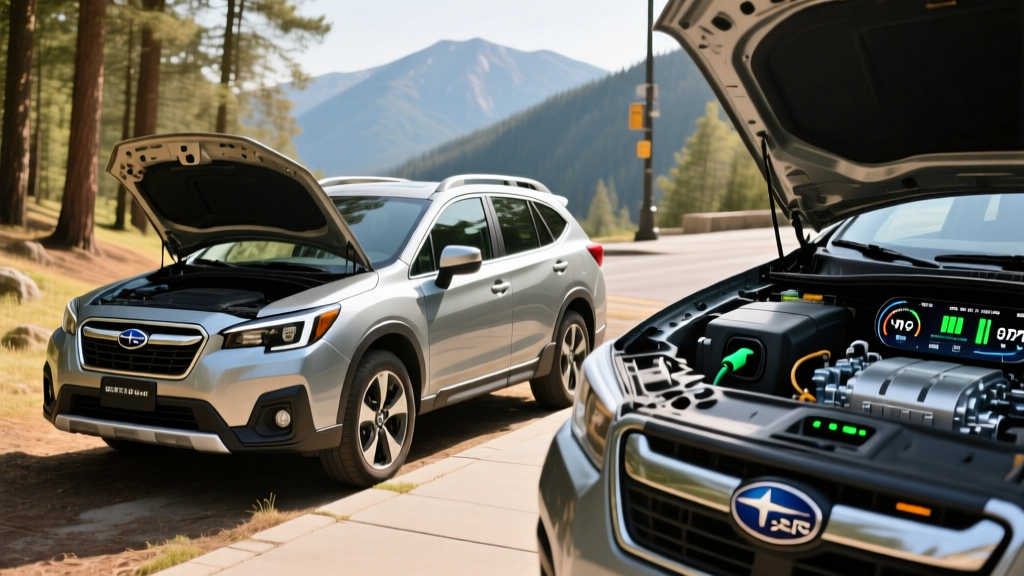
Subaru's hybrid strategy for the 2026 model year centers on conventional hybrid (HEV) technology across its most popular crossovers. Unlike plug-in hybrids (PHEVs), these vehicles never require a charging cable — the gasoline engine and regenerative braking handle all battery replenishment. For buyers navigating Subaru's showrooms this year, understanding exactly which models carry the hybrid powertrain, what efficiency gains they deliver, and how the battery warranty works is essential before signing a purchase agreement.
2026 Subaru Hybrid Lineup at a Glance
Subaru offers its hybrid system on two core models for 2026: the compact Crosstrek Hybrid and the midsize Forester Hybrid. Both use a 2.5-liter flat-four (Boxer) engine paired with an electric motor integrated into the Lineartronic CVT. Power is routed through Subaru's symmetrical all-wheel-drive system — a non-negotiable feature across the entire brand. Subaru discontinued the plug-in hybrid (PHEV) version of the Crosstrek after the 2023 model year, so the 2026 lineup is strictly self-charging HEV.
| Attribute | Crosstrek Hybrid | Forester Hybrid |
|---|---|---|
| Powertrain | 2.5L Boxer-4 + electric motor (HEV) | 2.5L Boxer-4 + electric motor (HEV) |
| Combined HP | ~194 hp | ~194 hp |
| Drivetrain | Symmetrical AWD | Symmetrical AWD |
| Transmission | Lineartronic CVT | Lineartronic CVT |
| EPA Combined MPG | ~36 MPG | ~35 MPG |
| Plug-In Required? | No (self-charging HEV) | No (self-charging HEV) |
| Base MSRP (est.) | ~$31,000 | ~$36,500 |
Note: Specs reflect Subaru's announced 2026 model-year data. Final EPA certification figures may vary slightly by trim. Always confirm with the EPA Fuel Economy Guide before purchase.
EPA MPG Breakdown: City, Highway, and Combined
The headline number for Subaru's hybrid system is a meaningful improvement over the gasoline-only variants. Where the standard 2026 Crosstrek with the 2.5L engine achieves roughly 29 MPG combined, the hybrid variant pushes that to approximately 36 MPG — a 24% gain. The Forester Hybrid sees a similar uplift, moving from about 29 MPG combined (gas) to around 35 MPG combined (hybrid).
| Model | City MPG | Highway MPG | Combined MPG |
|---|---|---|---|
| Crosstrek Hybrid | ~38 | ~34 | ~36 |
| Forester Hybrid | ~37 | ~33 | ~35 |
| Crosstrek (gas, 2.5L AWD) | ~27 | ~32 | ~29 |
| Forester (gas, 2.5L AWD) | ~26 | ~33 | ~29 |
Like most conventional hybrids, the Subaru HEV system delivers its biggest advantage in city driving. The electric motor handles low-speed propulsion and stop-and-go traffic, where gasoline engines are least efficient. On the highway, the gas engine does most of the work, so the hybrid advantage narrows. Drivers who commute primarily in urban or suburban conditions will see the most benefit from the hybrid powertrain.
Hybrid vs. Plug-In Hybrid vs. Full EV: Which Subaru Buyer Are You?
Subaru's decision to drop the Crosstrek PHEV after 2023 left some buyers confused. Here's a clear breakdown of what each electrification level means and who it serves.
Conventional Hybrid (HEV)
How it works: Small battery (1–2 kWh) charged by the engine and regenerative braking. No plug needed.
Electric-only driving: Very short distances at low speed (under 1 mile).
Best for: Drivers who want better MPG without changing their fueling habits. Apartment dwellers without home charging access.
Plug-In Hybrid (PHEV)
How it works: Larger battery (10–20 kWh) that can be plugged in for 25–40 miles of electric-only range, then operates as a hybrid.
Electric-only driving: Meaningful daily commutes on electricity alone.
Best for: Drivers with home charging who want EV-like daily driving with gas backup for road trips. Not currently offered by Subaru for 2026.
Battery Electric (BEV)
How it works: Large battery (60–100+ kWh), no gasoline engine. Charged via plug only.
Electric-only driving: 100% of the time. 250–350+ miles per charge.
Best for: Drivers with reliable home Level 2 charging who want zero tailpipe emissions and minimal maintenance. Subaru's Solterra is the brand's current BEV offering.
- Choose the Subaru Hybrid (HEV) if: You want 35–36 MPG with AWD, have no home charging option, regularly drive in cold weather, and want the simplicity of gas-station refueling.
- Look at a PHEV from another brand (e.g., Toyota RAV4 Prime) if: You have home Level 2 charging, your daily commute is under 40 miles, and you want to drive mostly on electricity while keeping gas for longer trips.
- Consider the Subaru Solterra (BEV) if: You can install a Level 2 home charger, your daily driving is under 220 miles, and you want the lowest per-mile fuel cost and zero tailpipe emissions.
Powertrain Details: The Boxer Hybrid System
Subaru's 2026 hybrid system pairs its familiar 2.5-liter horizontally opposed (Boxer) four-cylinder engine with an electric motor-generator integrated into the transmission housing. The combined system output is approximately 194 horsepower — a noticeable bump over the 180 hp in the gas-only 2.5L models.
The electric motor provides instant torque at low RPM, which improves off-the-line acceleration and makes the CVT feel more responsive. Total system torque figures land around 175 lb-ft. The hybrid battery is a lithium-ion pack mounted under the rear cargo area, preserving the flat load floor and maintaining the same cargo volume as the gas models (approximately 20 cu ft behind the rear seats in the Crosstrek, 29 cu ft in the Forester).
Subaru's symmetrical AWD system operates identically to the gas models — a mechanical center differential splits torque front-to-rear. This is a key differentiator from Toyota's e-AWD hybrid system, which uses a separate rear electric motor instead of a mechanical driveshaft. Subaru's approach delivers more predictable all-wheel-drive behavior in deep snow and off-road conditions, at a slight weight penalty.
Battery Warranty, Longevity, and Replacement Costs
- Hybrid battery coverage: 8 years / 100,000 miles (10 years / 150,000 miles in CARB states including CA, CO, CT, ME, MD, MA, NJ, NY, OR, RI, VT, WA)
- Hybrid system components: 8 years / 100,000 miles (inverter, motor-generator, control module)
- Capacity threshold: Subaru warrants the battery against defects and abnormal capacity loss. Specific degradation percentage thresholds should be confirmed with your dealer at purchase.
Hybrid battery longevity is one of the most common concerns among first-time hybrid buyers. The data is reassuring: modern lithium-ion hybrid batteries in Toyota and Subaru HEV systems routinely last 150,000–200,000+ miles before requiring replacement. The small battery size (1–2 kWh) means it undergoes shallow charge-discharge cycles, which is far less stressful than the deep cycles in a full EV battery.
If replacement is needed out of warranty, expect to pay between $2,000 and $4,000 for a new hybrid battery pack, depending on the model and labor rates in your area. Refurbished packs are available from third-party suppliers for $1,000–$2,000. This is dramatically less than a full EV battery replacement, which can exceed $10,000–$15,000.
For peace of mind, Subaru's hybrid system is well-proven. The architecture has been in production since the 2019 model year (with Toyota engineering collaboration), and failure rates are low based on long-term owner surveys tracked by sources like Consumer Reports and J.D. Power dependability studies.
Pricing, Trims, and Tax Credit Eligibility
Subaru positions the hybrid variants as premium trims within each model line. Based on 2026 pricing announcements:
| Model / Trim | Est. MSRP | Hybrid Premium Over Gas |
|---|---|---|
| Crosstrek Hybrid (Sport Hybrid) | ~$31,000 | +$2,500–$3,000 |
| Crosstrek Hybrid (Limited Hybrid) | ~$34,500 | +$2,500–$3,000 |
| Forester Hybrid (Premium Hybrid) | ~$36,500 | +$2,500–$3,000 |
| Forester Hybrid (Limited Hybrid) | ~$40,000 | +$2,500–$3,000 |
The hybrid premium of approximately $2,500–$3,000 over equivalent gas trims pays for itself through fuel savings. At 15,000 miles per year and $3.50/gallon gasoline, a driver upgrading from 29 MPG (gas) to 36 MPG (hybrid) saves roughly $340 annually — meaning the premium is recouped in about 7–9 years at current fuel prices. Higher annual mileage or higher gas prices shorten that payback period significantly.
Ownership Costs and Fuel Savings Calculator
Here's a practical 5-year cost comparison between the gas and hybrid Crosstrek, assuming 15,000 miles per year and $3.50/gallon fuel:
| Cost Factor | Crosstrek Gas (29 MPG) | Crosstrek Hybrid (36 MPG) |
|---|---|---|
| Annual fuel consumption | 517 gallons | 417 gallons |
| Annual fuel cost | $1,810 | $1,459 |
| 5-year fuel cost | $9,050 | $7,295 |
| 5-year fuel savings | — | $1,755 |
Hybrid maintenance costs are comparable to the gas models. Regenerative braking reduces brake pad wear — many hybrid owners report brake pads lasting 80,000–100,000 miles. The hybrid system adds no additional fluid changes or scheduled service items beyond what the gas model requires. Insurance premiums for the hybrid trims are typically 3–5% higher than equivalent gas models, reflecting the slightly higher repair cost of hybrid-specific components.
Pros and Cons of the 2026 Subaru Hybrids
✓ Pros
- Standard symmetrical AWD with proven off-road and snow capability
- 35–36 MPG combined — a major improvement over gas models
- No plug-in charging required; no behavior change from gas cars
- Proven hybrid architecture with Toyota engineering roots
- 8-year/100,000-mile hybrid battery warranty (10/150k in CARB states)
- Strong resale value typical of Subaru crossovers
- Excellent visibility, ground clearance (8.7" Crosstrek), and practicality
✗ Cons
- No PHEV option — can't drive meaningful distances on electric only
- No federal tax credit eligibility for conventional HEVs
- Hybrid premium adds ~$2,500–$3,000 to purchase price
- CVT can feel sluggish during hard acceleration or highway merging
- Slightly lower highway MPG gains than city (hybrid advantage narrows at speed)
- Infotainment system still trails competitors in responsiveness
- Limited hybrid trim availability — may require dealer wait times
Frequently Asked Questions
How many MPG does the 2026 Subaru hybrid get?
The 2026 Crosstrek Hybrid achieves an estimated 38 city / 34 highway / 36 combined MPG. The Forester Hybrid lands at approximately 37 city / 33 highway / 35 combined. These figures represent a 20–25% improvement over the gasoline-only versions of each model.
Do I need to plug in the Subaru hybrid to charge it?
No. The 2026 Crosstrek Hybrid and Forester Hybrid are conventional hybrids (HEVs), not plug-in hybrids. The battery charges automatically through the gasoline engine and regenerative braking during deceleration. You fuel them exactly like a gas car — at a gas station.
Is there a Subaru plug-in hybrid for 2026?
Not currently. Subaru discontinued the Crosstrek Plug-In Hybrid after the 2023 model year. The 2026 lineup offers only conventional (self-charging) hybrids. If you want a Subaru with a plug, the Solterra is the brand's all-electric option. For a PHEV crossover with AWD, consider the Toyota RAV4 Prime or Mitsubishi Outlander PHEV.
How reliable are Subaru hybrid batteries?
Subaru's hybrid system, developed in partnership with Toyota, has demonstrated strong reliability since its 2019 introduction. Hybrid batteries in this architecture typically last 150,000–200,000+ miles. The battery is covered by an 8-year/100,000-mile warranty (10 years/150,000 miles in CARB-emission states). Out-of-warranty replacement costs range from $2,000–$4,000.
Does the 2026 Subaru hybrid qualify for a tax credit?
Conventional hybrids do not qualify for the federal §30D Clean Vehicle Credit, which applies only to BEVs and PHEVs meeting specific battery-sourcing and MSRP requirements. However, some states and municipalities offer separate incentives for hybrid vehicles. Check the Alternative Fuels Data Center for state-specific programs. Consult a tax professional for eligibility guidance.
How does Subaru's hybrid AWD compare to Toyota's?
Subaru uses a mechanical AWD system with a center differential that sends power to all four wheels via a driveshaft — the same system in its gas models. Toyota's hybrid AWD (e-AWD) uses a separate electric motor on the rear axle with no mechanical connection to the front. Subaru's approach provides more consistent torque distribution in challenging conditions (deep snow, mud), while Toyota's system is lighter and slightly more efficient on dry pavement.
Is the Subaru hybrid worth the extra cost over the gas model?
If you drive 15,000+ miles per year, primarily in city or suburban conditions, and plan to keep the vehicle 5+ years, the hybrid's fuel savings offset the ~$2,500–$3,000 price premium. If you drive mostly highway miles, drive fewer than 10,000 miles annually, or trade vehicles every 3 years, the payback is less certain. The hybrid also offers slightly quicker acceleration and reduced brake wear as secondary benefits.