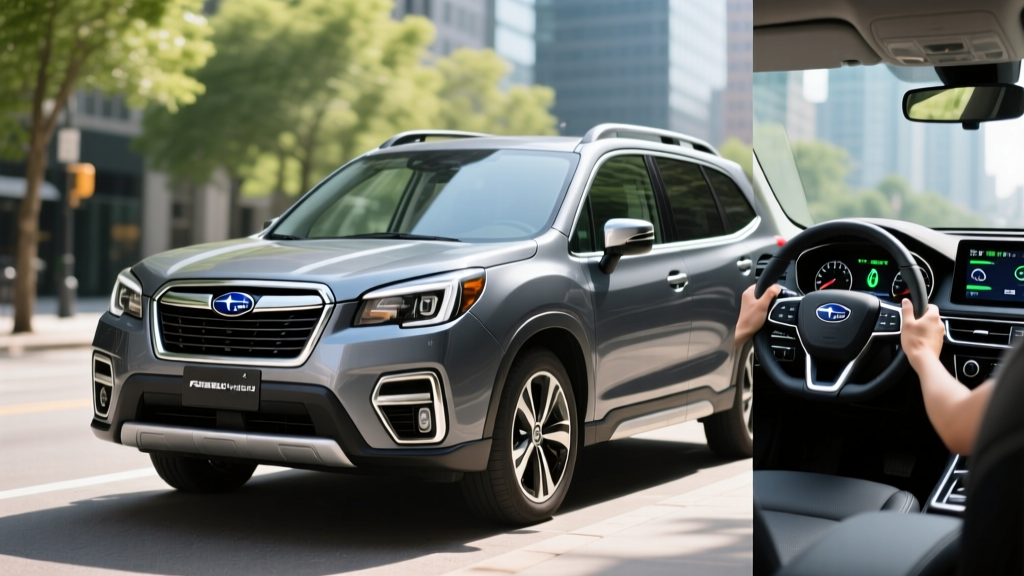
The 2026 Subaru Forester Hybrid Touring sits at a crossroads that many compact-SUV shoppers face: you want the all-weather confidence and cargo versatility of the Forester, you want better fuel economy than the gas-only model delivers, but you're not ready to plug in every night or commit to a full battery-electric vehicle. Subaru's answer is a conventional hybrid (HEV) — not a plug-in — that pairs its familiar 2.5-liter flat-four with a self-charging electric motor system to squeeze meaningful efficiency gains without changing how you fuel up.
This guide breaks down the Forester Hybrid Touring's EPA numbers, real-world fuel economy behavior, powertrain specifics, warranty coverage, and whether this top-trim hybrid makes sense versus a PHEV or a full EV for your daily routine.
Forester Hybrid Touring at a Glance: Key Specs
| Spec | Value |
|---|---|
| Powertrain | 2.5L flat-4 + electric motor (HEV) |
| Combined Horsepower | 194 hp |
| Drivetrain | Symmetrical AWD (standard) |
| EPA MPG (City / Hwy / Combined) | 35 / 34 / 35 |
| Battery Type | Lithium-ion (self-charging, ~1.1 kWh usable) |
| Plug-In Required? | No — regenerative braking + engine charges battery |
| 0–60 mph (est.) | ~8.5 seconds |
| Cargo Volume (rear seats up / down) | 28.9 / 74.4 cu ft |
| Base MSRP (Touring Hybrid) | $42,395 |
| Hybrid Battery Warranty | 8 years / 100,000 miles |
| Federal EV Tax Credit (§30D) | Not eligible (HEV, not a plug-in) |
EPA Fuel Economy and What You'll Actually See
The EPA rates the 2026 Forester Hybrid at 35 MPG combined (35 city / 34 highway), according to fueleconomy.gov. That's a notable improvement over the gas-only Forester's 29 MPG combined — roughly a 20% gain in fuel efficiency.
| Model | City MPG | Highway MPG | Combined MPG |
|---|---|---|---|
| 2026 Forester Hybrid (AWD) | 35 | 34 | 35 |
| 2026 Forester Gas (AWD) | 26 | 33 | 29 |
| Difference | +9 | +1 | +6 |
The city MPG advantage is where this hybrid earns its keep. If your commute involves frequent stops, school drop-off lines, or congested urban corridors, the electric motor handles low-speed propulsion and the engine shuts off at stops, eliminating idle fuel burn entirely.
HEV vs. PHEV vs. EV: Which Powertrain Fits Your Life?
Subaru does not currently offer a Forester plug-in hybrid (PHEV) in the U.S. market. The Forester Hybrid is strictly a conventional HEV — it charges its small lithium-ion battery through regenerative braking and the gasoline engine. You never plug it in.
HEV vs. PHEV — The Key Differences
| Factor | HEV (Forester Hybrid) | PHEV (e.g., Toyota RAV4 Prime) | Full EV (e.g., Tesla Model Y) |
|---|---|---|---|
| Plug in to charge? | No | Yes (optional) | Yes (required) |
| Electric-only range | ~1 mile at low speed | 35–42 miles | 280–330+ miles |
| Total range | ~500 miles | ~550+ miles | 280–330+ miles |
| Home charging needed? | No | Recommended (Level 2) | Yes (Level 2 ideal) |
| Federal tax credit (§30D) | No | Up to $7,500 (if eligible) | Up to $7,500 (if eligible) |
| Fuel cost per mile (avg.) | ~$0.10 | ~$0.05 (electric) / ~$0.10 (gas) | ~$0.04–$0.06 |
Choose the Forester Hybrid (HEV) if: You don't have access to home or workplace charging, you want a simpler ownership experience with zero plug-in routine, you drive in areas with sparse charging infrastructure, or you want AWD capability in a proven package without the upfront premium of a PHEV or EV.
Consider a PHEV or EV instead if: You have reliable Level 2 charging at home, your daily commute is under 40 miles (a PHEV could cover it entirely on electricity), you want to minimize or eliminate gasoline use, or you qualify for the federal §30D tax credit that can offset a PHEV/EV's higher purchase price.
Powertrain Deep Dive: 194 HP and How the Hybrid System Works
The Forester Hybrid's powertrain pairs Subaru's 2.5-liter naturally aspirated BOXER four-cylinder engine with an electric motor integrated into the Lineartronic CVT transmission. Combined output is 194 horsepower — up from the gas-only model's 180 hp. The electric motor provides instant torque fill at low RPMs, which makes around-town acceleration feel more responsive than the gas-only Forester despite the hybrid system's added weight.
The lithium-ion hybrid battery pack is modest — approximately 1.1 kWh of usable capacity. This is intentional: the battery is large enough to capture meaningful regenerative energy during braking and to power the electric motor for low-speed maneuvering, but small enough to avoid the weight, cost, and packaging compromises of a larger PHEV-style pack. The battery sits under the rear seat area, preserving the Forester's full cargo floor.
Subaru's Symmetrical All-Wheel Drive remains standard on the Hybrid Touring. The system uses a mechanical center differential to distribute torque front-to-rear, with the hybrid system's electric assist available to both axles. This is a key differentiator versus some competing hybrids that rely on a rear-mounted electric motor for AWD, which can feel less predictable on loose surfaces.
Pricing, Trim Positioning, and Tax Credit Reality
The 2026 Forester Hybrid Touring carries an MSRP of $42,395 (including destination). As the top trim, it includes features like a panoramic moonroof, heated and ventilated front seats, a 12.3-inch digital gauge cluster, Harman Kardon audio, wireless phone charging, and Subaru's EyeSight driver-assistance suite with adaptive cruise control and lane-centering.
| Trim | MSRP | Key Additions Over Base Hybrid |
|---|---|---|
| Hybrid Premium | $36,895 | Heated seats, power liftgate, 11.6" touchscreen |
| Hybrid Sport | $38,995 | Sport-tuned suspension, unique wheels, sport interior |
| Hybrid Limited | $40,495 | Leather, power passenger seat, blind-spot detection |
| Hybrid Touring | $42,395 | Panoroof, ventilated seats, Harman Kardon, 12.3" cluster |
The hybrid premium over a comparably equipped gas-only Forester Touring is approximately $2,500. At 6 MPG combined improvement and current national gas prices (~$3.30/gallon), a driver covering 15,000 miles annually would save roughly $400–$450 per year in fuel, recouping the hybrid premium in about 5–6 years. Higher-mileage drivers or those in expensive-gas states (California, Washington, New York) will break even faster.
Reliability, Battery Warranty, and Long-Term Costs
Subaru's hybrid system is relatively conservative in its battery usage. The system never fully charges or fully depletes the pack — it operates in a narrow state-of-charge window (roughly 40–80%) to minimize degradation. This buffer strategy is the same principle used by Toyota and Honda in their proven hybrid systems, and real-world data from these architectures consistently shows hybrid batteries lasting well beyond their warranty periods, often exceeding 150,000–200,000 miles with minimal capacity loss.
If a hybrid battery replacement is needed out of warranty, current industry pricing for a compact-SUV hybrid pack ranges from $2,000 to $3,500 (parts and labor), depending on the service provider. Refurbished or reconditioned packs are increasingly available at the lower end of that range. This is significantly less expensive than a full EV battery replacement, which can run $8,000–$18,000+.
Subaru's overall vehicle warranty includes 3 years / 36,000 miles bumper-to-bumper and 5 years / 60,000 miles powertrain coverage. The brand consistently ranks above average in long-term reliability surveys from Consumer Reports and J.D. Power, and the Forester specifically has a strong track record for durability in the compact-SUV segment.
Touring Trim Features: What You Get at the Top
The Touring trim is Subaru's luxury-oriented flagship for the Forester line, and the hybrid version carries the same premium equipment as its gas counterpart. For 2026, the Touring Hybrid includes:
- 12.3-inch digital instrument cluster with hybrid energy-flow display
- 11.6-inch vertical touchscreen with wireless Apple CarPlay and Android Auto
- Harman Kardon 9-speaker premium audio
- Panoramic power moonroof
- Heated and ventilated front seats; heated rear seats and steering wheel
- Nappa leather-trimmed upholstery
- Wireless Qi phone charging
- EyeSight Driver Assist with adaptive cruise control, lane-centering, and pre-collision braking
- Reverse automatic braking and blind-spot detection with rear cross-traffic alert
- 18-inch dark-finish alloy wheels
The hybrid energy-flow display on the digital cluster is worth mentioning: it provides a real-time visualization of whether the engine, electric motor, or both are providing propulsion, and shows regenerative-braking energy recapture during deceleration. Drivers who pay attention to this feedback tend to optimize their driving habits for better MPG — a form of "gamification" that consistently yields 1–3 MPG improvement over inattentive driving.
Who Should Buy the Forester Hybrid Touring — and Who Shouldn't
✓ The Forester Hybrid Touring Is For You If:
- You live in a snowy or rainy climate and prioritize AWD confidence
- You lack home/workplace charging access (apartment, street parking)
- Your daily driving mixes city and highway with no single dominant pattern
- You want a simple "fill up and go" ownership experience
- You value Subaru's safety reputation and EyeSight ADAS suite
- You plan to keep the vehicle 8+ years (warranty coverage, long-term durability)
✗ Look Elsewhere If:
- You have reliable Level 2 home charging and a sub-40-mile commute (a PHEV covers it on electricity)
- You want to eliminate gasoline entirely (consider a full EV like the Hyundai Ioniq 5 or Tesla Model Y)
- Federal tax credit eligibility is a priority ($7,500 requires a PHEV or BEV)
- You prioritize acceleration — 194 hp is adequate, not quick
- You tow frequently — the Hybrid's 1,500-lb tow rating matches the gas model but trails body-on-frame SUVs
Frequently Asked Questions
How many MPG does the Forester Hybrid Touring get?
The EPA rates it at 35 city / 34 highway / 35 combined. In real-world city driving with frequent stops, owners commonly report 36–38 MPG. Highway cruising at higher speeds may drop to 31–33 MPG. Cold weather reduces efficiency by 2–4 MPG due to increased engine runtime for cabin heating.
Does the Forester Hybrid need to be plugged in?
No. The Forester Hybrid is a conventional hybrid (HEV), not a plug-in hybrid (PHEV). Its small lithium-ion battery charges automatically through regenerative braking and the gasoline engine. You fuel it exactly like a gas car — at the pump.
How far can the Forester Hybrid drive on electric power alone?
Only about 1 mile at very low speeds (under 25 mph) in ideal conditions. The electric motor's primary role is to assist the gasoline engine during acceleration and to enable engine-off coasting and stop-start — not to provide meaningful electric-only driving range. If electric-only commuting is your goal, you need a PHEV or a full EV.
Does the Forester Hybrid qualify for any tax credit?
It does not qualify for the federal IRS §30D Clean Vehicle Credit, which is limited to plug-in vehicles (PHEVs and BEVs). Check your state energy office or local utility for possible hybrid-specific rebates, which vary by jurisdiction and change frequently. See IRS.gov §30D guidelines for current plug-in vehicle credit rules.
Is the Forester Hybrid reliable, and what does a battery replacement cost?
Subaru's hybrid system uses a conservative charge-discharge strategy that promotes long battery life. The hybrid battery is warranted for 8 years / 100,000 miles (10 years / 150,000 miles in CARB states). Out-of-warranty replacement, if ever needed, typically runs $2,000–$3,500. Subaru as a brand ranks above average in major reliability surveys, and the Forester platform has a strong long-term durability record.
How does the Forester Hybrid compare to the Toyota RAV4 Hybrid?
The RAV4 Hybrid (219 hp, 41 city / 38 highway / 41 combined EPA) holds a fuel-economy advantage and offers more horsepower. The Forester Hybrid counters with standard AWD across all trims (some RAV4 Hybrid trims are FWD), a slightly more spacious cargo area, and Subaru's EyeSight safety suite. The RAV4 Hybrid also starts at a lower MSRP. Your choice may come down to which AWD system you prefer, which dealer network serves you better, and whether the Forester's visibility and driving position suit you more.
What is the Forester Hybrid's total driving range on a full tank?
With a 14.0-gallon fuel tank and 35 MPG combined, the theoretical range is approximately 490 miles. Real-world range of 430–480 miles is typical depending on driving conditions. That's competitive with or better than most compact SUVs and eliminates range anxiety entirely — you refuel at any gas station in under 5 minutes.