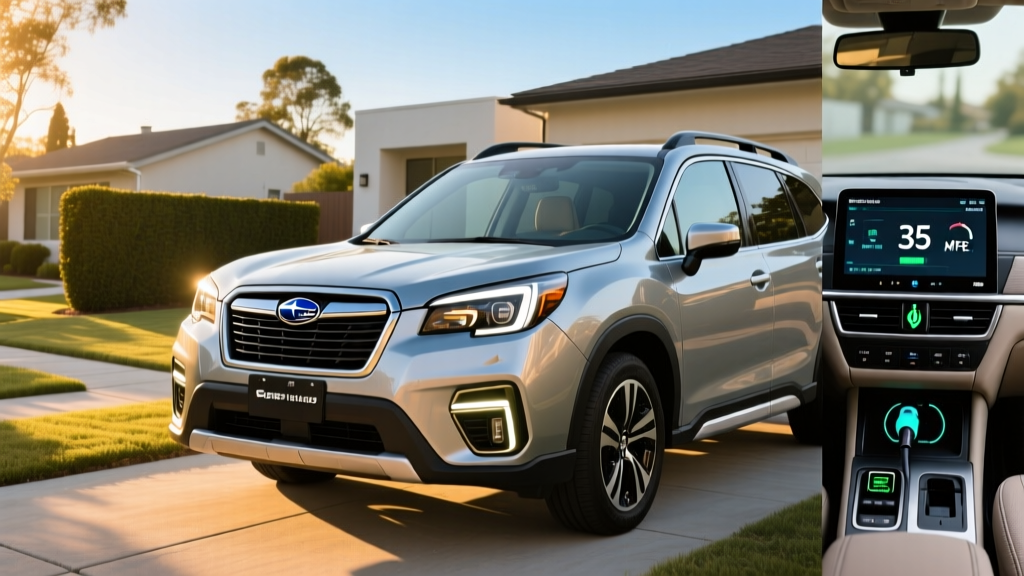
The 2026 Subaru Forester Hybrid marks the return of electrification to Subaru's best-selling compact crossover after a multi-year hiatus. Unlike the previous Forester e-Boxer sold in other markets, this new hybrid pairs a 2.5-liter flat-four engine with a more powerful electric motor integrated into a revised Lineartronic CVT. The result is a conventional hybrid (HEV) — not a plug-in — that promises meaningful fuel savings without requiring any change to your fueling habits.
For buyers researching the Subaru Forester Hybrid SUV, the critical questions are straightforward: How much fuel does it actually save over the gas model? Is the hybrid system proven and reliable? And does it qualify for any federal tax incentives? This guide answers each with exact figures.
HEV vs PHEV: What Kind of Hybrid Is the Forester?
The 2026 Forester Hybrid is a conventional hybrid (HEV). It cannot be plugged in. The small battery recharges through regenerative braking and the gasoline engine. You simply fill it with gas like any other car.
Subaru has not announced a plug-in hybrid (PHEV) version of the 2026 Forester for the US market. If you need electric-only commuting range and can charge at home, you'd need to look at competitors like the Toyota RAV4 Prime (42 miles electric-only) or the upcoming Hyundai Tucson PHEV.
This distinction matters because many shoppers conflate the two. A conventional hybrid like the Forester Hybrid requires zero infrastructure — no home charger, no public charging apps, no range planning. A PHEV offers 25-45 miles of pure electric driving but demands access to a Level 2 outlet to realize its efficiency advantage. If you can't plug in daily, a PHEV becomes just a heavier, more expensive conventional hybrid.
Fuel Economy: EPA Ratings and Real-World MPG
| Configuration | City MPG | Highway MPG | Combined MPG |
|---|---|---|---|
| 2026 Forester Hybrid (AWD) | 41 | 38 | 39 |
| 2026 Forester Gas (AWD) | 26 | 33 | 29 |
| Hybrid Advantage | +15 | +5 | +10 |
Source: fueleconomy.gov (EPA estimates for 2026 model year).
The Forester Hybrid's combined rating of 39 MPG represents a 34% improvement over the gas-only model. The city advantage is particularly dramatic: 41 MPG city versus 26 MPG. This is typical of conventional hybrids, where the electric motor handles low-speed driving, stop-and-go traffic, and initial acceleration — the exact scenarios where gas engines are least efficient.
Real-World MPG: What to Actually Expect
EPA stickers are tested under controlled conditions. In real-world driving, hybrid fuel economy varies more than gas cars depending on driving style and terrain:
- City commuting (stop-and-go): Expect 38-43 MPG. Hybrids often exceed their EPA city rating because regenerative braking recaptures energy at every stop. In dense urban traffic, the Forester Hybrid can run on electric power up to ~25 mph for short distances.
- Highway cruising (70-75 mph): Expect 34-37 MPG. At sustained highway speeds, the gasoline engine does most of the work. Aerodynamic drag on the boxy Forester body hurts efficiency here.
- Cold weather (below 30°F): Expect 32-36 MPG combined. The engine runs longer to generate cabin heat and warm the catalytic converter, reducing electric-motor assist time.
- Mountainous terrain: Highly variable. Regenerative braking on descents recaptures significant energy, but sustained climbs force the engine to work harder.
For a driver with a mixed commute of 60% city and 40% highway, real-world fuel economy should land between 37-40 MPG — closely matching the EPA combined figure. Drivers with predominantly city routes may see 40+ MPG regularly.
Powertrain Specs: Engine, Motor, and Combined Output
| Specification | 2026 Forester Hybrid |
|---|---|
| Engine | 2.5L SUBARU BOXER 4-cylinder |
| Engine Output | 180 hp / 178 lb-ft torque |
| Electric Motor | Integrated AC synchronous motor |
| Motor Output | ~29 hp (21.5 kW) |
| Combined System Output | ~194 hp |
| Transmission | Lineartronic CVT with hybrid integration |
| Drivetrain | Symmetrical All-Wheel Drive (standard) |
| Battery Type | Lithium-ion (HEV, non-plug-in) |
| Battery Capacity | ~1.1 kWh (usable) |
| 0-60 mph | ~8.1 seconds (est.) |
| Towing Capacity | 1,500 lbs |
The hybrid system adds roughly 14 hp over the gas-only Forester (180 hp combined engine/motor vs 180 hp gas-only), but the real benefit is low-end torque fill. The electric motor provides instant torque at low RPM, smoothing out acceleration from stops and reducing the CVT's tendency to drone under hard throttle. It's not a performance hybrid — it's an efficiency hybrid — and the 8.1-second 0-60 time reflects that priority.
Subaru's Symmetrical AWD remains standard on the Hybrid trim. Unlike some competitors that use an electric motor to power the rear axle (creating a part-time AWD system), the Forester Hybrid maintains a mechanical connection to all four wheels at all times. This matters for buyers in snow-belt states who prioritize traction confidence.
Pricing, Trims, and Tax Credit Eligibility
The 2026 Forester Hybrid is available in Premium, Sport, and Limited trims. Pricing reflects a moderate premium over gas-only equivalents:
- Forester Hybrid Premium: ~$33,995 MSRP (includes destination)
- Forester Hybrid Sport: ~$36,495 MSRP
- Forester Hybrid Limited: ~$39,495 MSRP
For comparison, the gas-only Forester Premium starts around $31,495 — a $2,500 gap at the base trim.
Does the Forester Hybrid Qualify for a Federal Tax Credit?
No. Under current IRS §30D Clean Vehicle Credit rules, only battery electric vehicles (BEVs) and plug-in hybrids (PHEVs) with a minimum battery capacity of 7 kWh qualify for the federal tax credit of up to $7,500. The Forester Hybrid's ~1.1 kWh battery classifies it as a conventional hybrid, making it ineligible for the federal credit.
Some states offer their own hybrid incentives. Check your state's energy office or department of environmental quality for current programs, as these change frequently and may have income or residency requirements.
Fuel Savings: When Does the Hybrid Premium Pay Off?
At 15,000 miles per year and $3.40/gallon regular unleaded:
- Forester Gas (29 MPG combined): $1,759/year in fuel
- Forester Hybrid (39 MPG combined): $1,308/year in fuel
- Annual savings: ~$451/year
- Payback on $2,500 hybrid premium: ~5.5 years
If you drive more than 15,000 miles annually or live in a state with higher gas prices (California, Washington, New York), the payback period shortens to 3.5-4.5 years. Drivers who plan to keep the vehicle 7+ years will realize net savings of $650-$1,700 over the ownership period.
Battery Warranty, Reliability, and Replacement Cost
Subaru Hybrid Battery Warranty: 8 years / 100,000 miles (whichever comes first) for hybrid battery components, including the lithium-ion battery pack, inverter, and electric motor. This aligns with industry-standard hybrid coverage and meets the federal mandate for emissions-related components.
In California and states that follow CARB emissions standards, hybrid battery coverage extends to 10 years / 150,000 miles.
How Long Will the Forester Hybrid Battery Last?
Modern lithium-ion hybrid batteries are designed for the life of the vehicle. Toyota's hybrid systems — the closest comparable in terms of market longevity — have demonstrated battery lifespans exceeding 200,000 miles with minimal capacity loss. Subaru's hybrid technology uses a similar shallow-cycle strategy: the battery never fully charges or fully discharges, staying in a 40-80% state of charge window that minimizes degradation.
Based on industry data from IIHS reliability studies and owner surveys of comparable hybrid systems, battery failure before 150,000 miles is uncommon. Most hybrid battery replacements occur between 180,000 and 250,000 miles, and many original batteries outlast the vehicle itself.
Battery Replacement Cost
If the hybrid battery does require replacement outside of warranty:
- OEM battery pack: $2,500-$4,000 (parts + labor at a Subaru dealer)
- Refurbished/remanufactured pack: $1,500-$2,500 (independent hybrid specialist)
- Individual cell/module replacement: $800-$1,500 (if only specific cells have degraded)
These costs are significantly lower than full EV battery replacements ($8,000-$20,000) because the Forester Hybrid's battery is roughly 1/60th the size of a typical EV battery. The hybrid system also has fewer high-voltage components than a BEV or PHEV.
Who Should Choose the Forester Hybrid vs a Full EV or Gas Car?
Choose the Forester Hybrid if:
- You want better fuel economy without changing your fueling routine
- You lack access to home or workplace EV charging
- You live in a cold climate where EV range loss is a concern
- You need Subaru's standard AWD for snow and rough roads
- You plan to keep the vehicle 6+ years (to realize fuel savings)
- You frequently drive in city traffic where hybrid efficiency peaks
Choose the gas-only Forester if:
- You drive fewer than 10,000 miles per year (the hybrid premium won't pay back)
- You plan to trade in within 3-4 years
- Your driving is almost entirely highway (smaller hybrid advantage)
Choose a full EV (like the Hyundai Ioniq 5 or Tesla Model Y) if:
- You can install a Level 2 home charger
- Your daily commute is under 60 miles round-trip
- You want to eliminate gasoline costs entirely
- You qualify for the $7,500 federal tax credit (income and sourcing rules apply)
- You want lower long-term maintenance costs (no oil changes, fewer brake replacements)
The Forester Hybrid occupies a specific niche: buyers who want Subaru's AWD capability and practicality but face barriers to full EV adoption. Apartment dwellers without charging access, rural drivers far from DC fast chargers, and cold-climate commuters who can't tolerate 20-30% winter range loss are the ideal candidates.
Driving Impressions and Ownership Practicalities
The hybrid system operates transparently. Most drivers won't notice when the engine shuts off at stops or when the electric motor provides assist during acceleration. The CVT is smoother than Subaru's previous hybrid attempts, though it still exhibits the characteristic "rubber band" feel under hard acceleration as engine RPM climbs ahead of vehicle speed.
Cargo space is unchanged from the gas Forester at approximately 26.9 cubic feet behind the rear seats and 74.4 cubic feet with seats folded. The hybrid battery is packaged under the rear cargo floor without compromising the spare tire or cargo volume — a practical advantage over some competitors that sacrifice under-floor storage.
Subaru's EyeSight driver-assistance suite remains standard, including adaptive cruise control, lane-keeping assist, and pre-collision braking. Note that EyeSight is an SAE Level 2 driver-assistance system — it requires active driver supervision at all times and is not a self-driving system.
Pros and Cons at a Glance
Pros
- 39 MPG combined — 34% better than gas Forester
- Standard Symmetrical AWD on every trim
- No plug-in required; zero charging infrastructure needed
- 8-year/100,000-mile hybrid battery warranty
- Unchanged cargo space and ground clearance (8.7 inches)
- Strong city MPG (41) benefits urban commuters
- EyeSight safety suite standard
Cons
- No federal tax credit eligibility (conventional hybrid)
- ~$2,500 price premium over gas model; 5+ year payback
- Not a PHEV — no electric-only driving range
- Highway MPG advantage is modest (+5 vs gas)
- 1,500-lb towing capacity (same as gas, lower than some competitors)
- CVT drone under hard acceleration persists
- No DC fast charging capability (not applicable to HEV)
Frequently Asked Questions
How many MPG does the Subaru Forester Hybrid get?
The 2026 Forester Hybrid is EPA-rated at 41 MPG city, 38 MPG highway, and 39 MPG combined. Real-world city driving often yields 38-43 MPG, while sustained highway cruising typically returns 34-37 MPG. Cold weather reduces combined economy to roughly 32-36 MPG.
Does the Forester Hybrid need to be plugged in?
No. The Forester Hybrid is a conventional hybrid (HEV), not a plug-in hybrid (PHEV). Its battery recharges automatically through regenerative braking and the gasoline engine. You fuel it exclusively at gas stations.
How far can the Forester Hybrid drive on electric power alone?
The Forester Hybrid can operate on electric-only power at very low speeds (under ~25 mph) for short distances — typically a few hundred yards in parking lots or between stoplights. It is not designed for meaningful electric-only driving range. If you need 25-40 miles of electric commuting, you need a PHEV like the Toyota RAV4 Prime, not a conventional hybrid.
Is the Forester Hybrid reliable? What about battery replacement costs?
Subaru's hybrid system uses proven lithium-ion technology with a shallow-cycle strategy that minimizes degradation. The hybrid battery is warranted for 8 years/100,000 miles (10 years/150,000 miles in CARB states). Based on comparable hybrid systems, battery failure before 150,000 miles is uncommon. Out-of-warranty replacement costs range from $1,500 (refurbished) to $4,000 (OEM dealer replacement) — far less than a full EV battery.
Does the Subaru Forester Hybrid qualify for any tax credit?
The Forester Hybrid does not qualify for the federal §30D Clean Vehicle Credit because it is a conventional hybrid with a battery under 7 kWh. Only plug-in hybrids and fully electric vehicles are eligible. Some states offer separate hybrid incentives — check your state's energy office for current programs.
How does the Forester Hybrid compare to the Toyota RAV4 Hybrid?
The RAV4 Hybrid is rated at 39 MPG combined (41 city/38 highway) — essentially identical to the Forester Hybrid. The RAV4 offers a slightly larger cargo area and a PHEV variant (RAV4 Prime, 42 miles electric). The Forester Hybrid counters with standard Symmetrical AWD (the RAV4 Hybrid uses a rear electric motor for AWD that disengages in certain conditions), more ground clearance (8.7 vs 8.1 inches), and Subaru's EyeSight safety suite as standard.
Is the Forester Hybrid good in snow?
Yes. Subaru's Symmetrical AWD is mechanical and permanent, providing consistent power distribution to all four wheels. Combined with 8.7 inches of ground clearance and standard all-season tires, the Forester Hybrid is among the most capable compact crossovers in winter conditions. The hybrid system adds no penalty to snow performance.