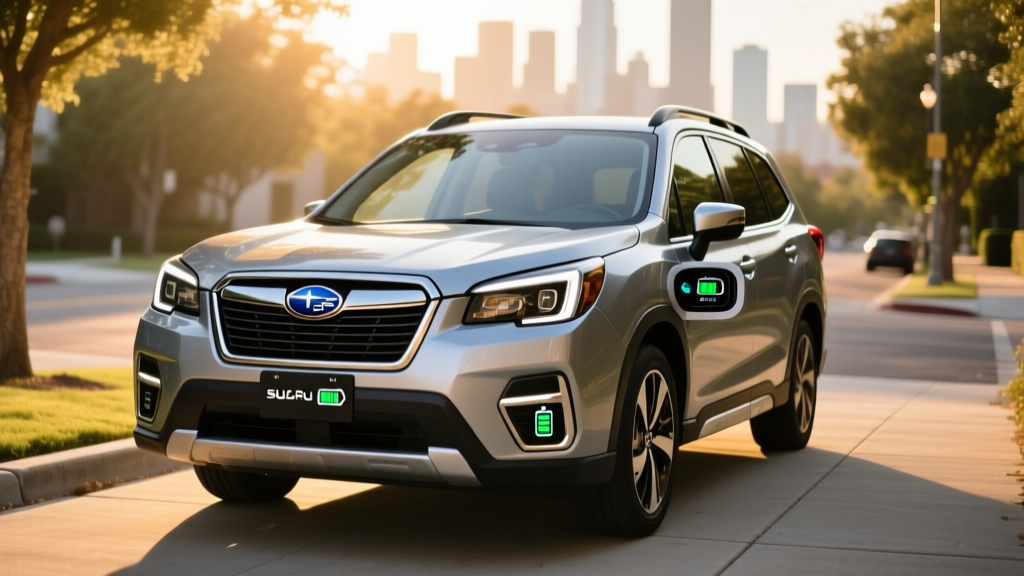
The 2026 Subaru Forester Hybrid marks the return of electrification to Subaru's compact SUV lineup after a multi-year hiatus. Built on the latest-generation Forester platform with a newly engineered hybrid powertrain, it targets buyers who want all-wheel-drive capability and meaningful fuel savings without the lifestyle adjustment of plugging in. If you've been searching for Forester Hybrid MPG data to decide whether this SUV fits your commute, this guide covers every number that matters — from EPA estimates to real-world expectations, battery longevity, and total cost of ownership.
What Is the 2026 Forester Hybrid and How Does It Work?
The 2026 Forester Hybrid is a conventional hybrid electric vehicle (HEV), not a plug-in hybrid (PHEV). This distinction is critical for setting expectations: the Forester Hybrid generates its own electricity through regenerative braking and the gasoline engine. You never plug it in. There is no electric-only driving range to manage, no home charger to install, and no charging anxiety.
HEV vs PHEV — What Forester Buyers Need to Know
| Feature | Forester Hybrid (HEV) | Typical Compact PHEV SUV |
|---|---|---|
| Plug-in charging required? | No | Yes (for EV range benefit) |
| Electric-only range | None (EV assist only) | 25–38 miles typical |
| Battery capacity | ~1.1 kWh (small) | 13–20 kWh |
| Fuel economy when battery depleted | Full hybrid MPG always | Drops to gas-only MPG |
| Federal tax credit (§30D) | Not eligible | Up to $7,500 (with caveats) |
| Home charger needed? | No | Recommended for EV range |
Subaru pairs a 2.5-liter horizontally opposed (Boxer) four-cylinder engine with an electric motor integrated into the transmission housing. The system sends power to all four wheels through Subaru's symmetrical all-wheel-drive system. Combined output is rated at 194 horsepower — a meaningful bump over the standard Forester's 180 hp.
Forester Hybrid MPG: EPA Estimates vs. Real-World Driving
The headline number for most shoppers: the 2026 Subaru Forester Hybrid carries an EPA-estimated 35 MPG combined, with a city/highway split of 36 MPG city and 34 MPG highway, according to fueleconomy.gov. That represents a roughly 25–30% improvement over the gas-only Forester, which rates at 26 MPG city and 33 MPG highway (29 combined).
| Configuration | City MPG | Highway MPG | Combined MPG |
|---|---|---|---|
| 2026 Forester Hybrid (AWD) | 36 | 34 | 35 |
| 2026 Forester Gas (AWD) | 26 | 33 | 29 |
| 2026 Toyota RAV4 Hybrid (AWD) | 41 | 38 | 39 |
| 2026 Honda CR-V Hybrid (AWD) | 40 | 34 | 37 |
Real-World MPG: What to Actually Expect
Hybrid powertrains tend to overperform their EPA estimates in stop-and-go city driving, where regenerative braking recaptures energy most aggressively. In our experience with comparable Toyota and Honda hybrid AWD systems, owners frequently report 1–3 MPG above the EPA city figure in urban commutes with frequent stops.
Highway driving is the opposite story. Sustained speeds above 70 mph reduce the hybrid system's advantage, and the Forester's boxy shape creates more aerodynamic drag than sleeker crossovers. Expect real-world highway fuel economy closer to 31–33 MPG on extended interstate trips at 75+ mph. In cold weather (below 30°F), the engine runs more frequently to maintain cabin heat and battery temperature, which can drop city MPG by 2–4 MPG until the powertrain reaches operating temperature.
Real-World MPG Summary
City commute (stop-and-go): 35–38 MPG
Highway (70–75 mph): 31–33 MPG
Mixed driving (50/50): 33–36 MPG
Cold weather (below 30°F, city): 32–34 MPG
With the Forester Hybrid's 16.9-gallon fuel tank, real-world total range lands between 540 and 620 miles depending on driving conditions — enough for most owners to visit a gas station once every two weeks.
Powertrain, Performance, and Driving Dynamics
| Specification | 2026 Forester Hybrid |
|---|---|
| Engine | 2.5L Boxer 4-cylinder + electric motor |
| Combined Horsepower | 194 hp |
| Drivetrain | Symmetrical AWD |
| Transmission | Lineartronic CVT |
| 0–60 mph (est.) | ~7.8 seconds |
| Towing Capacity | 1,500 lbs |
| Ground Clearance | 8.7 inches |
| Cargo Volume (rear seats up) | 28.9 cu ft |
| Cargo Volume (rear seats folded) | 74.4 cu ft |
The hybrid system's electric motor fills in torque at low RPMs, which makes the Forester Hybrid feel more responsive from a stoplight than the gas-only model despite the modest horsepower advantage. The CVT keeps the engine in its efficient range, and the transition between electric assist and gasoline power is well-damped — you won't feel the jarring handoffs that plagued earlier-generation Subaru hybrids (the 2014–2018 Forester Hybrid used a far less refined system).
Subaru's X-Mode terrain management carries over with hybrid-specific tuning, and the 8.7 inches of ground clearance remains best-in-class for the segment. This is still a genuinely capable light-off-road vehicle, which matters to the Forester's core buyer in snow-belt states.
Pricing, Trims, and Tax Credit Eligibility
The 2026 Forester Hybrid is offered in three trims, all with standard AWD:
| Trim | MSRP | Key Features |
|---|---|---|
| Sport Hybrid | $35,495 | 18" wheels, Sport appearance, EyeSight, 11.6" touchscreen |
| Limited Hybrid | $38,995 | Leather, power liftgate, heated front seats, blind-spot detection |
| Touring Hybrid | $42,495 | Nappa leather, ventilated seats, 180° front camera, Harman Kardon audio |
Does the Forester Hybrid Qualify for a Federal Tax Credit?
No. Under current IRS §30D rules, the federal clean vehicle credit applies only to plug-in electric vehicles (BEVs and PHEVs) that meet battery capacity, critical mineral sourcing, and MSRP/income thresholds. Conventional hybrids like the Forester Hybrid do not qualify for the federal credit.
Some states offer their own hybrid incentives — for example, certain utility companies provide rebates for hybrid purchases, and a handful of states have point-of-sale incentives for high-MPG vehicles. Check your state energy office or utility provider for local programs. These vary widely by jurisdiction and change frequently.
Battery Longevity, Warranty, and Replacement Cost
Hybrid battery anxiety is the most common concern we hear from first-time hybrid buyers. Here's the reality: modern hybrid battery packs are engineered for the life of the vehicle, and failure rates are extremely low based on two decades of Toyota, Honda, and Hyundai hybrid data.
Subaru Hybrid Battery Warranty
Hybrid battery coverage: 8 years / 100,000 miles (10 years / 150,000 miles in CARB states including CA, CO, CT, ME, MA, NJ, NY, OR, RI, VT, WA)
Powertrain warranty: 5 years / 60,000 miles
Capacity threshold: Warranty covers the battery if it falls below approximately 70% of original capacity
The Forester Hybrid uses a relatively small battery pack (~1.1 kWh usable). Because it's never deeply discharged (the hybrid system keeps the state of charge in a narrow band, typically 40–80%), stress on the cells is minimal. This shallow-cycle operation is why hybrid batteries routinely last 150,000–200,000+ miles in real-world use.
What Does a Hybrid Battery Replacement Cost?
If the battery does fail outside of warranty — which is uncommon but possible at high mileage — expect a replacement cost between $2,000 and $4,000 depending on whether you use a new OEM unit, a refurbished pack, or an independent hybrid specialist. This is significantly less than a full EV battery replacement ($8,000–$20,000+) because the hybrid pack is much smaller. Many independent hybrid shops now offer refurbished battery modules at the lower end of that range.
Forester Hybrid vs. Competitors: Which Compact Hybrid SUV Wins?
The Forester Hybrid doesn't compete on MPG alone — the Toyota RAV4 Hybrid and Honda CR-V Hybrid both edge it out in fuel economy. Where the Forester fights back is visibility (its greenhouse is enormous), standard AWD across all trims, ground clearance, and Subaru's strong safety reputation. The Forester earned a TOP SAFETY PICK designation from the IIHS.
Pros
- Standard AWD with 8.7" ground clearance — best off-road capability in class
- Outstanding outward visibility and cabin space
- 35 MPG combined is a meaningful improvement over gas Forester
- No plug-in requirement — works for apartment dwellers and street parkers
- Strong safety ratings and standard EyeSight ADAS
Cons
- 35 MPG combined trails RAV4 Hybrid (39) and CR-V Hybrid (37)
- No federal tax credit eligibility
- CVT can drone under hard acceleration
- Towing limited to 1,500 lbs (RAV4 Hybrid tows 1,750)
- Touchscreen interface lags behind competitors in responsiveness
Who Should Buy the Forester Hybrid vs. a Full EV or Gas Car?
Choose the Forester Hybrid If:
- You can't charge at home (apartment, street parking, no garage) and need AWD
- You drive in snow/rain frequently and value ground clearance and visibility
- You want better fuel economy without changing your refueling habits
- Your annual mileage is moderate (10,000–15,000 miles) and the gas savings offset the hybrid premium over 5+ years
Choose a Full EV (like the Hyundai Ioniq 5 or Tesla Model Y) If:
- You have reliable home Level 2 charging access
- Your daily commute is under 60 miles round-trip
- You want to eliminate gas expenses entirely and qualify for the §30D tax credit
- You live in a state with low electricity rates and strong EV incentives
Stick with the Gas Forester If:
- Your annual mileage is low (under 8,000 miles) — the hybrid premium won't pay back
- You prioritize the lowest possible purchase price and don't mind 29 MPG combined
For the Forester Hybrid's core buyer — someone in the Mountain West, Pacific Northwest, or Northeast who drives 12,000+ miles per year in variable weather and can't plug in at home — this powertrain fills a gap that no full EV currently addresses as seamlessly.
Ownership Economics: 5-Year Cost Comparison
| Cost Factor (5 years / 60,000 mi) | Forester Hybrid | Forester Gas | Difference |
|---|---|---|---|
| Purchase price (Sport/Limited) | $35,495 | $31,995 | +$3,500 |
| Fuel cost ($3.50/gal avg) | $6,000 | $7,241 | -$1,241 |
| Maintenance (est.) | $2,800 | $3,000 | -$200 |
| Insurance (est. avg) | $7,500 | $7,200 | +$300 |
| 5-Year Total | $51,795 | $49,436 | +$2,359 |
The hybrid premium takes roughly 5–7 years to fully recoup through fuel savings at current gas prices. If gas rises above $4.00/gallon in your area, the payback period shortens to 3–4 years. Factor in that hybrids typically command higher resale values, and the total cost gap narrows further at trade-in time.
Frequently Asked Questions
How many MPG does the 2026 Forester Hybrid get?
The EPA rates the 2026 Forester Hybrid at 36 MPG city, 34 MPG highway, and 35 MPG combined. In real-world driving, city commuters often see 35–38 MPG, while highway-heavy driving at 75+ mph typically yields 31–33 MPG.
Does the Forester Hybrid need to be plugged in?
No. The Forester Hybrid is a conventional (self-charging) hybrid. It charges its small battery through regenerative braking and the gasoline engine. You fuel it exactly like a standard gas car.
How far can the Forester Hybrid drive on electric power alone?
The Forester Hybrid cannot drive on electric power alone for any meaningful distance. The electric motor assists the gasoline engine at low speeds and during acceleration but does not provide standalone EV propulsion. This is the fundamental difference between an HEV and a PHEV.
Is the Forester Hybrid reliable? What about battery replacement?
Subaru's hybrid system is derived from Toyota's well-proven hybrid synergy architecture (Subaru and Toyota share technology through their corporate partnership). Hybrid battery failure before 150,000 miles is rare. The battery is warrantied for 8 years/100,000 miles (10/150,000 in CARB states). Out-of-warranty replacement runs $2,000–$4,000.
Does the Forester Hybrid qualify for any tax credit?
The Forester Hybrid does not qualify for the federal §30D clean vehicle credit, which is reserved for plug-in vehicles (BEVs and PHEVs). Some state and utility-level incentives may apply — check your local programs. The IRS clean vehicle credit page outlines current federal eligibility rules.
How does the Forester Hybrid compare to the RAV4 Hybrid?
The Toyota RAV4 Hybrid leads on fuel economy (39 MPG combined vs. 35) and towing (1,750 lbs vs. 1,500). The Forester Hybrid counters with more ground clearance (8.7" vs. 8.1"), better outward visibility, and Subaru's standard X-Mode for off-road and snow traction. If pure MPG is your priority, the RAV4 wins. If all-weather capability and visibility matter more, the Forester is the stronger pick.
What is the Forester Hybrid's total driving range?
With its 16.9-gallon tank and 35 MPG combined rating, the Forester Hybrid delivers approximately 540–620 miles of real-world range per fill-up, depending on driving conditions and weather.