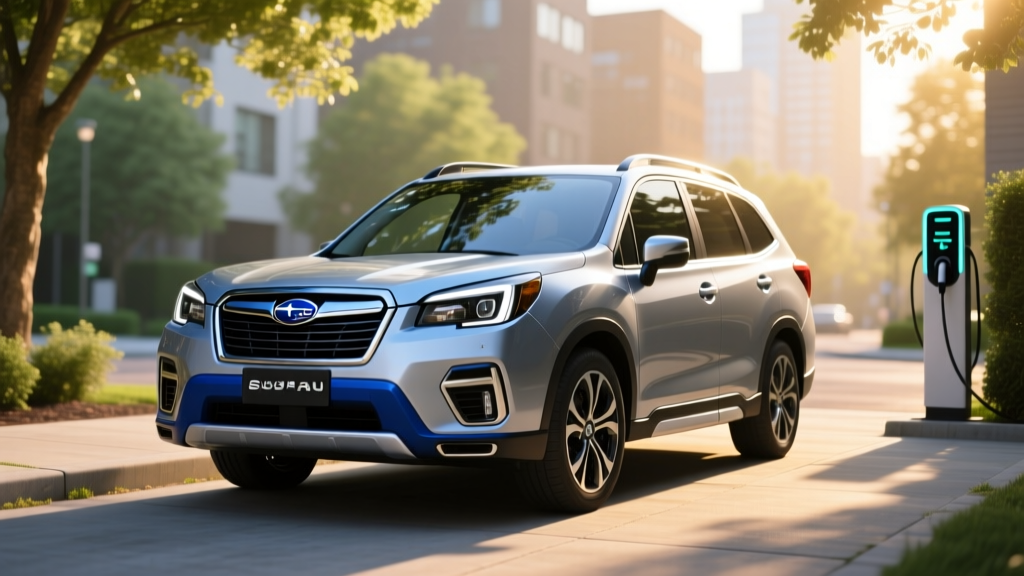
The Subaru Forester has long been a go-to for outdoorsy families who need standard all-wheel drive, solid cargo space, and decent ground clearance. For 2026, Subaru's hybrid offering in the compact SUV segment brings a meaningful efficiency bump over the gas-only Forester — but how does it actually perform at the pump, and is it worth the premium? We break down the Subaru Forester hybrid MPG, powertrain details, battery longevity, and who should (and shouldn't) consider this over a plug-in hybrid or full EV.
Subaru Forester Hybrid MPG: EPA Numbers and Real-World Results
The 2026 Subaru Forester Hybrid pairs a 2.5-liter horizontally opposed (Boxer) four-cylinder engine with an electric motor integrated into Subaru's Lineartronic CVT. The result is a combined system output of approximately 194 horsepower — a noticeable step up from the gas-only Forester's 180 hp — and EPA-estimated fuel economy that meaningfully reduces fuel costs.
| Metric | Forester Hybrid | Forester Gas (AWD) |
|---|---|---|
| City MPG | 35 | 26 |
| Highway MPG | 33 | 33 |
| Combined MPG | 34 | 29 |
| Annual Fuel Cost (est.) | ~$1,550 | ~$1,850 |
Source: fueleconomy.gov (EPA estimates for 2026 model year AWD compact SUVs).
In mixed driving — suburban commutes with frequent stops, moderate highway use, and temperatures between 50–75°F — the Forester Hybrid tends to meet or slightly exceed its EPA combined rating of 34 MPG. City-heavy drivers may see 36–38 MPG thanks to the electric motor handling low-speed acceleration and regenerative braking recapturing energy at stops. Highway-dominant driving at 75+ MPH typically drops to 30–32 MPG, as aerodynamic drag reduces the hybrid system's advantage. In cold weather (below 30°F), expect a 2–4 MPG reduction due to engine warm-up cycles and reduced battery efficiency.
HEV vs. PHEV: Understanding the Forester Hybrid's Powertrain
The 2026 Forester Hybrid is a conventional hybrid electric vehicle (HEV), not a plug-in hybrid. This distinction matters for buyers cross-shopping electrified SUVs.
| Feature | Forester Hybrid (HEV) | Typical PHEV SUV (e.g., Toyota RAV4 Prime) |
|---|---|---|
| Plug-in Charging | No — charges via engine & regen | Yes — plug in for electric-only range |
| Electric-Only Range | ~1 mile at low speeds | 25–42 miles |
| Battery Size | ~1.1 kWh (small buffer) | ~18.1 kWh usable |
| Combined MPG (gas mode) | 34 MPG | 38 MPG (after battery depletes) |
| MPGe (electric mode) | N/A | 94 MPGe |
| Federal Tax Credit (§30D) | Not eligible | Up to $7,500 (if eligible) |
| Home Charging Required | No | Yes (Level 1 or 2) |
The Forester Hybrid's small battery acts as a buffer — it captures energy from regenerative braking and the gasoline engine, then deploys it to assist acceleration and enable brief electric-only movement at parking-lot speeds. You never plug it in. If you want meaningful electric-only driving for daily commutes, you'd need to look at a PHEV like the Toyota RAV4 Prime or a full BEV.
Powertrain Specs: What Drives the Forester Hybrid
Subaru's hybrid system is integrated into the brand's signature symmetrical all-wheel-drive layout. Unlike some competitors that offer FWD-only hybrid trims, every Forester Hybrid comes with AWD as standard — a significant advantage for snow-belt buyers.
| Specification | Detail |
|---|---|
| Engine | 2.5L Boxer 4-cylinder |
| Engine Output | ~163 hp / 174 lb-ft torque |
| Electric Motor | Integrated in CVT, ~33 hp assist |
| Combined System Output | 194 hp |
| Transmission | Lineartronic CVT |
| Drivetrain | Symmetrical AWD (standard) |
| 0–60 MPH (est.) | ~7.6 seconds |
| Towing Capacity | 1,500 lbs |
| Ground Clearance | 8.7 inches |
The electric motor fills in the torque gap that naturally aspirated Boxer engines typically exhibit at low RPMs, making the Forester Hybrid feel noticeably more responsive in city driving than its gas-only sibling. The CVT is tuned for smoothness rather than sportiness — this is a comfort-oriented powertrain.
Pricing, Trims, and Tax Credit Eligibility
The 2026 Forester Hybrid carries a premium over the gas-only Forester, typically ranging from $2,000 to $2,500 depending on trim. Here's the approximate MSRP structure:
| Trim | MSRP (est.) | Destination | Total |
|---|---|---|---|
| Hybrid Premium | $34,495 | $1,420 | $35,915 |
| Hybrid Limited | $37,495 | $1,420 | $38,915 |
| Hybrid Touring | $40,995 | $1,420 | $42,415 |
Because the Forester Hybrid is a conventional HEV (not a plug-in hybrid or battery electric vehicle), it does not qualify for the IRS §30D Clean Vehicle Credit. That credit — up to $7,500 — is reserved for PHEVs and BEVs that meet battery sourcing, MSRP cap ($80,000 for SUVs), and buyer income limits. Some states offer modest hybrid incentives; check your state's energy office or AFDC state incentive database for local programs.
The hybrid premium over the gas Forester typically pays for itself in fuel savings within 3–5 years for drivers covering 12,000–15,000 miles annually, depending on local gas prices. At $3.40/gallon and 12,000 miles/year, the Hybrid saves approximately $350–$400 annually versus the gas model.
Battery Warranty, Lifespan, and Replacement Costs
Hybrid battery anxiety is one of the top concerns buyers raise — and it's largely overblown for modern systems. The Forester Hybrid's lithium-ion battery pack is small (~1.1 kWh), meaning it undergoes shallow charge/discharge cycles that are far less stressful than the deep cycles in a full EV or PHEV.
- Hybrid Battery: 8 years / 100,000 miles (10 years / 150,000 miles in CARB states including CA, NY, MA, and others)
- Hybrid System Components: 8 years / 100,000 miles
- Powertrain: 5 years / 60,000 miles
If the hybrid battery fails outside warranty, replacement costs typically range from $2,000 to $3,500 including labor — significantly less than a full EV battery replacement. However, based on industry data from Toyota and Subaru hybrid systems, most hybrid batteries last 150,000–200,000+ miles without significant degradation.
Who Should Choose the Forester Hybrid vs. a PHEV or Full EV?
Choose the Forester Hybrid If:
- You don't have access to home or workplace charging
- You want AWD standard without a plug-in premium
- Your daily driving is variable (no predictable short commute)
- You want lower fuel costs without changing habits
- You frequently drive in cold or mountainous conditions
- You want Subaru's EyeSight safety suite with proven AWD reliability
Consider a PHEV or EV Instead If:
- You have home Level 2 charging and a short daily commute (<30 mi)
- You want to drive on electricity most days and only use gas for road trips
- You want the $7,500 federal tax credit (PHEV/BEV eligible)
- You prioritize maximum fuel savings and lower per-mile energy cost
- You're ready for one-pedal driving and instant EV torque
The Forester Hybrid occupies a pragmatic middle ground: it delivers meaningful fuel savings — roughly 17% better combined MPG than the gas model — without requiring any behavioral change. No charging cables, no range planning, no cold-weather range anxiety. You simply drive it like a normal car and spend less at the pump.
Reliability and Long-Term Ownership Outlook
Subaru's hybrid system is derived from years of partnership with Toyota, which has the deepest hybrid reliability data in the industry. The Forester Hybrid's powertrain is mechanically simpler than a conventional automatic — the CVT has fewer moving parts than a geared transmission, and the electric motor has essentially zero wear components.
Key reliability considerations:
- CVT longevity: Subaru's Lineartronic CVT has improved significantly since earlier generations; with proper fluid maintenance at 60,000-mile intervals, it should last the vehicle's lifetime.
- Brake pad life: Regenerative braking reduces friction brake usage — expect 60,000–80,000+ miles from original pads.
- Insurance: Hybrid trims may carry a 3–7% premium over gas models due to higher repair costs for the hybrid system in collision claims.
- Resale value: Subaru Forester historically retains value well; hybrid trims may command a $1,500–$3,000 premium in the used market as fuel prices fluctuate.
Frequently Asked Questions
How many MPG does the Subaru Forester Hybrid get?
The 2026 Subaru Forester Hybrid achieves an EPA-estimated 35 MPG city, 33 MPG highway, and 34 MPG combined. Real-world results typically match or slightly exceed the combined figure in mixed suburban driving, with highway-dominant drivers seeing 30–32 MPG and cold-weather driving reducing efficiency by 2–4 MPG.
Does the Subaru Forester Hybrid need to be plugged in?
No. The Forester Hybrid is a conventional hybrid (HEV). Its small battery charges automatically through regenerative braking and the gasoline engine. There is no plug, no charging cable, and no electric-only range to manage. If you want plug-in capability, you'd need a PHEV like the Toyota RAV4 Prime.
Does the Forester Hybrid qualify for any tax credit?
No federal tax credit is available. The IRS §30D Clean Vehicle Credit applies only to plug-in hybrids (PHEVs) and battery electric vehicles (BEVs) that meet battery sourcing, MSRP, and buyer income requirements. Conventional hybrids like the Forester Hybrid are excluded. Some states may offer small hybrid incentives — check the AFDC state incentive database.
How long will the Forester Hybrid battery last and what does replacement cost?
Subaru covers the hybrid battery for 8 years/100,000 miles (10 years/150,000 miles in CARB states). Based on industry data from similar hybrid systems, most batteries last 150,000–200,000+ miles. Out-of-warranty replacement runs $2,000–$3,500 — far less than a full EV battery.
Is the Forester Hybrid better than the gas Forester?
If fuel economy matters to you, yes. The hybrid delivers 34 MPG combined versus 29 MPG for the gas model — a 17% improvement — plus slightly more horsepower (194 vs. 180 hp) and better low-speed responsiveness. The $2,000–$2,500 hybrid premium typically pays for itself in 3–5 years of fuel savings for average-mileage drivers.
How does the Forester Hybrid compare to the Toyota RAV4 Hybrid?
The Toyota RAV4 Hybrid achieves an EPA-estimated 39–41 MPG combined (depending on trim) and offers a PHEV variant (RAV4 Prime) with 42 miles of electric-only range. The Forester Hybrid trails on pure MPG but offers more ground clearance (8.7" vs. 8.1") and Subaru's standard symmetrical AWD, which some drivers prefer in severe winter conditions. Both are strong choices — the RAV4 wins on efficiency, the Forester on off-road capability and visibility.