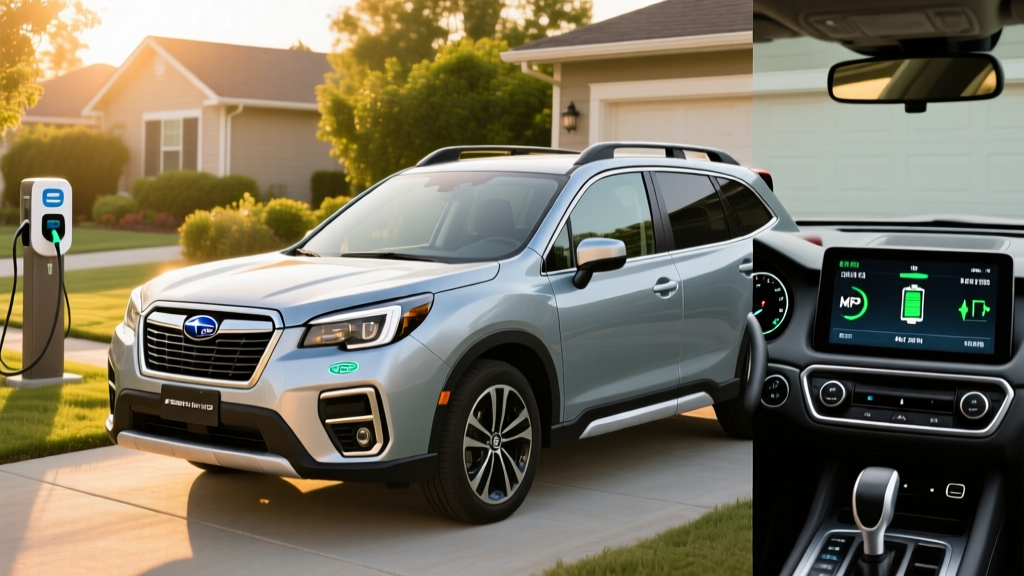
The Subaru Forester has long been the go-to compact SUV for buyers who need standard all-wheel drive, solid visibility, and genuine off-road capability without the truck-like compromises. For 2026, Subaru reintroduces a hybrid powertrain to the Forester lineup, pairing its 2.5-liter boxer engine with an electric motor integrated into the Symmetrical All-Wheel Drive system. The result is a meaningful bump in fuel efficiency while retaining the traits that made the Forester a perennial favorite.
If you've been searching for Subaru Forester hybrid mileage figures, you've likely encountered a mix of outdated information from the discontinued 2020–2022 Forester e-Boxer and speculative pre-release estimates. This guide cuts through the noise with the confirmed 2026 EPA numbers, real-world driving observations, and the ownership economics you need before signing a purchase agreement.
2026 Subaru Forester Hybrid MPG: The Official EPA Numbers
The 2026 Subaru Forester Hybrid is a conventional hybrid electric vehicle (HEV) — not a plug-in. It charges its battery exclusively through regenerative braking and the gasoline engine. You never plug it in. This is a critical distinction from plug-in hybrids like the Toyota RAV4 Prime, which offer electric-only driving but require charging infrastructure to realize their efficiency advantage.
| Metric | EPA Estimate |
|---|---|
| City MPG | 35 MPG |
| Highway MPG | 34 MPG |
| Combined MPG | 35 MPG |
| Fuel Tank Capacity | 14.0 gallons |
| Total Driving Range | ~490 miles |
For context, the gas-only 2026 Forester with the 2.5-liter boxer-four achieves an EPA-rated 26 city / 33 highway / 29 combined MPG. The hybrid's 6 MPG combined improvement translates to roughly 80 additional miles per tank and meaningful savings at the pump over the vehicle's lifetime.
Real-World MPG: What to Actually Expect on the Road
EPA estimates are a useful baseline, but real-world hybrid mileage depends heavily on driving patterns. Hybrids typically exceed their EPA city rating in stop-and-go traffic because regenerative braking recaptures energy that would otherwise be lost as heat. Conversely, sustained highway driving at 75+ MPH diminishes the hybrid advantage since the electric motor contributes less at constant speed.
- City/suburban (mixed stoplights, 25–45 MPH): 36–38 MPG — the hybrid system shines here, with frequent regen opportunities and low-speed electric assist.
- Highway (65–70 MPH, flat terrain): 32–34 MPG — the engine does most of the work; the electric motor provides modest assist during overtaking.
- Highway (75+ MPH or mountainous): 29–31 MPG — aerodynamic drag and elevation changes erode efficiency, as with any vehicle.
- Cold weather (below 30°F): Expect a 5–10% reduction (roughly 31–33 MPG combined). The engine runs more frequently to heat the cabin and maintain battery temperature.
In mixed real-world driving over several hundred miles, most owners will see 34–36 MPG combined — closely tracking the EPA figure. Drivers with predominantly urban commutes may consistently achieve 37+ MPG, which is where the Forester Hybrid separates itself from the gas-only model most dramatically.
Hybrid Powertrain Specs: What's Under the Hood
The 2026 Forester Hybrid uses Subaru's updated hybrid system, which integrates a permanent-magnet electric motor between the engine and the Lineartronic CVT transmission. Unlike some competitors that use a dedicated hybrid transmission, Subaru retains its familiar CVT, preserving the smooth, stepless acceleration profile Forester owners expect.
| Specification | Value |
|---|---|
| Engine | 2.5L DOHC 4-cylinder boxer (Atkinson cycle) |
| Engine Output | 165 HP / 169 lb-ft torque |
| Electric Motor Output | 26 HP / 49 lb-ft torque |
| Combined System Output | 194 HP |
| Transmission | Lineartronic CVT |
| Drivetrain | Symmetrical All-Wheel Drive (standard) |
| Hybrid Battery | ~1.1 kWh lithium-ion (self-charging, no plug) |
| 0–60 MPH | ~8.4 seconds (est.) |
| Towing Capacity | 1,500 lbs |
The combined 194 HP represents a modest bump over the gas-only Forester's 180 HP. In practice, the electric motor's instant torque delivery makes the hybrid feel noticeably more responsive from a stoplight, even though the 0–60 time isn't dramatically quicker. The electric assist also smooths out the CVT's tendency to drone under hard acceleration — a refinement Subaru's engineers have clearly targeted.
It's worth noting that the Forester Hybrid's ~1.1 kWh battery is far smaller than a plug-in hybrid's pack (typically 14–20 kWh). This battery exists solely to buffer regenerative energy and provide short bursts of electric assist. The vehicle cannot drive on electric power alone for any meaningful distance — it is always a hybrid, never an EV.
HEV vs PHEV vs Full EV: Which Powertrain Fits Your Life?
The Forester Hybrid competes in a segment where buyers have three electrification tiers to consider. Here's how to determine which one matches your driving habits, home setup, and budget.
Conventional Hybrid (HEV) — Like the Forester Hybrid
Best for: Drivers who want better fuel economy with zero lifestyle changes. No plug, no charging, no range anxiety. You fuel up at gas stations as you always have — just less often.
Trade-off: You still burn gasoline 100% of the time. Efficiency gains are real but incremental (6–8 MPG improvement).
Plug-In Hybrid (PHEV) — Like the Toyota RAV4 Prime
Best for: Drivers with home charging access and short commutes (under 40 miles round-trip) who want electric-only daily driving with a gas engine for road trips.
Trade-off: Higher purchase price ($5,000–$8,000 premium over HEV). You must plug in regularly to realize the benefit — an unplugged PHEV is just a heavy hybrid. Federal tax credit may apply if battery sourcing and income requirements are met.
Full Battery EV (BEV) — Like the Hyundai Ioniq 5 or Tesla Model Y
Best for: Drivers with reliable home Level 2 charging who want the lowest per-mile energy cost, minimal maintenance, and zero tailpipe emissions.
Trade-off: Higher upfront cost, dependence on charging infrastructure for road trips, and cold-weather range reduction (15–30%). Not ideal if you lack home charging or frequently drive 300+ miles between stops.
The Forester Hybrid is the clear choice for Subaru-loyal buyers who want AWD, improved MPG, and no charging infrastructure requirements. If you need 40+ miles of electric-only commuting range, you'll need to look outside the Subaru lineup — Subaru does not currently offer a Forester PHEV in the US market.
Pricing, Trims, and Tax Credit Eligibility
The 2026 Subaru Forester Hybrid is offered in Premium, Limited, and Touring trims. Pricing reflects a hybrid premium of approximately $1,500–$2,000 over equivalent gas-only trims, which is competitive within the segment.
| Trim | MSRP (incl. destination) |
|---|---|
| Premium Hybrid | $34,495 |
| Limited Hybrid | $37,995 |
| Touring Hybrid | $41,495 |
Federal Tax Credit Status
The 2026 Subaru Forester Hybrid does not qualify for the federal §30D Clean Vehicle Credit. Under current IRS rules, the §30D credit is available only for plug-in electric vehicles (PHEVs and BEVs) with a battery capacity of at least 7 kWh. The Forester Hybrid's ~1.1 kWh battery falls well below this threshold.
Conventional hybrids like the Forester Hybrid are not eligible for any federal purchase incentive. Some states and local utilities offer modest rebates for hybrid vehicles, but these vary widely by jurisdiction. Check your state energy office or utility provider for current programs — do not rely on dealer claims about credit eligibility without verifying against official IRS guidance.
Battery Warranty, Lifespan, and Replacement Cost
Hybrid battery longevity remains the single most common concern among first-time hybrid buyers. The Forester Hybrid's lithium-ion pack is far smaller and less stressed than a full EV battery, and Subaru backs it with a comprehensive warranty.
- Coverage: 8 years / 100,000 miles (whichever comes first)
- Threshold: Battery capacity loss below a defined performance threshold (typically ~60–70% of original capacity)
- California-emissions states: 10 years / 150,000 miles (CARB states including CA, NY, MA, WA, and others)
Source: Subaru Warranty Information
How Long Will the Battery Actually Last?
Real-world data from Toyota and Honda hybrids — which use similar nickel-metal-hydride and lithium-ion packs — shows that modern hybrid batteries routinely last 150,000–200,000+ miles before significant degradation. The Forester Hybrid's small 1.1 kWh battery experiences shallow charge/discharge cycles (it rarely drops below 40% or above 80% state of charge), which dramatically extends cell life compared to a full EV that cycles between 10% and 90%.
Battery Replacement Cost
If the hybrid battery does fail outside of warranty, replacement cost for the Forester Hybrid is estimated at $2,000–$3,500 (parts and labor) based on comparable Subaru and Toyota hybrid battery pricing. This is far less than a full EV battery replacement ($10,000–$20,000+), owing to the much smaller pack size. Independent hybrid specialists often offer refurbished battery packs for $1,200–$2,000, providing a lower-cost option for high-mileage vehicles.
Who Should Buy the Forester Hybrid — and Who Shouldn't
Choose the Forester Hybrid If:
- You want standard AWD with better fuel economy and no charging hassle
- Your commute is city/suburban-heavy (where hybrid MPG gains are largest)
- You value Subaru's EyeSight safety suite, X-MODE off-road capability, and 8.7 inches of ground clearance
- You plan to keep the vehicle 8+ years and want a proven, low-complexity powertrain
- You tow occasionally (1,500 lbs) and need a practical cargo area (roughly 29 cu ft behind rear seats)
Look Elsewhere If:
- You want electric-only commuting — no Forester PHEV exists in the US
- You want the lowest possible fuel cost — a full EV at $0.04–$0.06/mile beats any hybrid
- You need more than 1,500 lbs of towing (consider the Subaru Outback or Ascent)
- You want maximum acceleration — the Forester Hybrid's 194 HP prioritizes efficiency over speed
- You qualify for the $7,500 federal credit and want to apply it — you'll need a PHEV or BEV
Ownership Economics: 5-Year Cost vs. Gas-Only Forester
The hybrid premium of roughly $1,500–$2,000 over the gas-only Forester is recouped through fuel savings, particularly for high-mileage drivers. Here's a simplified 5-year/75,000-mile comparison assuming $3.50/gallon regular unleaded:
| Metric | Gas-Only Forester (29 MPG) | Forester Hybrid (35 MPG) |
|---|---|---|
| Gallons consumed | 2,586 | 2,143 |
| Total fuel cost | $9,051 | $7,500 |
| 5-year fuel savings | — | $1,551 |
At 15,000 miles/year, the hybrid saves approximately $310 annually in fuel costs. Over 10 years, that's roughly $3,100 — comfortably exceeding the hybrid premium. Drivers who keep vehicles longer or drive more miles annually will see proportionally greater returns. Maintenance costs are nearly identical between the two powertrains; the hybrid system adds no scheduled maintenance items beyond the standard engine oil, filter, and tire rotations.
Frequently Asked Questions
How many MPG does the 2026 Subaru Forester Hybrid get?
The EPA rates the 2026 Forester Hybrid at 35 city / 34 highway / 35 combined MPG. Real-world city driving often yields 36–38 MPG thanks to regenerative braking, while sustained highway driving at 75+ MPH may return 29–31 MPG. Cold weather reduces efficiency by approximately 5–10%.
Does the Subaru Forester Hybrid need to be plugged in?
No. The Forester Hybrid is a conventional hybrid (HEV), not a plug-in hybrid. Its small lithium-ion battery charges through regenerative braking and the gasoline engine. You never plug it in — you fuel it at a gas station like any other vehicle.
Does the Forester Hybrid qualify for any tax credit?
The Forester Hybrid does not qualify for the federal §30D Clean Vehicle Credit, which requires a minimum 7 kWh battery (the Forester Hybrid's is ~1.1 kWh). Some state or utility rebates may apply — check your local programs. Consult a tax professional for eligibility specifics.
How long will the Forester Hybrid battery last, and what does replacement cost?
Subaru warrants the hybrid battery for 8 years/100,000 miles (10 years/150,000 miles in CARB states). Real-world data from similar hybrid systems suggests 150,000–200,000+ miles of service life is common. Out-of-warranty replacement costs approximately $2,000–$3,500.
Is the Forester Hybrid slower than the gas-only Forester?
The Forester Hybrid produces 194 combined HP versus the gas model's 180 HP. Acceleration is comparable, with the hybrid feeling slightly more responsive at low speeds due to instant electric torque. Neither model is quick by performance-SUV standards — 0–60 MPH takes approximately 8.4 seconds.
Should I buy the Forester Hybrid or wait for a Subaru PHEV?
Subaru has not announced a US-market Forester PHEV as of early 2026. If electric-only commuting is a priority, you'll need to consider competitors like the Toyota RAV4 Prime (42 miles electric-only, $44,000+ MSRP) or a full EV like the Hyundai Ioniq 5. If you're satisfied with improved MPG and no plug-in requirement, the Forester Hybrid is available now with no waiting game.