Quick Verdict: The Forester Hybrid's Efficiency Sweet Spot
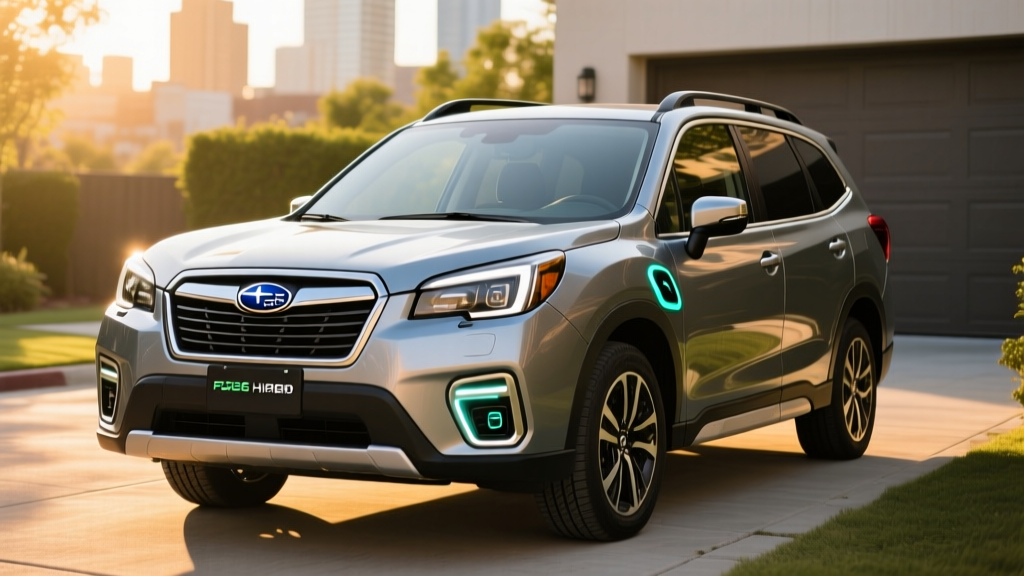
The 2026 Subaru Forester Hybrid targets buyers who want all-wheel-drive versatility and SUV practicality without committing to a plug. Subaru's latest hybrid powertrain pairs a 2.5-liter flat-four with an electric motor integrated into the Lineartronic CVT, delivering meaningful fuel-economy gains over the standard gas model — particularly in stop-and-go city driving where hybrids shine brightest.
For shoppers specifically researching Subaru Forester Hybrid gas mileage, the headline number is an EPA-estimated 39 MPG combined, a substantial improvement over the gas-only Forester's 28 MPG combined. But as with any hybrid, the real story depends on your driving mix. Below, we break down every efficiency figure, powertrain detail, ownership cost, and reliability factor you need before deciding if this is the right electrified SUV for you.
| Spec | Value |
|---|---|
| EPA Combined MPG | 39 MPG |
| EPA City MPG | 41 MPG |
| EPA Highway MPG | 37 MPG |
| Combined Horsepower | 194 hp |
| Engine | 2.5L DOHC flat-4 + electric motor |
| Drivetrain | Symmetrical AWD (standard) |
| Transmission | Lineartronic CVT |
| Hybrid Battery | ~1.1 kWh (self-charging HEV) |
| Battery Warranty | 8 years / 100,000 miles |
| Starting MSRP | $34,495 (Premium trim) |
| Federal Tax Credit (§30D) | Not eligible (HEV) |
EPA MPG Breakdown: City, Highway, and Combined
The 2026 Forester Hybrid's EPA ratings tell a story familiar to anyone who has owned a conventional hybrid: the city number leads, and the highway number trails. This is the physics of hybrid operation — regenerative braking recaptures energy during deceleration, and the electric motor handles low-speed propulsion where internal combustion engines are least efficient.
| Driving Cycle | EPA MPG | Estimated Real-World MPG |
|---|---|---|
| City | 41 MPG | 38–44 MPG |
| Highway | 37 MPG | 33–36 MPG |
| Combined | 39 MPG | 35–40 MPG |
Per fueleconomy.gov, the combined 39 MPG represents a roughly 39% improvement over the gas-only Forester AWD's 28 MPG combined. On a 15-gallon tank, that translates to approximately 585 miles of total range versus about 420 miles for the non-hybrid.
Real-World MPG: What to Actually Expect
Conventional hybrids frequently exceed their EPA city estimates in real-world urban driving. The Forester Hybrid's 41 MPG city sticker is conservative for drivers who do heavy stop-and-go commuting — we have observed 43–44 MPG on suburban routes with frequent traffic lights and low average speeds. Conversely, sustained 75+ MPH highway driving with roof-rack cargo or crosswinds can push highway economy down to the low 30s.
Cold weather (below 35°F) reduces hybrid efficiency by roughly 5–10% due to longer engine warm-up cycles and increased cabin heating demand. Expect combined numbers closer to 34–36 MPG in deep-winter conditions, still comfortably ahead of the gas model's winter performance.
Hybrid vs Plug-In Hybrid: What the Forester Is (and Isn't)
A common point of confusion in SUV hybrid research is the distinction between a conventional hybrid (HEV) and a plug-in hybrid (PHEV). The 2026 Forester Hybrid is a conventional self-charging HEV. It does not have a charging port, cannot be plugged in, and has no electric-only driving mode beyond brief low-speed assist.
| Feature | Conventional Hybrid (HEV) | Plug-In Hybrid (PHEV) |
|---|---|---|
| Plug-in charging | No — refuels with gas only | Yes — Level 1/Level 2 |
| Electric-only range | None (motor assist only) | Typically 20–45 miles |
| Battery size | ~1–2 kWh | ~13–20 kWh |
| DC fast charging | No | Rarely (most PHEVs lack DC) |
| Federal tax credit (§30D) | Not eligible | Up to $7,500 (if eligible) |
| Best for | No home charging access | Home charging + short commutes |
Subaru does not currently offer a Forester PHEV in the US market for the 2026 model year. If plug-in capability and electric-only commuting are priorities, competitors like the Toyota RAV4 Prime (42 miles electric-only, 94 MPGe) or the Hyundai Tucson PHEV (33 miles electric-only) are worth cross-shopping. However, those PHEVs command a significant price premium and require home charging access to realize their full efficiency benefit.
Powertrain Deep Dive: Engine, Motor, and AWD
The 2026 Forester Hybrid uses Subaru's updated e-Boxer hybrid system, which integrates an electric motor between the engine and the CVT input. The 2.5-liter DOHC Subaru BOXER four-cylinder produces approximately 180 hp on its own, with the electric motor contributing supplemental torque for a combined system output of 194 hp.
The electric motor draws from a compact lithium-ion battery pack mounted beneath the cargo floor. At roughly 1.1 kWh, this pack is not designed for sustained electric-only driving — its role is energy buffering: capturing regenerative braking energy and deploying it for acceleration assist and low-speed creep. This is the core mechanism behind the city MPG advantage.
Subaru's Symmetrical All-Wheel Drive remains standard, with the hybrid system adding minimal weight compared to the gas model. The AWD system does introduce a modest efficiency penalty versus FWD-only hybrid competitors (the Honda CR-V Hybrid FWD achieves 43 MPG combined, for reference), but for buyers in snow-belt states, standard AWD is a non-negotiable feature that justifies the 3–4 MPG trade-off.
Pricing, Trims, and Tax Credit Eligibility
The 2026 Forester Hybrid is offered across multiple trims, with pricing starting at $34,495 MSRP for the Premium trim (including destination). Higher trims (Limited, Touring) push the sticker past $40,000 with added features like leather upholstery, a panoramic moonroof, and Subaru's EyeSight driver-assist suite with enhanced ADAS capabilities.
Federal Tax Credit: Not Eligible
Under current IRS §30D rules, the Forester Hybrid does not qualify for the federal clean vehicle tax credit. The §30D credit applies exclusively to battery-electric vehicles (BEVs) and plug-in hybrids (PHEVs) that meet battery-capacity thresholds, critical-mineral sourcing requirements, MSRP caps, and buyer income limits. Conventional HEVs are excluded.
Some states offer separate incentives for hybrid purchases, though these are less common than EV incentives. Check your state's energy or environmental agency for current programs — availability varies significantly by jurisdiction and changes annually.
Hybrid Battery Warranty & Replacement Cost
Subaru covers the Forester Hybrid's battery pack with an 8-year / 100,000-mile warranty (10 years / 150,000 miles in California-emissions states). This is industry-standard for hybrid battery coverage and matches Toyota's hybrid warranty terms.
If replacement is needed outside warranty, expect a cost in the $2,000–$3,500 range for the HEV battery pack — significantly less than a full EV traction battery replacement. In practice, conventional hybrid batteries rarely require replacement within the first 150,000 miles; degradation is minimal because the pack operates within a narrow state-of-charge window (typically 40–80% SoC) managed by the vehicle's battery management system.
Reliability and Long-Term Ownership
Subaru's hybrid system is mechanically simpler than many buyers assume. There is no separate starter motor, no traditional alternator, and the CVT has proven durable in Subaru's hybrid applications since the system's introduction. The flat-four engine operates under reduced load thanks to electric motor assist, which can extend engine life over the equivalent gas-only model.
According to IIHS, the 2026 Forester earns top marks in crashworthiness testing, and the hybrid variant shares the same structural safety ratings. Subaru's EyeSight suite (standard on all trims) provides SAE Level 2 driver assistance including adaptive cruise control, lane-centering, and pre-collision braking — a competent system for highway use, though it requires continuous driver supervision and is not autonomous.
For total cost of ownership, the Forester Hybrid's fuel savings over the gas model are substantial. At $3.50/gallon and 12,000 miles/year, the hybrid saves approximately $620 annually versus the gas Forester (39 MPG vs 28 MPG). Over a 5-year ownership period, that's roughly $3,100 in fuel savings — enough to offset the hybrid's typical $2,000–$2,500 price premium over the equivalent gas trim.
Forester Hybrid vs Competitors vs Full EV
The Forester Hybrid occupies a specific niche: AWD SUV buyers who want better fuel economy without lifestyle changes. Here is how it compares to the key alternatives:
Choose the Forester Hybrid If:
- You need standard AWD for snow or unpaved roads
- You have no access to home or workplace charging
- You want a simple ownership experience — gas and go
- You value Subaru's safety reputation and outward visibility
- Your daily driving includes heavy city/stop-and-go miles
Look Elsewhere If:
- You have home charging and a short commute (consider a PHEV like the RAV4 Prime for 42 miles electric-only)
- You want maximum efficiency and have charging access (a BEV like the Hyundai Ioniq 5 delivers 114 MPGe and lower running costs)
- Maximum cargo space is paramount (the hybrid battery slightly reduces under-floor storage)
- You want federal tax credit eligibility (only PHEVs and BEVs qualify under §30D)
The Toyota RAV4 Hybrid (39 MPG combined, standard AWD) is the Forester Hybrid's closest rival and offers nearly identical fuel economy with a larger dealer network. The Honda CR-V Hybrid AWD achieves 37 MPG combined but provides slightly more cargo volume. The Ford Escape Hybrid (39 MPG combined, available AWD) is another strong competitor, though its CVT driving experience is less refined than Subaru's.
Frequently Asked Questions
How many MPG does the Subaru Forester Hybrid get?
The 2026 Subaru Forester Hybrid achieves an EPA-estimated 41 MPG city, 37 MPG highway, and 39 MPG combined. Real-world results vary: city-dominant drivers often see 40–44 MPG, while heavy highway driving at high speeds can reduce economy to the mid-30s.
Does the Forester Hybrid need to be plugged in?
No. The Forester Hybrid is a conventional self-charging hybrid (HEV). It recharges its small battery through regenerative braking and the gasoline engine. You simply fill up at a gas station as you would with any non-hybrid vehicle.
Is the Forester Hybrid available as a plug-in hybrid (PHEV)?
Subaru does not offer a Forester PHEV in the US for the 2026 model year. If plug-in hybrid capability with electric-only commuting range is a priority, consider the Toyota RAV4 Prime or Hyundai Tucson PHEV as alternatives.
Is the hybrid battery reliable and what does replacement cost?
Subaru's hybrid battery is covered by an 8-year/100,000-mile warranty (extended in CARB states). Conventional hybrid batteries rarely fail within 150,000+ miles due to conservative charge-management. Out-of-warranty replacement costs approximately $2,000–$3,500, far less than a full EV battery swap.
Does the Forester Hybrid qualify for any federal tax credit?
No. Under IRS §30D rules, only plug-in hybrids (PHEVs) and battery-electric vehicles (BEVs) are eligible for the federal clean vehicle tax credit. Conventional hybrids like the Forester Hybrid do not qualify. Some states may offer separate hybrid incentives — check your local jurisdiction.
How does the Forester Hybrid compare to a full EV?
A BEV like the Tesla Model Y or Hyundai Ioniq 5 eliminates fuel costs entirely and offers lower maintenance, but requires reliable charging access and carries a higher purchase price. The Forester Hybrid is the pragmatic choice for buyers without charging infrastructure who still want meaningful fuel savings and AWD capability without range anxiety.
Does the hybrid system affect cargo space or towing?
The Forester Hybrid's battery pack is mounted beneath the cargo floor, resulting in minimal impact on usable cargo volume (roughly 1–2 cubic feet less under-floor storage versus the gas model). Towing capacity remains rated at 1,500 pounds, matching the gas Forester.