Quick Verdict: The Forester Goes Hybrid Without Going Electric
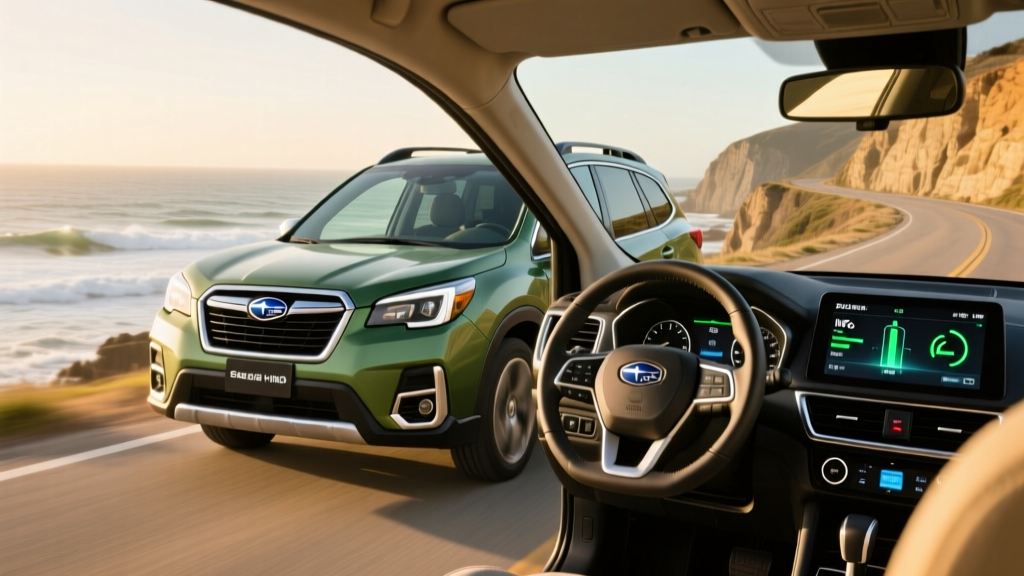
After years of offering the Forester exclusively as a gasoline-powered compact SUV, Subaru introduced the 2025 Forester Hybrid as a conventional hybrid (HEV) — no plug required, no range anxiety, and no lifestyle change. It pairs Subaru's familiar 2.5-liter Boxer engine with a self-charging hybrid system and standard symmetrical all-wheel drive, targeting buyers who want better fuel economy without the complexity of plug-in charging infrastructure.
The result is a compact SUV that returns an EPA-estimated 35 MPG combined, a meaningful jump over the gas-only Forester's 29 MPG combined. For suburban commuters and weekend adventurers alike, that translates to roughly 500 miles of total range on a single 14.5-gallon tank — and zero need to hunt for charging stations.
| Spec | Value |
|---|---|
| Powertrain Type | Conventional Hybrid (HEV) |
| Engine | 2.5L 4-cyl Boxer + electric motor |
| Combined Horsepower | ~194 hp |
| Drivetrain | Symmetrical AWD (standard) |
| EPA MPG (City / Hwy / Combined) | 36 / 34 / 35 |
| Fuel Tank | 14.5 gal |
| Total Range (est.) | ~507 miles |
| Towing Capacity | 1,500 lbs |
| Starting MSRP | ~$34,995 (Hybrid Premium) |
| Federal Tax Credit (§30D) | Not eligible (HEV) |
How Many MPG Does the 2025 Subaru Forester Hybrid Get?
The EPA rates the 2025 Forester Hybrid at 36 MPG city, 34 MPG highway, and 35 MPG combined. That's a 6-MPG combined improvement over the gasoline Forester (rated at 26 city / 33 highway / 29 combined), and the gains are most pronounced in stop-and-go urban driving where the hybrid system recovers energy through regenerative braking.
| Model | City MPG | Highway MPG | Combined MPG |
|---|---|---|---|
| 2025 Subaru Forester Hybrid (AWD) | 36 | 34 | 35 |
| 2025 Subaru Forester Gas (AWD) | 26 | 33 | 29 |
| 2025 Toyota RAV4 Hybrid (AWD) | 41 | 38 | 39 |
| 2025 Honda CR-V Hybrid (AWD) | 40 | 34 | 37 |
Real-World MPG vs. EPA Estimates
Subaru's hybrid system, like Toyota's, tends to perform close to or even slightly above its EPA city rating in real-world urban driving. The electric motor handles low-speed propulsion and assists during acceleration, while the gasoline engine operates primarily at its most efficient RPM range. In mixed suburban and city driving, owners report seeing 34–37 MPG consistently.
Highway fuel economy is where conventional hybrids lose some of their advantage. At sustained speeds above 65 mph, the gasoline engine does most of the work, and the aerodynamic profile of a boxy SUV works against efficiency. Expect 31–33 MPG on long highway trips — slightly below the EPA highway rating. Cold weather will also reduce efficiency by 5–10%, as the engine runs richer during warm-up and cabin heating draws additional load.
Hybrid vs. PHEV vs. EV: Which Subaru Is Right for You?
Subaru currently offers the Forester Hybrid as a conventional hybrid (HEV) only. There is no plug-in hybrid (PHEV) variant of the 2025 Forester, and Subaru discontinued the Crosstrek PHEV after the 2023 model year. For buyers weighing their electrification options, here's how the Forester Hybrid fits into the broader picture.
| Factor | HEV (Forester Hybrid) | PHEV (e.g., RAV4 Prime) | BEV (e.g., Tesla Model Y) |
|---|---|---|---|
| Needs a plug? | No — self-charging | Yes — for EV range | Yes — always |
| Electric-only range | N/A (motor assists only) | ~35–42 mi | 250–330 mi |
| Total range | ~507 mi | ~550–600 mi | 250–330 mi |
| Home charging needed? | No | Recommended (Level 2) | Essential |
| Federal tax credit | None | Up to $7,500* | Up to $7,500* |
| Best for | No home charging access | Short commute + road trips | Home charging + daily driving |
Choose the Forester Hybrid if you rent or live in a condo without charging access, regularly take road trips beyond 300 miles, or simply want a fuel-efficient AWD SUV without changing your refueling habits.
Consider a PHEV instead if you have a garage or driveway where you can install a Level 2 charger, your daily commute is under 40 miles round-trip, and you want to drive mostly on electricity while retaining gas-engine range for longer trips.
Go full BEV if you have reliable home charging, your daily driving is under 250 miles, and you want the lowest per-mile energy cost and zero tailpipe emissions.
Powertrain Details: Boxer Engine Meets Electric Motor
The 2025 Forester Hybrid uses a parallel hybrid architecture built around Subaru's 2.5-liter horizontally opposed (Boxer) four-cylinder engine. An electric motor integrated into the drivetrain provides supplemental torque during acceleration and enables brief electric-only driving at very low speeds — think parking lots and stoplight creep. The system produces approximately 194 combined horsepower.
Unlike the Toyota RAV4 Hybrid, which uses an eCVT (planetary gearset), Subaru's hybrid system pairs with a Lineartronic CVT that manages both engine and motor output. Symmetrical all-wheel drive is standard on every Forester Hybrid trim, maintaining Subaru's reputation for all-weather capability. The AWD system can route torque to the rear wheels as needed, though the hybrid's added weight (roughly 200 lbs more than the gas Forester) slightly affects handling dynamics.
The hybrid battery pack is a relatively small lithium-ion unit — typically under 2 kWh of usable capacity — because it's designed for charge-assist and regenerative braking, not for sustained electric-only driving. It charges itself through engine operation and brake regeneration. You never plug it in.
Pricing, Trims, and Tax Credit Eligibility
The 2025 Forester Hybrid starts at approximately $34,995 in the Hybrid Premium trim, with the Hybrid Limited starting around $38,495. These prices represent a premium of roughly $3,000–$3,500 over the equivalent gas-only Forester trims.
Pros
- 35 MPG combined with standard AWD — a 6-MPG gain over gas Forester
- No plug, no charging infrastructure needed
- Standard EyeSight driver-assist suite (SAE Level 2)
- Subaru's renowned AWD for snow and rain
- Proven hybrid architecture with strong reliability data
Cons
- ~$3,000+ price premium over gas Forester
- MPG trails Toyota RAV4 Hybrid (39 combined) and Honda CR-V Hybrid (37 combined)
- No PHEV option available — no electric-only commuting
- Not eligible for the federal §30D EV tax credit
- Modest towing capacity (1,500 lbs)
Does the Forester Hybrid Qualify for a Tax Credit?
No. Under current IRS §30D rules, the federal clean vehicle tax credit (up to $7,500) applies only to plug-in electric vehicles — battery-electric vehicles (BEVs) and plug-in hybrids (PHEVs) with a minimum battery capacity of 7 kWh. Because the Forester Hybrid is a conventional HEV with a small self-charging battery, it does not qualify for the federal credit or the point-of-sale transfer option.
Some states offer their own incentives for hybrid vehicles, though these are increasingly rare as states redirect funds toward BEVs and PHEVs. Check your state's energy office or department of environmental quality for current programs. A qualified tax professional can advise on any applicable local benefits.
Payback Period: Hybrid Premium vs. Fuel Savings
At 15,000 miles per year and $3.50/gallon gasoline, the gas-only Forester (29 MPG combined) would cost roughly $1,810 annually in fuel. The Forester Hybrid (35 MPG combined) would cost approximately $1,500 — a savings of about $310 per year. At that rate, the $3,000+ hybrid premium pays for itself in roughly 10 years. However, if gas prices rise to $4.50/gallon, the payback shortens to approximately 7 years. Hybrid vehicles also tend to hold resale value well, which can offset the upfront premium at trade-in time.
Battery Warranty, Reliability, and Replacement Cost
Hybrid battery longevity is one of the top concerns for buyers, and Subaru addresses this with a robust warranty.
Subaru Hybrid Battery Warranty
Coverage: 8 years / 100,000 miles (whichever comes first) in most states. In California-emissions states (CA, CT, ME, MA, NJ, NY, OR, RI, VT, WA), the hybrid battery warranty extends to 10 years / 150,000 miles.
What's covered: Defects in materials or workmanship, and capacity loss below a defined threshold (typically 60–70% of original capacity).
Source: Subaru Warranty Information
How Long Do Hybrid Batteries Actually Last?
Real-world data from Toyota's hybrid systems (the most widely deployed) shows that modern lithium-ion hybrid batteries routinely last 150,000–200,000+ miles before significant degradation. Subaru's hybrid system uses a similar architecture and chemistry. Because the battery in a conventional hybrid is small and never deeply discharged — it operates in a narrow state-of-charge window between roughly 40% and 80% — the cells experience far less stress than a BEV battery that cycles from 10% to 90% daily.
Based on Consumer Reports data and hybrid repair industry figures, a replacement hybrid battery pack for a Forester Hybrid would cost approximately $2,000–$3,500 including labor if needed outside warranty. However, the vast majority of hybrid owners will never need a battery replacement during their ownership.
Overall Reliability Outlook
Subaru's conventional hybrid system is relatively simple compared to a PHEV or BEV powertrain. There's no onboard charger, no high-voltage DC fast-charging hardware, and no large battery pack generating thermal management concerns. The 2.5-liter Boxer engine is a well-established design. Subaru's EyeSight driver-assist system (adaptive cruise control, lane-keeping assist, pre-collision braking) is standard and is classified as SAE Level 2 — meaning the driver must remain attentive and keep hands on the wheel at all times.
One historical Subaru concern — head gasket issues on older Boxer engines — has been largely resolved in the current-generation FB25 engine used in the Forester. The hybrid variant adds an electric motor and inverter, both of which have proven highly reliable across the industry.
Who Should Buy the 2025 Forester Hybrid?
The Forester Hybrid Is the Right Fit If:
- You live in an apartment, condo, or street-parking situation with no access to charging
- You drive 10,000–18,000 miles per year and want to reduce fuel costs without behavioral change
- You need standard AWD for snow, rain, or light off-road use
- You regularly take road trips of 300–500+ miles and don't want to plan around charging stops
- You want a compact SUV with strong visibility, good cargo space (~28.9 cu ft behind rear seats), and Subaru's safety reputation
Look Elsewhere If:
- You want electric-only commuting — consider the Toyota RAV4 Prime PHEV (42 mi EV range) or a BEV like the Hyundai Ioniq 5
- Maximum fuel economy is the priority — the RAV4 Hybrid (39 MPG combined) and CR-V Hybrid (37 MPG combined) edge out the Forester
- You want the federal tax credit — you'll need a PHEV or BEV with eligible battery sourcing
- You need more than 1,500 lbs of towing capacity
Frequently Asked Questions
Do I need to plug in the Subaru Forester Hybrid?
No. The 2025 Forester Hybrid is a conventional hybrid (HEV), not a plug-in hybrid. Its small battery charges automatically through the gasoline engine and regenerative braking. You refuel it at a gas station just like any other car.
How far can the Forester Hybrid go on a full tank?
With a 14.5-gallon fuel tank and an EPA combined rating of 35 MPG, the Forester Hybrid can travel approximately 507 miles between fill-ups. In real-world mixed driving, expect 450–490 miles before the low-fuel warning.
Is the Forester Hybrid slower than the gas version?
No. The hybrid system adds electric motor torque, bringing combined output to approximately 194 hp versus the gas Forester's 180 hp. Acceleration feels slightly more responsive, particularly from a stop. Expect 0–60 mph in roughly 7.5 seconds for the hybrid, about half a second quicker than the gas model.
Does the hybrid system affect cargo space?
The hybrid battery pack is compact and mounted under the rear cargo floor. Cargo volume remains approximately 28.9 cubic feet behind the rear seats and 74.4 cubic feet with the rear seats folded — essentially identical to the gas Forester.
How does the Forester Hybrid compare to the Toyota RAV4 Hybrid?
The RAV4 Hybrid leads on fuel economy (39 MPG combined vs. 35 MPG) and offers a PHEV variant (RAV4 Prime, 42 mi EV range). The Forester Hybrid counters with Subaru's standard symmetrical AWD (widely regarded as superior in deep snow), excellent outward visibility, and a slightly lower starting price for the hybrid trim. If maximum MPG is your priority, the RAV4 wins. If AWD performance and Subaru's safety ecosystem matter more, the Forester Hybrid is compelling.
What maintenance does the Forester Hybrid require?
Routine maintenance mirrors the gas Forester: oil changes every 6,000 miles, tire rotations, brake inspections, and fluid checks. One hybrid-specific benefit: regenerative braking reduces wear on the friction brakes, so brake pads often last 80,000–100,000+ miles. There is no additional scheduled maintenance for the hybrid battery or electric motor.
Will Subaru release a Forester PHEV or all-electric Forester?
As of early 2026, Subaru has not announced a plug-in hybrid or battery-electric Forester. Subaru's electrification roadmap includes the Solterra BEV (co-developed with Toyota) and plans for additional EVs by 2027–2028, but the Forester Hybrid remains the most electrified Forester available. Any future PHEV or BEV Forester would be announced separately with preliminary specifications.