The 2025 Subaru Crosstrek Hybrid: What Plug-In Buyers Need to Know
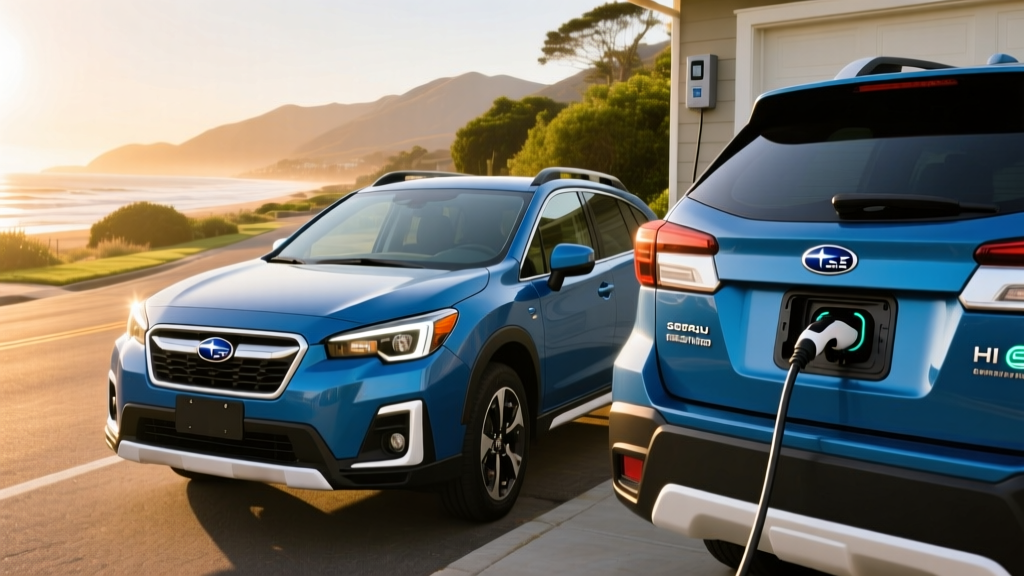
Subaru's plug-in hybrid offering for 2025 centers on the Crosstrek Hybrid — a compact crossover that pairs a 2.0-liter boxer engine with a hybrid-electric system derived from Toyota's fourth-generation Prius Prime architecture. It's a niche product with genuine trade-offs, and whether it makes sense for you depends entirely on your daily commute, charging access, and how much you value Subaru's standard all-wheel drive.
This guide breaks down every number that matters: EPA range, real-world MPG, charging specs, battery warranty, pricing, and federal tax credit eligibility under current IRS §30D rules.
HEV vs PHEV: Understanding Subaru's Hybrid Lineup
Before diving into specs, it's critical to separate Subaru's two hybrid approaches:
| Feature | Conventional Hybrid (HEV) | Plug-In Hybrid (PHEV) |
|---|---|---|
| Plug-in required? | No — charges via regen and engine | Yes — plugs in for electric-only range |
| Electric-only driving | Minimal (low-speed assist only) | 17 miles (EPA) |
| Battery size | ~1.1 kWh (small buffer) | 13.1 kWh usable |
| Fuel economy (gas only) | 35 MPG combined | 35 MPG combined (after battery depleted) |
| Federal tax credit | No | Up to $4,502 (see eligibility below) |
The conventional hybrid charges itself through regenerative braking and the gasoline engine — you never plug it in. The PHEV adds a larger battery pack and the ability to drive roughly 17 miles on electricity alone before the gasoline engine kicks in. If your round-trip commute is under 34 miles and you can charge at home, the PHEV lets you burn almost zero gasoline on most days.
Fuel Economy: EPA Numbers and Real-World MPG
Here's how the 2025 Crosstrek Hybrid stacks up on the EPA cycle:
| Metric | Value |
|---|---|
| MPGe (combined, electric + gas) | 90 MPGe |
| MPG combined (gas-only, battery depleted) | 35 MPG |
| MPG city (gas-only) | 36 MPG |
| MPG highway (gas-only) | 34 MPG |
| Electric-only range | 17 miles (EPA) |
| Total range (electric + gas) | ~480 miles |
| Fuel tank capacity | 13.2 gallons |
Real-world note: Hybrids tend to beat their EPA highway figures in stop-and-go city driving, where regenerative braking recaptures energy on every deceleration. Expect 37–40 MPG in urban commutes with gentle driving. Highway cruising at 75+ mph will pull that down to 31–33 MPG. In sub-freezing temperatures, the engine runs more frequently to heat the cabin, reducing electric-only range to roughly 12–14 miles and dropping gas-mode MPG by 2–3 points. Source: fueleconomy.gov.
Powertrain, Battery, and Charging Specs
| Specification | 2025 Crosstrek Hybrid |
|---|---|
| Engine | 2.0L 4-cylinder boxer |
| Combined horsepower | 148 hp (net system output) |
| Engine output | 137 hp @ 5,200 rpm |
| Electric motor output | 88 kW (118 hp) |
| Drivetrain | Symmetrical All-Wheel Drive (standard) |
| Transmission | eCVT (planetary gearset) |
| Battery chemistry | Lithium-ion (NMC) |
| Battery capacity (usable) | 13.1 kWh |
| Level 1 charging (120V) | ~5 hours (full charge) |
| Level 2 charging (240V, 3.3 kW) | ~2.5 hours (full charge) |
| DC fast charging | Not supported |
| Charge port | J1772 (Level 1/2 only) |
| 0–60 mph | ~9.2 seconds |
The 3.3 kW onboard charger is the Crosstrek Hybrid's most significant charging limitation. At that rate, even a Level 2 station can only add roughly 10–12 miles of electric range per hour of charging. There is no DC fast-charge capability — this vehicle is designed for overnight home charging, not road-trip top-ups. If you can't charge at home or at work, the electric-only benefit shrinks dramatically.
Battery & Powertrain Warranty: Subaru covers the hybrid battery pack for 8 years / 100,000 miles (whichever comes first), with a capacity-retention threshold of roughly 70% before a warranty claim is honored. The hybrid system components (inverter, motor, eCVT) carry the same 8-year/100,000-mile coverage. The conventional powertrain warranty is 5 years / 60,000 miles.
Pricing and Federal Tax Credit Eligibility
The 2025 Subaru Crosstrek Hybrid starts at approximately $36,995 MSRP (before destination). That's roughly $8,000–$10,000 above a base gas-only Crosstrek, and about $5,000 above the conventional HEV variant.
Federal tax credit (§30D): The Crosstrek Hybrid qualifies for up to $4,502 under the IRS clean vehicle credit — not the full $7,500. The reduced amount reflects current critical-mineral and battery-component sourcing requirements. To claim it, you must meet all of the following:
- Income cap: Modified AGI ≤ $150,000 (single), $225,000 (head of household), $300,000 (joint) — per IRS §30D guidelines
- MSRP cap: Vehicle MSRP must not exceed $80,000 for SUVs/trucks (Crosstrek qualifies)
- Point-of-sale transfer: You may transfer the credit to the dealer at purchase for an immediate price reduction
- Battery sourcing: Credit amount depends on critical-mineral and component sourcing — the $4,502 figure reflects partial compliance
After the federal credit, the effective price drops to roughly $32,493 — still a premium over the gas model, but the math improves if your daily driving stays within electric-only range and your electricity rate is low.
Real-World Ownership: Who Should Buy This PHEV?
The Crosstrek Hybrid is not for everyone. Here's a practical decision framework:
Choose the Crosstrek PHEV if:
- Your round-trip commute is 15–30 miles and you can charge at home overnight
- You want AWD for snow/rain but prefer electric daily driving
- You take occasional long road trips and don't want range anxiety
- You value Subaru's EyeSight safety suite and cargo practicality
Choose a full BEV (like the Hyundai Ioniq 5 or Tesla Model Y) if:
- You have reliable home charging and rarely drive over 250 miles without stopping
- You want to eliminate gasoline entirely and access DC fast charging
- You qualify for the full $7,500 federal credit on a BEV
Choose the conventional Crosstrek HEV if:
- You can't charge at home or at work
- You want better MPG than a gas car but don't want the PHEV price premium
- Your commute is mostly highway (where electric-only range offers minimal benefit)
Pros
- Standard AWD — rare in the PHEV segment
- 17 miles electric covers most short commutes
- 35 MPG combined after battery depletion is solid for AWD
- EyeSight driver-assist (Level 2) standard on all trims
- Good cargo space (20.8 cu ft behind rear seats)
Cons
- No DC fast charging — limits road-trip electric use
- 3.3 kW onboard charger is slow even for Level 2
- Only 17 miles of electric range (competitors offer 30–42)
- ~$37K starting price is steep for the compact crossover segment
- Partial federal credit ($4,502, not $7,500)
- 0–60 in 9.2 seconds — adequate but not quick
Battery Longevity and Replacement Costs
Hybrid and PHEV battery packs have proven remarkably durable. Toyota-derived hybrid systems (which the Crosstrek Hybrid uses under license) have a long track record — many Prius packs exceed 150,000–200,000 miles before meaningful degradation. Subaru's 8-year/100,000-mile warranty provides a floor, but real-world data from the Prius Prime platform suggests the pack will likely outlast the vehicle's economic life.
If replacement is needed out of warranty, expect a cost in the range of $4,000–$7,000 for the battery pack (parts and labor). That's a significant sum, but it's comparable to a major transmission repair on a conventional vehicle — and statistically unlikely to be needed within the first decade of ownership.
Frequently Asked Questions
How many MPG does the 2025 Subaru Crosstrek Hybrid get?
The EPA rates it at 35 MPG combined (36 city / 34 highway) when running on gasoline after the battery is depleted. In electric mode, it achieves 90 MPGe combined. Real-world city driving with regenerative braking can push gas-mode MPG to 37–40, while sustained highway speeds above 75 mph may drop it to 31–33 MPG.
How far can the Crosstrek PHEV go on electric only?
The EPA estimates 17 miles of electric-only range. In mild weather with gentle acceleration, expect 16–19 miles. In freezing temperatures or with aggressive driving, that drops to 12–14 miles. Once the battery is depleted, the gasoline engine takes over seamlessly.
Hybrid vs PHEV vs EV — which is right for me?
A conventional hybrid (HEV) is best if you can't plug in and just want better MPG. A PHEV like the Crosstrek Hybrid is ideal if you can charge at home and your commute is under 20 miles round-trip — you'll burn minimal gasoline while retaining gas-engine flexibility for road trips. A full BEV makes the most sense if you have home charging, want zero tailpipe emissions, and your longest typical trip is under 250 miles (or you're comfortable planning DC fast-charge stops).
Is the Subaru Crosstrek Hybrid reliable?
Subaru's hybrid system is derived from Toyota's proven Prius Prime platform, which has one of the strongest reliability records in the industry. The hybrid battery carries an 8-year/100,000-mile warranty. Subaru's EyeSight driver-assist system is well-rated by the IIHS. The main reliability considerations are standard Subaru items: head gasket history on older boxer engines (largely resolved in current generations) and CVT longevity (the eCVT planetary gearset is mechanically simpler and more durable than Subaru's traditional chain-driven CVT).
Does the 2025 Crosstrek Hybrid qualify for a tax credit?
Yes — up to $4,502 under the federal §30D clean vehicle credit, subject to income caps ($150K single / $300K joint), MSRP limits, and battery-sourcing requirements. The credit can be transferred to the dealer at point of sale for an immediate price reduction. Always verify current eligibility on irs.gov before purchasing, as sourcing rules and credit amounts can shift.
Can the Crosstrek Hybrid DC fast charge?
No. The Crosstrek Hybrid only supports Level 1 (120V) and Level 2 (240V) charging via a J1772 connector. The onboard charger maxes out at 3.3 kW, meaning a full charge takes about 2.5 hours on Level 2 or 5 hours on a standard household outlet. This is a significant limitation compared to PHEVs like the Toyota RAV4 Prime, which also lacks DC fast charging but offers a 6.6 kW onboard charger for faster Level 2 top-ups.