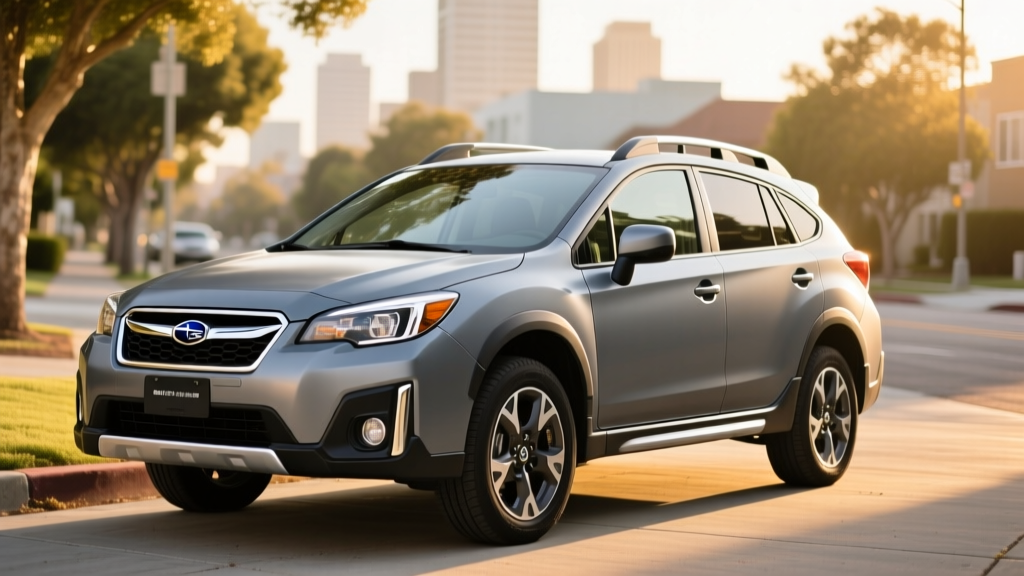
The Subaru 2015 XV Crosstrek Hybrid occupies a specific niche in the used-EV marketplace: a conventional hybrid (HEV) compact crossover with Subaru's hallmark symmetrical all-wheel drive, aimed at buyers who want better fuel economy without plugging in. Now well into its second decade on the road, this model is a popular entry point for budget-conscious shoppers eyeing their first hybrid. But with a 13.5 kWh nickel-metal hydride (NiMH) battery pack and a powertrain that was Subaru's first production hybrid, prospective buyers need clear data on what holds up — and what doesn't — after 10+ years of service.
This guide covers the 2015 XV Crosstrek Hybrid's real-world MPG, battery longevity and replacement cost, powertrain specs, and how it stacks up against modern hybrids, PHEVs, and full EVs for today's buyers.
HEV vs PHEV: What the 2015 Crosstrek Hybrid Actually Is
Before evaluating specs, it's essential to place this vehicle correctly. The 2015 XV Crosstrek Hybrid is a conventional hybrid electric vehicle (HEV), not a plug-in hybrid (PHEV). This distinction drives everything from daily use to tax-credit eligibility.
| Feature | HEV (2015 Crosstrek Hybrid) | PHEV (e.g., modern Crosstrek PHEV) | Full EV (BEV) |
|---|---|---|---|
| Plug-in charging required? | No — charges via engine + regen | Yes — Level 1/2 AC charging | Yes — Level 1/2/DC charging |
| Electric-only driving | Very limited (under 1 mi at low speed) | Typically 17–30+ mi | Full range (200–400+ mi) |
| Fuel source | Gasoline + regenerative braking | Gasoline + grid electricity | Grid electricity only |
| Federal tax credit (§30D) | Not eligible | Up to $7,500 (if eligible) | Up to $7,500 (if eligible) |
| Used EV credit (§25E) | Not eligible | Potentially up to $4,000 | Potentially up to $4,000 |
The 2015 Crosstrek Hybrid uses its electric motor to assist the gasoline engine and enable brief low-speed electric-only movement, but it cannot be plugged in and has no meaningful electric-only range. You refuel it like any other gas car. This is fundamentally different from Subaru's later Crosstrek Hybrid PHEV (sold 2019–2023 in the U.S.), which offered ~17 miles of electric-only range and plug-in capability.
Fuel Economy: EPA Ratings and Real-World MPG
The headline number for any hybrid buyer is fuel efficiency. Here's what the EPA certified for the 2015 XV Crosstrek Hybrid, sourced from fueleconomy.gov:
| Driving Cycle | EPA Rating |
|---|---|
| City | 29 MPG |
| Highway | 33 MPG |
| Combined | 31 MPG |
For comparison, the gas-only 2015 Crosstrek with the 2.0L engine and CVT was rated at 26 city / 34 highway / 29 combined. The hybrid's advantage shows up most in city driving, where regenerative braking and electric-motor assist reduce fuel consumption by roughly 3 MPG over the conventional model.
Real-World MPG: What Owners Actually Report
Based on aggregated owner data from Fuelly and Subaru forums, real-world combined fuel economy for the 2015 XV Crosstrek Hybrid typically falls between 28 and 32 MPG, clustering near the EPA combined figure. Several factors shift this number:
- City-heavy driving: Hybrids thrive in stop-and-go traffic. Owners with 80%+ city routes frequently report 31–33 MPG.
- Highway-dominant commutes: At sustained 70+ MPH speeds, the hybrid system provides less benefit. Expect 29–31 MPG.
- Cold weather (below 32°F): The engine runs more frequently to maintain cabin heat and battery temperature, dropping observed MPG by 2–4 points to roughly 25–28 MPG combined.
- Elevation and terrain: Mountainous routes reduce efficiency; the hybrid system recaptures energy on descents but works harder on climbs.
The honest takeaway: the 31 MPG combined EPA figure is achievable in moderate climates with mixed driving, but it is not a dramatic leap over the gas-only Crosstrek. The hybrid's efficiency gain is real but modest — roughly 7–10% improvement in typical use.
Powertrain Specs: Engine, Motor, and Combined Output
| Specification | Detail |
|---|---|
| Engine | 2.0L horizontally opposed (Boxer) 4-cylinder |
| Engine horsepower | 148 HP @ 6,000 RPM |
| Electric motor output | 13.4 HP (10 kW) |
| Combined system output | ~160 HP (net) |
| Transmission | Lineartronic CVT (continuously variable) |
| Drivetrain | Symmetrical All-Wheel Drive (AWD) |
| Hybrid battery | 13.5 kWh NiMH (nickel-metal hydride) |
| 0–60 MPH | ~10.5 seconds (est.) |
| Curb weight | ~3,450 lbs (roughly 300 lbs more than gas model) |
The 13.4 HP electric motor is integrated between the engine and CVT. It provides torque-fill at low RPMs, smooths stop-start transitions, and enables engine-off coasting at very low speeds. It does not provide meaningful all-electric acceleration. The combined system output of roughly 160 HP gives the hybrid slightly more urgency off the line than the gas-only model's 148 HP, but the added 300 lbs of battery and hybrid hardware largely offsets this. Expect 0–60 times in the mid-10-second range — adequate for merging, not sporty.
The AWD system is Subaru's familiar symmetrical layout with an electronically controlled continuously transfer clutch. Hybrid components do not compromise ground clearance (8.7 inches) or the X-Mode traction system, which was a key selling point for outdoor-oriented buyers.
Battery Longevity, Warranty, and Replacement Cost
Original Hybrid Battery Warranty: 8 years / 100,000 miles (whichever comes first) in most U.S. states. In California-emission states (CA, CT, ME, MA, NJ, NY, OR, RI, VT, WA), the warranty extends to 10 years / 150,000 miles.
Current Status (2026): For a 2015 model, the original factory battery warranty has expired in all jurisdictions. Battery replacement is an out-of-pocket expense unless covered by an extended warranty.
How Long Does the NiMH Battery Last?
Nickel-metal hydride batteries in this generation of Toyota/Subaru hybrids have demonstrated strong longevity. Based on owner reports and hybrid-service-shop data, the 13.5 kWh NiMH pack in the 2015 Crosstrek Hybrid typically retains functional capacity to 150,000–200,000 miles before significant degradation triggers a check-engine light or noticeable efficiency loss.
NiMH chemistry degrades more gracefully than early lithium-ion packs — you'll see a gradual MPG decline rather than sudden failure. Common failure modes include individual cell imbalance (which can sometimes be addressed by reconditioning) and thermal-stress degradation in hot-climate vehicles.
Battery Replacement Cost
As of 2026, replacement costs for the 2015 Crosstrek Hybrid battery pack break down as follows:
- New OEM battery (Subaru dealer): $3,000–$4,000 including parts and labor
- Remanufactured battery (independent hybrid shop): $1,800–$2,800 installed
- Reconditioned / used battery: $800–$1,500 installed (variable quality, shorter warranty)
Given that a clean 2015 Crosstrek Hybrid trades for roughly $10,000–$15,000 on the used market in 2026, a $3,000+ OEM battery replacement represents 20–30% of the vehicle's value. This is a critical factor in purchase decisions — always request battery health data before buying.
Pre-Purchase Battery Health Check
Before purchasing a used 2015 XV Crosstrek Hybrid, insist on a hybrid battery diagnostic scan from a shop with Subaru Select Monitor or an equivalent OBD-II hybrid-capable tool. This scan reveals:
- Individual cell block voltage variance (imbalance above 0.3V signals degradation)
- Battery internal resistance trending
- State of Health (SoH) percentage
- Historical trouble codes related to the hybrid system
Driving Impressions and Practical Ownership
The 2015 Crosstrek Hybrid drives much like its gas-only sibling, with two notable differences. First, the transition between electric-motor assist and engine engagement is smooth by 2015 standards, though not as seamless as Toyota's contemporary Hybrid Synergy Drive. Second, the regenerative braking has a distinctly firmer pedal feel than the gas model — it takes a few days to modulate smoothly.
Cargo space takes a minor hit: the hybrid battery sits under the rear cargo floor, raising the load floor by roughly 1 inch and eliminating the spare tire (replaced by a tire-repair kit). Cargo volume behind the rear seats is approximately 20.8 cubic feet, compared to 22.3 in the gas model. With rear seats folded, you get about 50.4 cu ft.
Infotainment and safety tech reflect 2015 standards: a 6.1-inch touchscreen (on Hybrid Touring trims), standard rear-view camera, and available EyeSight driver-assist (adaptive cruise, pre-collision braking, lane-departure warning). EyeSight is a SAE Level 2 system — it assists with steering and speed but requires full driver attention at all times.
Pricing, Tax Credits, and Value in 2026
The 2015 XV Crosstrek Hybrid was originally sold in a single well-equipped trim (roughly $26,780 MSRP new, including destination). On the 2026 used market:
- Fair purchase range (private party): $9,500–$13,000 depending on mileage, condition, and battery health
- Dealer retail: $11,000–$15,500
Tax Credit Eligibility
The 2015 Crosstrek Hybrid is a conventional HEV. It does not qualify for the federal §30D new clean vehicle credit (which applies only to PHEVs and BEVs meeting battery-sourcing and MSRP caps, per IRS guidelines). It also does not qualify for the §25E used clean vehicle credit, which similarly excludes conventional hybrids.
Some states may offer minor registration incentives or HOV-lane access for hybrids, but these vary by jurisdiction and many have expired for older models. Check your state's DMV or energy office for current programs.
Who Should Buy This Hybrid vs. a PHEV or Full EV?
Choose the 2015 Crosstrek Hybrid if:
- You want AWD and 8.7 inches of ground clearance for dirt roads, snow, or camping access
- You lack home or workplace charging access (apartment, street parking)
- Your budget is under $15,000 and you want a fuel-efficient crossover
- You drive a city-heavy commute where hybrid efficiency shines (29–33 MPG real-world)
- You plan to keep the vehicle 3–5 years and drive under 15,000 miles/year
Choose a PHEV (e.g., Toyota RAV4 Prime, Subaru Crosstrek PHEV 2019–2023) if:
- You have Level 2 home charging and a short commute (under 25 miles)
- You want electric-only daily driving with gas flexibility for road trips
- You can spend $20,000–$35,000 on a newer used vehicle
Choose a full EV (BEV) if:
- You have reliable home Level 2 charging
- Your daily driving is under 200 miles and you road-trip infrequently
- You want to eliminate gasoline entirely and access the §25E used EV credit (up to $4,000 on qualifying models)
- You can spend $18,000+ for a used Chevrolet Bolt EUV, Hyundai Kona Electric, or similar
Pros and Cons at a Glance
Pros
- Standard AWD with 8.7" ground clearance — genuine off-pavement capability
- No plug-in required — works for apartment dwellers and street parkers
- Proven NiMH battery chemistry with 150K–200K mile typical lifespan
- EyeSight safety suite available (adaptive cruise, auto-braking)
- Modest city MPG improvement over gas model (31 vs 29 combined)
Cons
- Only ~2 MPG combined improvement over the gas Crosstrek — small gain for added complexity
- NiMH battery warranty expired; replacement costs $1,800–$4,000
- No electric-only driving range (not a PHEV)
- Added ~300 lbs of weight impacts handling and tire wear
- Reduced cargo volume and no spare tire
- No federal tax credit eligibility (HEV, not PHEV/BEV)
Frequently Asked Questions
How many MPG does the 2015 Subaru XV Crosstrek Hybrid get?
The EPA rates it at 29 city / 33 highway / 31 combined. Real-world owners typically report 28–32 MPG combined, with city-heavy drivers occasionally seeing 33 MPG and cold-weather highway driving dropping to 25–28 MPG.
Can I plug in the 2015 Crosstrek Hybrid to charge it?
No. This is a conventional hybrid (HEV), not a plug-in hybrid (PHEV). The battery charges exclusively through the gasoline engine and regenerative braking. There is no charge port.
How far can the 2015 Crosstrek Hybrid go on electric power alone?
Essentially zero practical electric-only range. The 13.4 HP electric motor can move the car at very low speeds (parking lots, traffic creep) for under a mile, but it cannot sustain highway or even neighborhood speeds on electric power alone. If electric-only commuting is your goal, you need a PHEV or BEV.
Is the 2015 Crosstrek Hybrid reliable?
The powertrain is generally reliable. The 2.0L Boxer engine and CVT have known but manageable issues (head-gasket monitoring, CVT fluid changes). The NiMH hybrid battery typically lasts 150,000–200,000 miles. Subaru's hybrid system was simpler and less stressed than some competitors, contributing to longevity. However, at 10+ years old, condition depends heavily on maintenance history. A pre-purchase inspection including a hybrid battery scan is essential.
What does it cost to replace the hybrid battery?
Expect $3,000–$4,000 for a new OEM battery at a Subaru dealer, $1,800–$2,800 for a remanufactured pack at an independent hybrid specialist, or $800–$1,500 for a used/reconditioned unit. Given the vehicle's 2026 market value of $10,000–$15,000, battery replacement is a significant percentage of the car's worth.
Does the 2015 Crosstrek Hybrid qualify for any tax credit?
No. As a conventional hybrid (HEV), it does not qualify for the federal §30D new-vehicle credit or the §25E used-vehicle credit. These credits apply only to plug-in vehicles (PHEVs and BEVs) meeting specific battery-sourcing, MSRP, and buyer-income requirements. Check fueleconomy.gov for current eligible vehicles.
Is the 2015 Crosstrek Hybrid better than the gas-only Crosstrek?
It depends on your priorities. The hybrid delivers roughly 2 MPG combined improvement and slightly more low-end torque, at the cost of 300 lbs of extra weight, reduced cargo space, no spare tire, and eventual hybrid-battery replacement expense. For high-mileage city drivers, the fuel savings can offset these trade-offs. For highway-dominant or low-mileage drivers, the gas-only model is simpler and cheaper to own long-term.
Should I buy a 2015 Crosstrek Hybrid or a newer used EV?
If you lack home charging access or need AWD on a tight budget, the 2015 Crosstrek Hybrid fills a practical niche. If you can charge at home and want lower running costs, a used EV like a 2017–2020 Chevrolet Bolt EV ($10,000–$16,000 in 2026) offers dramatically lower per-mile energy costs and may qualify for the $4,000 §25E used EV credit — but lacks AWD. For AWD plus electric, a used Tesla Model 3 Dual Motor or Ford Mustang Mach-E starts around $20,000–$28,000.
Final Assessment: A Niche Used Hybrid with Honest Trade-offs
The Subaru 2015 XV Crosstrek Hybrid is not a fuel-economy standout — its 31 MPG combined barely edges out the gas-only Crosstrek, and it lacks the plug-in capability that defines modern hybrid ownership. What it does offer is a rare combination for its era and price point: AWD, high ground clearance, hybrid efficiency, and proven Subaru durability in a package that doesn't require lifestyle changes (no charging, no range planning).
For 2026 used-car shoppers, the critical decision point is battery health. At 10–11 years old, many examples are approaching the mileage where NiMH replacement becomes a realistic expense. Budget $1,500–$3,000 as a battery-reserve fund, get a pre-purchase hybrid diagnostic, and the 2015 Crosstrek Hybrid can be a sensible, capable, and efficient daily driver for the right buyer. If your needs lean toward electric-only commuting or maximum fuel savings, look at a used PHEV or BEV instead — the hybrid landscape has advanced considerably since 2015.