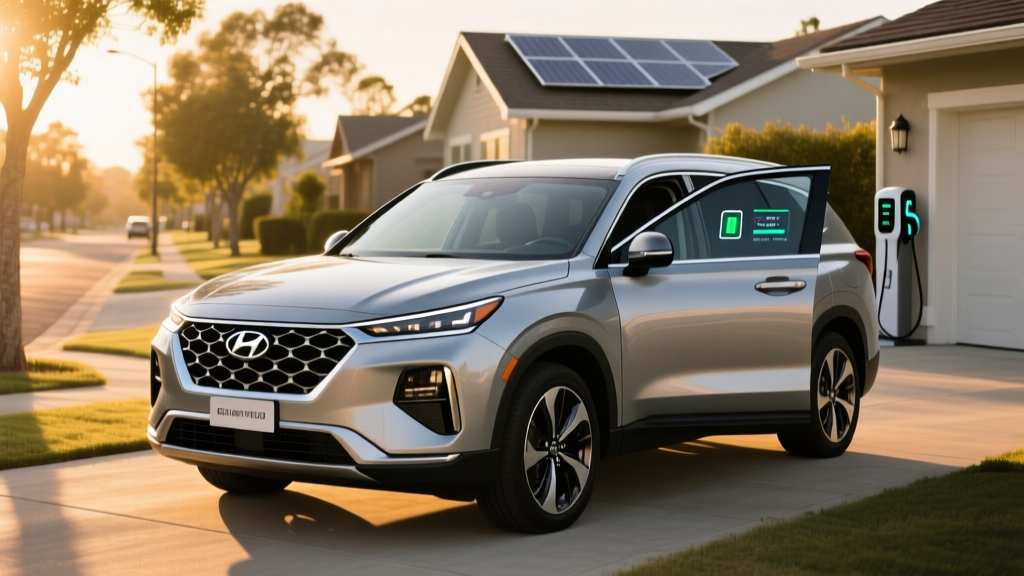
The Hyundai Santa Fe Plug-In Hybrid occupies a specific niche: family-SUV space and utility with the ability to handle most daily commutes on electricity alone, while keeping a gas engine for road trips and cold-weather flexibility. For 2026, Hyundai continues the third-generation Santa Fe's boxy, rugged styling while refining the PHEV powertrain that debuted with this generation. If you're researching the Santa Fe plug-in hybrid, you likely want hard numbers on electric range, fuel economy, charging logistics, and whether the federal tax credit applies. This guide delivers exactly that, based on EPA data, Hyundai specifications, and real-world ownership patterns.
Quick Verdict: Who the Santa Fe PHEV Is For
The 2026 Santa Fe Plug-In Hybrid is best suited for households that can charge at home (Level 1 or Level 2), drive fewer than 30 miles round-trip on most weekdays, but still need the flexibility of a gasoline engine for longer trips or towing. It's not a full EV replacement — it's a bridge vehicle that eliminates daily gasoline use without introducing range anxiety. If you can't charge at home or at work, the PHEV premium over the conventional Santa Fe Hybrid is difficult to justify, and you'd save money choosing the HEV variant instead.
- You have home or workplace charging access (even a standard 120V outlet works overnight)
- Your typical daily driving is under 30 miles round-trip
- You want to reduce fuel costs without committing to a full EV
- You need three-row SUV cargo space and towing capability
- You cannot charge at home or work
- Your daily commute regularly exceeds 35 miles
- You want a lower purchase price and don't care about electric-only driving
- You have reliable home Level 2 charging and rarely drive more than 250 miles in a day
- You want zero tailpipe emissions and minimal maintenance
HEV vs PHEV: Understanding the Two Santa Fe Hybrids
Hyundai sells the 2026 Santa Fe in three powertrain configurations: conventional gas (2.5L turbo), conventional hybrid (HEV), and plug-in hybrid (PHEV). The distinction between the HEV and PHEV matters enormously for your wallet and daily routine.
| Feature | Santa Fe Hybrid (HEV) | Santa Fe Plug-In Hybrid (PHEV) |
|---|---|---|
| Battery Size | ~1.5 kWh (small buffer) | 13.8 kWh usable (22.8 kWh gross) |
| Plug-In Required? | No — regenerative braking charges it | Yes — plug in to access EV range |
| Electric-Only Range | Less than 1 mile at low speed | EPA-estimated 30 miles |
| Combined Horsepower | 232 HP | 261 HP |
| EPA Combined MPG/MPGe | 36 MPG combined | 79 MPGe (electric+gas) / 34 MPG (gas-only) |
| Starting MSRP | ~$39,000 | ~$42,600 |
| Federal Tax Credit | None | Up to $3,500 (subject to §30D sourcing rules) |
The conventional HEV operates like a traditional hybrid — the small battery is charged through regenerative braking and the engine, and the electric motor assists during acceleration and low-speed driving. You never plug it in. The PHEV carries a much larger battery that you charge by plugging into a wall outlet or charging station, enabling genuine electric-only driving for a meaningful distance before the gasoline engine engages.
Electric Range, MPGe, and Fuel Economy Breakdown
The 2026 Santa Fe Plug-In Hybrid carries an EPA-estimated 30 miles of electric-only range. That figure assumes moderate temperatures, mixed city/highway driving, and no heavy climate-control use. In real-world conditions, expect the following:
Real-World Expectations:
- Mild weather, city driving: 28–32 miles (regen braking extends range)
- Highway at 70+ mph: 22–26 miles (aerodynamic drag drains battery faster)
- Cold weather (below 35°F): 20–24 miles (cabin heating and battery chemistry reduce efficiency)
Once the battery depletes, the Santa Fe PHEV operates as a conventional hybrid. The EPA rates it at 34 MPG combined in hybrid mode — competitive with the dedicated HEV variant's 36 MPG combined, and a slight penalty for the PHEV's heavier battery pack.
| Driving Mode | City | Highway | Combined |
|---|---|---|---|
| Electric + Gas (MPGe) | — | — | 79 MPGe |
| Hybrid-only (MPG) | 33 MPG | 35 MPG | 34 MPG |
| Santa Fe HEV (MPG) | 35 MPG | 38 MPG | 36 MPG |
Real-world note: Hyundai hybrids tend to meet or slightly exceed EPA city estimates thanks to aggressive regenerative braking in stop-and-go traffic. Highway numbers are more likely to fall below the sticker, especially at speeds above 75 mph or with roof cargo boxes that increase drag. On a 200-mile highway road trip with no initial charge, owners typically report 31–33 MPG — close to but slightly under the EPA highway figure. Source: fueleconomy.gov.
Powertrain Specs: Engine, Motor, and Combined Output
The 2026 Santa Fe PHEV pairs a 1.6-liter turbocharged four-cylinder engine (178 HP, 195 lb-ft torque) with a 90 kW (121 HP) electric motor integrated into the six-speed automatic transmission. Combined system output is 261 horsepower and 271 lb-ft of torque, sent to all four wheels through Hyundai's HTRAC all-wheel-drive system.
| Specification | 2026 Santa Fe PHEV |
|---|---|
| Engine | 1.6L Turbo GDI 4-cylinder |
| Engine Output | 178 HP / 195 lb-ft |
| Electric Motor | 90 kW (121 HP) / 195 lb-ft |
| Combined System Output | 261 HP / 271 lb-ft |
| Transmission | 6-speed automatic |
| Drivetrain | HTRAC AWD (standard) |
| Battery (Gross / Usable) | 22.8 kWh / 13.8 kWh |
| Battery Chemistry | NMC (Nickel Manganese Cobalt) |
| EPA Electric Range | 30 miles |
| Hybrid MPG (Combined) | 34 MPG |
| 0–60 mph | ~7.8 seconds (estimated) |
| Towing Capacity | 2,000 lbs |
| Cargo Volume (behind 3rd row) | 10.4 cu ft |
| Cargo Volume (behind 2nd row) | 36.4 cu ft |
The PHEV's 261 HP gives it a meaningful edge over the HEV's 232 HP, and you feel it during highway merging and passing. The electric motor delivers instant torque at low RPMs, which makes the Santa Fe PHEV feel quicker off the line than the 0–60 time alone suggests. The six-speed automatic is a deliberate choice over a CVT — Hyundai prioritized driving feel and towing capability, and the traditional transmission handles both better than the e-CVT found in some competitors.
Charging: Times, Connectors, and Home Setup
The Santa Fe PHEV charges through a J1772 connector (the standard for all non-Tesla plug-in vehicles in North America). It does not support DC fast charging — a limitation shared by nearly all PHEVs due to their smaller battery packs, which don't benefit from high-speed charging the way a 75+ kWh EV battery does.
| Charging Method | Power | 0–100% Time | Notes |
|---|---|---|---|
| Level 1 (120V household outlet) | ~1.4 kW | ~11 hours | Adequate for overnight charging; plug in when you get home |
| Level 2 (240V home/public station) | 7.2 kW (max onboard) | ~2 hours 15 min | Recommended for daily use; requires 240V outlet or hardwired station |
| DC Fast Charging | Not supported | N/A | No CCS or CHAdeMO capability |
Home charging reality: Most PHEV owners find Level 1 charging (a standard 120V garage outlet) sufficient. The 13.8 kWh usable battery refills overnight in roughly 10–11 hours, which covers a typical 8-hour sleep cycle plus buffer. If you already have a 240V outlet (dryer, EV charger), Level 2 cuts that to about 2 hours — useful if you make multiple short trips with charging breaks in between.
A Level 2 home charging station installation typically costs $500–$1,500 for the equipment and electrician labor, assuming your electrical panel has capacity. Homes with older 100-amp panels may need a $1,500–$3,000 panel upgrade, which is a real cost to factor in. Always get a quote from a licensed electrician before purchasing charging equipment.
Pricing, Trims, and Tax Credit Eligibility
The 2026 Hyundai Santa Fe Plug-In Hybrid is offered in two trims:
- SEL Premium: ~$42,600 MSRP (before destination)
- Limited: ~$48,200 MSRP (before destination)
Destination charges add approximately $1,395. The SEL Premium is well-equipped with heated front seats, a 12.3-inch infotainment display, wireless Apple CarPlay/Android Auto, adaptive cruise control, and Hyundai's SmartSense safety suite. The Limited adds Nappa leather, ventilated front seats, a head-up display, and a premium Harman Kardon audio system.
Federal Tax Credit (§30D)
The Santa Fe PHEV's federal tax credit eligibility is complex and subject to change under current IRS rules. As of 2026, the vehicle may qualify for up to $3,500 under the §30D Clean Vehicle Credit, contingent on:
- MSRP Cap: SUVs must have an MSRP at or below $80,000 (Santa Fe PHEV qualifies)
- Buyer Income Limits: Modified AGI must not exceed $150,000 (single), $225,000 (head of household), or $300,000 (joint filers)
- Battery Sourcing: Critical minerals and battery components must meet escalating domestic-content thresholds — Hyundai's sourcing may not qualify for the full $7,500; the $3,500 partial credit is more likely
- Point-of-Sale Transfer: Eligible buyers can transfer the credit to the dealer at purchase, reducing the out-of-pocket price immediately
- Assembly: Final assembly must occur in North America (the Santa Fe is assembled in Georgia — qualifies)
Critical caveat: Battery-sourcing requirements tighten each year under the Inflation Reduction Act. A vehicle that qualifies for a partial or full credit in one model year may lose eligibility the next if its supply chain doesn't meet updated thresholds. Always verify current eligibility on the fueleconomy.gov tax credit page and consult a tax professional before relying on the credit for your purchase decision. Source: IRS.gov §30D.
Battery Warranty, Reliability, and Replacement Costs
Hyundai provides one of the strongest hybrid battery warranties in the industry:
Powertrain Warranty: 10 years / 100,000 miles
New Vehicle Limited Warranty: 5 years / 60,000 miles
Capacity Retention Threshold: Warranty covers the battery if it falls below approximately 70% of original capacity during the warranty period
PHEV batteries experience less stress than full EV batteries because they operate within a narrower state-of-charge window (the system reserves a buffer at the top and bottom to prevent degradation). The 13.8 kWh usable capacity in the Santa Fe PHEV is a fraction of its 22.8 kWh gross capacity — that large buffer is intentional and protective.
Reliability data: Hyundai's 1.6L turbo hybrid powertrain has been in service across multiple models (Tucson PHEV, Kia Sorento PHEV) since 2022, and early data shows no systemic battery or motor failures. The six-speed automatic is a proven design. Common complaints in owner forums center on infotainment software glitches rather than powertrain issues.
Battery replacement cost: If the high-voltage battery requires replacement out of warranty, expect a cost in the range of $5,000–$8,000 for the battery pack plus labor. This is significantly less than a full EV battery replacement ($12,000–$20,000+) because the PHEV pack is much smaller. However, given Hyundai's 10-year/100,000-mile coverage and the protective charge buffers, most owners will never face this expense. The 12V auxiliary battery (a standard lead-acid or AGM unit) will need replacement every 3–5 years at typical costs of $150–$250.
Real-World Ownership: What to Actually Expect
Based on owner reports and testing patterns, here's what daily life with the Santa Fe PHEV looks like:
- Daily commute (under 30 miles): You'll use almost zero gasoline during the week if you charge nightly. Electricity cost for 30 miles of EV driving averages $1.20–$1.80 depending on your utility rate (at $0.12–$0.18/kWh).
- Weekend road trip (200+ miles): Start with a full charge, drive 30 miles on electricity, then the hybrid system takes over at ~33 MPG highway. Total fuel cost for 200 miles: roughly $30–$35 at $3.50/gallon.
- Cold weather (below freezing): Electric range drops to 20–24 miles. The engine may start sooner to provide cabin heat unless you precondition while plugged in. Hybrid-mode MPG may dip to 30–31.
- Towing: The 2,000-lb rating is sufficient for a small trailer or a pair of dirt bikes, but don't expect to tow a boat. Towing cuts hybrid MPG to roughly 22–25.
Insurance note: PHEV insurance premiums run 5–12% higher than equivalent gas-only models due to higher repair costs for the high-voltage system and electric motor. Get quotes before purchasing — the fuel savings may or may not offset the insurance premium increase depending on your driving profile.
- 30 miles of EV range covers most daily commutes
- 261 HP provides confident highway merging
- Standard AWD — no FWD-only base trim
- Three-row seating in a midsize footprint
- 10-year/100,000-mile battery warranty
- No DC fast-charging dependency — a 120V outlet is sufficient
- North American assembly supports tax-credit eligibility
- Only ~$3,500 in federal tax credit (not the full $7,500)
- Electric range drops significantly in cold weather
- No DC fast-charging capability
- Third-row seat is tight for adults
- 2,000-lb towing capacity trails body-on-frame SUVs
- Higher insurance premiums than gas-only Santa Fe
- Hybrid MPG penalty vs the dedicated HEV variant (34 vs 36 combined)
Competitor Comparison: Santa Fe PHEV vs Rivals
| Spec | Hyundai Santa Fe PHEV | Kia Sorento PHEV | Toyota RAV4 Prime | Mitsubishi Outlander PHEV |
|---|---|---|---|---|
| EPA Electric Range | 30 mi | 32 mi | 42 mi | 38 mi |
| Combined HP | 261 HP | 261 HP | 302 HP | 248 HP |
| Hybrid MPG | 34 MPG | 34 MPG | 38 MPG | 26 MPG |
| Battery (Usable) | 13.8 kWh | 13.8 kWh | 14.9 kWh | 16.8 kWh |
| Third Row | Yes | Yes | No | Yes (tight) |
| DC Fast Charge | No | No | No | Yes (CHAdeMO) |
| Starting MSRP | ~$42,600 | ~$50,000 | ~$44,500 | ~$41,000 |
The Santa Fe PHEV shares its powertrain with the Kia Sorento PHEV but offers a lower entry price. The RAV4 Prime remains the range leader at 42 miles and the performance leader at 302 HP, but it lacks a third row and is often subject to dealer markups due to high demand. The Outlander PHEV uniquely offers CHAdeMO DC fast charging, though the CHAdeMO network is shrinking in North America.
Frequently Asked Questions
How many MPG does the Santa Fe Plug-In Hybrid get?
The EPA rates the 2026 Santa Fe PHEV at 34 MPG combined in hybrid mode (33 city / 35 highway). In real-world driving, expect 31–33 MPG on highway trips and potentially 35+ MPG in city driving where regenerative braking is most effective. When factoring in electric-only miles, the combined rating is 79 MPGe.
How far can the Santa Fe PHEV go on electric only?
The EPA estimates 30 miles of electric-only range. In practice, expect 28–32 miles in mild city conditions, 22–26 miles at sustained highway speeds, and 20–24 miles in freezing weather. Total combined range (electric + full tank of gas) exceeds 430 miles.
Does the Santa Fe PHEV qualify for a federal tax credit?
It may qualify for up to $3,500 under the §30D Clean Vehicle Credit, depending on battery-sourcing compliance, your income level, and current IRS rules. The vehicle is assembled in Georgia (meeting North American assembly requirements) and is under the $80,000 SUV MSRP cap. Always verify eligibility on fueleconomy.gov and consult a tax professional before purchasing.
Is the hybrid battery reliable, and what does replacement cost?
Hyundai covers the high-voltage battery for 10 years or 100,000 miles. Out-of-warranty replacement costs approximately $5,000–$8,000. Given the protective charge buffers built into PHEV systems and Hyundai's track record with this powertrain, most owners will never need a battery replacement during typical ownership.
Should I get the Santa Fe PHEV, HEV, or a full EV?
Choose the PHEV if you can charge at home and drive under 30 miles daily but need gas-engine flexibility. Choose the HEV if you can't charge at home. Choose a full EV like the Ioniq 5 if you have Level 2 home charging, rarely exceed 250 miles in a day, and want minimal maintenance and zero tailpipe emissions.
Can I charge the Santa Fe PHEV at a public DC fast charger?
No. The Santa Fe PHEV does not support DC fast charging. It charges via J1772 at up to 7.2 kW on Level 2 (about 2 hours 15 minutes for a full charge) or ~1.4 kW on Level 1 (about 11 hours). This is standard for nearly all plug-in hybrids.
What is the total cost of ownership compared to the gas Santa Fe?
Over five years and 75,000 miles, the PHEV saves an estimated $2,500–$4,000 in fuel costs versus the gas-only 2.5T model (depending on your electricity rate, gas prices, and how often you charge). That saving partially offsets the PHEV's ~$5,000–$7,000 higher purchase price. The break-even point typically arrives around year four if you charge daily and drive under 30 miles.
Sources: fueleconomy.gov (EPA ratings), IRS.gov §30D (tax credit rules), Hyundai USA specifications. All pricing and credit information reflects 2026 model-year data and is subject to change. Verify current incentive eligibility before purchase.