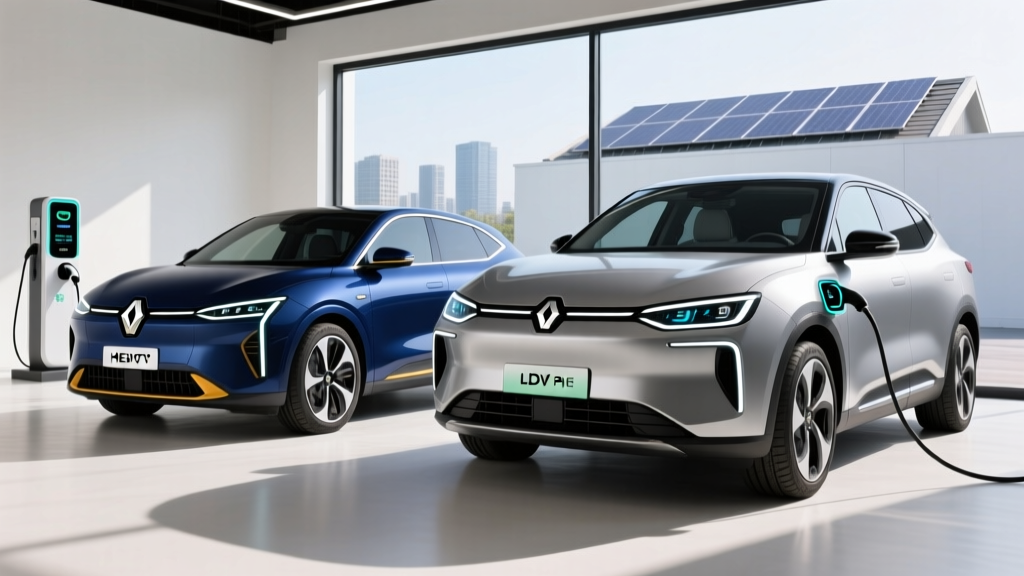
Renault and LDV (the British-commercial arm of SAIC Motor) occupy two very different lanes in the electrified-vehicle market. Renault's passenger cars and light vans lean on its E-Tech hybrid and plug-in hybrid systems, while LDV is carving out a niche in zero-emission and electrified commercial vans. If you're searching for Renault LDV hybrid electric vehicle types, you're likely weighing whether a self-charging hybrid (HEV), a plug-in hybrid (PHEV), or a full battery-electric vehicle (BEV) best fits your driving or fleet needs.
This guide breaks down the hybrid architectures both brands offer in the 2025–2026 model years, with exact MPG figures, battery capacities, electric-only range, and the tax-credit picture under current IRS §30D rules. We'll also cover real-world efficiency, battery longevity, and a clear decision framework so you know which powertrain type earns your money.
Understanding HEV vs PHEV: The Core Distinction
Before diving into specific models, it's essential to separate the two hybrid categories — because they serve fundamentally different use cases and have different fueling requirements.
Conventional Hybrid (HEV)
- No plug required. The small battery (~1–2 kWh) recharges via regenerative braking and the gasoline engine.
- Electric assist only. The motor supplements the engine at low speeds and during acceleration; it cannot drive the car on electricity alone for meaningful distances.
- Best for: Drivers without home charging access who want better MPG without changing habits.
Plug-In Hybrid (PHEV)
- Plugs in to charge. A larger battery (typically 10–20 kWh) provides 25–50 miles of pure electric driving.
- Electric-first, gas backup. Daily commutes run on electricity; the gas engine handles longer trips.
- Best for: Drivers with home/workplace Level 2 charging who want EV-like daily driving without range anxiety on road trips.
Neither Renault nor LDV currently sells a conventional HEV or PHEV passenger vehicle in the United States. Both brands' hybrid offerings are concentrated in European and other international markets. If you're a US-based buyer, this guide is most useful for understanding global powertrain trends, comparing import options, or evaluating these architectures for fleet planning and future US availability.
Renault E-Tech Hybrid Lineup: Specs and Efficiency
Renault's E-Tech badge covers both full-hybrid (HEV) and plug-in hybrid (PHEV) powertrains. The system pairs a 1.6-liter four-cylinder gasoline engine with one or two electric motors and a multi-mode clutchless gearbox. Here's how the key 2025–2026 models stack up:
| Model | Type | Combined HP | Battery (kWh) | EV Range | Combined MPG / MPGe | Starting MSRP (Europe) |
|---|---|---|---|---|---|---|
| Renault Clio E-Tech | HEV | 145 hp | 1.2 kWh | N/A (assist only) | ~58 MPG (WLTP) | €25,500 (~$27,800) |
| Renault Captur E-Tech | HEV | 145 hp | 1.2 kWh | N/A (assist only) | ~54 MPG (WLTP) | €30,500 (~$33,200) |
| Renault Captur E-Tech Plug-In | PHEV | 160 hp | 10.4 kWh | ~30 mi (WLTP) | ~200 MPGe / 50 MPG gas | €35,900 (~$39,100) |
| Renault Mégane E-Tech Plug-In | PHEV | 160 hp | 10.4 kWh | ~31 mi (WLTP) | ~210 MPGe / 52 MPG gas | €38,500 (~$41,900) |
| Renault Rafale E-Tech | HEV | 200 hp | 1.2 kWh | N/A (assist only) | ~50 MPG (WLTP) | €42,000 (~$45,700) |
Important note on WLTP vs EPA: European WLTP fuel-economy figures tend to run 10–15% higher than equivalent EPA estimates. If these models were EPA-rated, expect the Clio E-Tech at roughly 48–50 MPG combined and the Captur PHEV at around 25–28 miles of electric-only range. The Mégane E-Tech fully electric (BEV) is a separate model with a 60 kWh battery and ~280-mile WLTP range — it is not a hybrid.
LDV Electrified Vans: Where Hybrids Meet Commercial Fleets
LDV, owned by China's SAIC Motor, focuses on commercial vans in the UK and Australian markets. Unlike Renault, LDV has largely skipped the hybrid middle ground in favor of full battery-electric vans — though its lineup does include models that blur the line.
| Model | Powertrain | Battery / Fuel | Range | Payload | Starting Price |
|---|---|---|---|---|---|
| LDV eDeliver 7 | BEV | 77 kWh or 89 kWh | ~198–239 mi (WLTP) | ~1,200 kg | £40,000 (~$50,800) |
| LDV eDeliver 9 | BEV | 65 kWh, 77 kWh, or 89 kWh | ~120–215 mi (WLTP) | ~1,100 kg | £50,000 (~$63,500) |
| LDV Deliver 7 (diesel) | ICE (diesel) | N/A | ~500+ mi | ~1,200 kg | £28,000 (~$35,500) |
| LDV Mifa 9 (people mover) | BEV | 90 kWh | ~275 mi (WLTP) | 7 seats | £55,000 (~$69,800) |
LDV does not currently produce a hybrid (HEV) or plug-in hybrid (PHEV) van. The brand's electrification strategy has jumped straight to BEV, consistent with urban low-emission zone requirements in European and UK cities. For fleet operators comparing Renault LDV hybrid electric vehicle types, this means Renault offers the hybrid bridge (E-Tech HEV and PHEV) while LDV provides the full-electric destination — but no hybrid middle step.
Fuel Economy Deep Dive: Real-World MPG vs Sticker Numbers
Hybrid efficiency varies dramatically with driving conditions. Here's what the data shows:
| Vehicle | City MPG | Highway MPG | Combined MPG | Real-World Expectation |
|---|---|---|---|---|
| Clio E-Tech HEV | ~62 (WLTP) | ~52 (WLTP) | ~58 (WLTP) | City driving often exceeds EPA sticker; highway may fall 5–10% short |
| Captur E-Tech PHEV (gas-only mode) | ~52 | ~48 | ~50 | Once battery depletes, expect 42–47 MPG mixed driving |
| Captur E-Tech PHEV (charged daily) | N/A (electric) | N/A | ~200 MPGe | Commute-dependent: if under 25 mi round trip, near-zero gas use |
How many MPG does this hybrid get? For Renault's E-Tech HEV models, expect 48–58 MPG combined depending on model and driving mix. Hybrids inherently excel in city traffic where regenerative braking recovers energy and the electric motor handles low-speed propulsion. On sustained highway driving above 65 mph, the advantage narrows — the gas engine does most of the work, and aerodynamic drag dominates. Real-world city MPG often exceeds the combined rating by 5–8 MPG; highway MPG may fall 3–5 MPG below.
For the PHEV variants, fuel economy is entirely dependent on charging discipline. If you plug in nightly and your daily driving stays within the ~25–30 mile electric-only range, you may use almost no gasoline for months. Let the battery deplete and you're driving a slightly heavier conventional hybrid getting roughly 42–50 MPG.
PHEV Electric-Only Range and Charging Details
Renault's E-Tech plug-in hybrids use a 10.4 kWh lithium-ion battery pack paired with a 1.6L engine and two electric motors producing a combined 160 horsepower.
How far can it go on electric only? The Captur and Mégane E-Tech Plug-In deliver approximately 25–31 miles of electric-only range under WLTP testing. In real-world conditions — especially highway speeds or cold weather — expect 18–25 miles before the gasoline engine engages.
Charging Times for Renault E-Tech PHEV (10.4 kWh Battery)
- Level 1 (120V household outlet, ~1.4 kW): ~7–8 hours from empty to full
- Level 2 (240V, 3.7 kW wallbox): ~3 hours from empty to full
- DC fast charging: Not supported. Renault's E-Tech PHEVs use a Type 2 AC connector only — no CCS or CHAdeMO DC capability.
The lack of DC fast charging is typical for PHEVs in this segment. The small battery makes DC infrastructure unnecessary for daily use — a Level 2 home charger fully replenishes the pack overnight or during a workday.
Battery Longevity, Warranty, and Replacement Costs
Is this hybrid reliable and what is battery replacement cost? Renault provides an 8-year/100,000-mile (160,000 km) warranty on its E-Tech hybrid and PHEV traction batteries, covering capacity below 66% of original. This aligns with industry norms — Toyota, Hyundai, and most legacy automakers offer similar 8–10 year coverage.
For HEV models with the 1.2 kWh battery, replacement costs are relatively modest — typically €1,500–€2,500 ($1,600–$2,700) because the pack is small and the chemistry is well-proven NMC (nickel manganese cobalt). The PHEV's 10.4 kWh pack would run €4,000–€7,000 ($4,300–$7,600) for a replacement outside warranty.
LDV's electric vans carry an 8-year/100,000-mile battery warranty with a 70% capacity retention threshold — slightly more generous than Renault's 66% floor. Replacement costs for the larger 77–90 kWh packs in LDV vans are substantially higher: £12,000–£20,000 ($15,000–$25,000) out of warranty, though these figures are expected to decline as battery costs continue falling through 2026.
According to Renault's official E-Tech page, battery degradation in their hybrid systems is managed by a thermal management system and a software buffer that prevents full 0–100% cycling — the usable capacity is deliberately less than the gross capacity to extend cell life.
Tax Credits and Incentives: What Applies in 2026
Does it qualify for any tax credit? For US buyers, the answer is currently limited. Neither Renault nor LDV sells vehicles in the United States, so the IRS §30D federal tax credit (up to $7,500 for new clean vehicles) does not apply to these models. Even if imported, these vehicles would need to meet North American battery-sourcing and critical-mineral requirements to qualify — a threshold most European-market models do not currently satisfy.
For UK-based buyers (a primary market for both brands), the incentives are different:
- Renault E-Tech PHEV: Eligible for reduced company-car tax (BIK) rates compared to pure ICE vehicles, though the UK eliminated the Plug-In Car Grant in 2022.
- LDV electric vans: Qualify for the UK Plug-In Van Grant (up to £5,000 for small vans, £20,000 for large vans) and are exempt from London's ULEZ and congestion charges.
- Renault E-Tech HEV: No purchase incentive — conventional hybrids receive no grant in the UK or most EU markets as of 2026.
For US buyers considering the hybrid vs PHEV vs EV question with domestically available models, the IRS §30D guidelines remain the authoritative source for eligibility. Key 2026 requirements include:
- MSRP cap: $55,000 for sedans, $80,000 for SUVs/trucks/vans
- Buyer income cap: $150,000 single / $300,000 joint AGI
- Battery sourcing: critical minerals and battery components must meet phased-in domestic/free-trade-area thresholds
- Point-of-sale transfer: the credit can now be applied at purchase rather than waiting for tax filing
Hybrid vs PHEV vs EV: Which Fits Your Driving Pattern?
Choosing between Renault's hybrid options — or deciding whether to look at a full EV instead — depends on three variables: charging access, daily mileage, and trip flexibility.
Choose a Renault E-Tech HEV If:
- You have no access to home or workplace charging
- Your daily driving exceeds 40 miles and varies unpredictably
- You want 48–58 MPG without changing any fueling habits
- You drive primarily in urban or suburban conditions where regenerative braking maximizes efficiency
- Budget is a priority — HEVs cost €3,000–€5,000 less than equivalent PHEVs
Choose a Renault E-Tech PHEV If:
- You can install a Level 2 charger at home or have workplace charging
- Your daily commute is under 25 miles round-trip (keeping you in electric-only mode)
- You take regular road trips exceeding 200 miles where gas-engine flexibility matters
- You want reduced company-car tax (UK BIK) or fleet emissions benefits
- You're not ready to commit to a full BEV but want to reduce gasoline consumption
When to choose a full EV instead: If your daily driving stays under 200 miles, you have reliable home charging, and you want the lowest per-mile energy cost, a BEV like the Renault Mégane E-Tech Electric (60 kWh, ~280 mi WLTP) or LDV eDeliver 7 (for commercial use) eliminates gasoline entirely. BEVs have fewer moving parts, lower maintenance costs, and qualify for stronger incentives in most markets.
For fleet operators evaluating Renault LDV hybrid electric vehicle types, the calculus shifts to total cost of ownership (TCO). Renault's E-Tech HEV vans (like the Kangoo E-Tech) offer a low-risk entry point for mixed urban/suburban routes. LDV's eDeliver vans suit fixed urban delivery routes with depot charging. PHEVs make sense only when routes are predictable and charging infrastructure exists at the depot.
Frequently Asked Questions
Does Renault make a plug-in hybrid in 2026?
Yes. Renault offers E-Tech Plug-In Hybrid variants of the Captur and Mégane, both with a 10.4 kWh battery, approximately 25–31 miles of electric-only range (WLTP), and a combined 160 hp from the 1.6L engine and dual electric motors. These are sold primarily in European markets.
Does LDV make any hybrid vans?
No. As of the 2025–2026 model year, LDV does not produce a hybrid (HEV) or plug-in hybrid (PHEV) van. Its electrified lineup consists entirely of battery-electric vehicles (eDeliver 7, eDeliver 9, Mifa 9). LDV also offers conventional diesel vans for operators not ready to electrify.
How much does it cost to charge a Renault PHEV at home?
With a 10.4 kWh battery and UK electricity averaging £0.24/kWh (2026), a full home charge costs roughly £2.50 ($3.20). At 25 miles of electric range, that's approximately £0.10 ($0.13) per mile on electricity — versus roughly £0.15–0.18 ($0.19–0.23) per mile on gasoline at current prices.
Can Renault's E-Tech PHEV DC fast charge?
No. Renault's E-Tech plug-in hybrids support AC charging only via a Type 2 connector at up to 3.7 kW. A full charge takes approximately 3 hours on Level 2 or 7–8 hours on a standard 120V/230V household outlet. DC fast charging is not available — this is typical for PHEVs with small battery packs.
What is the battery warranty on Renault hybrids?
Renault covers the E-Tech hybrid and PHEV traction battery for 8 years or 100,000 miles (160,000 km), whichever comes first. The warranty guarantees capacity retention above 66% of original capacity. LDV's electric van batteries carry an 8-year/100,000-mile warranty with a 70% retention floor.
Are Renault E-Tech hybrids reliable?
Renault's E-Tech system uses a proven 1.6L naturally aspirated engine paired with a clutchless multi-mode transmission that has fewer wear components than conventional automatics. European reliability surveys (including What Car? and Warranty Direct data) place Renault in the mid-pack among mainstream brands. The hybrid system itself has fewer failure points than a turbocharged ICE powertrain, though the multimode gearbox is more complex than Toyota's planetary e-CVT.
Should I buy a Renault hybrid or a full EV?
If you have home charging and your daily driving is under 200 miles, a full EV (like the Renault Mégane E-Tech Electric or Renault 5 E-Tech) delivers lower running costs, zero tailpipe emissions, and minimal maintenance. Choose a hybrid if you lack reliable charging, regularly drive 200+ miles in a day, or need a lower purchase price. The PHEV bridges both worlds but only saves money if you actually plug it in regularly.