Quick Verdict: The RAV4 Prime Still Sets the PHEV Benchmark
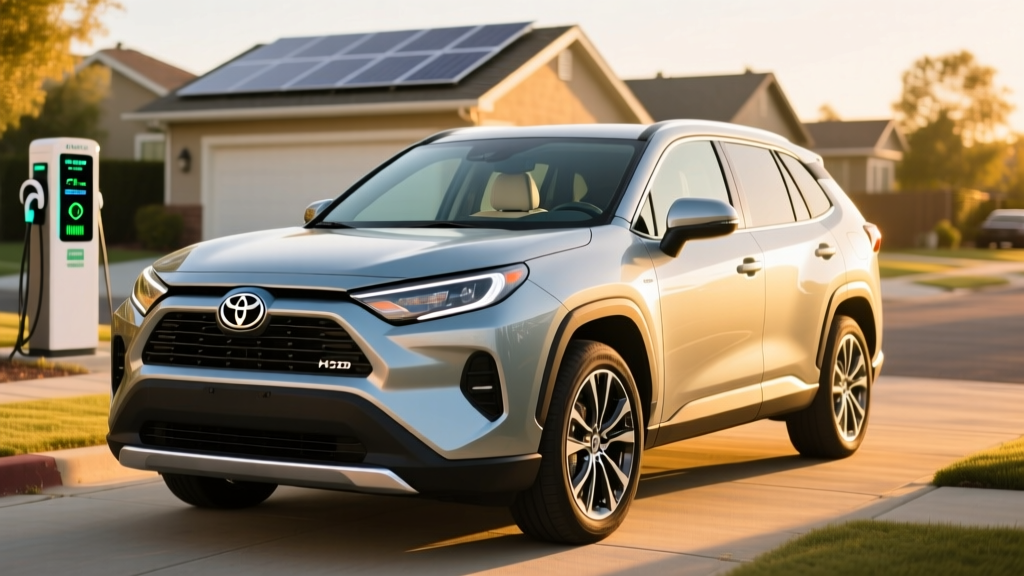
The Toyota RAV4 Prime — Toyota's nameplate for the plug in hybrid RAV4 — remains one of the most compelling vehicles in the compact SUV segment for buyers who want electric daily driving without committing to a full battery-electric vehicle. With 42 miles of EPA-rated electric-only range, a combined 302 horsepower, and the ability to road-trip on gasoline with no range anxiety, it threads a needle that few competitors can match.
But at a starting MSRP around $44,500 for the 2026 model year, it commands a significant premium over the conventional RAV4 Hybrid. This guide breaks down the real numbers — efficiency, charging, ownership costs, and tax credit eligibility — so you can decide whether the plug in hybrid RAV4 earns that premium in your driveway.
HEV vs PHEV: Which RAV4 Hybrid Is Which?
Toyota sells two electrified RAV4 variants, and the distinction matters for your wallet and your charging habits:
| Attribute | RAV4 Hybrid (HEV) | RAV4 Prime (PHEV) |
|---|---|---|
| Plug-in charging required? | No — self-charging via regen & engine | Yes — plug in to unlock EV range |
| Battery capacity | 1.6 kWh (NiMH) | 18.1 kWh (lithium-ion) |
| Electric-only range | ~1 mile at low speed | 42 miles (EPA) |
| Combined horsepower | 219 hp | 302 hp |
| EPA combined fuel economy | 39 MPG | 94 MPGe (electric+gas) / 38 MPG (gas only) |
| 0–60 mph | 7.4 seconds | 5.7 seconds |
| Starting MSRP (2026) | ~$33,500 | ~$44,500 |
| Federal tax credit | Not eligible | Up to $7,500 (eligibility varies) |
The conventional HEV never plugs in. Its small battery recharges through regenerative braking and the gasoline engine. You simply fill up at a gas station and drive. The PHEV (RAV4 Prime) has a much larger battery that you charge from a wall outlet or charging station, giving you a meaningful electric-only commute before the gas engine kicks in.
Fuel Economy & Electric Range: The Real Numbers
According to fueleconomy.gov, the 2026 RAV4 Prime delivers:
| Mode | City | Highway | Combined |
|---|---|---|---|
| Electric + Gas (MPGe) | 94 MPGe | 84 MPGe | 94 MPGe |
| Gasoline Only (MPG) | 40 MPG | 36 MPG | 38 MPG |
Electric-only range: 42 miles EPA. In real-world testing, expect 35–40 miles in mixed driving, dropping to roughly 30–33 miles in sustained highway driving at 70+ mph or in temperatures below 35°F. Cold weather reduces lithium-ion efficiency and forces the climate system to draw more from the pack.
Total combined range: Approximately 520–540 miles when combining a full charge plus the 14.5-gallon fuel tank.
Real-world MPG vs EPA: Toyota hybrids tend to meet or slightly exceed EPA city ratings thanks to aggressive regenerative braking in stop-and-go traffic. On the highway, where the engine runs more continuously, expect 34–36 MPG in gas-only mode — a few ticks below the 36 MPG sticker. Owners who charge nightly and commute under 40 miles round-trip report using gasoline only on weekend trips.
Powertrain & Performance
| Specification | Value |
|---|---|
| Engine | 2.5L inline-4 Atkinson cycle |
| Engine output | 177 hp / 165 lb-ft torque |
| Front electric motor | 134 kW (180 hp) |
| Rear electric motor | 40 kW (54 hp) |
| Combined system output | 302 hp |
| Drivetrain | AWD (electronic on-demand rear axle) |
| 0–60 mph | 5.7 seconds |
| Battery chemistry | Lithium-ion (NMC) |
| Battery capacity (usable) | 18.1 kWh |
| Towing capacity | 1,500 lbs (not rated for heavy towing) |
The 5.7-second 0–60 time makes the RAV4 Prime the quickest RAV4 variant by a wide margin — and one of the quickest compact SUVs in its price range. The electronic AWD system provides confident traction without a mechanical driveshaft to the rear wheels, reducing weight and drivetrain losses.
Charging: What You Need to Know
The RAV4 Prime uses a standard J1772 connector for AC charging. Here is the critical limitation every buyer must understand:
| Charging Level | Power (kW) | Time to Full Charge | Notes |
|---|---|---|---|
| Level 1 (120V household outlet) | ~1.4 kW | ~12 hours | Works but slow; fine for overnight if commute is short |
| Level 2 (240V, 16A) | ~3.3 kW | ~5.5 hours | Standard on SE trim |
| Level 2 (240V, 32A) | ~6.6 kW | ~2.5 hours | Available on XSE with upgraded onboard charger |
| DC Fast Charging | N/A | N/A | Not supported — no DC fast-charge port |
No DC fast charging. This is the RAV4 Prime's biggest charging limitation. Unlike some competitors (the Hyundai Tucson PHEV, for example, offers limited DC capability), the RAV4 Prime charges exclusively via AC. For most PHEV owners who charge at home overnight, this is a minor issue. But if you were hoping to top up at a highway DC fast charger during a road trip, that option does not exist here.
Home charging setup: A standard 120V outlet will replenish the battery overnight for shorter commutes. For the full 42-mile range each morning, a Level 2 home charger (240V) is strongly recommended. Installation of a Level 2 circuit typically costs $500–$1,500 depending on panel proximity, according to industry estimates.
Pricing, Trims & Tax Credit Eligibility
The 2026 RAV4 Prime is offered in two main trims:
- SE: ~$44,500 MSRP (3.3 kW onboard charger, cloth seats, 18-inch wheels)
- XSE: ~$48,500 MSRP (6.6 kW charger option available, SofTex seats, panoramic roof available, 19-inch wheels)
Federal tax credit (§30D): The RAV4 Prime may qualify for up to $7,500 in federal tax credits, but eligibility depends on several factors that change periodically. Under current IRS rules:
- MSRP cap: SUVs must have an MSRP at or below $80,000 — the RAV4 Prime clears this easily.
- Buyer income cap: Modified adjusted gross income must not exceed $150,000 (single) / $300,000 (joint).
- Battery sourcing requirements: Critical minerals and battery components must meet phased-in sourcing thresholds. Toyota's supply chain has been adjusting to these rules — verify current eligibility at irs.gov or through the dealer's point-of-sale verification system before purchase.
- Point-of-sale transfer: Eligible buyers can now transfer the credit to the dealer at purchase, reducing the purchase price directly rather than waiting for a tax refund.
Important caveat: Battery sourcing requirements have tightened progressively since 2024. Some model years and build dates of the RAV4 Prime have qualified for the full $7,500, while others have qualified for $3,750 or none at all depending on when they were placed in service. Always confirm with your dealer and consult a tax professional for your specific situation.
Battery Warranty, Reliability & Replacement Cost
Reliability: Toyota's hybrid powertrains have an extensive track record spanning over two decades (since the original Prius). The RAV4 Prime's lithium-ion pack is larger and more complex than the conventional hybrid's NiMH battery, but Toyota has engineered conservative charge buffers — you never use 100% of the pack, which reduces degradation stress. According to IIHS, the RAV4 Prime continues to earn top safety ratings, and Toyota's hybrid systems consistently rank at or near the top of long-term reliability surveys.
Battery replacement cost: If the hybrid battery fails outside warranty coverage, expect a replacement cost in the range of $5,000–$8,000 (parts and labor) based on current Toyota dealer pricing and third-party hybrid specialists. However, Toyota's hybrid batteries rarely require full replacement — individual module replacement is sometimes possible at lower cost. Most RAV4 Hybrid and Prime batteries outlast the 150,000-mile warranty period with minimal capacity loss.
Maintenance advantage: The RAV4 Prime requires no oil changes more frequently than a standard gas car (Toyota recommends every 10,000 miles), and regenerative braking significantly extends brake pad life. Many owners report original brake pads at 80,000+ miles.
Who Should Buy the Plug In Hybrid RAV4?
Choose the RAV4 Prime (PHEV) if:
- Your daily round-trip commute is under 40 miles and you can charge at home
- You want to drive electric most days but take road trips without planning charging stops
- You live in an area with limited public charging infrastructure
- You want the quickest RAV4 variant (5.7s 0–60) with AWD
- You qualify for the federal tax credit, narrowing the price gap with the HEV
Choose the RAV4 Hybrid (HEV) if:
- You cannot install a home charger (apartment, street parking, no garage)
- Your budget is closer to $35,000 and you don't qualify for tax credits
- You want excellent fuel economy (39 MPG combined) with zero behavior change
- You drive mostly highway miles where PHEV electric range offers less benefit
Choose a Full EV (e.g., Tesla Model Y, Hyundai Ioniq 5) if:
- You want zero gasoline use and have reliable home + destination charging
- Your daily driving exceeds 40 miles but stays under 250 miles
- You want minimal maintenance (no engine oil, spark plugs, or exhaust system)
- Lower per-mile "fuel" cost is your top priority (electricity at $0.14/kWh ≈ $0.04/mile vs. gas at $3.50/gal ≈ $0.12/mile)
Pros & Cons at a Glance
Pros
- 42-mile EV range covers most commutes gas-free
- 302 hp / 5.7s 0–60 — genuinely quick for a compact SUV
- 520+ mile total range eliminates road-trip range anxiety
- 10-year / 150,000-mile hybrid battery warranty
- Strong Toyota reliability and resale value
- Eligible for up to $7,500 federal credit (verify sourcing)
- Standard AWD
Cons
- No DC fast charging — AC only
- ~$11,000 premium over the RAV4 Hybrid HEV
- 5.5-hour Level 2 charge time (3.3 kW trim) is slow for PHEV
- Cargo space slightly reduced vs. gas RAV4 (battery under floor)
- EV range drops to ~30 miles in cold weather
- Tax credit eligibility depends on battery sourcing — not guaranteed
- 1,500-lb towing limit is low for the segment
Frequently Asked Questions
How many MPG does the plug in hybrid RAV4 get?
The RAV4 Prime gets 94 MPGe combined when using both its electric charge and gasoline engine. Once the battery is depleted and it operates as a conventional hybrid, it returns 38 MPG combined (40 city / 36 highway). In real-world city driving with regular charging, many owners report using very little gasoline at all.
How far can the RAV4 Prime go on electric only?
The EPA rates it at 42 miles of electric-only range. Real-world results typically fall between 35–41 miles in moderate temperatures, dropping to 30–33 miles in cold weather or sustained highway driving. This covers the majority of American daily commutes (the U.S. average is roughly 37 miles round-trip).
Does the RAV4 Prime qualify for a tax credit?
It may qualify for up to $7,500 under the IRS §30D clean vehicle credit, subject to buyer income limits ($150K single / $300K joint), the $80K SUV MSRP cap, and battery component/critical mineral sourcing requirements that change periodically. The credit can be transferred to the dealer at point of sale. Always verify current eligibility on irs.gov before purchasing.
Is the RAV4 Prime reliable, and what does a battery replacement cost?
Toyota's hybrid systems are among the most proven in the industry. The RAV4 Prime's lithium-ion battery is covered for 10 years / 150,000 miles. Out-of-warranty replacement costs roughly $5,000–$8,000, but full battery failures are rare — Toyota's hybrid batteries routinely exceed their warranty mileage with minimal capacity degradation.
Can I charge the RAV4 Prime at a DC fast charger?
No. The RAV4 Prime only supports AC charging (Level 1 at 120V or Level 2 at 240V). It does not have a DC fast-charge port. A full charge on a standard Level 2 home charger takes approximately 2.5 hours (with the 6.6 kW onboard charger) or 5.5 hours (with the 3.3 kW charger).
What's the difference between kW and kWh on the RAV4 Prime?
kWh (kilowatt-hours) measures energy stored — the RAV4 Prime's battery holds 18.1 kWh, which determines how far you can drive on electricity. kW (kilowatts) measures power flow rate — the onboard charger's kW rating (3.3 or 6.6 kW) determines how quickly the battery refills. Think of kWh as the size of the fuel tank and kW as the speed of the gas pump.
Should I get the RAV4 Prime or a full electric vehicle?
If you have home charging, a commute under 40 miles, and occasionally drive long distances to areas with sparse charging infrastructure, the RAV4 Prime gives you electric daily driving with gasoline backup. If your driving is predictable, you have reliable charging access, and you want zero gasoline expenses and minimal maintenance, a full EV like the Tesla Model Y or Hyundai Ioniq 5 may be a better long-term fit.