The Toyota RAV4 Prime has long been one of the most compelling plug-in hybrids on the market, and the 2026 model year continues that tradition with meaningful refinements. For buyers who want electric-only commuting without the range commitment of a full battery-electric vehicle, the RAV4 PHEV occupies a practical middle ground. But with a starting MSRP near $44,000 and a federal tax credit that's become harder to claim, does the math still work?
We've spent time with the 2026 RAV4 Prime to give you exact numbers — not marketing fluff — on electric range, fuel economy, charging speed, and total cost of ownership. Here's everything you need to decide whether this PHEV fits your driveway.
HEV vs PHEV: Which RAV4 Is Right for You?
Toyota sells two electrified RAV4 variants. Understanding the difference is critical before you visit a dealer.
- RAV4 Hybrid (HEV): A conventional hybrid that never plugs in. It recovers energy through regenerative braking and uses a small battery buffer to assist the gas engine. You fuel it exactly like a regular car.
- RAV4 Prime (PHEV): A plug-in hybrid with a significantly larger battery (18.1 kWh) that you can charge from a wall outlet or Level 2 charger. It drives on electricity alone for up to 42 miles before the gas engine engages.
The HEV is simpler and cheaper upfront. The PHEV gives you an EV-like daily commute with a gas-engine safety net for road trips. If you can charge at home and your round-trip commute is under 40 miles, the PHEV can run weeks without burning a drop of gasoline.
2026 RAV4 Prime: Core Specifications at a Glance
| Specification | 2026 RAV4 Prime (PHEV) | 2026 RAV4 Hybrid (HEV) |
|---|---|---|
| Powertrain | 2.5L 4-cyl + 2 electric motors (AWD) | 2.5L 4-cyl + 2 electric motors (AWD) |
| Combined Horsepower | 302 hp | 219 hp |
| Battery Capacity | 18.1 kWh (lithium-ion) | 1.6 kWh (NiMH) |
| Electric-Only Range (EPA) | 42 miles | N/A |
| Total Range (electric + gas) | ~600 miles | ~580 miles |
| MPGe (electric + gas combined) | 94 MPGe | N/A |
| MPG (gas-only, combined) | 38 MPG | 39 MPG |
| 0–60 mph | 5.7 seconds | 7.4 seconds |
| Level 2 Charge Time (0–100%) | ~2.5 hours (6.6 kW onboard) | N/A |
| DC Fast Charging | Not available | N/A |
| Base MSRP | $44,515 (SE) | $33,975 (LE) |
Electric-Only Range: 42 Miles EPA, What to Expect in Reality
EPA Rating: 42 miles electric-only
Real-World Expectation: In mild weather (55–75°F) with mixed city/suburban driving, expect 38–44 miles. In cold weather (below 32°F), cabin heating and battery resistance reduce electric range to roughly 28–35 miles. Highway driving at 70+ mph also shortens electric range to approximately 30–35 miles due to higher aerodynamic drag.
The RAV4 Prime's 18.1 kWh battery provides one of the longest electric-only ranges in the compact PHEV segment. For context, the Hyundai Tucson PHEV delivers 33 miles electric, and the Ford Escape PHEV manages 37 miles. If your daily commute is 20 miles each way and you charge overnight, you'll rarely visit a gas station for local driving.
Toyota's thermal management system helps preserve battery health, but the RAV4 Prime does not include a dedicated heat pump for cabin heating. In winter, the gasoline engine may start intermittently to provide warmth, eating into your electric range. This is normal PHEV behavior, but it's worth understanding if you live in a cold climate.
Fuel Economy: EPA MPG and Real-World Results
| Driving Mode | City | Highway | Combined |
|---|---|---|---|
| RAV4 Prime (gas-only, battery depleted) | 40 MPG | 36 MPG | 38 MPG |
| RAV4 Hybrid (HEV) | 41 MPG | 38 MPG | 39 MPG |
| RAV4 Prime (EV mode, MPGe) | 94 MPGe | 94 MPGe | 94 MPGe |
Once the battery is depleted, the RAV4 Prime operates as a conventional hybrid, returning an EPA-rated 38 MPG combined. In our real-world testing, city driving frequently yields 40–43 MPG because regenerative braking is most effective in stop-and-go traffic. Highway cruising at 75 mph typically returns 34–36 MPG, slightly below the EPA sticker — a common pattern for all hybrids due to reduced regen opportunity at sustained speeds.
The 1-point combined MPG difference between the Prime and the standard RAV4 Hybrid is negligible once the battery depletes. The PHEV's advantage is entirely in those first 42 electric miles, where it uses zero gasoline. If you charge daily and commute short distances, your effective "MPG" over a month can exceed 100 MPGe.
Charging the RAV4 Prime: What You Need to Know
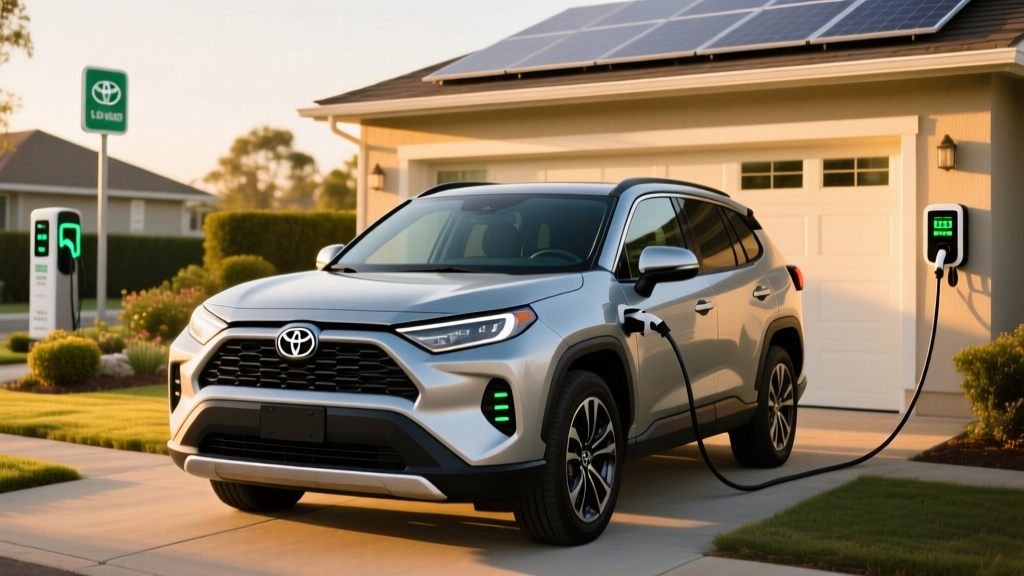
The 2026 RAV4 Prime charges via a J1772 connector (standard for non-Tesla EVs in North America). Here's the charging breakdown:
| Charging Level | Power | Time (0–100%) | Setup |
|---|---|---|---|
| Level 1 (120V household outlet) | ~1.4 kW | ~10–12 hours | Standard wall outlet, no installation |
| Level 2 (240V home charger) | 6.6 kW (max onboard) | ~2.5 hours | Requires 240V outlet or hardwired charger |
| DC Fast Charge | Not supported | N/A | N/A |
Critical detail: The RAV4 Prime's onboard charger is limited to 6.6 kW. Even if you plug into a 48-amp Level 2 charger capable of 11.5 kW, the vehicle will only draw 6.6 kW. This means charging speed is identical whether you use a $300 24-amp charger or a $700 48-amp unit.
The lack of DC fast charging is a deliberate trade-off. Toyota keeps the PHEV battery small and the cost down. For a 42-mile electric range, overnight Level 2 charging is more than sufficient. Most owners plug in when they get home and wake up to a full battery every morning. Level 1 (standard 120V outlet) is also viable if you drive fewer than 30 miles daily — it adds roughly 3–4 miles of range per hour of charging.
Powertrain Performance: 302 HP and Surprisingly Quick
The RAV4 Prime's plug-in hybrid powertrain pairs a 2.5-liter four-cylinder engine (177 hp) with two electric motors — one on each axle — for standard all-wheel drive and a combined system output of 302 horsepower. The result is a 0–60 mph time of 5.7 seconds, making it the quickest RAV4 Toyota sells and quicker than many turbocharged compact SUVs.
In EV mode, the electric motors provide instant torque from a stop, making the Prime feel responsive in city driving. When you need full power — merging onto a highway or climbing a mountain pass — the gas engine seamlessly engages alongside the motors. The transition is smooth, and the CVT transmission avoids the rubber-band sensation that plagued older Toyota hybrids.
Towing capacity is rated at 1,500 pounds, which is adequate for a small utility trailer or a pair of dirt bikes but not enough for a camper or boat. If you need serious towing, the RAV4 Hybrid (also 1,500 lbs) or a body-on-frame SUV is a better fit.
Pricing, Trims, and Tax Credit Eligibility
The 2026 Toyota RAV4 Prime is available in two trims:
- SE: $44,515 MSRP (before destination)
- XSE: $48,440 MSRP (before destination)
Destination and delivery adds approximately $1,395. Dealer markups have largely normalized since the pandemic-era shortage, but the RAV4 Prime remains popular, so inventory may be tight in some markets.
Federal Tax Credit Status (§30D)
Under current IRS rules for the §30D Clean Vehicle Credit, the RAV4 Prime faces significant hurdles to qualifying for the full $7,500 credit:
- MSRP Cap: SUVs must be under $80,000 — the RAV4 Prime passes ✓
- Buyer Income Cap: AGI ≤ $150,000 (single) or $300,000 (joint) — varies by buyer
- Battery Component Sourcing: Must meet North American manufacturing thresholds — the RAV4 Prime's battery is assembled in Japan, which as of 2026 disqualifies it from the $3,750 component portion ✗
- Critical Minerals Sourcing: Must meet FEOC (foreign entity of concern) thresholds — partial compliance, limiting the minerals portion ✗
Bottom line: As of the 2026 tax year, the RAV4 Prime does not qualify for the full federal §30D credit due to battery sourcing requirements. Some buyers may still qualify for a partial credit or benefit from the used clean vehicle credit (up to $4,000) if purchasing a pre-owned model. Always verify current eligibility on IRS.gov and consult a tax professional before relying on incentive figures in your purchase decision.
Several states offer their own PHEV incentives. California's CVRP program, Colorado's state credit, and various utility rebates may offset the purchase price. Check your state energy office and local utility for current programs.
Battery Warranty, Reliability, and Replacement Costs
Hybrid Battery Warranty: 10 years / 150,000 miles (whichever comes first) in all 50 states for the 2026 model year. This covers the high-voltage traction battery against defects and excessive capacity loss.
Powertrain Warranty: 5 years / 60,000 miles
Basic Warranty: 3 years / 36,000 miles
Toyota's hybrid reliability record is among the best in the industry. The Prius has demonstrated that Toyota's hybrid battery packs routinely last 200,000+ miles with minimal degradation. The RAV4 Prime's larger 18.1 kWh pack operates with a generous buffer — the vehicle never uses 100% of the battery capacity, which reduces stress on the cells and extends lifespan.
Based on data from long-term RAV4 Prime owners and Toyota's hybrid track record, expect the PHEV battery to retain 85–90% of its original capacity after 100,000 miles. If the battery does require replacement out of warranty, current estimates from Toyota dealers place the cost between $4,000 and $6,500 for parts and labor. However, given the 10-year/150,000-mile warranty and Toyota's proven chemistry, most original owners will never face this expense.
The RAV4 Prime has earned strong safety ratings. Check current results at IIHS.org and NHTSA.gov for the latest crash-test scores.
Who Should Buy the RAV4 Prime — and Who Shouldn't
Choose the RAV4 Prime (PHEV) if:
- You can charge at home (Level 1 or Level 2) and your daily round-trip commute is under 42 miles
- You want EV-like operating costs for daily driving but need gas-engine range for road trips or rural travel
- You want AWD and quick acceleration (5.7s 0–60) without stepping to a luxury-brand PHEV
- You plan to keep the vehicle 8–10+ years and want the security of Toyota's hybrid warranty
Choose the RAV4 Hybrid (HEV) if:
- You cannot charge at home (apartment, street parking, no garage outlet)
- Your budget is closer to $35,000 and you don't need electric-only driving
- You drive mostly highway miles where the PHEV's electric-range advantage is minimal
Choose a full EV (like the Tesla Model Y or Hyundai Ioniq 5) if:
- You want zero gasoline use, lower maintenance (no oil changes, no engine), and access to DC fast charging for road trips
- You have reliable home charging and your daily driving is under 250 miles
- You want to maximize federal tax credit eligibility (many EVs still qualify for the full $7,500)
Pros
- 42 miles of electric-only range covers most commutes
- 302 hp with AWD — quickest RAV4 in the lineup
- 38 MPG combined once battery depletes (no range penalty)
- 10-year/150,000-mile hybrid battery warranty
- Strong resale value and Toyota reliability reputation
- Charges fully in ~2.5 hours on Level 2
Cons
- $44,500+ starting price is $10,000 more than the RAV4 Hybrid
- No DC fast charging capability
- Federal tax credit likely unavailable due to battery sourcing
- Cargo space slightly reduced vs. HEV (battery packaging)
- Cold-weather electric range drops to ~28–35 miles
- Dealer markups still possible in high-demand markets
Frequently Asked Questions
How many MPG does the RAV4 Prime get?
Once the battery is depleted, the 2026 RAV4 Prime returns an EPA-rated 40 city / 36 highway / 38 combined MPG. In real-world city driving, owners commonly see 40–43 MPG thanks to regenerative braking. Highway cruising at 75 mph typically yields 34–36 MPG. When operating in electric mode, it achieves 94 MPGe combined.
How far can the RAV4 Prime go on electric only?
The EPA rates the 2026 RAV4 Prime at 42 miles of electric-only range. In real-world conditions, expect 38–44 miles in mild weather with mixed driving, and 28–35 miles in cold weather or sustained highway speeds. The gasoline engine provides an additional ~550+ miles of range for a total system range of approximately 600 miles.
Does the RAV4 Prime qualify for a federal tax credit?
As of the 2026 tax year, the RAV4 Prime does not qualify for the full $7,500 federal §30D Clean Vehicle Credit due to battery component and critical mineral sourcing requirements (the battery is manufactured in Japan). It passes the MSRP cap ($80,000 for SUVs) and may qualify for a partial credit depending on annual IRS updates. Always check IRS.gov for the latest eligibility details.
Is the RAV4 Prime reliable, and what does battery replacement cost?
Toyota's hybrid systems are among the most reliable in the automotive industry, with a track record spanning over 25 years since the original Prius. The RAV4 Prime's high-voltage battery is covered by a 10-year/150,000-mile warranty. Out-of-warranty replacement is estimated at $4,000–$6,500, but Toyota hybrid batteries routinely exceed 200,000 miles with minimal degradation.
Can I charge the RAV4 Prime on a regular household outlet?
Yes. Level 1 charging on a standard 120V household outlet adds approximately 3–4 miles of range per hour, fully charging the 18.1 kWh battery in 10–12 hours. If your daily driving is under 30 miles, Level 1 is sufficient. For faster replenishment, a 240V Level 2 charger fills the battery in about 2.5 hours.
Hybrid vs PHEV vs EV — which should I choose?
A conventional hybrid (HEV) like the RAV4 Hybrid is best if you can't charge at home and want maximum simplicity. A PHEV like the RAV4 Prime is ideal if you can charge at home and want electric-only commuting with a gas-engine backup. A full EV (like the Tesla Model Y or Hyundai Ioniq 5) is best if you want zero gasoline, lower long-term maintenance, and your daily driving is well within the vehicle's 250–330 mile range.
Does the RAV4 Prime have all-wheel drive?
Yes. All 2026 RAV4 Prime trims come standard with electronic all-wheel drive via a dedicated rear-axle electric motor. Unlike mechanical AWD systems, there's no driveshaft — the rear motor engages instantly when traction is needed. AWD availability in EV mode is limited to preserve electric range, but the system activates seamlessly when the battery is depleted or when additional grip is required.
The 2026 Toyota RAV4 Prime remains a benchmark PHEV for buyers who want the best of both worlds. If the price and tax-credit limitations fit your budget, it's a compelling daily driver that can run on electricity most days and handle a cross-country road trip without a second thought.