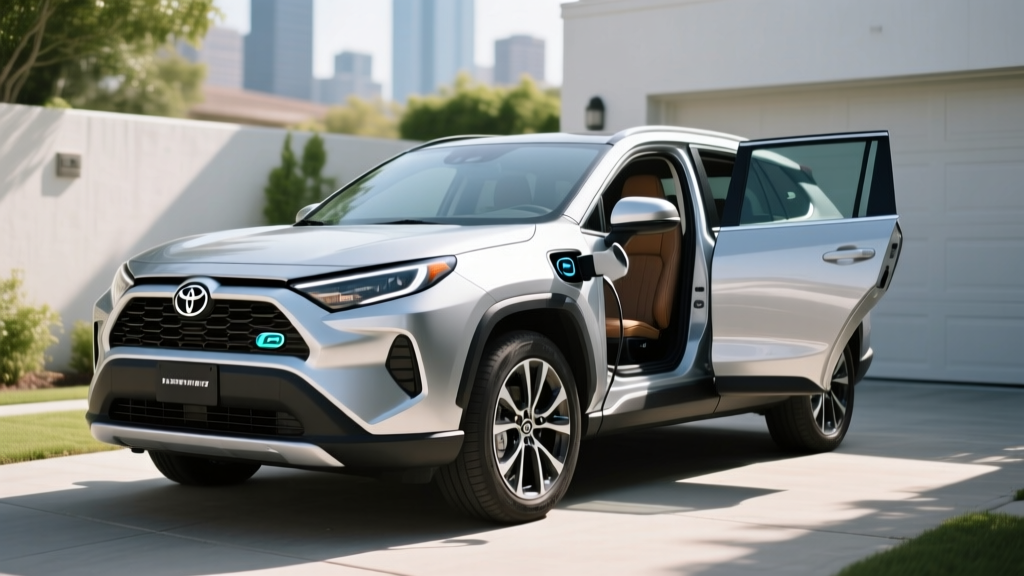
The Toyota RAV4 Prime — Toyota's name for the RAV4 plug-in hybrid — occupies a rare sweet spot in the electrified-vehicle market. It pairs a usable electric-only commute range with a gasoline engine that eliminates range anxiety on road trips, all wrapped in the best-selling non-truck nameplate in America. For 2026, the RAV4 Prime continues with the proven 302-horsepower powertrain, an 18.1 kWh battery, and 42 miles of EPA-rated electric range. But does it make financial sense versus the conventional RAV4 Hybrid, a full battery-electric vehicle (BEV), or a competing PHEV? This guide answers that question with hard numbers.
HEV vs. PHEV: What's the Difference on the RAV4?
Toyota sells two electrified RAV4 variants, and the distinction matters for your wallet and your daily routine.
| Attribute | RAV4 Hybrid (HEV) | RAV4 Prime (PHEV) |
|---|---|---|
| Plugs in? | No — self-charging via regen & engine | Yes — 18.1 kWh battery, Level 1 & Level 2 |
| Electric-only range | ~1 mile at very low speed | 42 miles (EPA) |
| Combined horsepower | 219 hp | 302 hp |
| EPA combined MPG (gas mode) | 41 MPG | 38 MPG |
| MPGe (electric + gas) | N/A | 94 MPGe |
| 0–60 mph | 7.4 sec | 5.7 sec |
| Starting MSRP | ~$33,575 | ~$44,615 |
| Federal tax credit (§30D) | Not eligible | Up to $7,500 (eligibility varies) |
The conventional RAV4 Hybrid (HEV) never plugs in. Its small 1.6 kWh battery recharges through regenerative braking and the gasoline engine. You drive it exactly like a gas car — just fill up and go — and it rewards you with excellent city fuel economy.
The RAV4 Prime (PHEV) carries a much larger 18.1 kWh lithium-ion battery that you charge by plugging in. That battery enables 42 miles of pure electric driving — enough for most commutes — before the 2.5-liter four-cylinder engine seamlessly takes over as a conventional hybrid.
Electric-Only Range and Total Range
EPA electric-only range: 42 miles
Real-world expectation: 35–40 miles in mixed driving; 30–35 miles in cold weather or sustained highway speeds above 70 mph.
Total range (electric + gas): Approximately 600 miles on a full charge plus a full 14.5-gallon tank.
The 42-mile EPA figure is achievable in moderate temperatures at city and suburban speeds. Toyota's regenerative braking system is well-tuned, so stop-and-go traffic actually helps preserve range. However, battery chemistry and cabin heating demands cut into that figure in winter — expect a 15–25% reduction when temperatures drop below freezing.
Once the battery depletes to its buffer threshold (the car never fully drains it, protecting long-term battery health), the RAV4 Prime operates as a conventional hybrid. The gasoline engine and motor-generators work together, delivering an EPA-rated 38 MPG combined in charge-sustaining (hybrid) mode.
Fuel Economy: EPA MPG and Real-World Numbers
| Mode | City | Highway | Combined |
|---|---|---|---|
| Electric + Gas (MPGe) | — | — | 94 MPGe |
| Gas-only hybrid mode (MPG) | 40 MPG | 36 MPG | 38 MPG |
Source: EPA Fuel Economy
Real-world MPG reality check: Like most hybrids, the RAV4 Prime tends to beat its EPA highway estimate in city driving, where regenerative braking recaptures energy at every stop. Owners who charge nightly and commute within 42 miles may go weeks without visiting a gas station. In our experience, drivers who keep the battery charged average an effective 70–100+ MPGe over a typical month of mixed commuting and errands. On a long road trip running purely on gasoline, expect 35–38 MPG at 70–75 mph — slightly below the EPA combined figure due to sustained highway speeds and aerodynamic drag.
Powertrain and Performance Specs
| Engine | 2.5L inline-4 Atkinson-cycle |
| Electric motors | Front motor (134 kW) + Rear motor (40 kW) |
| Combined system output | 302 hp |
| 0–60 mph | 5.7 seconds |
| Drivetrain | Electronic AWD (eAWD) |
| Battery capacity | 18.1 kWh (lithium-ion) |
| EV range (EPA) | 42 miles |
| Charge rate (Level 2) | 3.3 kW (standard) / 6.6 kW (available w/ Premium pkg) |
| DC fast charge | Not supported |
| Level 2 charge time (0–100%) | ~5.5 hrs (3.3 kW) / ~2.5 hrs (6.6 kW) |
| Level 1 charge time (120V) | ~12 hours |
| Cargo volume | 33.5 cu ft (rear seats up) |
| Towing capacity | 1,500 lbs |
The RAV4 Prime's 5.7-second 0–60 time makes it the quickest RAV4 Toyota has ever built — quicker than many turbocharged gas-only compact SUVs. The front electric motor delivers 134 kW (180 hp) on its own, which is what makes the electric-only driving feel genuinely peppy around town. The rear motor provides electronic all-wheel drive without a mechanical driveshaft, engaging instantly when traction is needed.
Charging the RAV4 Prime: What You Need to Know
The RAV4 Prime does not support DC fast charging. This is a deliberate engineering choice — the 18.1 kWh battery is small enough that Level 2 charging is practical for overnight replenishment.
| Level | Power | Time to Full | Notes |
|---|---|---|---|
| Level 1 (120V household) | ~1.4 kW | ~12 hours | Included cord; adequate for overnight |
| Level 2 (240V, 3.3 kW) | 3.3 kW | ~5.5 hours | Standard onboard charger |
| Level 2 (240V, 6.6 kW) | 6.6 kW | ~2.5 hours | Requires Premium package upgrade |
Practical charging advice: A standard 120V outlet will fully recharge the battery overnight for most owners. If you want faster top-ups — say, midday between errands — upgrading to a 240V Level 2 home charger is worthwhile, especially with the 6.6 kW onboard charger option. Home Level 2 installation typically costs $500–$1,500 for the charger unit and $800–$2,500 for electrician labor, depending on panel proximity and local permit requirements. Consult a licensed electrician for your specific setup.
Pricing, Trims, and Federal Tax Credit Eligibility
The 2026 RAV4 Prime starts around $44,615 (SE trim, including destination). The XSE trim with the Premium package — which adds the 6.6 kW charger, panoramic roof, and upgraded infotainment — pushes past $50,000.
Federal §30D Tax Credit — Eligibility Checklist for the RAV4 Prime:
- Vehicle MSRP cap: SUVs must be under $80,000 — the RAV4 Prime qualifies ✓
- Buyer income cap: AGI must not exceed $150,000 (single), $225,000 (head of household), or $300,000 (joint filers)
- Battery sourcing: Critical minerals and battery components must meet phased-in percentage thresholds from U.S. or FTA-partner countries — verify current-year compliance on IRS.gov
- Point-of-sale transfer: Eligible buyers can transfer the credit to the dealer at purchase, reducing the upfront price
- Assembly: Must be assembled in North America — the RAV4 Prime is built in Japan, which may affect eligibility depending on current-year rules
Critical caveat: The RAV4 Prime is assembled in Japan (Toyota's Tahara plant). Under current §30D rules, North American final assembly is required for the new clean vehicle credit. This has historically disqualified the RAV4 Prime from the full $7,500 federal credit. Always verify the latest eligibility list on fueleconomy.gov before purchasing, as trade agreements and rule updates can shift qualification status. Some buyers may qualify for the used EV tax credit (up to $4,000 or 30% of sale price) when purchasing a pre-owned RAV4 Prime, subject to income caps and a sale price under $25,000.
Battery Longevity, Warranty, and Replacement Cost
Hybrid battery warranty: 10 years / 150,000 miles (whichever comes first), covering defects and capacity loss below a defined threshold.
Powertrain warranty: 5 years / 60,000 miles.
Estimated out-of-warranty battery replacement: $4,000–$7,000 (parts + labor at a Toyota dealer), though many owners never need replacement.
Toyota's hybrid battery track record is among the best in the industry. The RAV4 Prime uses a lithium-ion pack (distinct from the NiMH in older Prius models), but Toyota's conservative battery management — maintaining a generous buffer at both the top and bottom of the state of charge — significantly reduces degradation. Data from earlier Toyota PHEVs (the first-gen RAV4 Prime and Prius Prime) shows typical capacity retention of 85–92% after 5 years and 80,000+ miles. For most owners, the battery will outlast their ownership of the vehicle.
Is the RAV4 Prime reliable? Toyota consistently ranks at or near the top of IIHS safety ratings and long-term reliability surveys from Consumer Reports and J.D. Power. The PHEV powertrain adds complexity (two electric motors, a larger battery, and a gas engine), but Toyota has been iterating on this hybrid synergy drive system for over 25 years. The main maintenance items remain routine: oil changes, brake fluid, cabin air filters, and tire rotations. Regenerative braking actually reduces brake pad wear — many owners report original brake pads at 80,000+ miles.
Who Should Buy the RAV4 Prime vs. a BEV or Gas Car?
Choose the RAV4 Prime (PHEV) if:
- Your daily commute is under 40 miles round-trip and you can charge at home
- You take road trips where charging infrastructure is sparse or unreliable
- You want EV-like daily driving without committing to full-electric range limitations
- You value the 302 hp performance bump and standard AWD
Choose the RAV4 Hybrid (HEV) if:
- You cannot charge at home (apartment, street parking, no garage outlet)
- You want the lowest purchase price and don't need electric-only mode
- Your driving is mostly longer trips where the PHEV's electric range adds little benefit
Choose a full BEV (e.g., Tesla Model Y, Hyundai Ioniq 5) if:
- You have reliable home Level 2 charging and want zero gasoline use
- You drive under 300 miles daily and want the lowest per-mile energy cost
- You want DC fast charging for road trips and access to the Supercharger or CCS network
The RAV4 Prime's ideal buyer has a garage with a 120V or 240V outlet, commutes 20–40 miles daily, and takes 3–5 road trips per year where a pure EV would require inconvenient charging stops. It's a bridge vehicle — not the cheapest option, not the greenest option, but the most flexible option for households that can't yet commit to a single-energy-source vehicle.
Pros
- 42 miles electric range covers most daily commutes
- 302 hp and 5.7-sec 0–60 — genuinely quick for a compact SUV
- Standard electronic AWD
- No range anxiety — 600+ miles total range
- 10-year / 150,000-mile hybrid battery warranty
- Proven Toyota reliability and strong resale value
Cons
- No DC fast charging capability
- $11,000+ premium over the RAV4 Hybrid
- Likely ineligible for the $7,500 federal §30D credit (Japan assembly)
- Cargo space slightly reduced vs. non-hybrid RAV4
- 3.3 kW base charger is slow; 6.6 kW requires Premium package
Frequently Asked Questions
How many MPG does the RAV4 plug-in hybrid get?
In hybrid (charge-sustaining) mode after the battery depletes, the RAV4 Prime earns an EPA-rated 40 city / 36 highway / 38 combined MPG. When factoring in electric-only driving, the combined rating is 94 MPGe. Real-world city MPG often exceeds the EPA estimate thanks to regenerative braking.
How far can the RAV4 Prime go on electric only?
The EPA rates the RAV4 Prime at 42 miles of electric-only range. In real-world conditions, expect 35–40 miles in moderate weather and 30–35 miles in freezing temperatures or sustained highway driving. The gasoline engine seamlessly starts once the battery reaches its buffer threshold.
Does the RAV4 Prime qualify for a federal tax credit?
Under current IRS §30D rules, the RAV4 Prime's Japan assembly has historically made it ineligible for the new clean vehicle credit, which requires North American final assembly. Always check the fueleconomy.gov eligible vehicle list before purchasing. A used RAV4 Prime may qualify for the up-to-$4,000 previously owned clean vehicle credit, subject to income and price caps.
Is the RAV4 Prime reliable and what does battery replacement cost?
Toyota's hybrid systems have a 25+ year track record. The RAV4 Prime's lithium-ion battery is covered by a 10-year / 150,000-mile warranty. Out-of-warranty replacement is estimated at $4,000–$7,000, but Toyota PHEV batteries historically show 85–92% capacity retention after 5 years, and most owners never require a replacement.
Can the RAV4 Prime DC fast charge?
No. The RAV4 Prime supports Level 1 (120V) and Level 2 (240V) AC charging only. A full charge takes approximately 12 hours on Level 1, 5.5 hours on a 3.3 kW Level 2, or 2.5 hours with the optional 6.6 kW onboard charger. For a PHEV with a small 18.1 kWh battery, overnight Level 1 or Level 2 charging is sufficient for daily use.
Hybrid vs. PHEV vs. EV — which is right for me?
If you can't charge at home, choose the conventional RAV4 Hybrid (HEV). If you can charge at home but take frequent long road trips, the RAV4 Prime (PHEV) offers the best of both worlds. If you have home charging and mostly drive under 300 miles per day, a full BEV like the Tesla Model Y or Hyundai Ioniq 5 delivers the lowest operating cost and smoothest driving experience.