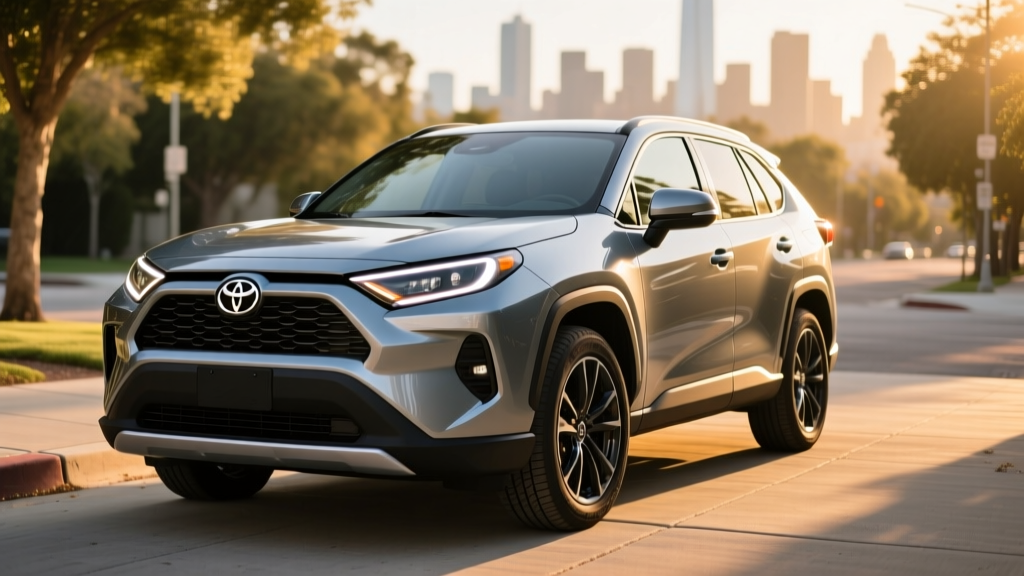
The Toyota RAV4 Hybrid has been America's best-selling hybrid SUV for years, and the XSE trim sits in a sweet spot: sport-tuned suspension, distinctive two-tone styling, and a tech-forward cabin without stepping all the way up to the Limited or Woodland Edition. For 2026, the RAV4 Hybrid XSE continues with the proven 2.5-liter four-cylinder hybrid powertrain, standard electronic all-wheel drive, and an EPA-estimated 39 MPG combined. If you're cross-shopping this against a full EV or a plug-in hybrid, this guide gives you the exact numbers you need to decide.
Quick Verdict: Who the RAV4 Hybrid XSE Is For
Buy the RAV4 Hybrid XSE if: You want a compact SUV that delivers 400+ miles of total range on a single tank, standard AWD, and proven reliability — without ever plugging in. It's ideal for apartment dwellers, road-trippers, and anyone in a charging desert who still wants electrified efficiency.
Look elsewhere if: You have reliable home charging and a short commute. The RAV4 Prime (PHEV) gives you 42 miles of electric-only range, or a full BEV like the Hyundai Ioniq 5 eliminates fuel stops entirely for daily driving.
HEV vs. PHEV: Understanding What You're Buying
Before we get into the specs, a critical distinction that trips up many buyers:
| Feature | RAV4 Hybrid (HEV) | RAV4 Prime (PHEV) |
|---|---|---|
| Plug-in required? | No — self-charging via engine + regen | Yes — 2.5 hours on Level 2 (240V) |
| Electric-only range | ~1 mile at low speed | 42 miles (EPA) |
| Total combined range | ~580 miles | ~600 miles (gas + electric) |
| Combined horsepower | 219 hp | 302 hp |
| Battery capacity | 1.6 kWh (NiMH) | 18.1 kWh (lithium-ion) |
| DC fast charging | Not applicable | Not available |
| Federal tax credit (§30D) | Not eligible | Not eligible (MSRP/battery sourcing) |
| Starting MSRP (2026) | ~$33,000 (LE) | ~$44,500 (SE) |
The RAV4 Hybrid XSE is a conventional hybrid (HEV). It never plugs in. The gasoline engine and regenerative braking keep a small battery charged, and the electric motor assists during acceleration and low-speed driving. You simply fill up at a gas station like any other car — you just visit far less often.
Fuel Economy: EPA Ratings vs. Real-World MPG
The EPA rates the 2026 RAV4 Hybrid (all trims with AWD, including the XSE) at 41 MPG city / 38 MPG highway / 39 MPG combined. Here's the full breakdown:
| Driving Scenario | EPA Estimate | Real-World Expectation |
|---|---|---|
| City | 41 MPG | 42–45 MPG (hybrids excel in stop-and-go) |
| Highway (70 mph) | 38 MPG | 34–37 MPG (aero drag reduces hybrid advantage) |
| Combined | 39 MPG | 37–41 MPG depending on driving mix |
| Cold weather (below 30°F) | — | 33–36 MPG (engine runs more for cabin heat) |
Why real-world often beats EPA in the city: Hybrid systems recover energy through regenerative braking every time you slow down. In stop-and-go traffic, the electric motor handles more of the workload, and the engine shuts off at stops. On the highway, the gas engine does most of the work, and the hybrid advantage narrows.
With a 14.5-gallon fuel tank, expect roughly 540–580 miles of total range in mixed driving. On a pure highway road trip in summer, that number can dip to around 500 miles. In city-heavy commuting, owners regularly report exceeding 600 miles between fill-ups.
Source: EPA Fuel Economy — Toyota RAV4 Hybrid AWD
Powertrain & Performance Specs
| Specification | 2026 RAV4 Hybrid XSE |
|---|---|
| Engine | 2.5L Dynamic Force 4-cylinder |
| Engine output | 176 hp / 163 lb-ft torque |
| Front electric motor | 118 hp / 149 lb-ft |
| Rear electric motor (AWD) | 54 hp / 89 lb-ft |
| Net combined horsepower | 219 hp |
| 0–60 mph | 7.4 seconds |
| Drivetrain | Electronic AWD (eAWD) |
| Transmission | eCVT (planetary gearset) |
| Hybrid battery | 1.6 kWh Nickel-Metal Hydride (NiMH) |
| Towing capacity | 1,750 lbs |
| Cargo volume (rear seats up) | 37.5 cu ft |
| Cargo volume (rear seats folded) | 69.8 cu ft |
The XSE trim adds a sport-tuned suspension with stiffer damping compared to the LE, XLE, and XLE Premium trims. The difference is subtle — it firms up the ride and reduces body roll in corners — but it gives the XSE a more planted feel on winding roads. You trade a small amount of low-speed ride comfort for that composure.
The eAWD system uses a dedicated rear electric motor (no mechanical driveshaft) to send up to 50% of torque to the rear wheels when needed. It's not a rock-crawling system, but it handles snow, rain, and light trail use with confidence. The rear motor activates automatically during acceleration, cornering, and low-traction situations.
Pricing, Trims & Tax Credit Eligibility
The 2026 RAV4 Hybrid XSE starts at approximately $36,250 MSRP (including destination). Adding popular options like the Premium package (panoramic glass roof, heated/ventilated front seats, SofTex-trimmed seats) pushes the price toward $39,000–$40,000.
Federal tax credit: The RAV4 Hybrid (HEV) does not qualify for the IRS §30D Clean Vehicle Credit. That credit applies only to plug-in electric vehicles (BEVs and PHEVs) with sufficient battery capacity and compliant battery sourcing. Conventional hybrids are excluded regardless of price or income.
What about the RAV4 Prime (PHEV)? Under current 2026 IRS rules, the RAV4 Prime has faced eligibility challenges due to battery component and critical mineral sourcing requirements under §30D. Always verify current eligibility on the IRS qualified vehicles list before purchasing, as sourcing compliance can change mid-year.
Some states offer separate hybrid or clean-fuel rebates (California's CVRP, for example, has historically focused on ZEVs). Check your state energy office or Alternative Fuels Data Center for local incentives.
Battery Warranty, Reliability & Replacement Cost
Hybrid Battery Warranty: Toyota covers the RAV4 Hybrid's battery with a 10-year / 150,000-mile warranty (whichever comes first) in all 50 states. This covers defects and capacity loss below a defined threshold.
Hybrid System Warranty: The inverter, electric motors, and related hybrid components are covered for 8 years / 100,000 miles.
How long do RAV4 Hybrid batteries actually last? Toyota's NiMH hybrid batteries have an exceptional track record. Data from fleet operators and owner surveys show most RAV4 Hybrid batteries last 150,000–200,000+ miles with minimal degradation. The NiMH chemistry is less energy-dense than lithium-ion but is extremely durable and tolerant of daily charge cycling. Unlike full EVs, the hybrid system only uses a narrow band of the battery's capacity (roughly 40–80% state of charge), which dramatically extends cycle life.
Battery replacement cost: If the hybrid battery does fail outside warranty, a refurbished/remanufactured NiMH module replacement typically runs $2,000–$3,500 installed at an independent hybrid specialist. A brand-new OEM battery from Toyota can cost $4,000–$5,500 installed. For context, this is a fraction of what a full EV battery replacement costs, and most owners never face this expense.
The RAV4 Hybrid consistently earns top reliability marks from Consumer Reports and has been an IIHS Top Safety Pick. The powertrain's simplicity — no turbocharger, no traditional transmission with clutch packs, no starter motor — means fewer failure points than a conventional gas-only SUV.
Source: IIHS — 2026 Toyota RAV4 Safety Ratings
What You Get with the XSE Trim Specifically
The XSE sits between the XLE Premium and the Limited in the RAV4 Hybrid lineup. Here's what distinguishes it:
- Exterior: Two-tone paint (available with black roof), unique 18-inch black alloy wheels, black exterior badges, sport-tuned suspension
- Interior: SofTex synthetic leather seats, 8-way power-adjustable driver's seat, leather-trimmed steering wheel, ambient lighting
- Tech: 10.5-inch Toyota Audio Multimedia touchscreen (wireless Apple CarPlay and Android Auto), 7-inch digital driver display, Qi wireless charging pad, six USB-C ports
- Safety: Toyota Safety Sense 2.5+ (pre-collision with pedestrian detection, full-speed adaptive cruise, lane departure alert with steering assist, lane tracing assist, automatic high beams, road sign assist)
- Available upgrades: Premium package adds panoramic glass roof, heated and ventilated front seats, heated steering wheel, 11-speaker JBL audio, and a 12.3-inch digital gauge cluster
RAV4 Hybrid XSE vs. the Alternatives
Here's how the XSE stacks up against common cross-shops:
| Vehicle | Combined MPG / MPGe | AWD? | Starting Price | Tax Credit |
|---|---|---|---|---|
| 2026 RAV4 Hybrid XSE | 39 MPG | Yes (eAWD) | ~$36,250 | None |
| 2026 Honda CR-V Hybrid Sport-L | 40 MPG | Yes | ~$38,500 | None |
| 2026 Ford Escape Hybrid | 39 MPG | Yes (optional) | ~$35,000 | None |
| 2026 RAV4 Prime (PHEV) | 94 MPGe / 38 MPG gas | Yes | ~$44,500 | Check IRS |
| 2026 Hyundai Tucson PHEV | 80 MPGe / 35 MPG gas | Yes | ~$40,000 | Check IRS |
The CR-V Hybrid edges the RAV4 by 1 MPG combined but costs roughly $2,000 more at comparable trims and lacks the RAV4's sport-tuned suspension option. The RAV4 Prime is significantly quicker (302 hp, 5.7-second 0–60) and offers 42 miles of EV range, but at a $8,000+ premium that takes years of fuel savings to recoup.
Hybrid vs. PHEV vs. Full EV: Which Fits You?
Choose the RAV4 Hybrid (HEV) if:
- You can't charge at home (apartment, street parking, no garage)
- You regularly take road trips over 300 miles
- You live in an area with sparse public charging infrastructure
- You want the lowest purchase price among electrified SUVs
- You don't want to think about charging — ever
Choose a PHEV (like the RAV4 Prime) if:
- You can install a Level 2 (240V) charger at home
- Your daily commute is under 40 miles round-trip (covers most days on electricity alone)
- You still want gas-engine range for longer road trips without charging stops
- You want to reduce fuel consumption dramatically without full EV commitment
Choose a full BEV (like the Ioniq 5 or Model Y) if:
- You have reliable home Level 2 charging
- Your daily driving is under 250 miles
- You want to eliminate oil changes, spark plugs, and gas station visits entirely
- You're eligible for the full §30D tax credit (up to $7,500) and state EV incentives
Pros & Cons at a Glance
Pros
- 39 MPG combined with standard AWD — no plug required
- 10-year/150,000-mile hybrid battery warranty
- Proven, durable NiMH battery chemistry
- 580-mile total range eliminates range anxiety entirely
- Sport-tuned suspension gives XSE a planted, engaging feel
- Strong resale value and reliability reputation
- Toyota Safety Sense 2.5+ is standard, not an add-on
Cons
- No federal tax credit eligibility (HEV exclusion)
- Highway MPG drops to mid-30s at sustained 75+ mph
- 1,750-lb towing capacity limits utility for boat/trailer owners
- eCVT drone under hard acceleration (no traditional gear shifts)
- XSE ride is firmer than LE/XLE — not everyone will prefer it
- No spare tire — tire repair kit only
Frequently Asked Questions
How many MPG does the RAV4 Hybrid XSE get?
The EPA rates it at 41 MPG city, 38 MPG highway, and 39 MPG combined. In real-world city-heavy driving, many owners see 42–45 MPG. On sustained highway trips at 75 mph, expect 34–37 MPG. Cold weather (below 30°F) can drop combined figures to 33–36 MPG because the engine runs more frequently to provide cabin heat.
Does the RAV4 Hybrid need to be plugged in?
No. The RAV4 Hybrid is a conventional hybrid (HEV). It charges its own small battery through the gasoline engine and regenerative braking. You never plug it in — just fill up at a gas station as usual.
Is the RAV4 Hybrid battery expensive to replace?
Most RAV4 Hybrid batteries last 150,000–200,000+ miles, well within the 10-year/150,000-mile warranty. If replacement is needed out of warranty, expect $2,000–$3,500 for a refurbished unit or $4,000–$5,500 for a new OEM battery installed. This is significantly cheaper than EV battery replacement.
Does the RAV4 Hybrid qualify for a tax credit?
No. The federal §30D Clean Vehicle Credit only applies to plug-in vehicles (BEVs and PHEVs). Conventional hybrids like the RAV4 Hybrid do not qualify regardless of price or buyer income. Some states may offer separate incentives — check your state's energy office.
What's the difference between the RAV4 Hybrid and RAV4 Prime?
The RAV4 Prime is a plug-in hybrid (PHEV) with an 18.1 kWh battery, 42 miles of electric-only range, 302 combined horsepower, and a starting price around $44,500. The standard RAV4 Hybrid (HEV) has a 1.6 kWh battery, no plug, 219 hp, and starts around $33,000. The Prime is faster and can commute electrically but costs significantly more and requires home charging to realize its benefits.
How does the XSE trim compare to other RAV4 Hybrid trims?
The XSE adds sport-tuned suspension, unique 18-inch black wheels, two-tone paint options, SofTex seats, an 8-way power driver seat, and a 10.5-inch touchscreen. It sits above the XLE Premium in sportiness and tech, below the Limited in luxury features. The mechanical powertrain (219 hp, 39 MPG) is identical across all RAV4 Hybrid trims.
Is the RAV4 Hybrid good in snow?
Yes. The electronic AWD system uses a dedicated rear electric motor to send torque to the rear wheels automatically when slippage is detected. Combined with the hybrid system's smooth torque delivery and standard traction control, the RAV4 Hybrid performs well in moderate snow and ice. For severe winter conditions, dedicated winter tires make a significant improvement over the standard all-season rubber.