Quick Verdict: The RAV4 Hybrid Woodland Edition in 2026
The 2026 Toyota RAV4 Hybrid Woodland Edition occupies a narrow but compelling lane: it's a conventional hybrid (HEV) with genuine off-road credibility, standard all-wheel drive, and real-world fuel economy that routinely beats its EPA sticker in city driving. If you want a RAV4 Hybrid that looks and performs the part on forest service roads without sacrificing the 39 MPG combined efficiency Toyota's hybrid system is known for, the Woodland Edition is the trim to get. If you need plug-in electric-only range, you're looking at the wrong vehicle — that's the RAV4 Prime (PHEV), a fundamentally different product we'll compare below.
This guide breaks down everything a buyer needs: exact EPA and real-world MPG figures, the 219 hp hybrid powertrain, pricing across trims, battery warranty and replacement costs, tax-credit eligibility, and a clear framework for whether this HEV, a PHEV, or a full battery-electric vehicle (BEV) is the right call for your driving pattern.
HEV vs. PHEV: What the Woodland Edition Actually Is
Conventional Hybrid (HEV) — RAV4 Hybrid Woodland Edition: Uses a 1.6 kWh nickel-metal hydride (NiMH) traction battery that charges exclusively through regenerative braking and the gasoline engine. You never plug it in. The electric motor assists the 2.5L four-cylinder to deliver 219 combined horsepower and enable low-speed electric-only creeping, but sustained electric-only driving is not possible. Fuel economy advantage comes from the engine shutting off at stops, regenerative braking recapturing energy, and the electric motor handling low-load conditions.
Plug-In Hybrid (PHEV) — RAV4 Prime: Packs an 18.1 kWh lithium-ion battery, a plug port (J1772 for Level 1/Level 2 AC charging), and an EPA-rated 42 miles of electric-only range before the gas engine engages. Total combined range exceeds 600 miles. Requires access to a 120V or 240V outlet to realize its efficiency advantage. Qualifies for up to $7,500 in federal tax credits under current IRS §30D rules (subject to income, MSRP, and battery-sourcing requirements).
The Woodland Edition is an HEV. No plug. No electric-only highway driving. No federal tax credit. What you get instead is simplicity — fuel it with gas, drive it normally, and let the hybrid system handle the rest. For buyers without reliable home or workplace charging access, this is often the more practical choice.
Fuel Economy: EPA Ratings and Real-World MPG
| Metric | EPA Rating | Real-World Expectation |
|---|---|---|
| City MPG | 41 MPG | 38–44 MPG (hybrids often exceed EPA in stop-and-go) |
| Highway MPG | 38 MPG | 34–37 MPG (sustained 70+ mph reduces regen benefit) |
| Combined MPG | 39 MPG | 37–41 MPG depending on driving mix |
| Fuel Tank Capacity | 14.5 gallons | — |
| Total Range | ~565 miles | ~500–590 miles depending on conditions |
Data source: fueleconomy.gov (EPA). The RAV4 Hybrid's city MPG exceeds its highway figure — a hallmark of Toyota's hybrid synergy drive system. Regenerative braking recaptures kinetic energy during deceleration, the engine shuts off at stops, and the electric motor handles launch from rest, all of which benefit urban driving disproportionately. On a 300-mile highway trip at 75 mph with moderate headwind, expect closer to 35 MPG. In mixed suburban commuting with frequent stops, owners regularly report 41–43 MPG over a full tank.
Cold weather reduces efficiency by roughly 5–10% in winter months due to increased engine run time for cabin heating and reduced battery efficiency at low temperatures. The Woodland Edition's standard AWD-i system (a rear-mounted electric motor providing rear-wheel torque) adds minimal efficiency penalty compared to FWD-only hybrid trims because the rear motor only engages when slip is detected or under hard acceleration.
Powertrain and Performance Specifications
| Specification | 2026 RAV4 Hybrid Woodland Edition |
|---|---|
| Engine | 2.5L Dynamic Force 4-cylinder (176 hp, 163 lb-ft) |
| Front Electric Motor | 118 hp, 149 lb-ft |
| Rear Electric Motor (AWD-i) | 54 hp, 89 lb-ft |
| Combined Net Horsepower | 219 hp |
| Transmission | eCVT (planetary gearset, not belt-driven) |
| 0–60 mph | 7.4 seconds (manufacturer estimate) |
| Drivetrain | Electronic On-Demand AWD (AWD-i) |
| Traction Battery | 1.6 kWh NiMH (sealed, no plug) |
| Towing Capacity | 1,750 lbs |
| Ground Clearance | 8.6 inches |
| Base MSRP | ~$37,500 (estimated, incl. destination) |
The Woodland Edition distinguishes itself from other RAV4 Hybrid trims with a TRD-tuned suspension (revised shock valving and spring rates for improved compliance on rough surfaces), all-terrain tires on 18-inch TRD-style wheels, and unique exterior styling cues including a blacked-out grille, bronze-finish badging, and roof rails. Mechanically, the hybrid powertrain is identical to the RAV4 Hybrid XLE and Limited trims — Toyota's proven 2.5L four-cylinder paired with front and rear electric motors through a planetary-gearset eCVT.
The eCVT is worth clarifying: it is not a conventional belt-and-pulley CVT like those in some competitors. Toyota's Hybrid Synergy Drive uses a planetary gearset that seamlessly blends engine and motor torque with no belts, no clutches, and no fixed gear ratios to shift. This contributes significantly to the system's long-term reliability — there are no friction components to wear out in the transmission.
Battery Warranty, Lifespan, and Replacement Cost
Toyota Hybrid Battery Warranty: 10 years / 150,000 miles (whichever comes first), covering defects and capacity loss below a functional threshold. This applies to all 2026 RAV4 Hybrid trims including the Woodland Edition.
Hybrid System Component Warranty: 8 years / 100,000 miles covering the inverter, electric motors, and associated control electronics.
Real-World Longevity: Toyota's NiMH hybrid batteries in the RAV4 and Prius lineages have demonstrated 150,000–250,000+ mile lifespans in widespread fleet and owner data. Degradation is gradual — expect a slight MPG reduction (1–3 MPG) over 100,000+ miles as the battery's usable capacity narrows, but not sudden failure in most cases.
If replacement is needed out of warranty, a new OEM RAV4 Hybrid traction battery from Toyota currently costs approximately $3,000–$4,000 for the part, with labor adding $500–$1,000 at a dealership. Refurbished/remanufactured NiMH modules are available from third-party suppliers for $1,500–$2,500 installed. Independent hybrid-specialty shops in most metro areas can perform module-level repair (replacing individual failed cells rather than the entire pack) for $800–$1,500, which is often sufficient for packs with one or two degraded modules rather than wholesale failure.
The 1.6 kWh NiMH pack in the RAV4 Hybrid is far less stressed than a large BEV battery — it operates within a narrow state-of-charge window (roughly 40–80% SoC) managed by the hybrid control system, which significantly reduces cycle wear. Toyota has been building this architecture since the 1997 Prius, and the failure-rate data is among the best in the industry.
Pricing, Trims, and Tax-Credit Eligibility
The 2026 RAV4 Hybrid Woodland Edition is positioned as a mid-to-upper trim within the RAV4 Hybrid lineup. Estimated pricing (including destination charge):
- RAV4 Hybrid LE (base): ~$33,000
- RAV4 Hybrid XLE: ~$35,000
- RAV4 Hybrid Woodland Edition: ~$37,500
- RAV4 Hybrid XSE: ~$38,500
- RAV4 Hybrid Limited: ~$42,000
Federal Tax Credit (§30D): The RAV4 Hybrid (HEV) does not qualify for the federal §30D Clean Vehicle Credit. That credit applies exclusively to plug-in electric vehicles (PHEVs and BEVs) meeting battery-sourcing, critical-mineral, MSRP, and buyer-income requirements. See IRS.gov §30D guidelines for current eligibility rules.
State Incentives: Some states offer rebates or HOV-lane access for conventional hybrids, but these programs vary widely and change frequently. Check your state's energy office or DMV for current availability. Most state EV incentives also require a plug-in vehicle.
If the federal tax credit is a priority for your purchase, the RAV4 Prime (PHEV) is the vehicle in Toyota's lineup that may qualify — it carries a ~$44,000 base MSRP (under the $80,000 SUV cap) and, depending on battery-sourcing compliance and your adjusted gross income, could be eligible for up to $7,500 at point of sale. Consult a tax professional to confirm your individual eligibility before relying on the credit in your budget.
Woodland Edition vs. Other RAV4 Options: Which Should You Choose?
Reasons to Choose the Woodland Edition (HEV)
- You don't have reliable home or workplace charging access
- You want AWD with all-terrain capability and 8.6 inches of ground clearance
- You prefer zero behavior change — just fill up with gas
- You drive a city-heavy commute where the hybrid system shines (41 MPG EPA city)
- You want Toyota's proven hybrid reliability with a 10-year/150,000-mile battery warranty
- You value the TRD-tuned suspension for rough roads without the RAV4 Prime's ~500 lb weight penalty
Reasons to Look Elsewhere
- Consider RAV4 Prime (PHEV) if: you have Level 2 home charging, want 42 miles of electric-only range for daily commuting, and want to pursue the $7,500 federal tax credit
- Consider a full BEV (e.g., Tesla Model Y, Hyundai Ioniq 5) if: you want zero gasoline use, have reliable charging, drive under 300 miles daily, and want lower per-mile fuel costs
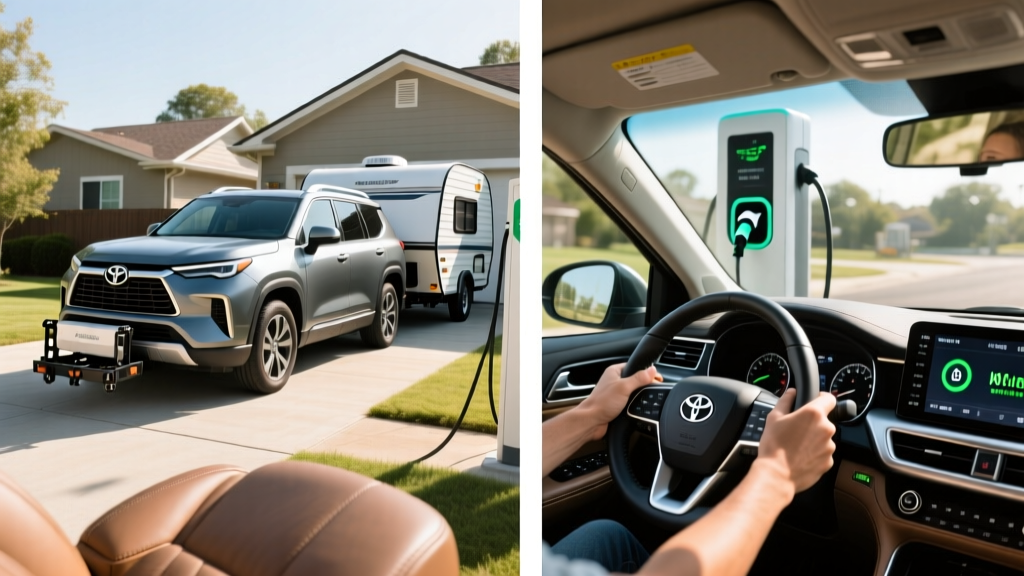
- The Woodland Edition's 1,750-lb towing capacity is modest — if you tow a trailer regularly, a turbocharged gas SUV or a BEV with higher tow ratings may serve better
- No federal tax credit available — your effective purchase price is the sticker price minus any state/local incentives
The decision framework is straightforward: if you can charge at home and your daily commute is under 40 miles round-trip, the RAV4 Prime lets you drive almost entirely on electricity Monday through Friday while retaining gas-engine range for road trips — and the potential $7,500 credit narrows the price gap significantly. If you can't charge at home, live in an apartment, or simply don't want to think about charging infrastructure, the Woodland Edition HEV delivers excellent efficiency with zero lifestyle compromise. A full BEV makes sense if your daily driving is predictable, you have charging access, and you want to eliminate gas station visits entirely — but cold-weather range loss and road-trip charging logistics remain real trade-offs that the RAV4 Hybrid avoids entirely.
Frequently Asked Questions
How many MPG does the RAV4 Hybrid Woodland Edition get?
The EPA rates the 2026 RAV4 Hybrid (all AWD trims including Woodland Edition) at 41 city / 38 highway / 39 combined MPG. In real-world city and suburban driving, owners frequently report 40–44 MPG thanks to the hybrid system's regenerative braking advantage in stop-and-go traffic. Highway-only driving at 75+ mph typically yields 34–37 MPG. Cold weather reduces these figures by approximately 5–10%.
Does the RAV4 Hybrid Woodland Edition plug in?
No. The RAV4 Hybrid is a conventional hybrid (HEV). Its 1.6 kWh traction battery charges exclusively through regenerative braking and the gasoline engine. There is no plug port. If you want a plug-in RAV4 with electric-only range, the RAV4 Prime is the PHEV variant — it has an 18.1 kWh battery, 42 miles of EPA electric-only range, and a J1772 charge port for Level 1 (120V) and Level 2 (240V) AC charging.
How far can the RAV4 Prime go on electric only?
The RAV4 Prime (PHEV, not the Woodland Edition) delivers an EPA-rated 42 miles on electricity alone before the gasoline engine engages. Total combined range (electric + gas) exceeds 600 miles. The Prime's battery charges in approximately 4.5 hours on a 240V Level 2 charger or about 12 hours on a standard 120V household outlet. It does not support DC fast charging — AC charging only.
Is the RAV4 Hybrid reliable, and what does a battery replacement cost?
Toyota's hybrid powertrain is among the most proven in the industry, with the planetary-gearset eCVT and NiMH battery architecture in continuous production since 1997. The hybrid battery is warranted for 10 years / 150,000 miles. Out-of-warranty replacement costs approximately $3,500–$5,000 at a dealer (parts + labor) or $1,500–$2,500 through a refurbished pack or module-level repair at an independent hybrid shop. Real-world data shows most RAV4 Hybrid batteries lasting 150,000–250,000+ miles with gradual capacity loss rather than sudden failure.
Does the RAV4 Hybrid qualify for any tax credit?
The conventional RAV4 Hybrid (HEV) does not qualify for the federal §30D Clean Vehicle Credit — that credit requires a plug-in vehicle (PHEV or BEV) meeting specific battery-sourcing, MSRP, and buyer-income thresholds. Some states offer modest incentives for hybrids (rebates, HOV access, or registration fee reductions), but these vary by jurisdiction and change frequently. The RAV4 Prime (PHEV) may qualify for up to $7,500 federally, subject to current-year IRS rules. Always verify eligibility at IRS.gov and consult a tax professional before budgeting around the credit.
What makes the Woodland Edition different from other RAV4 Hybrid trims?
The Woodland Edition adds a TRD-tuned suspension with revised damping for improved rough-road compliance, all-terrain tires on unique 18-inch wheels, black exterior trim accents, bronze-finish badging, and standard roof rails. The hybrid powertrain (219 hp, 2.5L + dual electric motors, AWD-i) is identical to other RAV4 Hybrid trims. The Woodland Edition is a styling and suspension package, not a powertrain upgrade — you get the same 39 MPG combined and 7.4-second 0–60 time as an XLE or Limited.
Is the RAV4 Hybrid a good choice for towing?
The RAV4 Hybrid is rated for 1,750 lbs of towing capacity across all trims. This handles a small utility trailer, a pair of dirt bikes, or a light pop-up camper, but it's not suited for larger boat trailers or travel trailers. If regular towing above 2,000 lbs is a requirement, you'll need to look at body-on-frame SUVs or larger crossovers — though these sacrifice the RAV4 Hybrid's fuel economy advantage significantly.