The Toyota RAV4 Hybrid has held the top spot in the compact hybrid SUV segment for years, and the current generation continues that dominance with a refreshed lineup. If you're researching RAV4 Hybrid trims, you're likely weighing fuel savings against feature content, trying to figure out whether the standard hybrid (HEV) or the plug-in RAV4 Prime (PHEV) makes more sense for your commute, and wondering which trim level delivers the best value. This guide breaks down every 2026 RAV4 Hybrid trim with exact EPA figures, real-world MPG expectations, powertrain specs, and pricing so you can make a data-driven decision.
RAV4 Hybrid vs. RAV4 Prime: HEV and PHEV Explained
Toyota sells two electrified RAV4 variants, and confusing them is the most common mistake shoppers make. Here's the critical distinction:
RAV4 Hybrid (HEV)
- No plug required. The battery charges through regenerative braking and the gasoline engine.
- 1.6 kWh battery (nickel-metal hydride) — small, used for assist and low-speed electric creep.
- EPA combined: 39–41 MPG depending on trim and wheel size.
- No federal tax credit — the §30D credit requires plug-in capability with a minimum battery capacity.
RAV4 Prime (PHEV)
- Plug-in required to access the full 42 miles of electric-only range.
- 18.1 kWh lithium-ion battery — substantially larger, enabling genuine electric commuting.
- EPA: 94 MPGe combined (electric + gas) / 38 MPG combined (gas-only after battery depletion).
- Federal §30D tax credit eligible — up to $7,500, subject to income caps, MSRP limits, and battery-sourcing requirements (see IRS details below).
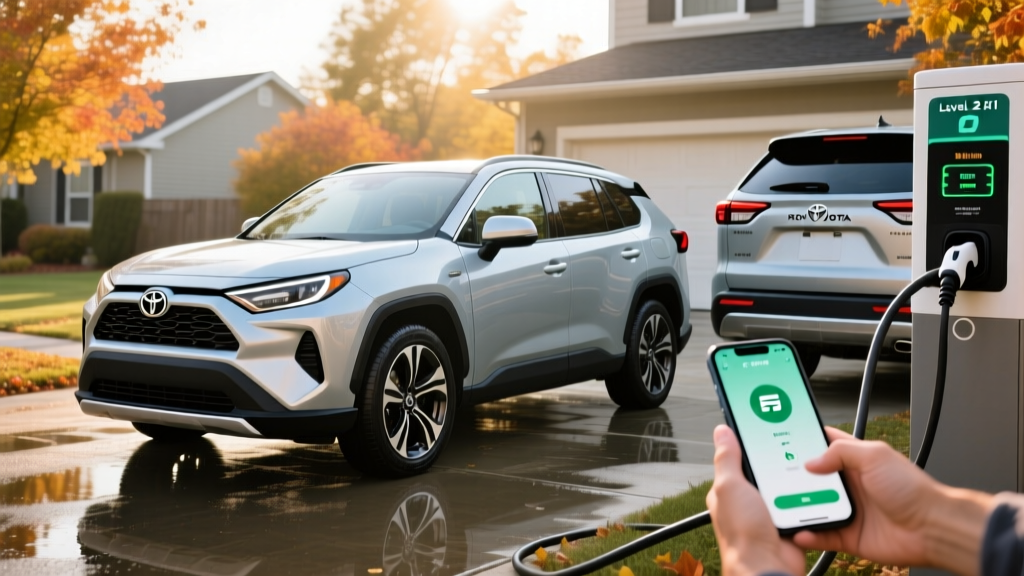
- No DC fast charging. Level 2 (240V) charges the battery in approximately 2.5 hours with the optional 6.6 kW onboard charger; the standard 3.3 kW charger takes about 4.5 hours.
If you can charge at home and your daily round-trip commute is under 40 miles, the Prime effectively operates as an EV on most days while retaining a gas engine for road trips. If you lack home charging access or drive long highway distances daily, the standard HEV is simpler and more cost-effective upfront.
2026 RAV4 Hybrid Trim Lineup and Pricing
The 2026 RAV4 Hybrid (HEV) comes in five trims. All feature a 2.5-liter four-cylinder engine paired with front and rear electric motors for standard electronic all-wheel drive (AWD). Combined system output is 219 horsepower.
| Trim | MSRP (AWD) | EPA Combined MPG | EPA City / Hwy | Key Features |
|---|---|---|---|---|
| LE | $33,425 | 41 MPG | 41 / 38 | 8" touchscreen, TSS 3.0, 17" alloy wheels |
| XLE | $35,375 | 41 MPG | 41 / 38 | Dual-zone climate, blind-spot monitor, 18" wheels |
| XLE Premium | $37,325 | 41 MPG | 41 / 38 | SofTex seats, power liftgate, moonroof |
| Woodland Edition | $38,125 | 39 MPG | 38 / 35 | All-terrain tires, TRD-tuned suspension, roof rails |
| Limited | $40,975 | 39 MPG | 39 / 36 | 12.3" display, JBL audio, panoramic roof, 19" wheels |
Source: fueleconomy.gov and Toyota specifications. MSRP includes destination charge; dealer markups may apply.
The MPG drop on the Woodland Edition and Limited trims comes from larger, heavier wheels and all-terrain or low-profile tires that increase rolling resistance. If maximizing fuel economy is your priority, the LE, XLE, or XLE Premium on 18-inch wheels delivers the best returns.
RAV4 Prime Trims: PHEV Pricing and Electric Range
The RAV4 Prime is a performance-oriented PHEV with 302 combined horsepower — making it the quickest RAV4 in the lineup with a 0–60 mph time of approximately 5.7 seconds. It's offered in two trims:
| Trim | MSRP | EV Range | MPGe / Gas MPG | 0–60 mph |
|---|---|---|---|---|
| SE | $44,915 | 42 miles | 94 MPGe / 38 MPG | 5.7 sec |
| XSE | $48,590 | 42 miles | 94 MPGe / 38 MPG | 5.7 sec |
Source: fueleconomy.gov. Range and MPGe figures are EPA-estimated.
The 42-mile electric-only range is EPA-rated and holds up well in moderate temperatures. In cold weather (below 30°F), expect that range to drop to roughly 30–35 miles due to cabin heating demands and reduced battery efficiency. On the highway above 70 mph with a depleted battery, real-world gas-only fuel economy typically lands between 34–36 MPG — slightly below the 38 MPG EPA sticker, which is common for PHEVs operating in hybrid mode at sustained highway speeds.
Real-World MPG: What Owners Actually Report
EPA estimates for the RAV4 Hybrid are conservative in city driving and slightly optimistic on the highway. Here's what to expect based on owner data and independent testing:
- City driving: Most owners report 42–45 MPG in stop-and-go traffic. Hybrids thrive here — regenerative braking recaptures energy, and the electric motor handles low-speed propulsion without engaging the gas engine.
- Highway driving (65–70 mph): Expect 35–37 MPG. At sustained speeds, the gasoline engine does most of the work, and aerodynamic drag reduces efficiency.
- Highway driving (75–80 mph): Drops further to roughly 32–34 MPG.
- Cold weather (below 25°F): Combined MPG can dip to 34–36 MPG for the HEV as the engine runs more frequently to provide cabin heat and warm the catalytic converter.
The Woodland Edition's all-terrain tires typically cost owners 2–3 MPG across all conditions compared to the standard LE/XLE. If you don't need off-road capability, stick with the street tires.
Battery Warranty, Lifespan, and Replacement Cost
Toyota Hybrid Battery Warranty
HEV (RAV4 Hybrid): 10 years / 150,000 miles (whichever comes first) on the hybrid battery and all hybrid-system components. This applies in all 50 states.
PHEV (RAV4 Prime): 10 years / 150,000 miles on the traction battery and hybrid components, consistent with Toyota's updated warranty coverage for all electrified models from 2020 onward.
Toyota's hybrid battery track record is among the best in the industry. The RAV4 Hybrid uses a proven nickel-metal hydride (NiMH) pack that rarely requires replacement within the warranty period. Data from fleet operators and long-term owners suggests these batteries commonly last 150,000–200,000+ miles before significant degradation occurs.
If replacement is needed out of warranty:
- RAV4 Hybrid (HEV) NiMH battery: Approximately $3,000–$4,000 including parts and labor at a Toyota dealer. Third-party refurbished units are available for $2,000–$2,500.
- RAV4 Prime (PHEV) lithium-ion battery: Approximately $8,000–$12,000 at a dealer. The larger, more complex pack carries a higher replacement cost — a factor to weigh if you plan to keep the vehicle well past the warranty period.
Toyota's hybrid reliability ratings consistently rank at or near the top of the compact SUV category. The RAV4 Hybrid earns strong marks from both IIHS (Top Safety Pick+ for recent model years) and NHTSA (5-star overall rating), giving buyers confidence in long-term ownership costs.
Tax Credits and Incentives: What You Can Actually Claim
This is where the HEV and PHEV diverge sharply:
- RAV4 Hybrid (HEV): Does not qualify for the federal §30D clean vehicle credit. The IRS requires plug-in capability and a minimum battery capacity of 7 kWh for eligibility. No federal incentive applies to conventional hybrids.
- RAV4 Prime (PHEV): Potentially eligible for up to $7,500 under §30D, but eligibility depends on multiple factors that change frequently: buyer income caps ($150K single / $300K joint MAGI), vehicle MSRP caps ($80,000 for SUVs), and battery component/critical mineral sourcing requirements. As of 2026, the RAV4 Prime's battery sourcing has shifted, and the full $7,500 is not guaranteed — check the latest IRS guidance before purchasing. The credit can now be transferred to the dealer at point of sale, reducing your out-of-pocket cost immediately.
- State incentives: Vary widely. States like California, Colorado, and Massachusetts offer additional rebates for PHEVs ($1,000–$4,000 depending on income and battery size). Check your state's energy office or DMV for current programs.
After applying the maximum federal credit and a typical state incentive, a RAV4 Prime SE could effectively cost in the mid-$30,000 range — closing the gap with the HEV Limited trim while offering superior performance and electric commuting.
RAV4 Hybrid vs. RAV4 Prime vs. Full EV: Decision Framework
Choose the RAV4 Hybrid (HEV) if:
- You cannot charge at home (apartment, street parking, no garage).
- Your budget is $33,000–$41,000 and you want maximum value per dollar.
- You drive mostly city/suburban miles and want 40+ MPG without thinking about charging.
- You plan to own the vehicle 8–10 years and want minimal maintenance complexity.
Choose the RAV4 Prime (PHEV) if:
- You have Level 2 home charging (or can install it) and your commute is under 42 miles round-trip.
- You want 302 HP performance with the option of silent electric driving.
- You qualify for the §30D credit and want to offset the higher MSRP.
- You take frequent road trips where a pure EV's charging stops would be inconvenient.
Choose a full EV (e.g., Tesla Model Y, Hyundai Ioniq 5) if:
- You have reliable home charging and your typical trips are under 250 miles.
- You want zero tailpipe emissions and minimal drivetrain maintenance (no oil changes, no gas engine).
- You're comfortable planning DC fast-charging stops on longer road trips.
Frequently Asked Questions
How many MPG does the RAV4 Hybrid get?
The EPA rates most 2026 RAV4 Hybrid trims at 41 MPG combined (41 city / 38 highway). The Woodland Edition and Limited trim are rated at 39 MPG combined. In real-world city driving, many owners consistently achieve 42–45 MPG thanks to regenerative braking. Highway cruising at 70+ mph typically yields 33–37 MPG.
How far can the RAV4 Prime go on electric only?
The EPA rates the RAV4 Prime at 42 miles of electric-only range. In moderate temperatures with mixed driving, this figure is accurate. In cold weather (below 30°F), expect 30–35 miles. Once the battery depletes, the Prime operates as a conventional hybrid with an EPA rating of 38 MPG combined on gasoline.
Is the RAV4 Hybrid reliable and what does battery replacement cost?
The RAV4 Hybrid has one of the strongest reliability records in the compact SUV segment. Toyota covers the hybrid battery for 10 years / 150,000 miles. Out-of-warranty replacement for the HEV's NiMH battery runs approximately $3,000–$4,000 at a dealer. Most hybrid batteries last 150,000–200,000+ miles based on fleet and long-term owner data.
Does the RAV4 Hybrid qualify for any tax credit?
The standard RAV4 Hybrid (HEV) does not qualify for the federal §30D clean vehicle credit — it's a conventional hybrid without plug-in capability. The RAV4 Prime (PHEV) may qualify for up to $7,500, but eligibility depends on your income, the vehicle's battery-sourcing compliance, and current IRS rules. Always verify on irs.gov before purchasing.
Do I need to plug in the RAV4 Hybrid?
No. The standard RAV4 Hybrid (HEV) charges its small battery through regenerative braking and the gasoline engine. You never plug it in. Only the RAV4 Prime (PHEV) requires plugging in to access its 42-mile electric-only range — without plugging in, the Prime still operates as a hybrid but you lose the electric commuting benefit.
Which RAV4 Hybrid trim offers the best value?
The XLE at $35,375 hits the sweet spot for most buyers: it adds blind-spot monitoring, dual-zone climate control, and 18-inch wheels over the base LE for roughly $2,000 more, while maintaining the top 41 MPG combined rating. The XLE Premium is worth the upgrade if you want a moonroof and power liftgate. The Limited trim's 19-inch wheels and premium features cost you 2 MPG and $5,600 more than the XLE.
Pros
- 41 MPG combined (LE/XLE) — best-in-class for AWD compact SUVs
- Standard AWD on every hybrid trim with no fuel-economy penalty vs. FWD
- 10-year / 150,000-mile hybrid battery warranty across all trims
- RAV4 Prime offers 302 HP and 42 miles EV range with gas-engine backup
- Strong IIHS Top Safety Pick+ and NHTSA 5-star ratings
- Excellent resale value — RAV4 Hybrid retains value better than most competitors
Cons
- HEV trims do not qualify for any federal tax credit
- RAV4 Prime's $44,915+ starting price is steep before incentives
- RAV4 Prime has no DC fast charging — Level 2 only
- Woodland Edition and Limited trim sacrifice 2 MPG for larger wheels
- Infotainment system still lags behind competitors in responsiveness
- RAV4 Prime availability remains constrained at many dealers