If you're researching the RAV4 Hybrid towing capacity before hitching a small trailer, bike rack, or pop-up camper to Toyota's best-selling hybrid SUV, you need exact numbers — not brochure generalizations. The RAV4 Hybrid is engineered for efficiency first, and that priority shapes what it can (and can't) safely pull. This guide covers the 2026 Toyota RAV4 Hybrid's tow rating, powertrain specs, fuel economy, and how it stacks up against the plug-in RAV4 Prime and full-electric alternatives for buyers who need light-duty hauling.
RAV4 Hybrid Towing Capacity: The Official Numbers
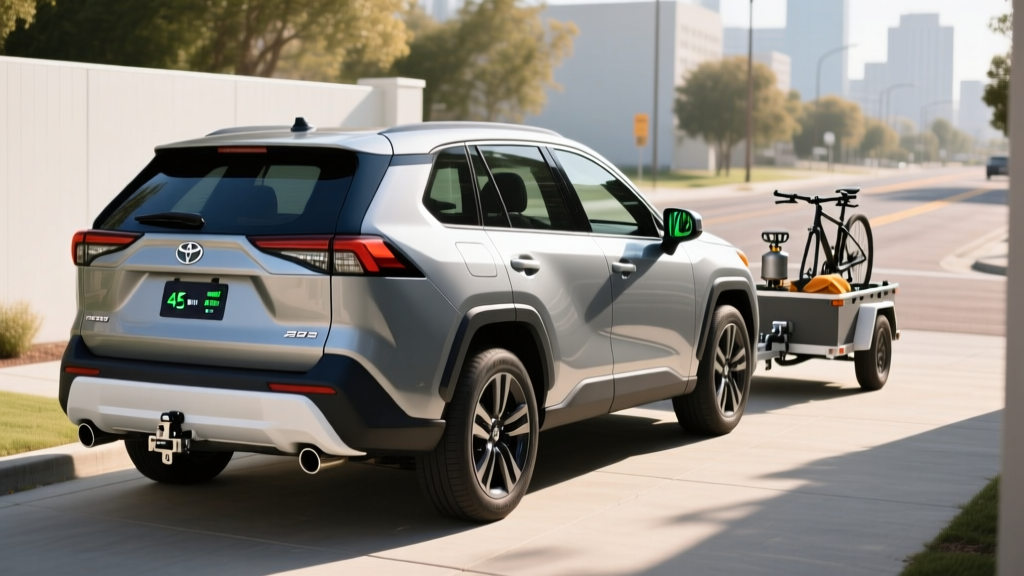
The 2026 Toyota RAV4 Hybrid carries a manufacturer-rated maximum towing capacity of 1,500 pounds when properly equipped. This rating applies across the LE, XLE, XLE Premium, SE, and Limited trims. The RAV4 Hybrid uses Toyota's electronic on-demand all-wheel-drive (AWD) system with a separate rear-mounted electric motor, which provides the traction stability needed for light trailering.
For context, a lightweight aluminum utility trailer weighs 600–900 lbs empty, a pair of dirt bikes can run 200–250 lbs each, and a small pop-up camper typically starts at 1,200 lbs. The RAV4 Hybrid handles these loads within its rating, but a loaded enclosed cargo trailer or a hard-sided travel trailer will exceed the 1,500-lb limit quickly.
| Specification | Value |
|---|---|
| Max Towing Capacity | 1,500 lbs |
| Max Payload | 1,750 lbs |
| GVWR | ~4,900 lbs |
| Drivetrain | AWD (electronic on-demand) |
| Hitch Type Required | Class II (1.25" receiver) |
| Factory Tow Package | Not required; aftermarket hitch compatible |
RAV4 Hybrid vs. RAV4 Prime (PHEV): Towing and Powertrain Differences
Toyota offers the RAV4 in two electrified flavors, and the distinction matters if you're weighing towing capability against electric driving range:
- RAV4 Hybrid (HEV): A conventional self-charging hybrid. It uses a 2.5-liter four-cylinder engine paired with electric motors. You never plug it in — the battery recharges through regenerative braking and the gasoline engine. Max tow: 1,500 lbs.
- RAV4 Prime (PHEV): A plug-in hybrid with a larger 18.1 kWh battery pack. It delivers up to 42 miles of electric-only range before the gas engine engages. It's more powerful at 302 combined horsepower, and its tow rating matches the HEV at 1,500 lbs despite the extra battery weight.
| Attribute | RAV4 Hybrid (HEV) | RAV4 Prime (PHEV) |
|---|---|---|
| Powertrain Type | Conventional Hybrid | Plug-in Hybrid |
| Combined Horsepower | 219 hp | 302 hp |
| Engine | 2.5L 4-cyl + 2 electric motors | 2.5L 4-cyl + 2 electric motors |
| Battery Capacity | 1.6 kWh (NiMH) | 18.1 kWh (Li-ion) |
| Electric-Only Range | N/A (not plug-in) | 42 miles (EPA) |
| Total Range | ~580 miles | ~600 miles (electric + gas) |
| EPA MPG (Combined) | 39 MPG | 38 MPG (gas) / 94 MPGe (electric+gas) |
| 0–60 mph | 7.4 sec | 5.7 sec |
| Max Towing Capacity | 1,500 lbs | 1,500 lbs |
| Plug-in Charging | No | Yes (Level 1/Level 2; no DC fast charge) |
| Starting MSRP | ~$33,500 | ~$44,500 |
The RAV4 Prime's 302 hp gives it noticeably stronger acceleration when merging onto highways with a trailer, but the tow rating remains identical. The extra 500+ lbs of battery mass in the Prime eats into payload capacity, so your available tongue weight is actually tighter on the PHEV variant despite the higher horsepower.
Fuel Economy: EPA Ratings and Real-World MPG
The RAV4 Hybrid's fuel economy is its primary selling point over the gas-only RAV4. Here's the EPA-rated breakdown per fueleconomy.gov:
| Trim | City MPG | Highway MPG | Combined MPG |
|---|---|---|---|
| LE / XLE / XLE Premium | 41 | 38 | 39 |
| SE / Woodland Edition | 39 | 37 | 38 |
| Limited (20" wheels) | 38 | 35 | 36 |
When towing near the 1,500-lb maximum, expect a 25–35% drop in combined MPG. Plan fuel stops accordingly: the 14.5-gallon tank gives roughly 360 miles of range unladen, but that shrinks to around 250–280 miles with a trailer attached on flat terrain at highway speeds.
Powertrain Deep Dive: How the Hybrid System Handles Towing
The RAV4 Hybrid pairs a 2.5-liter Dynamic Force four-cylinder engine (176 hp, 163 lb-ft) with a front electric motor (118 hp, 149 lb-ft) and a rear electric motor (54 hp, 89 lb-ft) for a combined system output of 219 horsepower. The rear motor activates only when the system detects slip or when AWD is demanded — including during trailering.
The eCVT (electronically controlled continuously variable transmission) is smooth under normal driving, but it behaves differently under tow load. Expect the engine to hold higher RPMs on inclines as the planetary gearset optimizes for power delivery rather than efficiency. This is normal hybrid behavior under load, not a sign of strain — Toyota's hybrid synergy drive system is engineered for sustained high-RPM operation.
The RAV4 Hybrid does not include a factory tow package with an integrated trailer brake controller. For trailers approaching 1,500 lbs — especially those with their own brakes — you'll need an aftermarket brake controller (e.g., Curt Echo or Tekonsha Prodigy) wired to the vehicle's 4-pin connector.
Battery Warranty, Lifespan, and Replacement Cost
The RAV4 Hybrid's 1.6 kWh nickel-metal hydride (NiMH) battery is small by EV standards, but it's also subjected to shallow charge-discharge cycles — the hybrid system never fully depletes or fully charges it, which dramatically extends cycle life. Real-world data from high-mileage Prius and RAV4 Hybrid owners shows these batteries routinely lasting 150,000–200,000+ miles before meaningful degradation.
If replacement is needed out of warranty, a new OEM hybrid battery for the RAV4 Hybrid costs approximately $3,000–$4,500 installed at a Toyota dealer. Refurbished or aftermarket options run $1,500–$2,500. This is far less than a full EV battery replacement because the pack is small and the chemistry (NiMH) is mature and inexpensive.
The RAV4 Prime's 18.1 kWh lithium-ion battery carries the same 10-year/150,000-mile warranty but would cost significantly more to replace — roughly $8,000–$12,000 — due to its larger capacity and Li-ion chemistry.
Pricing, Trims, and Tax Credit Eligibility
| Trim | MSRP (approx.) |
|---|---|
| LE | $33,500 |
| XLE | $35,500 |
| XLE Premium | $37,800 |
| SE | $38,200 |
| Woodland Edition | $38,700 |
| Limited | $41,500 |
Federal tax credit: The conventional RAV4 Hybrid (HEV) does not qualify for the IRS §30D Clean Vehicle Credit. That credit applies only to plug-in electric vehicles (BEVs and PHEVs) with sufficient battery capacity and compliant critical-mineral/battery-component sourcing.
The RAV4 Prime (PHEV) has historically qualified for up to $7,500 in federal tax credits, but eligibility under current 2026 IRS rules depends on battery-component and critical-mineral sourcing requirements that change annually. Toyota's North American assembly and battery sourcing determine year-by-year qualification. Always verify current eligibility on fueleconomy.gov and consult a tax professional before relying on the credit for purchase decisions. The §30D credit also has income caps ($150K single / $300K joint for new vehicles) and MSRP caps ($80,000 for SUVs).
Some states offer their own hybrid or PHEV rebates — check your state energy office or DMV for current programs, as these vary widely and change frequently.
RAV4 Hybrid vs. Full EV vs. Gas: Which Should You Choose?
- Choose the RAV4 Hybrid if: You want maximum fuel savings over a gas RAV4 without changing your fueling habits, you need AWD and light towing (1,500 lbs), and you don't have reliable access to home or workplace charging for a plug-in vehicle.
- Choose the RAV4 Prime (PHEV) if: You can charge at home (Level 2, 240V), your daily commute is under 42 miles (covering most errands on electricity), you want 302 hp for more confident highway merging with a trailer, and you may qualify for the federal tax credit to offset the ~$11,000 price premium over the HEV.
- Choose a full EV (e.g., Tesla Model Y, Hyundai Ioniq 5) if: You want zero tailpipe emissions, your daily driving is under 250 miles, you have home charging, and you don't need to tow — most compact EV SUVs have tow ratings between 2,000–3,500 lbs but lack the RAV4's proven hybrid reliability track record.
- Stick with the gas RAV4 if: You drive under 8,000 miles per year (the hybrid fuel savings won't offset the price premium), you regularly tow over 1,500 lbs, or your budget is strictly under $30,000.
For buyers specifically asking about towing: no compact hybrid or PHEV SUV offers more than 1,500–2,000 lbs of tow capacity. If you regularly pull a 3,000+ lb boat or travel trailer, you'll need to look at body-on-frame SUVs or trucks — hybrid or otherwise.
Frequently Asked Questions
Can the RAV4 Hybrid tow a small camper trailer?
Yes, if the loaded camper weighs under 1,500 lbs. Most teardrop trailers (800–1,200 lbs) and lightweight pop-up campers fit within this limit. Hard-sided travel trailers almost always exceed 1,500 lbs loaded and are not compatible with the RAV4 Hybrid's tow rating.
Does towing damage the RAV4 Hybrid battery?
No. The hybrid system manages battery temperature and charge state automatically. Towing within the rated capacity does not accelerate battery degradation. The hybrid battery's 10-year/150,000-mile warranty remains in full effect regardless of towing use.
Do I need a hitch installed to tow with the RAV4 Hybrid?
Yes. Toyota does not include a hitch receiver from the factory on most trims. You'll need an aftermarket Class II (1.25-inch receiver) hitch, professionally installed. Expect $300–$600 for the hitch and installation. A 4-pin wiring harness is needed for trailer lights.
How does the RAV4 Hybrid's tow capacity compare to competitors?
The Honda CR-V Hybrid is rated at 1,000 lbs — lower than the RAV4. The Ford Escape Hybrid (when available) also rates at 1,500 lbs. The Subaru Outback (non-hybrid) tows 2,700 lbs, but it isn't a hybrid. Among compact hybrid SUVs, the RAV4's 1,500-lb rating is at the top of the segment.
Is the RAV4 Hybrid reliable for long-term ownership?
Toyota's hybrid system has one of the strongest long-term reliability records in the industry. The RAV4 Hybrid consistently earns top marks from Consumer Reports and J.D. Power for dependability. The hybrid battery, eCVT, and electric motors have fewer wear components than a conventional automatic transmission, and real-world failure rates before 150,000 miles are low.