Quick Verdict: The RAV4 Hybrid Lineup at a Glance
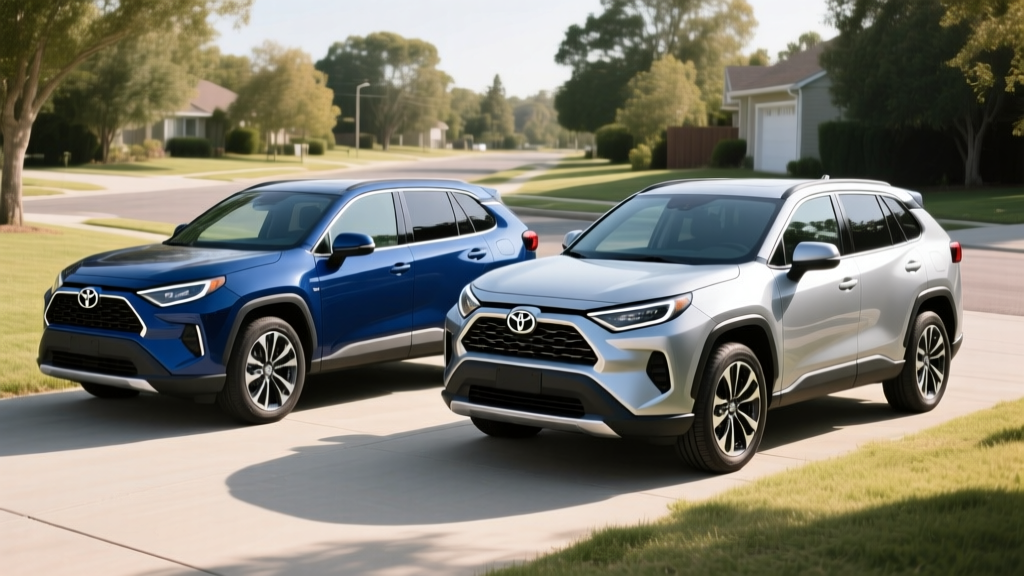
The Toyota RAV4 Hybrid remains one of the best-selling electrified vehicles in the United States for good reason. It delivers meaningful fuel savings over its gas-only sibling without requiring a plug, while the RAV4 Prime plug-in hybrid variant offers 42 miles of electric-only driving for commuters who can charge at home. For buyers researching the rav 4 hybrid 2024 model year, understanding the difference between these two powertrains — and where each fits in a broader EV-versus-hybrid decision — is the key to a smart purchase.
HEV vs PHEV: What's the Difference?
RAV4 Hybrid (HEV): A conventional hybrid. It pairs a 2.5-liter four-cylinder engine with electric motors and a small battery (~1.6 kWh). You never plug it in — the battery charges through regenerative braking and the engine. It delivers strong MPG in all conditions.
RAV4 Prime (PHEV): A plug-in hybrid. It uses a larger 18.1 kWh battery pack that you can charge from a wall outlet or public charger. It delivers 42 miles of pure electric driving before the gas engine kicks in, operating as a conventional hybrid afterward.
EPA Fuel Economy: RAV4 Hybrid vs RAV4 Prime
Fuel economy is the headline reason buyers choose the RAV4 Hybrid over the gas-only RAV4. Here's how the numbers break down across the lineup, per fueleconomy.gov:
| Model | City MPG | Highway MPG | Combined MPG | MPGe (PHEV EV Mode) |
|---|---|---|---|---|
| RAV4 Hybrid AWD (LE/XLE) | 41 | 38 | 39 | — |
| RAV4 Hybrid AWD (Woodland Ed.) | 38 | 35 | 37 | — |
| RAV4 Prime (SE/XSE) | 40 | 36 | 38 | 94 MPGe |
| Gas RAV4 AWD (baseline) | 27 | 34 | 30 | — |
Real-World MPG vs. EPA Sticker
Toyota's hybrid system excels in stop-and-go city driving, where the electric motor handles low-speed propulsion and regenerative braking recaptures energy. Many owners report exceeding the EPA city estimate of 41 MPG in urban commuting — 43 to 45 MPG is common in warm weather on flat terrain. Highway driving tells a different story: at sustained 70-80 mph speeds, expect 34-36 MPG, slightly below the EPA highway figure. Cold weather (below 30°F) reduces fuel economy by roughly 10-15% as the engine runs more frequently to heat the cabin and warm the catalytic converter.
For RAV4 Prime owners who charge regularly, the effective fuel economy is dramatically higher. If your daily commute falls within 42 miles and you charge every night, you may use almost no gasoline for weeks at a time.
RAV4 Prime: Electric-Only Range and Charging
The RAV4 Prime's 18.1 kWh lithium-ion battery delivers an EPA-rated 42 miles of electric-only range. In real-world conditions, expect 35-40 miles in mixed driving with climate control on, and up to 44-45 miles in mild weather at lower speeds. This is enough for most American commutes — the average one-way commute in the U.S. is roughly 16 miles, per Census Bureau data.
| Spec | RAV4 Prime (PHEV) |
|---|---|
| Battery Capacity | 18.1 kWh (usable ~14.5 kWh) |
| Electric-Only Range | 42 miles (EPA) |
| Total Combined Range | ~600 miles (EV + gas tank) |
| Level 1 Charging (120V) | ~12 hours (0-100%) |
| Level 2 Charging (240V, 3.3 kW) | ~4.5 hours (0-100%) |
| Level 2 Charging (240V, 6.6 kW option) | ~2.5 hours (0-100%) |
| DC Fast Charging | Not available |
| Charge Port | J1772 (Level 1/2 only) |
The RAV4 Prime does not support DC fast charging. This is typical for PHEVs — the battery is small enough that Level 2 charging fully replenishes it overnight. Buyers who want DC fast charging should consider a full battery-electric vehicle (BEV) instead.
Powertrain Specs: Horsepower, Motors, and Drivetrain
Both RAV4 Hybrid variants use Toyota's 2.5-liter Dynamic Force four-cylinder engine paired with electric motors, but the output differs significantly:
| Spec | RAV4 Hybrid (HEV) | RAV4 Prime (PHEV) |
|---|---|---|
| Combined Horsepower | 219 hp | 302 hp |
| Engine | 2.5L I4 + 2 electric motors | 2.5L I4 + 2 electric motors (higher output) |
| Drivetrain | AWD (eAWD — rear electric motor) | AWD (eAWD — rear electric motor) |
| 0-60 mph | ~7.4 seconds | ~5.7 seconds |
| Towing Capacity | 1,750 lbs | 2,500 lbs |
The RAV4 Prime's 302 combined horsepower makes it the quickest RAV4 in the lineup — quicker than many sport compacts. The conventional Hybrid's 219 hp is more than adequate for daily driving and highway merging, and the eAWD system provides confident traction in rain and light snow without a mechanical driveshaft to the rear wheels.
Pricing, Trims, and Tax Credit Eligibility
The 2024 RAV4 Hybrid and Prime carry meaningful price differences. Here's the MSRP breakdown by key trim level (destination charges included):
| Model & Trim | MSRP (2024) |
|---|---|
| RAV4 Hybrid LE | $33,425 |
| RAV4 Hybrid XLE | $34,925 |
| RAV4 Hybrid XLE Premium | $37,845 |
| RAV4 Hybrid Woodland Edition | $36,425 |
| RAV4 Hybrid Limited | $40,565 |
| RAV4 Prime SE | $44,415 |
| RAV4 Prime XSE | $48,575 |
Does the RAV4 Hybrid or Prime Qualify for a Federal Tax Credit?
RAV4 Hybrid (HEV): No. Conventional hybrids do not qualify for the IRS §30D Clean Vehicle Credit. This credit applies only to plug-in vehicles (PHEVs and BEVs) meeting battery-sourcing and critical-mineral requirements.
RAV4 Prime (PHEV): The RAV4 Prime's eligibility under current IRS §30D rules depends on several factors:
- MSRP cap: SUVs must be under $80,000 MSRP — both Prime trims qualify.
- Buyer income cap: AGI must not exceed $150,000 (single), $225,000 (head of household), or $300,000 (joint).
- Battery sourcing: The vehicle must meet critical-mineral and battery-component requirements that phase in stricter thresholds each year. Toyota's supply chain has shifted, and eligibility can change mid-year.
- Point-of-sale transfer: If eligible, the credit (up to $7,500) can be applied at the dealer as a down-payment reduction, rather than waiting for a tax refund.
Always verify current eligibility on fueleconomy.gov's tax credit tool before purchasing, as sourcing rules and qualified-vehicle lists update regularly. Consult a tax professional for your specific situation.
State incentives: Several states offer additional rebates for PHEVs. California's CVRP program, for example, has offered rebates for qualifying PHEVs, though program availability and income requirements vary by jurisdiction. Check your state energy office for current programs.
Battery Warranty, Reliability, and Replacement Cost
Toyota Hybrid Battery Warranty
Hybrid Battery: 10 years / 150,000 miles (whichever comes first) on 2020+ model year RAV4 Hybrids and Primes, transferable to subsequent owners.
Hybrid System Components: 8 years / 100,000 miles (inverter, control module, etc.).
Powertrain: 5 years / 60,000 miles.
Is the RAV4 Hybrid Reliable?
Toyota's hybrid synergy drive system is one of the most proven electrified powertrains on the road, with over 25 years of continuous refinement since the original Prius. The RAV4 Hybrid earns strong reliability scores from Consumer Reports and J.D. Power. The eCVT transmission has no traditional gears or belts — it uses a planetary gearset that is exceptionally durable.
Hybrid Battery Replacement Cost
If the hybrid battery fails outside warranty coverage, a replacement for the RAV4 Hybrid (HEV) typically runs $3,000 to $5,000 including labor. The RAV4 Prime's larger 18.1 kWh pack costs significantly more — estimated at $8,000 to $12,000 for a full replacement. However, catastrophic battery failure in Toyota hybrids is rare. Most degradation is gradual: owners typically see 10-15% capacity loss over 10-15 years, which slightly reduces electric-only range (on the Prime) or fuel economy (on the HEV) but does not disable the vehicle.
Unlike a full EV, a degraded hybrid battery does not strand you — the gasoline engine continues to operate normally. This is a meaningful advantage for buyers in areas without robust EV service infrastructure.
Hybrid vs PHEV vs EV: Which RAV4 Fits Your Life?
Choose the RAV4 Hybrid (HEV) If:
- You cannot charge at home (apartment, street parking, no garage)
- You want maximum simplicity — no plug, no charging apps, no cord management
- You drive 15,000+ miles/year and want consistent 38-41 MPG everywhere
- Your budget is $33,000-$41,000
- You frequently tow small loads (1,750 lb capacity)
Choose the RAV4 Prime (PHEV) If:
- You have Level 1 or Level 2 charging access at home
- Your daily round-trip commute is under 42 miles
- You want EV-like silent driving for daily errands plus gas flexibility for road trips
- You want 302 hp and the quickest acceleration in the RAV4 lineup
- You may qualify for the $7,500 federal tax credit, narrowing the price gap with the HEV
When Should You Skip Both and Buy a Full EV?
A battery-electric vehicle like the Tesla Model Y, Hyundai Ioniq 5, or Ford Mustang Mach-E makes sense if you have reliable home charging, your daily driving stays under 250 miles, and you want to eliminate gasoline entirely. Full EVs have lower per-mile "fuel" costs (roughly $0.04-$0.06 per mile on electricity vs. $0.10-$0.14 on gas for the Hybrid at $3.50/gallon), fewer moving parts, and no oil changes. The trade-offs are higher upfront cost, dependence on charging infrastructure for road trips, and potential cold-weather range loss of 20-30%.
Ownership Costs: 5-Year Snapshot
| Cost Factor | RAV4 Hybrid LE | RAV4 Prime SE | Gas RAV4 LE (AWD) |
|---|---|---|---|
| MSRP | $33,425 | $44,415 | $30,625 |
| Est. Federal Tax Credit | $0 | Up to $7,500* | $0 |
| Effective Price (after credit) | $33,425 | ~$36,915 | $30,625 |
| 5-Year Fuel Cost (75,000 mi) | ~$6,400 | ~$3,200 (50% EV driving) | ~$8,750 |
| Est. Maintenance (5 yr) | ~$2,500 | ~$2,200 | ~$3,200 |
| 5-Year Total (purchase + fuel + maint.) | ~$42,325 | ~$42,315 | ~$42,575 |
*Tax credit eligibility depends on income, sourcing, and current IRS rules. Verify before purchase.
The RAV4 Prime reaches near cost-parity with the gas RAV4 over five years when the full tax credit applies, while delivering dramatically lower tailpipe emissions and a superior driving experience. The RAV4 Hybrid sits in between — a strong value play with no charging requirement.
Frequently Asked Questions
How many MPG does the 2024 RAV4 Hybrid get?
The 2024 RAV4 Hybrid AWD (LE and XLE trims) earns an EPA-estimated 41 city / 38 highway / 39 combined MPG. Real-world city driving often yields 43-45 MPG in warm weather. Highway driving at 75+ mph typically returns 34-36 MPG. The Woodland Edition, with all-terrain tires, drops to 38/35/37 MPG.
How far can the RAV4 Prime go on electric only?
The RAV4 Prime delivers an EPA-rated 42 miles of electric-only range. Real-world results range from 35-40 miles with climate control active, to 44-45 miles in mild conditions at moderate speeds. Once the battery is depleted, the Prime operates as a conventional hybrid, achieving 38 combined MPG — so total combined range (electric + 14.5-gallon gas tank) exceeds 600 miles.
Does the RAV4 Hybrid need to be plugged in?
No. The RAV4 Hybrid (HEV) is a conventional hybrid that charges its small battery entirely through regenerative braking and the gasoline engine. You fuel it like any other car. Only the RAV4 Prime (PHEV) benefits from being plugged in — and even the Prime will operate normally on gas if you forget to charge it.
Is the RAV4 Hybrid battery expensive to replace?
A RAV4 Hybrid (HEV) battery replacement costs approximately $3,000-$5,000 out of warranty. The RAV4 Prime's larger PHEV battery runs $8,000-$12,000. However, Toyota covers the hybrid battery for 10 years/150,000 miles, and catastrophic failure is uncommon. Most batteries experience gradual 10-15% capacity loss over a decade, which is barely noticeable in an HEV and reduces EV range modestly in the Prime.
Does the 2024 RAV4 Hybrid qualify for a federal tax credit?
The conventional RAV4 Hybrid (HEV) does not qualify for any federal tax credit. The RAV4 Prime (PHEV) may qualify for up to $7,500 under IRS §30D, subject to buyer income limits ($150K single / $300K joint), MSRP caps (under $80K for SUVs — both trims qualify), and battery critical-mineral sourcing requirements. Eligibility can change as supply chains shift — verify on fueleconomy.gov and consult a tax professional before relying on the credit.
Hybrid vs PHEV vs EV — which should I choose?
HEV (RAV4 Hybrid): Best if you can't charge at home and want simplicity. No behavior change required.
PHEV (RAV4 Prime): Best if you have home charging and a short commute. You get EV driving daily with gas-engine backup for long trips.
BEV (full electric): Best if you have home charging, rarely exceed 250 miles/day, and want the lowest operating costs and zero tailpipe emissions. Requires planning for road-trip charging.