Introduction: The Resale Value Dilemma
When buying a new vehicle, the manufacturer's suggested retail price (MSRP) is only half the financial story. The true cost of ownership is heavily dictated by how much value the vehicle retains when it is time to sell, trade it in, or return it at the end of a lease. In the current automotive landscape, the battle for resale supremacy is no longer just about brand loyalty or exterior styling; it is fundamentally about powertrain technology. Today, we are putting the industry benchmark, the Toyota RAV4, into a head-to-head product showdown to analyze hybrid car resale value and depreciation.
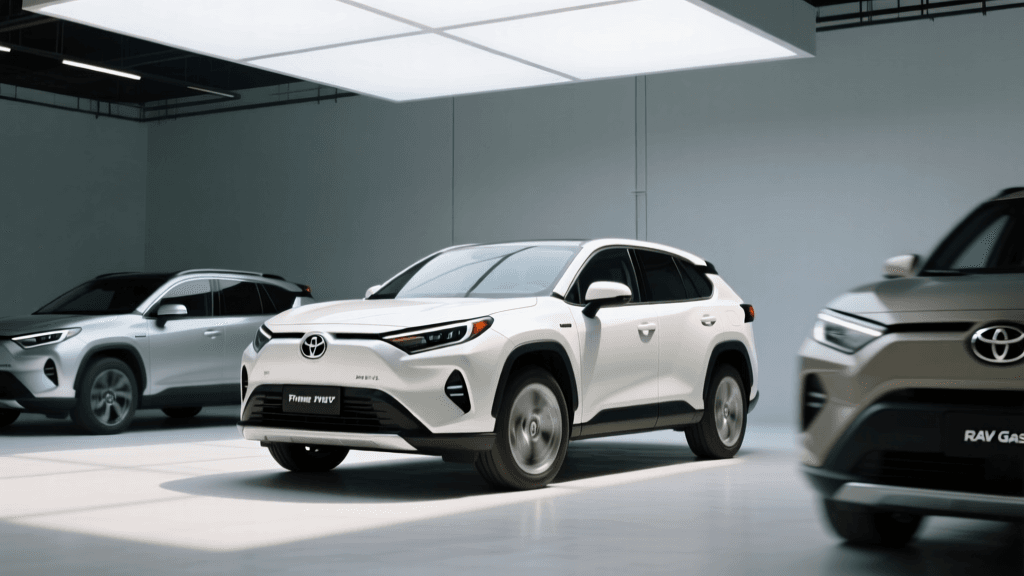
Buyers are increasingly caught in a tug-of-war between traditional internal combustion engine (ICE) vehicles, standard hybrids (HEV), plug-in hybrids (PHEV), and fully electric vehicles (BEV). While EVs have dominated headlines, recent market data shows that standard hybrids are quietly dominating the used car market, retaining their value at an astonishing rate. To understand why, we are comparing the Toyota RAV4 Gas, the RAV4 Hybrid, and the RAV4 Prime (PHEV) across 3-year and 5-year depreciation metrics.
The Contenders: Gas vs. Hybrid vs. PHEV
Before diving into the financial data, it is crucial to understand the mechanical differences that influence buyer demand on the used market.
- Toyota RAV4 Gas (ICE): The traditional gasoline-powered model. It offers the lowest upfront MSRP but suffers from lower fuel economy and higher long-term maintenance costs associated with complex transmissions and engine wear.
- Toyota RAV4 Hybrid (HEV): Utilizes a smaller battery and electric motors to assist the gas engine. It requires no plug-in charging, delivers vastly superior city fuel economy, and features an electronically controlled CVT that eliminates traditional transmission failure points.
- Toyota RAV4 Prime (PHEV): The plug-in hybrid variant. It boasts a larger battery capable of roughly 42 miles of pure electric range, combined with over 300 horsepower. It commands a massive premium upfront but offers the lowest daily running costs for those with home charging.
Head-to-Head Depreciation Analysis (3-Year and 5-Year)
Historically, gas-powered vehicles were the safe bet for resale value, while early hybrids suffered from fears of catastrophic battery replacement costs. That narrative has completely flipped. Today, the used car market heavily favors hybrids due to skyrocketing fuel prices and widespread consumer hesitation regarding the charging infrastructure required for full EVs.
Below is an estimated depreciation and resale value comparison based on current market trends, average annual mileage (12,000 miles/year), and typical vehicle condition. Note that the RAV4 Prime's higher initial MSRP means its dollar-value depreciation is steeper, but its percentage retention remains highly competitive.
| Metric | RAV4 Gas (LE AWD) | RAV4 Hybrid (XLE AWD) | RAV4 Prime (SE AWD) |
|---|---|---|---|
| Approx. MSRP | $30,000 | $33,500 | $44,500 |
| 3-Year Depreciation (%) | ~34% | ~22% | ~28% |
| 3-Year Est. Resale Value | $19,800 | $26,130 | $32,040 |
| 5-Year Depreciation (%) | ~50% | ~36% | ~44% |
| 5-Year Est. Resale Value | $15,000 | $21,440 | $24,920 |
| Est. 5-Year Fuel Cost | $9,800 | $7,400 | $4,200 (w/ home charging) |
As the table illustrates, the RAV4 Hybrid is the undisputed champion of percentage-based value retention. By year five, the Hybrid retains nearly 64% of its value, while the gas model is cut in half. The Prime PHEV sits in the middle; its high initial cost means it loses more dollars overall, but its desirability as a versatile commuter vehicle keeps its percentage depreciation well below the industry average.
Why Hybrids Are Beating EVs and Gas Cars in Resale Value
Why is the standard hybrid outperforming both its gas and fully electric siblings in the resale market? The answer lies in the intersection of battery longevity, consumer convenience, and market demand.
According to the U.S. Department of Energy's Alternative Fuels Data Center, hybrid electric vehicles utilize regenerative braking and smaller battery packs that are rarely subjected to the deep, 100% to 0% discharge cycles that degrade larger EV batteries. Because the HEV battery is constantly being micro-cycled and kept in an optimal state of charge by the vehicle's computer, long-term degradation is minimal.
Furthermore, the EPA's Fuel Economy guide highlights that modern hybrid batteries are designed to last the life of the vehicle, often exceeding 150,000 miles without needing replacement. This has effectively neutralized the primary fear of used-car buyers: the dreaded out-of-warranty battery replacement bill. When buyers are confident the battery will outlast the car, they are willing to pay a premium on the used market.
Conversely, fully electric vehicles (BEVs) are currently suffering from steep depreciation. Rapid advancements in EV battery technology, frequent price cuts on new models by manufacturers like Tesla, and widespread anxiety over public charging reliability have made used car shoppers hesitant to pay top dollar for older EVs. The RAV4 Hybrid offers the perfect compromise: electric-assisted efficiency with the absolute certainty of a gas station backup.
The Total Cost of Ownership (TCO) Factor
Depreciation is the largest single expense of vehicle ownership, but it must be viewed alongside fuel, maintenance, and insurance to calculate the true Total Cost of Ownership (TCO).
While the RAV4 Gas model saves you roughly $3,500 at the dealership on day one, the RAV4 Hybrid easily makes up that difference at the gas pump and in the service bay over five years. Hybrids experience less brake wear due to regenerative braking, and the lack of a traditional geared transmission eliminates a major failure point. When you factor in that the Hybrid will yield an estimated $6,440 more in resale value after five years, the Hybrid effectively pays for its initial premium and then some.
The RAV4 Prime PHEV offers the lowest fuel costs, but its high MSRP and the potential need for home charger installation mean it requires a longer ownership horizon (7+ years) to break even against the standard Hybrid purely on financial metrics, unless you can leverage specific local utility rebates or favorable lease structures.
Actionable Advice: Maximizing Your Hybrid Resale Value
If you are planning to enter the hybrid market, how you buy and maintain the vehicle will drastically impact its future resale value. As noted in Edmunds' comprehensive guide to vehicle depreciation, the steepest drop in value occurs in the first year, but strategic choices can mitigate your losses.
- Target the Right Trim Levels: Base models (like the LE) depreciate faster than mid-tier and premium trims. The RAV4 Hybrid XLE Premium or the rugged Woodland Edition hold their value exceptionally well because used-car buyers are actively searching for these specific, highly-optioned configurations.
- Color Matters: Stick to high-demand, conservative colors like Magnetic Gray Metallic, Midnight Black, or Blueprint. While a two-tone Lunar Rock exterior might catch your eye on the showroom floor, it limits your pool of potential buyers on the used market, giving them leverage to negotiate the price down.
- PHEV Battery Conditioning: If you opt for the RAV4 Prime, do not treat the battery like a smartphone. Avoid leaving the vehicle plugged in at 100% charge for days on end, and try not to let it sit at 0% for extended periods. Utilizing the vehicle's built-in charge scheduling features will preserve the battery's state of health (SoH), which is a major selling point for future buyers.
- Maintain Meticulous Records: Because hybrid buyers are inherently protective of the powertrain, presenting a binder of dealer-stamped service records proving that the engine oil, coolant, and transmission fluids were changed on time will allow you to command top dollar above the Kelley Blue Book average.
- Consider the 'Slightly Used' Sweet Spot: If you want to bypass the initial 20% first-year depreciation hit, look for a 2-year-old off-lease RAV4 Hybrid. However, be warned: because hybrids hold their value so well, the discount on a 2-year-old model is often much smaller than it would be on a comparable gas-powered SUV.
The Verdict: Which RAV4 Should You Buy?
When analyzing the head-to-head data for hybrid car resale value and depreciation, the Toyota RAV4 Hybrid (HEV) emerges as the undisputed financial champion. It requires no lifestyle changes, no home charging infrastructure, and offers the lowest percentage-based depreciation of the trio. It is the ultimate hedge against fluctuating gas prices and EV charging anxieties, making it a highly liquid asset when it is time to sell.
The RAV4 Prime (PHEV) is the superior vehicle from a performance and daily-commuting standpoint, but its high entry price means it is a lifestyle purchase rather than a pure financial play. Buy the Prime if you have solar panels or cheap home electricity and plan to drive it into the ground over a decade.
Finally, the RAV4 Gas model is only recommended for buyers with strict upfront budget constraints who cannot absorb the $3,000+ premium for the hybrid powertrain. Just be prepared to accept a significantly lower trade-in offer when year five rolls around.