Quick Verdict: Which RAV4 Hybrid Fits You?
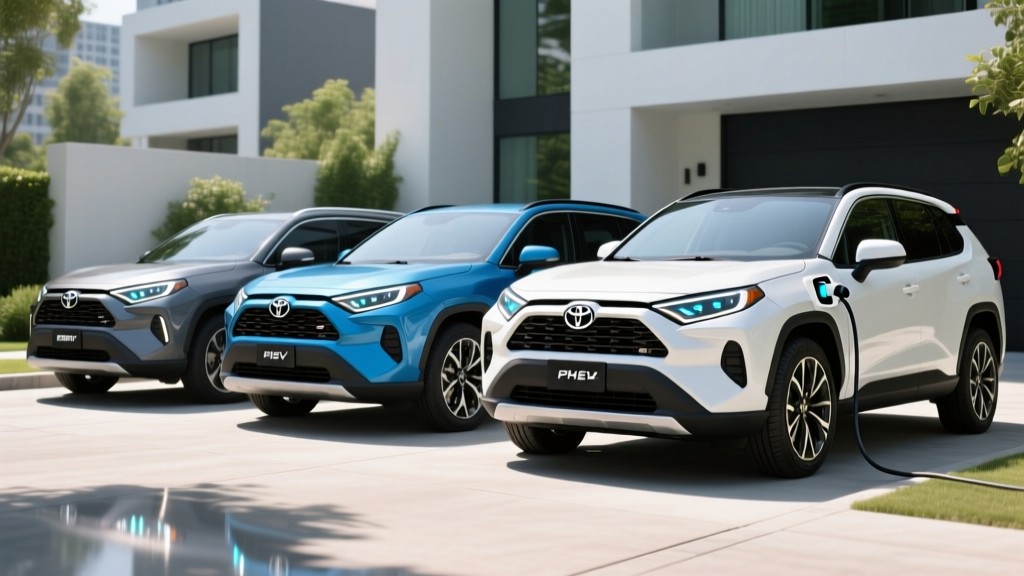
Toyota sells the RAV4 in two electrified flavors for 2026: the conventional RAV4 Hybrid (HEV) and the plug-in RAV4 Prime (PHEV). The HEV delivers a combined 39–41 MPG with no plug required, starting around $33,500. The Prime pairs a 42-mile electric-only range with 38 MPG once the battery depletes, starts near $44,500, and may qualify for up to $7,500 in federal tax credits under current IRS §30D rules. Both share Toyota's proven hybrid synergy drive, but they serve very different drivers.
HEV vs PHEV — The Core Difference
RAV4 Hybrid (HEV): A small battery (1.6 kWh) recharges itself through regenerative braking and the gas engine. You never plug it in. It operates as an electrically assisted gas car.
RAV4 Prime (PHEV): A larger battery (18.1 kWh) can be plugged in to charge, giving you ~42 miles of pure electric driving before the gas engine kicks in. After that, it functions like a regular hybrid.
RAV4 Hybrid (HEV): Fuel Economy & Real-World MPG
The 2026 RAV4 Hybrid pairs a 2.5-liter four-cylinder engine with front and rear electric motors for a combined 219 horsepower. All-wheel drive (AWD) is standard across all trims — Toyota eliminated the FWD-only option several model years ago.
| Trim | City MPG | Highway MPG | Combined MPG |
|---|---|---|---|
| LE / XLE | 41 | 38 | 40 |
| XLE Premium | 41 | 38 | 40 |
| Woodland Edition | 38 | 35 | 37 |
| SE / XSE | 41 | 38 | 39 |
| Limited | 41 | 37 | 39 |
Source: EPA / fueleconomy.gov
Real-World MPG vs EPA Sticker
Hybrids typically exceed their EPA city rating in stop-and-go traffic because regenerative braking recaptures energy the gas engine would waste. Owners consistently report 42–45 MPG in urban commuting. Highway driving is the opposite — sustained 75 MPH cruising yields closer to 34–36 MPG because the electric motor provides less assistance at speed. In cold weather (below 30°F), expect a 3–5 MPG drop due to increased engine runtime for cabin heat and reduced battery efficiency.
RAV4 Prime (PHEV): Electric Range, MPG & Powertrain
The RAV4 Prime is Toyota's most powerful RAV4 variant. A 2.5-liter engine combined with more potent front and rear electric motors produces 302 combined horsepower — enough for a 5.7-second 0–60 MPH time, quicker than many sport compacts.
| Specification | RAV4 Prime (PHEV) |
|---|---|
| Battery Capacity | 18.1 kWh (lithium-ion) |
| EPA Electric-Only Range | 42 miles |
| EPA Combined Range (EV + Gas) | ~600 miles |
| MPGe (Electric Mode) | 94 MPGe |
| MPG (After Battery Depletes) | 38 combined (40 city / 36 hwy) |
| Combined Horsepower | 302 hp |
| 0–60 MPH | 5.7 seconds |
| Level 1 Charging (120V) | ~12 hours (full charge) |
| Level 2 Charging (240V, 3.3 kW onboard) | ~4.5 hours |
| Level 2 Charging (240V, 6.6 kW onboard*) | ~2.5 hours |
| DC Fast Charging | Not supported |
*The 6.6 kW onboard charger is available on Premium and higher trims. Source: Toyota RAV4 Prime specifications
Real-World Electric Range Expectations
The EPA's 42-mile electric rating assumes moderate temperatures and mixed driving. In practice:
- Summer city driving (70°F): 40–44 miles achievable with gentle acceleration
- Highway at 70 MPH: ~32–35 miles before engine engagement
- Cold weather (below 30°F): ~28–32 miles — battery chemistry is less efficient and cabin heating draws significant energy
Unlike a full EV, range depletion isn't stressful: the gas engine seamlessly takes over and you have 14.5 gallons of fuel as backup.
Pricing, Trims & Federal Tax Credit Eligibility
Here's what the 2026 RAV4 Hybrid lineup costs before incentives:
| Model & Trim | Starting MSRP | Federal Tax Credit |
|---|---|---|
| RAV4 Hybrid LE | $33,575 | None (HEV) |
| RAV4 Hybrid XLE | $35,075 | None (HEV) |
| RAV4 Hybrid XLE Premium | $36,575 | None (HEV) |
| RAV4 Hybrid Woodland Edition | $37,275 | None (HEV) |
| RAV4 Hybrid SE | $37,575 | None (HEV) |
| RAV4 Hybrid XSE | $38,975 | None (HEV) |
| RAV4 Hybrid Limited | $41,075 | None (HEV) |
| RAV4 Prime SE | $44,590 | Up to $7,500* |
| RAV4 Prime XSE | $47,590 | Up to $7,500* |
| RAV4 Prime XSE Premium | $51,090 | Up to $7,500* |
*Prices include destination charge. Source: Toyota RAV4 Hybrid and Toyota RAV4 Prime official pages.
RAV4 Prime — §30D Federal Tax Credit Requirements (2026)
The RAV4 Prime may qualify for up to $7,500 under the IRS §30D Clean Vehicle Credit. Eligibility depends on all of the following:
- MSRP cap: Vehicle MSRP must not exceed $80,000 for SUVs (RAV4 Prime qualifies)
- Buyer income cap: AGI must not exceed $150,000 (single), $225,000 (head of household), or $300,000 (joint)
- Battery sourcing: Critical minerals and battery components must meet phased-in domestic/content thresholds — these tighten annually and can reduce or eliminate the credit for specific model years
- Point-of-sale transfer: You can transfer the credit to the dealer for an immediate price reduction at purchase, or claim it on your tax return
- Assembly: Vehicle must undergo final assembly in North America (RAV4 Prime is built in Japan — verify current eligibility on fueleconomy.gov)
Critical caveat: Because the RAV4 Prime is assembled in Japan, it may not meet the North American final assembly requirement for §30D. Always verify the specific VIN's eligibility at fueleconomy.gov before purchase, and consult a tax professional. Rules change frequently.
Battery Warranty, Reliability & Replacement Cost
Hybrid battery longevity is the top concern for first-time hybrid buyers. Toyota has one of the strongest track records in the industry, with millions of hybrid vehicles on the road — many exceeding 200,000 miles on the original battery.
Toyota Hybrid Battery Warranty
| Hybrid Battery Coverage | 10 years / 150,000 miles (whichever comes first) |
| Hybrid System Components | 8 years / 100,000 miles |
| Capacity Retention Threshold | Warranty covers defects; no guaranteed minimum SoH percentage stated |
| Transferability | Fully transferable to subsequent owners |
How Long Do RAV4 Hybrid Batteries Actually Last?
Based on long-term owner data and fleet reports:
- HEV (1.6 kWh battery): Degradation is minimal because the system keeps the battery in a narrow state-of-charge window (roughly 40–80%). Most HEV batteries outlast the vehicle. Failures before 150,000 miles are rare.
- Prime PHEV (18.1 kWh battery): Larger batteries experience more cycling, but Toyota's thermal management and conservative buffer strategy protect longevity. Expect 10–15% capacity loss over 10 years / 100,000 miles under normal use. Real-world reports from early Prime owners (2021+) show minimal electric-range degradation.
Battery Replacement Cost
If replacement is needed out of warranty:
- RAV4 Hybrid (HEV): $2,000–$3,500 for a refurbished or new hybrid battery pack, plus labor
- RAV4 Prime (PHEV): $4,000–$7,000 for the larger traction battery, plus labor
These costs are significantly lower than full EV battery replacements. Individual cell module replacement (rather than the full pack) is sometimes possible at independent hybrid specialists for $500–$1,500.
Who Should Choose Which RAV4 Hybrid?
Choose the RAV4 Hybrid (HEV) If:
- You don't have access to home or workplace charging
- You want maximum fuel savings with zero behavior change
- Your budget is under $40,000
- You drive mostly city miles (where the hybrid system shines)
- You plan to keep the vehicle 10+ years and value proven simplicity
Choose the RAV4 Prime (PHEV) If:
- You can charge at home (Level 2 strongly recommended — Level 1 takes 12 hours)
- Your daily commute is under 40 miles round-trip (you'll rarely use gas)
- You want 302 hp and a sub-6-second 0–60 time
- You want EV-like daily driving with gas-engine road-trip flexibility
- You qualify for the federal tax credit or your state offers PHEV incentives
Choose a Full EV (e.g., Tesla Model Y, Hyundai Ioniq 5) Instead If:
- You want zero tailpipe emissions and zero oil changes
- You have reliable home charging and your trips rarely exceed 250 miles
- You want to eliminate gas station visits entirely
- Your state offers strong EV rebates beyond the federal credit
Pros & Cons at a Glance
RAV4 Hybrid (HEV) — Pros
- 40+ MPG combined with no plug-in required
- Standard AWD across all trims
- Proven reliability with 10-year battery warranty
- Strong resale value
- Lower starting price than PHEV
RAV4 Hybrid (HEV) — Cons
- No electric-only driving mode
- No federal tax credit eligibility
- 219 hp is adequate but not quick
- Highway MPG drops noticeably vs city
RAV4 Prime (PHEV) — Pros
- 42 miles electric-only covers most commutes
- 302 hp — the fastest RAV4 available
- 94 MPGe in electric mode
- Seamless transition to hybrid when battery depletes
- Standard AWD with 2,500-lb towing capacity
RAV4 Prime (PHEV) — Cons
- $44,590+ starting price
- No DC fast charging — Level 2 only
- Japan assembly may disqualify from §30D federal credit
- Cargo space slightly reduced vs HEV (battery packaging)
- Long dealer waitlists in many markets
Frequently Asked Questions
How many MPG does the RAV4 Hybrid get?
The 2026 RAV4 Hybrid achieves 41 city / 38 highway / 40 combined MPG in most trims, per the EPA. The Woodland Edition rates slightly lower at 37 combined due to all-terrain tires. Real-world city driving often yields 42–45 MPG thanks to regenerative braking, while highway-only driving at 75 MPH typically returns 34–36 MPG.
How far can the RAV4 Prime go on electric only?
The EPA rates the RAV4 Prime at 42 miles of electric-only range. In real-world summer city driving, 40–44 miles is achievable. Cold weather and highway speeds reduce this to 28–35 miles. Once depleted, the gas engine engages and the vehicle operates as a conventional hybrid with 38 MPG combined — giving a total range of roughly 600 miles.
Does the RAV4 Prime qualify for a tax credit?
The RAV4 Prime may qualify for up to $7,500 under the IRS §30D Clean Vehicle Credit, but eligibility depends on North American final assembly, battery sourcing requirements, buyer income, and MSRP caps. Because the RAV4 Prime is assembled in Japan, it may not meet the final assembly requirement. Always verify your specific VIN at fueleconomy.gov and consult a tax professional before relying on the credit.
Is the RAV4 Hybrid reliable? What about battery replacement?
Toyota's hybrid system is among the most reliable powertrains in the industry, backed by a 10-year/150,000-mile hybrid battery warranty. The HEV battery typically lasts the life of the vehicle. Out-of-warranty replacement runs $2,000–$3,500 for the HEV and $4,000–$7,000 for the Prime's larger pack. These costs are modest compared to full EV battery replacements.
Does the RAV4 Hybrid need to be plugged in?
No. The conventional RAV4 Hybrid (HEV) charges its own small battery through regenerative braking and the gas engine. You simply fuel it like any other car. Only the RAV4 Prime (PHEV) benefits from being plugged in — and even the Prime will operate normally on gas alone if you never charge it.
Can the RAV4 Prime DC fast charge?
No. The RAV4 Prime does not support DC fast charging. It charges via Level 1 (120V, ~12 hours) or Level 2 (240V, 2.5–4.5 hours depending on onboard charger). This is typical for PHEVs — the smaller battery doesn't require DC fast-charging infrastructure, and home Level 2 charging is sufficient for daily use.
Hybrid vs PHEV vs full EV — which is right for me?
If you lack home charging, choose the HEV. If you have home charging and a short commute, the PHEV gives you electric daily driving with gas backup. If you have home charging, rarely drive more than 250 miles between charges, and want zero gas usage, a full EV like the Tesla Model Y or Hyundai Ioniq 5 may be a better fit. The RAV4 Hybrid lineup covers the first two scenarios exceptionally well.