RAV4 Hybrid Horsepower: The Numbers That Matter
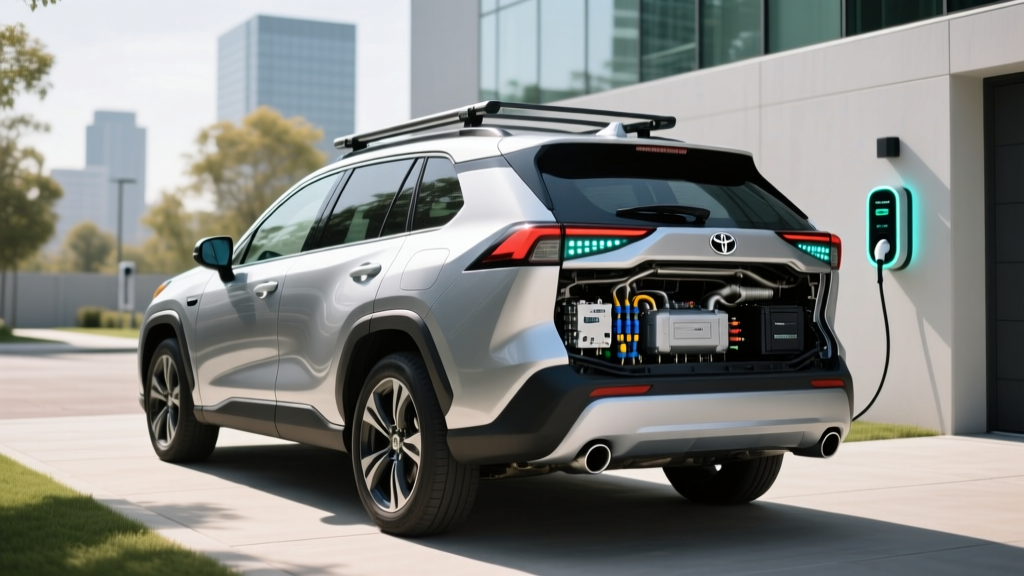
The 2026 Toyota RAV4 Hybrid pairs a 2.5-liter four-cylinder engine with dual electric motors to produce a combined system output of 219 horsepower. That figure represents the net power available when the gasoline engine and electric motors work together — not a simple addition of each component's peak rating.
Here's how the powertrain breaks down:
| Component | Specification |
|---|---|
| Engine | 2.5L Dynamic Force 4-cylinder (176 hp / 163 lb-ft) |
| Front Electric Motor | 118 hp / 149 lb-ft |
| Rear Electric Motor (AWD) | 54 hp / 89 lb-ft |
| Net Combined System Output | 219 hp |
| Transmission | eCVT (planetary gearset, no traditional belts) |
| Drivetrain | Electronic On-Demand AWD (standard) |
| 0–60 mph | 7.4 seconds |
| Towing Capacity | 1,750 lbs |
The RAV4 Hybrid's eCVT is not a belt-and-pulley continuously variable transmission. Toyota's Hybrid Synergy Drive uses a planetary gearset that blends engine and motor power seamlessly — there are no rubber bands or slippage. This design is a key reason the powertrain consistently ranks among the most reliable in the industry.
HEV vs. PHEV: Which RAV4 Are We Talking About?
The standard RAV4 Hybrid is a conventional hybrid (HEV). It charges its small battery through regenerative braking and the gasoline engine. You never plug it in.
The RAV4 Prime is a plug-in hybrid (PHEV) with a larger battery, more powerful motors, and an electric-only driving mode. It produces 302 hp combined and offers 42 miles of electric range. We cover both below.
Fuel Economy: EPA Ratings vs. Real-World MPG
The EPA rates the 2026 RAV4 Hybrid at 41 MPG city / 38 MPG highway / 40 MPG combined for LE and XLE trims. Higher trims with larger wheels and additional weight drop slightly to 39 MPG combined.
| Trim | City | Highway | Combined |
|---|---|---|---|
| LE / XLE | 41 MPG | 38 MPG | 40 MPG |
| XLE Premium / SE | 39 MPG | 37 MPG | 38 MPG |
| XSE / Limited | 39 MPG | 37 MPG | 38 MPG |
Real-world note: Toyota hybrids tend to exceed their EPA city ratings in stop-and-go driving because regenerative braking recovers energy that a gas car wastes as heat. On the highway, where the engine runs more continuously, expect numbers closer to — or slightly below — the EPA highway figure. In mixed suburban driving, many owners report 42–44 MPG consistently. In cold weather (below 30°F), expect a 5–10% reduction as the engine runs more frequently to provide cabin heat and maintain battery temperature.
For reference, the non-hybrid gas-only RAV4 AWD achieves 27 MPG combined — making the hybrid roughly 48% more fuel-efficient in everyday driving. Data sourced from fueleconomy.gov.
RAV4 Prime PHEV: Electric Range and Powertrain Specs
If you want electric-only commuting with the flexibility of a gas engine for road trips, the RAV4 Prime is the upgrade path. Here's how it compares to the standard hybrid:
| Specification | RAV4 Hybrid (HEV) | RAV4 Prime (PHEV) |
|---|---|---|
| Combined Horsepower | 219 hp | 302 hp |
| 0–60 mph | 7.4 sec | 5.7 sec |
| EPA Electric-Only Range | N/A (no plug) | 42 miles |
| Total Combined Range | ~580 miles | ~600 miles |
| Battery Capacity | 1.6 kWh (NiMH) | 18.1 kWh (Li-ion) |
| Level 1 Charge (120V) | N/A | ~12 hours (10–100%) |
| Level 2 Charge (240V) | N/A | ~2.5 hours (10–100%) |
| DC Fast Charging | N/A | Not supported |
| MPG (hybrid mode) | 40 combined | 38 combined |
| MPGe (electric mode) | N/A | 94 MPGe |
| Base MSRP | ~$33,425 | ~$44,990 |
The RAV4 Prime's 42 miles of electric-only range covers most daily commutes. On a full charge, you can drive to work, run errands, and return home without burning a drop of gasoline — then take a 500-mile road trip the same weekend without range anxiety. The 18.1 kWh lithium-ion battery charges on any standard 120V outlet overnight, or in about 2.5 hours on a 240V Level 2 charger.
DC fast charging is not available on the RAV4 Prime. This is typical for PHEVs — the battery is small enough that Level 2 charging is sufficient, and adding DC hardware would increase cost and weight.
Hybrid vs. PHEV vs. Full EV: Which Fits Your Life?
Choose the RAV4 Hybrid (HEV) if:
- You don't have reliable access to home or workplace charging
- You want maximum fuel efficiency with zero behavior change
- Your budget is under $40,000
- You drive 15,000+ miles/year and want the lowest cost-per-mile without plugging in
Choose the RAV4 Prime (PHEV) if:
- You can install a Level 2 charger at home (240V, ~$500–$1,500 install)
- Your daily commute is under 40 miles round-trip
- You want EV-like daily driving but need gas flexibility for longer trips
- You want 302 hp and 5.7-second 0–60 performance
Choose a full EV (like the bZ4X or Tesla Model Y) if:
- You have home charging and rarely drive more than 250 miles in a single day
- You want zero tailpipe emissions and minimal maintenance (no oil changes, no engine)
- You want access to the full $7,500 federal tax credit (subject to eligibility)
Pricing, Trims, and Tax Credit Eligibility
The 2026 RAV4 Hybrid starts at approximately $33,425 (LE trim, including destination). Fully loaded Limited trims reach around $42,000. The RAV4 Prime starts at roughly $44,990 and tops out near $51,000.
Federal tax credit status: The standard RAV4 Hybrid does not qualify for the federal §30D clean vehicle credit — it is a conventional hybrid, not a plug-in vehicle. The RAV4 Prime (PHEV) may qualify for up to $7,500 under current IRS rules, but eligibility depends on multiple factors:
- MSRP cap: SUVs must have an MSRP at or below $80,000 (RAV4 Prime qualifies)
- Buyer income cap: Modified AGI must not exceed $150,000 (single), $225,000 (head of household), or $300,000 (joint)
- Battery sourcing: Critical minerals and battery components must meet escalating domestic-content thresholds — these tighten annually and can reduce or eliminate the credit
- Point-of-sale transfer: Eligible buyers can transfer the credit to the dealer for an upfront price reduction
Always verify current eligibility on IRS.gov before purchasing, as battery sourcing rules change frequently. Consult a tax professional for your specific situation.
Reliability and Battery Warranty: What to Expect Long-Term
Toyota Hybrid Battery Warranty
Coverage: 10 years / 150,000 miles (whichever comes first) on the hybrid battery pack and all hybrid system components, including the inverter and electric motors.
Capacity retention: Toyota does not publish a specific degradation threshold for hybrids (unlike EVs), but the warranty covers defects and failures that impair function.
Toyota's hybrid system is one of the most proven electrified powertrains on the road — the Prius has used essentially the same planetary-gearset architecture since 1997. The RAV4 Hybrid's nickel-metal hydride (NiMH) battery is small (1.6 kWh) and is never deeply discharged, which significantly extends its lifespan. Many Toyota hybrids reach 200,000+ miles on the original battery pack.
The RAV4 Prime's larger lithium-ion (Li-ion) battery carries the same 10-year/150,000-mile warranty. Because PHEV batteries cycle more deeply than HEV batteries, some gradual capacity loss is expected over time — but Toyota engineers a buffer into the pack to maintain usable electric range.
Battery replacement cost: If the hybrid battery fails outside of warranty, replacement typically runs $3,000–$5,000 for the standard RAV4 Hybrid and $5,000–$8,000 for the RAV4 Prime. Refurbished and third-party replacement options exist for less. According to reliability data tracked by Consumer Reports, Toyota consistently ranks at or near the top for predicted reliability, and the RAV4 Hybrid is one of their strongest performers.
Pros and Cons at a Glance
Pros
- 219 hp provides confident highway merging and passing
- 40+ MPG combined — among the best for any compact SUV
- Standard AWD with no mechanical linkage (rear motor only)
- 10-year/150,000-mile hybrid battery warranty
- No charging infrastructure needed (HEV)
- Strong resale value and proven long-term reliability
- RAV4 Prime adds 302 hp and 42 miles of electric range
Cons
- HEV does not qualify for federal EV tax credit
- 1,750-lb towing capacity limits utility vs. truck-based SUVs
- RAV4 Prime carries an ~$11,500 premium over the base hybrid
- Engine noise under hard acceleration (eCVT drone)
- RAV4 Prime does not support DC fast charging
- Real-world highway MPG falls slightly short of EPA city rating
Frequently Asked Questions
How many MPG does the RAV4 Hybrid get?
The 2026 RAV4 Hybrid achieves 41 city / 38 highway / 40 combined MPG on LE and XLE trims. Real-world city driving often exceeds the EPA rating thanks to regenerative braking. Expect 38–44 MPG depending on driving conditions, temperature, and trim level.
How far can the RAV4 Prime go on electric only?
The RAV4 Prime delivers an EPA-rated 42 miles of electric-only range on a full charge. This covers most daily commutes without engaging the gasoline engine. Total combined range (electric + gas) reaches approximately 600 miles.
Is the RAV4 Hybrid reliable and what does battery replacement cost?
Yes. Toyota's hybrid system is among the most reliable powertrains in the industry, with the hybrid battery covered for 10 years / 150,000 miles. Out-of-warranty replacement costs $3,000–$5,000 for the standard hybrid and $5,000–$8,000 for the Prime. Many units exceed 200,000 miles on the original battery.
Does the RAV4 Hybrid qualify for a tax credit?
The standard RAV4 Hybrid (HEV) does not qualify for the federal §30D clean vehicle credit because it is not a plug-in vehicle. The RAV4 Prime (PHEV) may qualify for up to $7,500, subject to income limits, MSRP caps, and battery sourcing requirements. Check current rules at IRS.gov.
Do I need to plug in the RAV4 Hybrid?
No. The standard RAV4 Hybrid is a self-charging hybrid — it generates electricity through regenerative braking and the gasoline engine. You fuel it like any conventional car. Only the RAV4 Prime requires plugging in to access its electric-only range.
How does the RAV4 Hybrid's 219 hp compare to the gas-only model?
The gas-only 2026 RAV4 AWD produces 203 hp from its 2.5L engine. The hybrid's 219 hp combined output is modestly higher, but the electric motors deliver instant torque from zero RPM, making the hybrid feel noticeably quicker off the line. The RAV4 Prime's 302 hp is a significant performance upgrade.