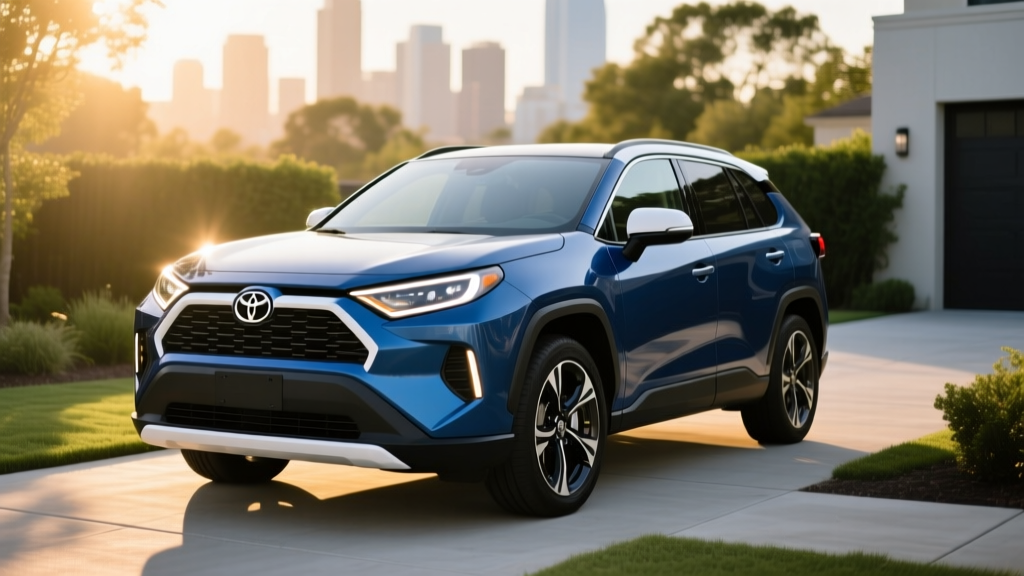
The Toyota RAV4 Hybrid AWD remains one of the most-purchased electrified vehicles in the United States, and for good reason: it pairs standard electronic all-wheel drive with mid-30s-to-low-40s MPG in a compact crossover footprint that fits real families. For 2026, Toyota continues the fifth-generation RAV4 Hybrid lineup with incremental tech and safety updates while keeping the proven 2.5-liter hybrid powertrain that has earned a reputation for durability across hundreds of thousands of miles on the road.
This guide covers everything a buyer needs to know about the 2026 RAV4 Hybrid AWD — from exact EPA fuel economy figures and real-world MPG expectations to the hybrid battery warranty, pricing across trims, and how it compares to the RAV4 Prime plug-in hybrid and full battery-electric alternatives.
RAV4 Hybrid AWD Fuel Economy: EPA Ratings vs Real-World MPG
The 2026 RAV4 Hybrid AWD carries the same EPA-rated fuel economy that has defined this generation since its refresh. Here is the official breakdown from fueleconomy.gov:
| Metric | Value |
|---|---|
| City MPG | 41 MPG |
| Highway MPG | 38 MPG |
| Combined MPG | 39 MPG |
| Fuel Tank Capacity | 14.5 gallons |
| Total Driving Range | ~565 miles |
The hybrid's city advantage is significant: the electric motor handles low-speed propulsion and assists the gasoline engine during acceleration, while regenerative braking recharges the 1.6 kWh nickel-metal hydride (NiMH) traction battery at every stop. You never plug it in — the system manages charge automatically.
Powertrain Specs: 219 HP with Electronic AWD
The RAV4 Hybrid AWD uses Toyota's fourth-generation hybrid system with a 2.5-liter Dynamic Force inline-4 engine paired with three electric motor-generators — two up front and one dedicated rear motor for all-wheel drive.
| Specification | Value |
|---|---|
| Engine | 2.5L inline-4, Atkinson cycle |
| Engine Output | 176 HP / 163 lb-ft torque |
| Front Electric Motors | Two motor-generators (MG1, MG2) |
| Rear Electric Motor | 54 HP / 89 lb-ft (AWD engagement) |
| Net Combined System HP | 219 HP |
| 0-60 MPH | 7.4 seconds |
| Transmission | eCVT (electronically controlled) |
| Drivetrain | Electronic On-Demand AWD |
| Towing Capacity | 1,750 lbs |
| Traction Battery | 1.6 kWh NiMH (sealed, self-charging) |
The electronic AWD system is not a traditional mechanical setup with a driveshaft. Instead, the rear electric motor engages automatically when the system detects front-wheel slip — during rain, snow, or hard cornering. It operates seamlessly and requires no driver input. The rear motor also applies torque vectoring during turns, subtly braking the inside rear wheel to sharpen handling.
Compared to the gas-only RAV4 AWD (203 HP, ~28 MPG combined), the hybrid delivers more power and roughly 40% better fuel economy while maintaining the same cargo volume and seating for five.
Hybrid vs Plug-In Hybrid: RAV4 Hybrid vs RAV4 Prime
Toyota also sells the RAV4 Prime, a plug-in hybrid electric vehicle (PHEV) with a larger battery and the ability to drive on electricity alone. Here is how the two stack up side by side:
| Attribute | RAV4 Hybrid AWD (HEV) | RAV4 Prime (PHEV) |
|---|---|---|
| Powertrain Type | Conventional hybrid (no plug) | Plug-in hybrid |
| Combined HP | 219 HP | 302 HP |
| Electric-Only Range | N/A (self-charging) | 42 miles (EPA) |
| Battery Capacity | 1.6 kWh NiMH | 18.1 kWh lithium-ion |
| Plug-In Charging | No | Yes (Level 1 or Level 2) |
| DC Fast Charge | No | No |
| Level 2 Charge Time (0-100%) | N/A | ~2.5 hours (6.6 kW onboard charger) |
| Combined MPG (gas mode) | 39 MPG | 38 MPG |
| MPGe (electric + gas) | N/A | 94 MPGe |
| Total Range | ~565 miles | ~600 miles |
| 0-60 MPH | 7.4 sec | 5.7 sec |
| Starting MSRP (2026) | ~$33,575 | ~$44,590 |
| Federal Tax Credit (§30D) | Not eligible | Up to $7,500 (eligibility varies) |
Choose the RAV4 Hybrid (HEV) if: You want maximum simplicity, no charging routine, a lower purchase price, and proven long-term reliability. You don't have reliable access to a plug at home or work.
Choose the RAV4 Prime (PHEV) if: You can charge at home (Level 2 recommended), your daily commute is under 42 miles round-trip, you want to drive mostly on electricity while keeping a gas engine for road trips, and you can capture the federal tax credit to offset the higher MSRP.
Pricing, Trims, and Tax Credit Eligibility
The 2026 RAV4 Hybrid AWD is offered across multiple trims. Pricing below reflects base MSRP before destination charges:
| Trim Level | Starting MSRP |
|---|---|
| LE | ~$33,575 |
| XLE | ~$35,075 |
| XLE Premium | ~$37,275 |
| SE | ~$37,575 |
| Woodland Edition | ~$37,775 |
| Limited | ~$40,075 |
Federal tax credit status: The conventional RAV4 Hybrid (HEV) does not qualify for the IRS §30D Clean Vehicle Credit. That credit is reserved for plug-in vehicles (BEVs and PHEVs) that meet battery-sourcing, critical-mineral, MSRP cap, and buyer income requirements outlined at irs.gov. The RAV4 Prime PHEV may qualify for up to $7,500, but eligibility depends on current-year sourcing rules, your adjusted gross income, and the vehicle's MSRP falling under the $80,000 SUV cap. Consult a tax professional before relying on credit estimates.
Some states offer their own hybrid or clean-vehicle rebates that may apply to the HEV. Check your state energy office or DMV for current programs — these vary widely by jurisdiction and change frequently.
Hybrid Battery Warranty, Lifespan, and Replacement Cost
The top concern among hybrid shoppers is battery longevity. Here is what the data shows:
- Chemistry advantage: The RAV4 Hybrid uses a nickel-metal hydride (NiMH) battery, which is less energy-dense than lithium-ion but extremely durable. NiMH cells tolerate deep temperature swings and do not suffer the same calendar degradation as some lithium chemistries.
- Shallow cycling: The hybrid system never fully charges or fully depletes the battery — it operates in a narrow state-of-charge window (roughly 40-80%). This dramatically reduces wear. The battery is essentially "babied" by the powertrain computer.
- Real-world lifespan: Based on fleet data and long-term owner reports, RAV4 Hybrid batteries routinely last 150,000-200,000+ miles before any significant capacity loss. Many first-generation Prius batteries exceeded 200,000 miles on the original pack.
- Replacement cost: If the battery does fail outside warranty, a new OEM replacement runs approximately $3,000-$4,500 including labor at a Toyota dealer. Refurbished/remanufactured units are available for $1,500-$2,500. Individual module replacement (only the failed cells) can cost under $1,000 at independent hybrid specialists.
For context, the average American drives ~14,000 miles per year. At that rate, the 10-year/150,000-mile warranty covers most owners through the entire first-ownership cycle, and real-world data suggests the battery will outlast the vehicle's economic life in many cases.
Reliability, Safety, and Long-Term Ownership
Toyota's hybrid powertrain is one of the most proven electrified systems on the road. The RAV4 Hybrid benefits from:
- No plug-in complexity: There is no charging port, onboard charger, or external charging hardware to maintain or repair.
- Reduced brake wear: Regenerative braking handles most deceleration, meaning the friction brake pads and rotors last significantly longer than on gas-only vehicles — often 80,000-100,000+ miles before replacement.
- eCVT durability: The electronically controlled continuously variable transmission uses a planetary gearset with no belts, clutches, or traditional gears to wear out. It is widely regarded as one of the most reliable transmissions in the industry.
- No 12V alternator: The hybrid system's DC-DC converter replaces the traditional alternator, eliminating another common failure point.
On safety, the 2026 RAV4 comes standard with Toyota Safety Sense 3.0, which includes pre-collision braking with pedestrian detection, lane departure alert with steering assist, full-speed adaptive cruise control, lane tracing assist, and automatic high beams. The RAV4 has consistently earned top marks from the IIHS and NHTSA in prior model years.
Who Should Buy the RAV4 Hybrid AWD — And Who Shouldn't
Pros
- 39 MPG combined — real-world often higher in city
- Standard AWD with no fuel-economy penalty vs FWD
- 219 HP — quicker than most compact hybrid SUVs
- No plug-in routine — fill up and go
- 10-year/150,000-mile hybrid battery warranty
- Strong resale value and proven reliability
- ~565 miles total range on a single tank
Cons
- No federal tax credit (HEV, not a plug-in)
- Engine noise under hard acceleration (eCVT drone)
- 1,750-lb towing limit — below some turbocharged rivals
- Infotainment interface lags behind some competitors
- Rear-seat legroom is adequate but not class-leading
- No DC fast charging option (not applicable to HEV)
- Buy the RAV4 Hybrid AWD if: You want an efficient, reliable AWD crossover with no charging hassle, you drive 12,000-20,000 miles per year, and you value low total cost of ownership over electric-only driving.
- Consider the RAV4 Prime (PHEV) if: You have home Level 2 charging, your commute is under 42 miles, you want electric-only daily driving with gas backup, and the ~$11,000 higher MSRP (partially offset by the tax credit) fits your budget.
- Consider a full EV (BEV) if: You have reliable home charging, you want zero tailpipe emissions, you're ready for a pure-electric ownership experience, and models like the Hyundai Ioniq 5, Tesla Model Y, or Toyota bZ4X meet your range and cargo needs.
2026 RAV4 Hybrid AWD vs the Competition
The compact hybrid SUV segment has grown. Here is how the RAV4 Hybrid AWD compares to key rivals on the metrics that matter:
| Vehicle | Combined MPG | HP | AWD? | Starting MSRP |
|---|---|---|---|---|
| Toyota RAV4 Hybrid AWD | 39 MPG | 219 | Standard | ~$33,575 |
| Honda CR-V Hybrid AWD | 37 MPG | 204 | Standard (Sport trims) | ~$35,395 |
| Ford Escape Hybrid AWD | 39 MPG | 210 | Available | ~$34,500 |
| Hyundai Tucson Hybrid AWD | 37 MPG | 226 | Standard | ~$34,900 |
| Kia Sportage Hybrid AWD | 38 MPG | 227 | Standard | ~$33,090 |
The RAV4 Hybrid holds its own on fuel economy and power, and Toyota's long-term reliability reputation and resale value remain segment benchmarks. The Honda CR-V Hybrid offers slightly more rear-seat room but trails on MPG and horsepower. The Hyundai Tucson and Kia Sportage twins deliver more horsepower and competitive pricing but have less established long-term hybrid durability track records.
Frequently Asked Questions
How many MPG does the RAV4 Hybrid AWD actually get?
The EPA rates the 2026 RAV4 Hybrid AWD at 41 city / 38 highway / 39 combined MPG. In real-world driving, expect 37-44 MPG depending on conditions. City and suburban driving with frequent stops favors the hybrid system and often yields 42+ MPG. Sustained highway speeds above 70 MPH and cold weather will pull the average toward the mid-to-high 30s.
Does the RAV4 Hybrid need to be plugged in?
No. The RAV4 Hybrid is a conventional hybrid (HEV), not a plug-in. It charges its own small battery through regenerative braking and the gasoline engine. You simply fill up at a gas station like any other car. If you want plug-in capability with electric-only driving, look at the RAV4 Prime PHEV.
Is the RAV4 Hybrid reliable, and what does a battery replacement cost?
Toyota's hybrid system is among the most reliable powertrains in the automotive industry, with decades of real-world data supporting this claim. The hybrid battery is warrantied for 10 years/150,000 miles, and real-world lifespans of 150,000-200,000+ miles are common. Out-of-warranty replacement costs approximately $3,000-$4,500 for a new OEM battery, or $1,500-$2,500 for a refurbished unit.
Does the RAV4 Hybrid qualify for any tax credits?
The conventional RAV4 Hybrid (HEV) does not qualify for the federal IRS §30D Clean Vehicle Credit, which requires a plug-in vehicle. Some states may offer separate incentives for hybrids — check your state's energy office. The RAV4 Prime PHEV may qualify for up to $7,500 federally, subject to income caps, MSRP limits, and battery-sourcing requirements that change annually.
Hybrid vs PHEV vs full EV — which should I choose?
A conventional hybrid (HEV) like the RAV4 Hybrid is ideal if you want better fuel economy with zero lifestyle change — no charging, no range planning, just fill up and drive. A plug-in hybrid (PHEV) like the RAV4 Prime makes sense if you can charge at home, want electric-only commuting, and need a gas engine for longer trips. A full EV (BEV) is the right choice if you have reliable home charging, want the lowest per-mile energy cost, and are ready to plan around charging infrastructure for road trips. Your access to charging and daily mileage are the two biggest factors in this decision.
How does the AWD system work on the RAV4 Hybrid?
The RAV4 Hybrid uses an electronic on-demand AWD system with a dedicated 54-HP electric motor powering the rear axle. There is no mechanical driveshaft connecting the front and rear. The rear motor engages automatically when the system detects front-wheel slip or when additional traction is needed. It also provides torque vectoring during cornering. The system adds minimal weight and does not reduce the EPA fuel economy rating compared to a hypothetical FWD-only variant.