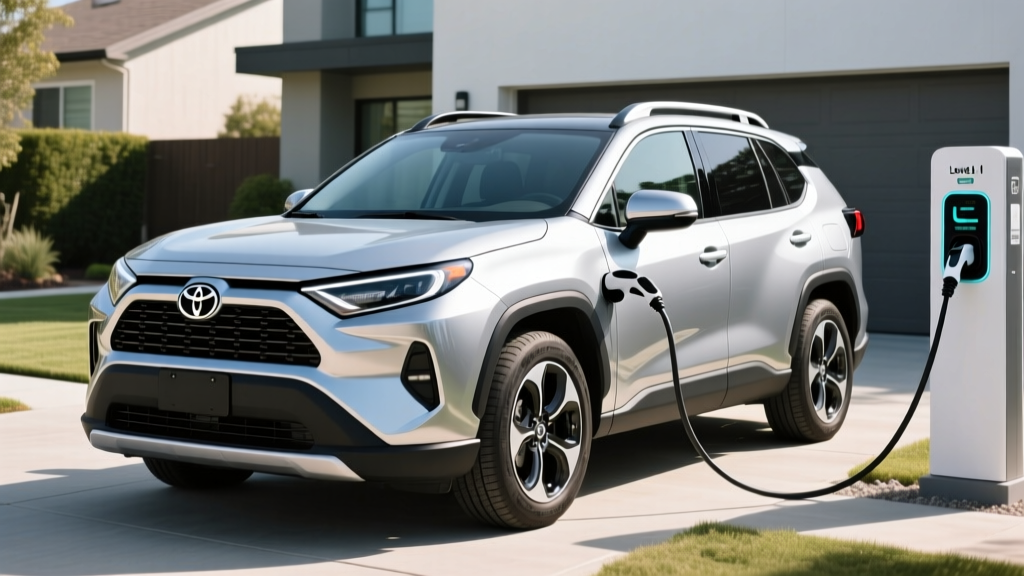
For buyers searching for a hybrid with 4WD that delivers genuine all-weather traction without sacrificing fuel economy, the 2026 Toyota RAV4 Hybrid remains the segment benchmark. Its electronic on-demand AWD-e system uses a dedicated rear-axle electric motor to send torque to the rear wheels when needed, eliminating the weight and friction losses of a mechanical driveshaft. The result is a compact SUV that achieves up to 41 MPG city while providing confident grip on snow, rain, and light off-road terrain.
This guide breaks down the 2026 RAV4 Hybrid AWD-e's powertrain, real-world fuel economy, reliability record, battery warranty, and how it compares to its plug-in hybrid sibling (RAV4 Prime) and full-electric alternatives.
2026 RAV4 Hybrid AWD-e: Core Specifications
| Attribute | Value |
|---|---|
| Powertrain | 2.5L inline-4 + 3 electric motors (front MG1/MG2, rear MGR) |
| Combined Horsepower | 219 HP (net system) |
| AWD System | Electronic on-demand AWD-e (rear motor up to 1,300 rpm / ~75 mph) |
| EPA MPG (City / Hwy / Combined) | 41 / 38 / 39 MPG |
| Fuel Tank Capacity | 14.5 gallons |
| Total Driving Range | ~565 miles (EPA estimate) |
| Hybrid Battery | 1.6 kWh lithium-ion (sealed NiMH on some trims) |
| 0–60 mph | 7.4 seconds |
| Towing Capacity | 1,750 lbs |
| Cargo Volume (behind rear seats) | 37.5 cu ft |
| Starting MSRP (LE AWD-e) | $34,445 |
| Battery Warranty | 10 years / 150,000 miles |
Source: fueleconomy.gov — EPA estimates. Actual mileage will vary.
Fuel Economy: EPA vs. Real-World MPG
The RAV4 Hybrid AWD-e carries EPA ratings of 41 city / 38 highway / 39 combined MPG. But hybrid fuel economy behaves differently than conventional gas cars — and in ways that often benefit real-world drivers.
| Driving Scenario | Expected MPG | Why |
|---|---|---|
| City / stop-and-go | 42–45 MPG | Regenerative braking and electric-only low-speed operation maximize efficiency |
| Suburban mixed | 38–41 MPG | Balanced regen and engine use; near EPA combined |
| Highway (70–80 mph) | 34–37 MPG | Less regen benefit; aerodynamic drag dominates at speed |
| Cold weather (below 30°F) | 32–36 MPG | Engine runs more for cabin heat; battery less efficient when cold |
How many MPG does this hybrid get in practice? Owner-reported data on Fuelly and similar tracking platforms consistently shows the RAV4 Hybrid averaging 37–40 MPG in mixed driving — very close to the EPA combined figure. City-heavy commuters often exceed 41 MPG, while sustained highway road trippers should budget for the mid-30s. The AWD-e system engages the rear motor only during acceleration from a stop, low-traction conditions, or heavy throttle, so its efficiency penalty versus the FWD variant is minimal — just 1 MPG combined.
How AWD-e Works: Electric All-Wheel Drive Explained
The RAV4 Hybrid's AWD-e is not a traditional mechanical 4WD system with a transfer case, center differential, or driveshaft connecting the front and rear axles. Instead, it uses a dedicated rear-mounted electric motor (MGR) that independently drives the rear wheels when the system detects slip, hard acceleration, or specific driving modes.
Key characteristics of the AWD-e system:
- No mechanical connection between front and rear axles — the rear motor is electrically powered by the hybrid battery
- Active up to ~75 mph (1,300 rpm rear motor speed) — above that, the vehicle operates in FWD
- Torque vectoring — the system can apply up to 50% of available torque to the rear axle during launch and low-traction scenarios
- Multi-Terrain Select on higher trims adds Mud/Sand and Rock/Dirt modes that adjust throttle response and traction control
- Trail Mode (available on Adventure and TRD Off-Road trims with conventional AWD, not AWD-e) provides brake-based limited-slip for more rugged terrain
For buyers specifically seeking a hybrid with 4WD capability for snow, rain, gravel roads, and light trail use, the AWD-e system is highly effective. It is not, however, a substitute for a body-on-frame 4WD system with low-range gearing for serious rock crawling or deep mud. Think of it as intelligent all-weather traction, not off-road hardware.
RAV4 Hybrid (HEV) vs. RAV4 Prime (PHEV): Which Is Right for You?
Toyota offers two electrified RAV4 variants with AWD. Understanding the difference between the conventional hybrid (HEV) and the plug-in hybrid (PHEV, branded "Prime") is essential before you buy.
| Specification | RAV4 Hybrid (HEV) | RAV4 Prime (PHEV) |
|---|---|---|
| Type | Conventional Hybrid — no plug-in required | Plug-in Hybrid — charges from a wall outlet or charger |
| Combined HP | 219 HP | 302 HP |
| EPA MPG (gas-only) | 39 combined | 38 combined (charge-sustaining) |
| Electric-Only Range | N/A (brief EV mode at low speed only) | 42 miles (EPA) |
| MPGe (electric + gas) | N/A | 94 MPGe |
| Battery Size | 1.6 kWh | 18.1 kWh lithium-ion |
| Level 1 Charge (120V) | N/A — self-charging | ~12 hours (0–100%) |
| Level 2 Charge (240V) | N/A — self-charging | ~2.5 hours (0–100%) |
| DC Fast Charging | No | No |
| AWD System | AWD-e (electronic) | AWD-e (electronic, more powerful rear motor) |
| 0–60 mph | 7.4 sec | 5.7 sec |
| Starting MSRP | $34,445 | $45,445 |
| Federal Tax Credit (§30D) | Not eligible | Up to $7,500 (eligibility varies) |
| Battery Warranty | 10 yr / 150,000 mi | 10 yr / 150,000 mi |
The bottom line: The RAV4 Hybrid (HEV) is for drivers who want maximum simplicity — no charging, no plug, just excellent fuel economy and AWD-e traction. The RAV4 Prime (PHEV) is for drivers who can charge at home, want 42 miles of electric-only commuting, and value the 302 HP performance boost. The Prime's $11,000 price premium is partially offset by the federal §30D tax credit of up to $7,500, depending on your income, the vehicle's MSRP cap compliance, and battery critical-mineral sourcing requirements.
2026 RAV4 Hybrid Pricing by Trim
| Trim | MSRP (incl. destination) | Notable Features |
|---|---|---|
| LE | $34,445 | Toyota Safety Sense 3.0, 8" touchscreen, wireless CarPlay/Android Auto |
| XLE | $36,945 | Power liftgate, dual-zone climate, SofTex seats, blind-spot monitor |
| XLE Premium | $39,245 | SofTex-trimmed heated seats, moonroof, 10-way power driver seat |
| Woodland Edition | $39,745 | TRD-tuned suspension, all-weather floor liners, unique styling |
| SE | $39,445 | Sport-tuned suspension, 19" alloy wheels, paddle shifters |
| XSE | $41,045 | Bi-tone paint, heated steering wheel, 12.3" digital cluster |
| Limited | $43,645 | JBL audio, panoramic moonroof, ventilated front seats, 360° camera |
Tax credit note: The conventional RAV4 Hybrid (HEV) does not qualify for the federal §30D new clean vehicle credit — that credit is reserved for plug-in electric vehicles (BEVs and PHEVs) meeting battery sourcing and MSRP requirements. Some states offer hybrid-specific rebates or HOV lane access; check your state's energy office for current programs.
Reliability, Battery Lifespan, and Replacement Cost
Hybrid battery longevity is consistently the top concern for first-time hybrid buyers. Here's what the data shows for the RAV4 Hybrid:
Is the RAV4 Hybrid reliable? Toyota's hybrid synergy drive system has been in production since 1997 (Prius), and the current-generation RAV4 Hybrid uses a well-proven fourth-generation THS (Toyota Hybrid System) powertrain. Consumer Reports consistently rates the RAV4 Hybrid above average for predicted reliability. The eCVT transmission has no traditional gears or belts — it uses a planetary gearset that is mechanically simple and durable.
What does hybrid battery replacement cost? If the hybrid battery fails outside warranty, replacement costs typically range from $2,000 to $4,000 for the RAV4 Hybrid's relatively small 1.6 kWh pack. This is far less than a full EV battery replacement because the pack is small. Independent hybrid specialists often offer refurbished battery packs for $1,500–$2,500. In practice, Toyota hybrid batteries routinely last 150,000–200,000+ miles with minimal degradation, as the system keeps the battery in a narrow 40–80% state-of-charge window to maximize longevity.
Other maintenance savings: Hybrids use regenerative braking, which significantly extends brake pad life — many owners report 80,000–100,000 miles on original brake pads. There's no alternator, starter motor, or accessory belt to replace. Oil changes are still required but the engine runs less frequently, keeping oil cleaner longer.
Hybrid vs. PHEV vs. Full EV: Which Fits Your Lifestyle?
Choosing between a conventional hybrid, plug-in hybrid, and full battery-electric vehicle depends on your daily driving patterns, home charging access, and budget. Here's a practical decision framework:
Choose the RAV4 Hybrid (HEV) if:
- You cannot charge at home (apartment, street parking, no garage outlet)
- You want zero behavior change — just fill up at any gas station
- Your budget is under $40,000 and you want AWD capability
- You regularly take long road trips through areas with sparse charging infrastructure
- You want proven reliability with minimal new-technology risk
Choose the RAV4 Prime (PHEV) if:
- You can install a Level 2 charger at home and your commute is under 42 miles round-trip
- You want electric-only daily driving but gas-engine flexibility for road trips
- You qualify for the $7,500 federal tax credit, narrowing the price gap
- You want the 302 HP performance upgrade
Choose a full EV (e.g., Tesla Model Y, Hyundai Ioniq 5) if:
- You have reliable home Level 2 charging
- Your daily driving is under 250 miles and you can plan road-trip charging stops
- You want the lowest per-mile fuel cost and minimal drivetrain maintenance
- You want access to the full $7,500 federal tax credit (vehicle and buyer eligibility permitting)
Pros and Cons: 2026 RAV4 Hybrid AWD-e
Pros
- 41/38/39 MPG EPA — among the most efficient AWD compact SUVs available
- Electronic AWD-e adds all-weather capability with virtually no fuel-economy penalty
- 10-year/150,000-mile hybrid battery warranty
- Strong resale value — Toyota RAV4 Hybrid historically retains value well
- No charging infrastructure required — works with existing gas station network
- 535+ mile real-world driving range between fill-ups
- Toyota Safety Sense 3.0 standard (pre-collision, lane tracing, adaptive cruise)
Cons
- AWD-e system disengages above ~75 mph (FWD-only at high speed)
- Not eligible for federal EV/PHEV tax credits
- 1,750-lb towing capacity limits utility for boat or camper trailers
- Infotainment system functional but not class-leading in responsiveness
- Engine noise under hard acceleration (typical of eCVT powertrain behavior)
- No DC fast charging capability (not applicable to HEVs, but limits any electric-only use)
Frequently Asked Questions
How many MPG does the 2026 RAV4 Hybrid with AWD get?
The EPA rates it at 41 city / 38 highway / 39 combined MPG. In real-world mixed driving, owners typically see 37–40 MPG. City-heavy routes often yield 42+ MPG thanks to regenerative braking, while sustained 75-mph highway driving drops to the mid-30s.
Does the RAV4 Hybrid need to be plugged in?
No. The RAV4 Hybrid is a conventional hybrid (HEV) that charges its battery entirely through regenerative braking and the gasoline engine. You never plug it in. This is different from the RAV4 Prime (PHEV), which does plug in for electric-only range.
Is AWD-e the same as 4WD?
Not exactly. AWD-e is an electronic all-wheel-drive system that provides automatic torque to the rear wheels when needed. It does not have a low-range transfer case or locking differentials found in traditional 4WD systems. For snow, rain, gravel, and light trails, AWD-e is highly capable. For serious off-roading, a body-on-frame 4WD vehicle (like a 4Runner) is more appropriate.
How long will the RAV4 Hybrid battery last?
Toyota's hybrid batteries are designed to last the life of the vehicle. The battery is warranted for 10 years or 150,000 miles. Real-world data from Prius and RAV4 Hybrid owners shows many batteries lasting 200,000+ miles with minimal degradation, as the system avoids deep discharge cycles.
What does it cost to replace the hybrid battery?
Out-of-warranty replacement for the RAV4 Hybrid's 1.6 kWh battery pack typically costs $2,000–$4,000 at a Toyota dealer. Refurbished packs from independent specialists run $1,500–$2,500. Given the battery's small size and Toyota's state-of-charge management, full replacement is uncommon before 150,000+ miles.
Does the RAV4 Hybrid qualify for any tax credit?
The conventional RAV4 Hybrid (HEV) does not qualify for the federal §30D new clean vehicle tax credit, which requires plug-in capability and minimum battery capacity. However, the RAV4 Prime (PHEV) may qualify for up to $7,500, subject to MSRP caps, buyer income limits, and battery sourcing requirements. Some states offer additional hybrid incentives — check your state energy office.
RAV4 Hybrid vs. Honda CR-V Hybrid AWD — which is better?
The 2026 Honda CR-V Hybrid AWD rates at 40/34/37 MPG (city/hwy/combined) — slightly behind the RAV4's 41/38/39 on the highway. The RAV4 offers more cargo space (37.5 vs. 36.3 cu ft) and a longer hybrid battery warranty. The CR-V Hybrid has a more refined interior and slightly smoother ride quality. Both are excellent choices; the RAV4 wins on fuel economy and range, the CR-V on interior polish.
Can the RAV4 Hybrid AWD-e handle snow?
Yes. The AWD-e system automatically sends torque to the rear wheels when front-wheel slip is detected, providing confident traction on snow and ice. Combined with Toyota Safety Sense's stability control and available all-season or winter tires, the RAV4 Hybrid AWD-e is a strong choice for winter-commute climates. It is not, however, a substitute for dedicated snow tires in severe conditions.