Quick Verdict: The 2023 RAV4 Hybrid at a Glance
The 2023 Toyota RAV4 Hybrid remains one of the most compelling hybrid SUVs for buyers who want dramatic fuel savings without changing their driving habits. With an EPA-rated 41 MPG city / 38 MPG highway / 40 MPG combined, standard electronic all-wheel drive, and 219 combined horsepower, it delivers efficiency and practicality in a proven package. Starting at $30,450 MSRP (LE trim, before destination), it undercuts many rivals while offering Toyota's reputation for hybrid longevity.
For buyers weighing whether to go hybrid, plug-in hybrid, or full electric, this guide breaks down the 2023 RAV4 Hybrid's real-world performance, battery durability, and how it compares to the RAV4 Prime PHEV and competing electrified SUVs.
| Spec | 2023 RAV4 Hybrid | 2023 RAV4 Prime (PHEV) |
|---|---|---|
| Powertrain | 2.5L 4-cyl + 3 electric motors | 2.5L 4-cyl + 3 electric motors (higher output) |
| Combined HP | 219 hp | 302 hp |
| EPA MPG (City/Hwy/Combined) | 41 / 38 / 40 MPG | 38 / 35 / 38 MPG (gas) / 94 MPGe (EV mode) |
| Electric-Only Range | N/A (no plug) | 42 miles (EPA) |
| Battery Capacity | 1.6 kWh (NiMH, self-charging) | 18.1 kWh (Li-ion) |
| Plug-In Charging | No | Yes — Level 1 (120V) or Level 2 (240V) |
| DC Fast Charging | N/A | Not supported |
| 0–60 mph | 7.4 sec | 5.7 sec |
| Starting MSRP | $30,450 (LE) | $43,090 (SE) |
| Drivetrain | Electronic AWD (standard) | Electronic AWD (standard) |
HEV vs PHEV: Which RAV4 Is Actually Right for You?
Conventional Hybrid (HEV) — RAV4 Hybrid: You never plug in. The gasoline engine and regenerative braking recharge a small 1.6 kWh battery. The electric motor assists the engine during acceleration and can propel the vehicle at low speeds for very short distances. You simply drive it like a normal car and get ~40 MPG.
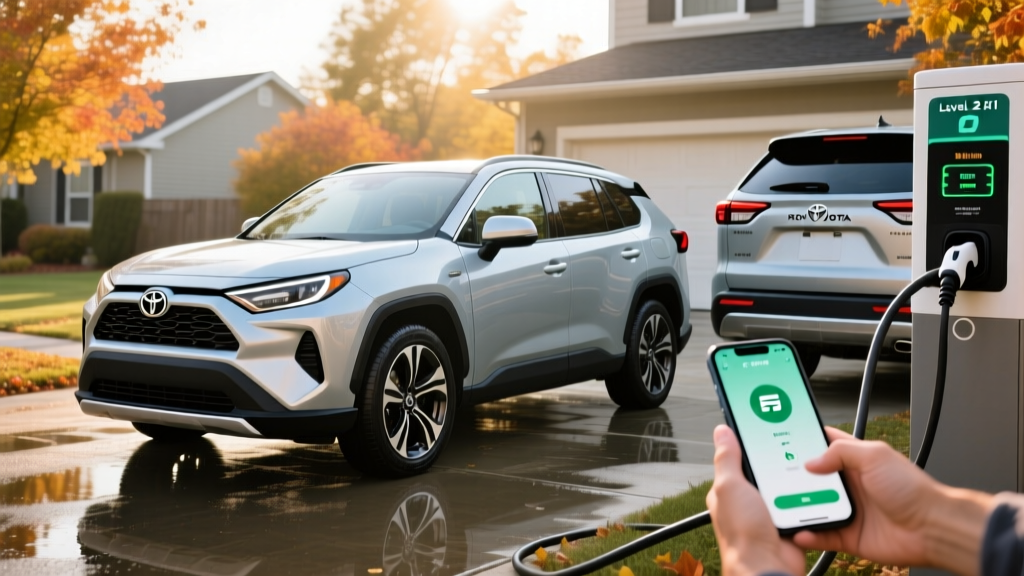
Plug-In Hybrid (PHEV) — RAV4 Prime: You plug in to charge a much larger 18.1 kWh lithium-ion battery. That gives you 42 miles of pure electric driving (EPA) before the gasoline engine kicks in. Once the battery depletes, it operates as a conventional hybrid at 38 MPG combined. If you can charge at home and your daily commute is under 42 miles, you may use almost zero gasoline for daily driving.
The decision framework:
- Choose the RAV4 Hybrid (HEV) if you don't have reliable access to a plug (apartment dwellers, street parkers), want the lowest purchase price, or drive long unpredictable distances where plug-in benefit diminishes.
- Choose the RAV4 Prime (PHEV) if you can install a Level 2 charger at home, have a commute under ~40 miles, want 302 hp and 5.7-second 0–60 performance, and can absorb the ~$12,600 higher starting price.
Real-World MPG: What the 2023 RAV4 Hybrid Actually Delivers
The EPA rates the 2023 RAV4 Hybrid at 41 MPG city / 38 MPG highway / 40 MPG combined across all trims, per fueleconomy.gov. These are strong numbers for a compact SUV, but real-world results vary based on driving style, climate, and terrain.
| Driving Scenario | Expected MPG | Notes |
|---|---|---|
| City / stop-and-go | 40–45 MPG | Hybrids excel here; regen braking and electric assist shine |
| Highway (70 mph, flat) | 34–38 MPG | Aerodynamic drag reduces hybrid advantage at sustained speed |
| Combined (mixed driving) | 37–41 MPG | Closely matches EPA for most owners |
| Cold weather (below 30°F) | 33–37 MPG | Engine runs more to heat cabin; battery efficiency drops |
| Heavy cargo / towing | 30–34 MPG | 1,500 lb tow capacity; added load penalizes MPG |
Why hybrids often beat EPA in the city: Unlike gas cars, hybrids recapture energy through regenerative braking at every stoplight and use the electric motor for low-speed acceleration — the least efficient operating range for a gasoline engine. Many owners report 43–45 MPG on city-heavy commutes, a rare case where the sticker number understates real-world performance.
Why highway MPG drops: At 70+ mph, aerodynamic drag dominates and the gasoline engine does nearly all the work. The hybrid system provides minimal benefit at sustained highway speeds. Drivers who are 90% highway may see combined numbers closer to 35–37 MPG.
Powertrain Deep Dive: 219 HP with Electronic AWD
The 2023 RAV4 Hybrid pairs a 2.5-liter Dynamic Force inline-4 engine (176 hp, 163 lb-ft) with three electric motor-generators:
- Front motor (MG2): 118 hp, 149 lb-ft — primary drive motor
- Front generator (MG1): Functions as a starter, generator, and assists powertrain control
- Rear motor: 54 hp, 89 lb-ft — powers the rear axle for electronic AWD
Combined system output is 219 horsepower. The rear motor activates automatically when slip is detected or during hard acceleration, providing AWD traction without a mechanical driveshaft. This means zero drivetrain loss to the rear wheels under normal cruising, contributing to the strong fuel economy.
The eCVT (electronically controlled continuously variable transmission) uses a planetary gearset rather than a belt-and-pulley design. Unlike some CVTs, Toyota's eCVT is a power-split device with no belts, chains, or cones to wear — it's one of the most durable transmission designs in the industry.
RAV4 Prime PHEV: 42 Miles Electric, 302 HP, and a $12,640 Premium
If you're researching the 2023 RAV4 Hybrid, the RAV4 Prime deserves consideration. It uses the same 2.5L engine but with more powerful electric motors and an 18.1 kWh lithium-ion battery pack.
Key RAV4 Prime specs:
- Electric-only range: 42 miles (EPA) — enough for most daily commutes
- Total combined range: ~600 miles (electric + gas)
- Combined horsepower: 302 hp (the fastest RAV4 Toyota makes)
- 0–60 mph: 5.7 seconds
- MPGe (electric mode): 94 MPGe
- Gas-only MPG (after battery depletion): 38 combined
- Charging: Level 1 (120V) in ~12 hours; Level 2 (240V) in ~4.5 hours with the upgraded 6.6 kW onboard charger (standard on XSE; 3.3 kW / ~7.5 hr on SE)
- DC fast charging: Not supported — a notable omission for a PHEV in this price range
The RAV4 Prime starts at $43,090 (SE trim) vs the Hybrid's $30,450 (LE). That's a significant premium, but the Prime qualifies for more incentives and delivers dramatically more power. For buyers with home charging access and short commutes, the Prime can operate as a daily EV with the security of a gas engine for road trips.
Battery Warranty, Lifespan, and Replacement Cost
2023 RAV4 Hybrid Battery Warranty:
- Hybrid battery: 10 years / 150,000 miles (whichever comes first), transferable to subsequent owners
- Hybrid system components: 8 years / 100,000 miles
- Capacity retention: Toyota warrants the battery against abnormal voltage loss but does not specify a minimum capacity percentage (unlike BEVs, which typically warrant 70% retention)
The RAV4 Hybrid uses a 1.6 kWh nickel-metal hydride (NiMH) battery. NiMH chemistry is less energy-dense than lithium-ion but extremely well-proven for longevity. Toyota's hybrid battery packs from the Prius lineage have demonstrated 150,000–250,000+ mile lifespans with minimal degradation in real-world use. The battery operates in a narrow state-of-charge window (roughly 40–80%), which dramatically reduces wear compared to full EVs that regularly cycle from 10–90%.
Battery replacement cost: If the hybrid battery fails outside warranty, a new OEM replacement runs approximately $2,000–$3,500 installed at a dealership. Refurbished or aftermarket options can reduce this to $1,000–$2,000. Given the 10-year/150,000-mile warranty and NiMH durability, out-of-pocket replacement during typical ownership is uncommon.
RAV4 Prime (PHEV) battery: The 18.1 kWh lithium-ion pack carries the same 10-year/150,000-mile warranty. Replacement cost is significantly higher — estimated $8,000–$12,000 — reflecting the much larger battery. However, Toyota's lithium-ion packs in the Prius Prime have shown strong longevity in early data.
Pricing, Trims, and Tax Credit Eligibility
The 2023 RAV4 Hybrid is available in six trims:
- LE: $30,450 — Toyota Safety Sense 2.5, 8" touchscreen, wireless CarPlay/Android Auto
- XLE: $32,350 — Dual-zone climate, blind-spot monitor, 18" alloy wheels
- XLE Premium: $34,150 — SofTex seats, sunroof, power liftgate
- SE: $34,750 — Sport-tuned suspension, 18" black wheels, paddle shifters
- XSE: $36,250 — Two-tone paint, 19" wheels, 9" touchscreen
- Limited: $39,250 — JBL audio, panoramic roof, heated/ventilated front seats
All prices are MSRP before the $1,335 destination charge.
Federal Tax Credit Status (IRS §30D, current rules):
- ❌ RAV4 Hybrid (HEV): Does NOT qualify for the §30D Clean Vehicle Credit. Conventional hybrids are not eligible — the credit applies only to plug-in vehicles (PHEVs and BEVs) with ≥4 kWh of battery capacity.
- ⚠️ RAV4 Prime (PHEV): Previously qualified for up to $7,500, but as of 2024+, the RAV4 Prime no longer meets the critical-mineral and battery-component sourcing requirements under the Inflation Reduction Act. Verify current eligibility at fueleconomy.gov before purchasing.
- ⚠️ Used RAV4 Prime: May qualify for the Used Clean Vehicle Credit (§25E) — up to $4,000 or 30% of sale price (whichever is lower) on a used PHEV purchased from a dealer for $25,000 or less, subject to buyer income limits ($75K single / $150K joint). Very few used Primes hit this price point currently.
State incentives: Some states offer additional rebates for PHEVs (not conventional hybrids). California's CVRP, for example, has historically offered rebates for PHEVs — check your state's energy office for current programs. These vary by jurisdiction and change frequently.
Reliability and Safety Record
Toyota's hybrid powertrain is among the most proven in the automotive industry. The RAV4 Hybrid's eCVT and NiMH battery have been refined over two decades of Prius engineering. The 2023 model carries strong reliability projections from both IIHS (Top Safety Pick for qualifying build dates) and predicted reliability scores from industry analysts.
Safety: All trims include Toyota Safety Sense 2.5 as standard: pre-collision system with pedestrian detection, full-speed dynamic radar cruise control, lane departure alert with steering assist, lane tracing assist, automatic high beams, and road sign assist. The RAV4 Hybrid earned a 5-star overall NHTSA safety rating.
Pros
- 40+ MPG in real-world city driving
- Standard AWD at no extra cost
- Proven hybrid reliability; 10-yr battery warranty
- No charging infrastructure needed
- Strong cargo space (37.6 cu ft rear seats up)
- Competitive pricing for a hybrid SUV
Cons
- No federal tax credit for HEV
- Highway MPG drops to mid-30s at 75+ mph
- eCVT drone under hard acceleration
- Infotainment is functional but dated vs rivals
- No DC fast charging option (Prime PHEV)
- Wait times at dealers may still be elevated
Who Should Buy the 2023 RAV4 Hybrid?
Buy the RAV4 Hybrid (HEV) if:
- You want 40 MPG without ever plugging in
- You live in an apartment or lack home charging access
- Your budget is $30K–$40K for a compact SUV
- You drive a mix of city and highway and value low operating cost
- You plan to keep the vehicle 8–10+ years and want proven longevity
Consider the RAV4 Prime (PHEV) instead if:
- You can install a Level 2 charger at home
- Your daily commute is under 42 miles round-trip
- You want 302 hp and sub-6-second 0–60 performance
- You can stretch to the ~$43K starting price
Consider a full EV (e.g., Tesla Model Y, Hyundai Ioniq 5) instead if:
- You want zero tailpipe emissions and lowest per-mile fuel cost
- You have reliable home charging and your trips rarely exceed 250 miles
- You want to qualify for the full $7,500 federal tax credit (on eligible models)
- You want minimal maintenance (no oil changes, fewer moving parts)
Frequently Asked Questions
How many MPG does the 2023 RAV4 Hybrid get in real driving?
The EPA rates it at 41 city / 38 highway / 40 combined MPG. In real-world driving, most owners report 37–42 MPG combined. City-heavy drivers often exceed the EPA estimate (43–45 MPG), while predominantly highway drivers may see 34–37 MPG. Cold weather and heavy cargo reduce efficiency by 3–7 MPG.
How far can the RAV4 Prime go on electric only?
The 2023 RAV4 Prime (PHEV) delivers 42 miles of EPA-rated electric-only range. Real-world results vary: 38–42 miles in mild weather with moderate driving, dropping to 32–36 miles in cold weather or at highway speeds. Once depleted, the Prime operates as a conventional hybrid at 38 MPG combined.
Does the 2023 RAV4 Hybrid qualify for any federal tax credit?
No. The conventional RAV4 Hybrid (HEV) does not qualify for the IRS §30D Clean Vehicle Credit — that credit applies only to plug-in vehicles (PHEVs and BEVs). The RAV4 Prime PHEV previously qualified but no longer meets current battery-sourcing requirements. Always verify eligibility at fueleconomy.gov and consult a tax professional before relying on credit availability.
Is the RAV4 Hybrid reliable, and what does a battery replacement cost?
Toyota's hybrid system is among the most reliable powertrains on the market, with decades of Prius-derived engineering. The hybrid battery is warrantied for 10 years / 150,000 miles. If replacement is needed out of warranty, expect $2,000–$3,500 for a new OEM NiMH pack. Most owners never need a replacement during typical ownership.
Do I need to plug in the RAV4 Hybrid?
No. The RAV4 Hybrid is a conventional (HEV) hybrid — it charges its own battery through the gasoline engine and regenerative braking. You never plug it in. Only the RAV4 Prime (PHEV) requires or benefits from plug-in charging.
How does the RAV4 Hybrid compare to a full EV for daily use?
The RAV4 Hybrid offers ~40 MPG with zero behavior change — no charging, no range planning. A full EV like the Tesla Model Y offers lower per-mile energy cost (~$0.04/mi vs ~$0.09/mi for the hybrid at $3.50/gal) and zero tailpipe emissions, but requires home charging access and planning for trips over ~300 miles. If charging access is uncertain, the hybrid is the lower-risk choice.