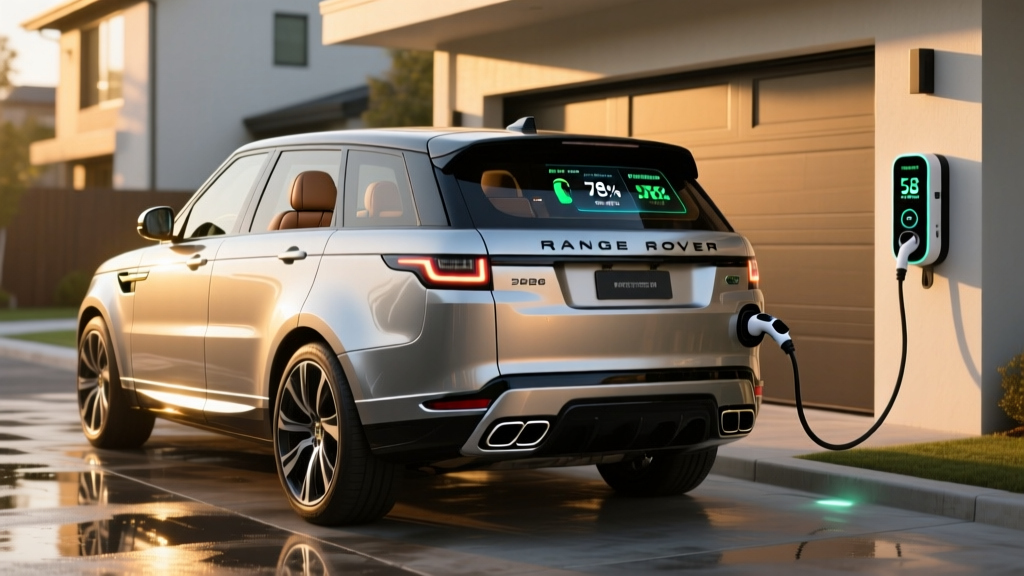
The Range Rover Sport PHEV occupies a narrow but compelling lane in the luxury SUV market: full-electric daily commuting wrapped in a chassis that can still tow 5,500 pounds and cross a continent without charging infrastructure anxiety. For 2026, Land Rover continues the P460e and P550e plug-in hybrid variants built on the MLA-Flex architecture, pairing a 3.0-liter inline-six with a 141-kW electric motor and a 38.2 kWh (usable) lithium-ion battery pack. The result is a luxury SUV that genuinely functions as an EV for most commutes, then seamlessly becomes a hybrid for road trips.
But the Range Rover Sport PHEV is also a six-figure vehicle in a segment where competitors like the BMW X5 xDrive50e undercut it by over $20,000 while offering comparable electric range. This guide breaks down exactly what you get, what you pay, and whether the math works for your driving pattern.
HEV vs PHEV: Where the Range Rover Sport Fits
Land Rover does not sell a conventional hybrid (HEV) version of the Range Rover Sport in the US market. Every electrified Sport is a plug-in hybrid (PHEV), meaning it carries a substantially larger battery than a standard hybrid and can be charged from an external power source to drive on electricity alone.
| Feature | Conventional Hybrid (HEV) | Plug-In Hybrid (PHEV) — RR Sport |
|---|---|---|
| Battery Size | 1–2 kWh | 38.2 kWh usable |
| Electric-Only Range | 0.5–2 miles at low speed | EPA 31 miles |
| Plug-In Charging | No — regenerates only | Yes — Level 2 AC (no DC fast charge) |
| Gas Engine Role | Primary propulsion, motor assists | Backup after battery depletes; assists under load |
| Tax Credit Eligibility | None | Potential §30D credit (see below) |
The practical implication: if you cannot charge at home or at work, the Range Rover Sport PHEV loses most of its value proposition. You would be hauling around a 600-pound battery pack as dead weight, achieving fuel economy only marginally better than a mild-hybrid competitor. Home charging access is essentially mandatory to justify the PHEV premium.
Electric Range, Battery, and Charging Specs
The 2026 Range Rover Sport PHEV uses a 38.2 kWh usable battery (from a 38.2 kWh gross pack housed beneath the floor). The EPA rates the P460e at 31 miles of electric-only range. On the WLTP cycle used in Europe, the figure is higher at roughly 70 miles (112 km), but US EPA testing is more demanding and reflects real-world conditions more accurately.
EPA Sticker: 31 miles (P460e)
Mild weather, city driving: 30–34 miles (regen braking helps in stop-and-go)
Highway (70 mph, moderate temps): 22–26 miles
Cold weather (below 30°F): 18–24 miles (cabin heating draws significant power)
The electric motor produces 141 kW (189 hp) on its own, which is sufficient for confident merging and highway cruising without the gas engine engaging — up to a top electric speed of 87 mph.
Charging Speed and Times
A critical limitation: the Range Rover Sport PHEV does not support DC fast charging. AC charging is the only option.
| Charging Level | Power (kW) | 0–100% Time | Infrastructure |
|---|---|---|---|
| Level 1 (120V household) | ~1.4 kW | ~27 hours | Standard outlet |
| Level 2 (240V, 32A) | 7.2 kW | ~5.5 hours | Home wallbox or public AC station |
| DC Fast Charge | Not supported | N/A | N/A |
The 7.2 kW onboard charger means a full recharge from empty takes about 5.5 hours on a Level 2 home charger. For most owners, plugging in overnight easily replenishes the 31-mile buffer. However, if you deplete the battery on a road trip, you cannot quickly top it up at a DC fast charger — the engine simply takes over as a hybrid.
Powertrain, Performance, and Efficiency
The 2026 Range Rover Sport PHEV comes in two powertrain tunes:
| Spec | P460e | P550e |
|---|---|---|
| Engine | 3.0L turbo I6 + electric motor | 3.0L turbo I6 + electric motor |
| Combined Horsepower | 454 hp | 542 hp |
| Combined Torque | 516 lb-ft | 590 lb-ft |
| 0–60 mph | 5.2 seconds | 4.3 seconds |
| Battery (usable) | 38.2 kWh | 38.2 kWh |
| EPA Electric Range | 31 miles | 29 miles |
| Towing Capacity | 5,500 lbs | 5,500 lbs |
| Drivetrain | AWD (standard) | AWD (standard) |
Both variants use an eight-speed ZF automatic transmission with the electric motor integrated between the engine and gearbox. The inline-six features a 48-volt mild-hybrid system of its own, so even when the main PHEV battery is depleted, you still benefit from regenerative braking and stop-start assist.
Fuel Economy: EPA and Real-World MPG
Once the battery is depleted and the Range Rover Sport operates as a conventional hybrid, fuel economy drops considerably given the vehicle's 5,600-pound curb weight and boxy aerodynamics.
| Driving Mode | EPA Estimate | Real-World Expectation |
|---|---|---|
| Charge-depleting (EV mode) | 46 MPGe combined | 40–48 MPGe (city-favorable) |
| Charge-sustaining (hybrid mode) | 21 MPG combined | 18–22 MPG (varies by terrain/speed) |
| City (hybrid mode) | 21 MPG | 20–23 MPG |
| Highway (hybrid mode) | 22 MPG | 19–21 MPG |
The real-world numbers reflect this vehicle's mass and aerodynamic profile. Expect closer to 19 MPG on sustained highway drives at 75+ mph, and up to 23 MPG in suburban driving with gentle throttle inputs. Compared to the BMW X5 xDrive50e (rated at 22 MPG combined in hybrid mode), the Range Rover Sport PHEV trails by roughly 1–2 MPG — a difference that matters little at this price point but is worth noting for high-mileage drivers.
If your daily commute falls within the 31-mile electric range and you charge nightly, your gasoline consumption could drop to near zero on weekdays. Multiple owners report going weeks between fill-ups in this usage pattern.
Pricing, Trims, and Tax Credit Eligibility
The 2026 Range Rover Sport PHEV commands a significant premium over the mild-hybrid and diesel variants:
| Trim | Base MSRP | Typical As-Tested |
|---|---|---|
| P460e SE | $89,575 | $95,000–$102,000 |
| P460e Autobiography | $99,075 | $105,000–$115,000 |
| P550e Autobiography | $114,075 | $118,000–$130,000 |
Federal §30D Tax Credit
The Range Rover Sport PHEV's eligibility for the federal clean vehicle credit under IRS §30D is complex and subject to change. As of 2026, the key requirements include:
- MSRP Cap: SUVs must be under $80,000 — the RR Sport PHEV exceeds this cap at all trim levels, making it ineligible for the new-vehicle §30D credit.
- Battery Component Sourcing: Must meet North American assembly thresholds for battery components and critical minerals.
- Buyer Income Cap: AGI must not exceed $150,000 (single) / $300,000 (joint).
- Point-of-Sale Transfer: Eligible buyers can apply the credit at purchase, but this is moot if the vehicle exceeds the MSRP cap.
Bottom line: at an MSRP starting near $90,000, the Range Rover Sport PHEV does not qualify for the $7,500 federal tax credit due to the SUV price cap. Some state-level incentives (such as those in California, Colorado, or New York) may still apply — check your state's incentive database at the AFDC for specifics, as these vary by jurisdiction and change frequently.
Battery Warranty, Reliability, and Replacement Cost
Land Rover provides the following warranty coverage for the PHEV powertrain:
High-Voltage Battery: 8 years / 62,000 miles (whichever comes first), guaranteed to retain at least 70% of original capacity
Powertrain (engine + motor + transmission): 4 years / 50,000 miles
Basic Vehicle Warranty: 4 years / 50,000 miles
Roadside Assistance: 4 years / 50,000 miles
The 70% capacity retention threshold is industry-standard for PHEVs and BEVs. In practice, a degraded Range Rover Sport PHEV battery at 70% health would still deliver roughly 22 miles of electric range — usable, but noticeably reduced.
Reliability Track Record
Land Rover's reliability reputation remains a concern for prospective buyers. J.D. Power consistently ranks the brand below industry average in dependability studies. The MLA-Flex platform and PHEV powertrain are relatively new (introduced for the 2023 model year), so long-term data beyond three to four years is still limited.
The high-voltage battery itself is unlikely to fail catastrophically — lithium-ion packs typically degrade gradually rather than dying outright. However, the surrounding power electronics, onboard charger, and thermal management system add complexity that can result in costly out-of-warranty repairs.
Battery Replacement Cost
Should the high-voltage battery require full replacement outside warranty, expect a cost between $12,000 and $18,000 including parts and labor. This figure is consistent with other luxury PHEVs in this battery-size class. Individual module replacement (if only certain cells fail) may reduce the cost to $4,000–$8,000, but this depends on dealer capability and parts availability.
Driving Experience and Daily Practicality
The Range Rover Sport PHEV's greatest strength is its dual personality. In EV mode, the cabin is whisper-quiet, the throttle response is instant, and the air suspension glides over imperfections. The 141-kW electric motor provides enough thrust for highway merging without waking the inline-six.
When the battery depletes, the transition to hybrid mode is nearly imperceptible — the engine starts under load or when additional power is demanded, and the eight-speed transmission manages the combined torque smoothly. The regenerative braking system offers adjustable levels via paddle shifters, though true one-pedal driving is not available as it is in full EVs.
Cargo space is slightly compromised by the battery placement: 28.6 cubic feet behind the second row (compared to 31.9 cu ft in the mild-hybrid Sport). The spare tire is replaced by a tire-repair kit. Ground clearance and wading depth remain impressive at 8.4 inches and 33.5 inches respectively — capabilities that no electric competitor currently matches.
Range Rover Sport PHEV vs. Competitors
| Spec | RR Sport P460e | BMW X5 xDrive50e | Porsche Cayenne E-Hybrid |
|---|---|---|---|
| Base MSRP | $89,575 | $67,275 | $91,000 |
| Combined HP | 454 hp | 483 hp | 463 hp |
| EPA EV Range | 31 miles | 38 miles | 32 miles |
| Battery (usable) | 38.2 kWh | 25.7 kWh | 25.9 kWh |
| 0–60 mph | 5.2 sec | 4.6 sec | 4.4 sec |
| Hybrid MPG (combined) | 21 MPG | 22 MPG | 21 MPG |
| DC Fast Charge | No | No | No |
| §30D Tax Credit | No (over MSRP cap) | No (over MSRP cap) | No (over MSRP cap) |
| Towing | 5,500 lbs | 5,000 lbs | 7,700 lbs |
The BMW X5 xDrive50e offers more electric range at a substantially lower price, making it the rational choice for most luxury PHEV buyers. The Porsche Cayenne E-Hybrid delivers sharper dynamics and higher towing capacity. The Range Rover Sport PHEV justifies its premium through off-road capability, interior material quality, and brand cachet — attributes that are difficult to quantify on a spec sheet but matter deeply to its target buyer.
Who Should Buy the Range Rover Sport PHEV?
- Your daily commute is under 30 miles round-trip and you can charge at home
- You need genuine off-road capability (Terrain Response, wading depth) alongside daily electrified driving
- You regularly tow up to 5,500 lbs and want electric assist for low-speed trailer maneuvering
- You value interior luxury, air suspension comfort, and brand prestige over spec-sheet value
- You want zero gasoline expenses and lower maintenance costs
- Your daily range needs exceed 31 miles and you want a 250+ mile all-electric buffer
- You have reliable home and destination charging access for longer trips
- You cannot install a Level 2 charger at home or work
- You want lower upfront cost and simpler maintenance
- Your driving is predominantly highway road trips where the PHEV battery adds dead weight
Frequently Asked Questions
How many MPG does the Range Rover Sport PHEV get?
The EPA rates the P460e at 21 MPG combined (21 city / 22 highway) in hybrid mode after the battery is depleted. In real-world driving, expect 18–22 MPG depending on speed, terrain, and temperature. When operating in electric mode, efficiency is rated at 46 MPGe combined.
How far can the Range Rover Sport PHEV go on electric only?
The EPA rates the P460e at 31 miles of electric-only range. In mild city driving, you may achieve 30–34 miles. On the highway at 70 mph, expect 22–26 miles. In cold weather below freezing, the range can drop to 18–24 miles due to cabin heating demands and reduced battery efficiency.
Does the Range Rover Sport PHEV qualify for a federal tax credit?
No. The federal §30D clean vehicle credit has an $80,000 MSRP cap for SUVs, and the Range Rover Sport PHEV starts at $89,575 — exceeding this limit at every trim level. Some state incentives may still apply depending on your jurisdiction. Consult the IRS clean vehicle credit page and your tax professional for current eligibility.
Is the Range Rover Sport PHEV reliable?
Land Rover ranks below industry average in most dependability studies (J.D. Power, Consumer Reports). The PHEV powertrain adds complexity with the high-voltage battery, power electronics, and dual power sources. The high-voltage battery carries an 8-year/62,000-mile warranty with 70% capacity retention guarantee. Long-term reliability data for this specific MLA-Flex PHEV platform is still limited to approximately three model years.
What does a Range Rover Sport PHEV battery replacement cost?
A full high-voltage battery replacement outside warranty is estimated at $12,000–$18,000 including parts and labor. Partial module replacement may cost $4,000–$8,000 if only certain cells degrade. With the 8-year warranty and typical lithium-ion degradation curves (roughly 1–2% capacity loss per year under normal use), most owners should not face this expense during typical ownership periods.
Can the Range Rover Sport PHEV use DC fast chargers?
No. The Range Rover Sport PHEV supports only AC charging — up to 7.2 kW on Level 2. A full charge from empty takes approximately 5.5 hours. DC fast charging is not available on this or most PHEVs in this class, as the battery size does not justify the added cost and weight of DC charging hardware.
Hybrid vs PHEV vs EV — which is right for me?
If you can charge at home and your daily driving is under 35 miles, a PHEV like the Range Rover Sport lets you commute on electricity while keeping a gas engine for road trips and towing. If you drive more than 40 miles daily and have reliable charging access, a full EV eliminates gas expenses entirely. If you cannot charge at home at all, a conventional hybrid (HEV) provides modest fuel savings with no behavior change — though Land Rover does not offer an HEV Sport in the US market.
- 31 miles of genuine EV range covers most commutes
- Best-in-class off-road capability among luxury PHEVs
- Whisper-quiet electric driving with instant torque
- 38.2 kWh battery is among the largest in the PHEV segment
- 5,500-lb towing capacity maintained
- Sumptuous interior with standard air suspension
- Starts at $89,575 — ineligible for federal §30D tax credit
- No DC fast charging capability
- Below-average reliability ratings for the brand
- 21 MPG in hybrid mode is unremarkable for the class
- Cargo space reduced vs. mild-hybrid variant
- Competitors offer more EV range at lower price (BMW X5 xDrive50e)