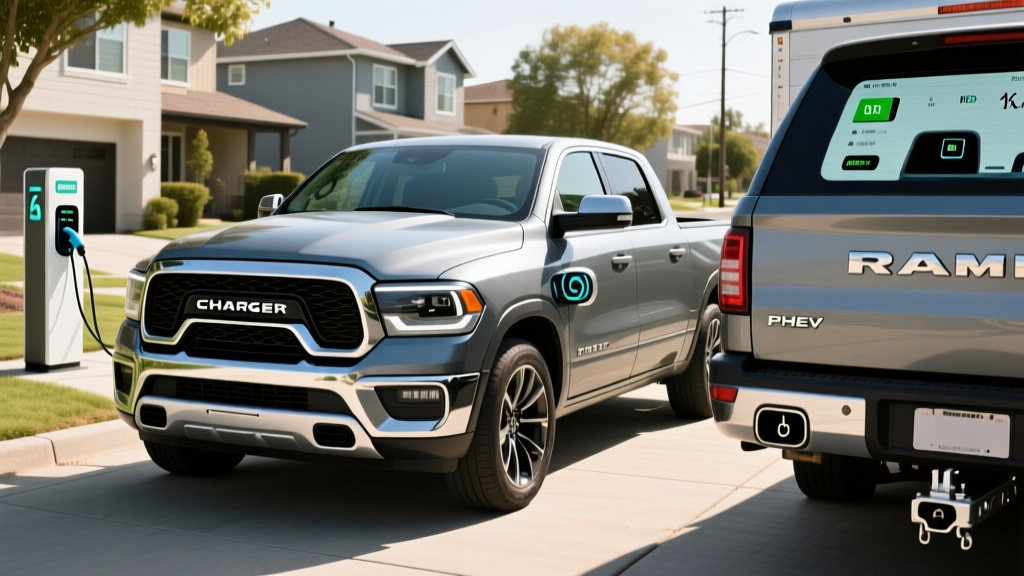
The RamCharger is not a conventional hybrid and it is not a battery-electric truck. It is a plug-in hybrid with a 3.6-liter Pentastar V6 that never turns a wheel — it exists solely to generate electricity when the battery runs low. That makes the 2026 RamCharger Ram 1500 PHEV one of the most unusual powertrains on the market, and one of the most practical for truck buyers who want daily electric driving without range anxiety on a job site or a cross-country tow.
Below, we break down exactly what this extended-range electric vehicle (EREV) can do: its EPA electric-only range, real-world fuel economy, towing capacity, charging times, and whether it qualifies for the federal §30D tax credit. We also compare it against full EVs and conventional hybrids so you can decide which electrified truck fits your workflow.
What Is the RamCharger? HEV vs PHEV vs EREV Explained
Before diving into specs, it helps to understand where the RamCharger sits in the electrification spectrum. Conventional hybrids (HEVs) like the Ford Maverick Hybrid use a small battery and regenerative braking to improve MPG but cannot plug in. Plug-in hybrids (PHEVs) like the Toyota RAV4 Prime add a larger battery and an electric-only driving mode, typically 30–50 miles, before a gas engine takes over.
The RamCharger goes a step further. It is technically an EREV — an extended-range electric vehicle. The 3.6L V6 onboard generator never mechanically drives the wheels. Instead, twin electric motors on each axle handle all propulsion. The result is EV-like torque delivery and smoothness at all times, with the gas engine acting as a mobile power plant when you exceed the battery's range.
| Type | Plug In? | Electric-Only Range | Engine Role | Example |
|---|---|---|---|---|
| HEV (Hybrid) | No | 0–2 miles at low speed | Drives wheels + charges battery | Ford Maverick Hybrid |
| PHEV (Plug-In Hybrid) | Yes | 30–50 miles typical | Drives wheels + charges battery | Toyota RAV4 Prime |
| EREV (Extended-Range EV) | Yes | 60–100+ miles | Generator only — never drives wheels | RamCharger Ram 1500 |
| BEV (Battery EV) | Yes | 200–400+ miles | No gas engine | Ford F-150 Lightning |
RamCharger Ram 1500 PHEV: Full Spec Table
| Powertrain | Dual electric motors (front + rear) + 3.6L V6 onboard generator |
| Combined Horsepower | 663 hp |
| Combined Torque | 615 lb-ft |
| Battery (usable) | 92 kWh (NMC lithium-ion) |
| EPA Electric-Only Range | 69 miles |
| Total Combined Range | ~690 miles (est.) |
| 0–60 mph | 4.4 seconds |
| Max Towing Capacity | 14,000 lbs |
| Max Payload | 2,625 lbs |
| Level 2 Charging (7.2 kW) | ~13 hours (0–100%) |
| DC Fast Charging | Not available |
| Onboard Generator Output | 150 kW continuous |
| Base MSRP (Warlock trim) | $69,995 |
| Top Trim MSRP (Limited) | ~$85,000+ |
| Battery/Powertrain Warranty | 8 years / 100,000 miles |
Electric-Only Range and Real-World MPG
The EPA rates the RamCharger at 69 miles of electric-only range, which is among the longest of any plug-in truck or SUV currently on the market. That distance covers the average American's round-trip commute (roughly 37 miles, per the U.S. Census Bureau) with room to spare — meaning many owners could drive electric-only on weekdays and only burn fuel on weekend road trips or towing runs.
EPA electric range: 69 miles. In practice, expect 55–65 miles in mixed driving with moderate climate control use. In freezing temperatures (below 32°F), NMC battery chemistry and cabin heating demands can reduce electric-only range by 20–30%, bringing it closer to 48–55 miles. Highway-only driving at 75+ mph will also trim range due to the RamCharger's large frontal area and truck aerodynamics.
Once the battery is depleted, the 3.6L V6 generator kicks on. Because the RamCharger is a heavy, full-size truck with permanent all-wheel drive, do not expect Prius-level efficiency in charge-sustaining mode. Ram targets an estimated 24–26 MPG combined when running on gasoline. That is competitive with the conventional Ram 1500 V6 eTorque (rated around 22 MPG combined on fueleconomy.gov) and significantly better than the 5.7L HEMI V8 variants (18–20 MPG).
| Mode | City | Highway | Combined |
|---|---|---|---|
| Electric-Only (MPGe) | TBD by EPA | TBD by EPA | ~70 MPGe (est.) |
| Charge-Sustaining (Gas) | ~26 MPG | ~23 MPG | ~25 MPG |
Note: Final EPA MPG figures for the 2026 model year were not yet published at the time of writing. The estimates above are based on Ram's preliminary data and comparable EREV powertrains. Check fueleconomy.gov for certified numbers once released.
Charging the RamCharger: Level 1, Level 2, and the No-DC-Fast-Charge Limitation
The RamCharger's 92 kWh battery is large for a PHEV — roughly the size of some full EVs — and that creates a charging challenge. Ram equips the truck with a 7.2 kW onboard charger for Level 2 AC charging. At that rate, a full 0–100% charge takes approximately 13 hours. Overnight charging on a home Level 2 wall connector (240V, 32A) will replenish the battery by morning if you plug in around 6 PM.
The critical limitation: the RamCharger does not support DC fast charging. There is no CCS or NACS port for 150+ kW public fast chargers. This is a deliberate engineering trade-off — the onboard generator essentially is the fast charger, producing up to 150 kW of electrical power on demand from gasoline. But if you planned to rely on Electrify America or Tesla Supercharger stops for quick top-ups, the RamCharger is not designed for that workflow.
| Charging Level | Power | 0–100% Time | Miles of EV Range per Hour |
|---|---|---|---|
| Level 1 (120V household) | ~1.4 kW | ~66 hours | ~5 miles |
| Level 2 (240V, 32A) | 7.2 kW | ~13 hours | ~27 miles |
| DC Fast Charge | Not supported | N/A | N/A |
| Onboard Generator (gas) | 150 kW | Continuous | Unlimited while fuel remains |
For home charging, you will want a hardwired Level 2 station on a 40A or 50A circuit. Budget $500–$800 for a quality Level 2 EVSE (ChargePoint Home Flex, Emporia Level 2, or similar) and $800–$2,000 for electrician installation depending on panel proximity and whether your home needs a service upgrade. A licensed electrician should confirm your panel's spare capacity before committing to a 240V circuit.
Powertrain Deep Dive: 663 HP and the Series-Hybrid Advantage
The RamCharger's dual-motor layout — one electric motor per axle — delivers standard all-wheel drive with instant torque vectoring. The combined 663 horsepower and 615 lb-ft of torque put it in performance-truck territory: the 4.4-second 0–60 time beats the F-150 Lightning Extended Range (roughly 5.0 seconds) and matches some V8 muscle cars.
Because the V6 generator is decoupled from the wheels, Ram can run it at its most efficient RPM regardless of vehicle speed. This "series hybrid" architecture eliminates the parasitic losses of a traditional transmission and torque converter. It also means the engine can serve double duty: at a job site, the RamCharger can function as a mobile generator, potentially powering tools or equipment — though Ram has not yet published official V2L (vehicle-to-load) wattage specs for the production model.
Pricing, Trims, and Federal Tax Credit Eligibility
The 2026 RamCharger starts at $69,995 for the Warlock trim, with the Limited and top-spec trims climbing past $85,000. That places it firmly in the premium full-size truck segment, competing with high-trim F-150 Lightnings, the Chevrolet Silverado EV, and loaded conventional Ram 1500s.
Under current IRS rules for the §30D New Clean Vehicle Credit, PHEVs and EREVs can qualify for up to $7,500 if they meet all of the following criteria:
- MSRP cap: Vans, SUVs, and pickup trucks must have an MSRP at or below $80,000. RamCharger Warlock ($69,995) qualifies; Limited trims above $80,000 do not.
- Buyer income limits: Adjusted gross income must not exceed $150,000 (single), $225,000 (head of household), or $300,000 (married filing jointly).
- Battery sourcing: A percentage of critical minerals and battery components must be sourced from the U.S. or free-trade-agreement countries. These thresholds increase annually and are subject to FEOC (Foreign Entity of Concern) restrictions. Verify current-year compliance on the IRS §30D page.
- Point-of-sale transfer: Buyers can transfer the credit to the dealer at purchase, reducing the out-of-pocket price immediately rather than waiting for tax filing.
Eligibility rules change frequently. Consult a tax professional and check irs.gov before purchasing.
If the Warlock trim qualifies for the full $7,500 credit and you use the point-of-sale transfer, the effective starting price drops to approximately $62,495 — narrowing the gap with well-equipped gas Ram 1500s and making the economics of daily electric driving more compelling.
Battery Longevity, Warranty, and Replacement Cost
Ram covers the 92 kWh battery pack and electric drive components for 8 years or 100,000 miles, whichever comes first. The warranty guarantees the battery will retain a minimum percentage of its original capacity (typically 60–70% for PHEV/EREV warranties, though Ram's exact retention threshold should be confirmed in your purchase documents). The 3.6L V6 generator, being a proven Pentastar engine in its 15th+ year of production, carries strong parts availability and service familiarity across the Ram dealer network.
Battery replacement cost is a common concern for hybrid and PHEV buyers. For a 92 kWh NMC pack, out-of-warranty replacement would likely fall in the $12,000–$18,000 range based on current industry pricing of roughly $130–$180 per kWh for replacement modules. However, NMC batteries in thermally managed systems (the RamCharger uses active liquid cooling) historically degrade slowly — typically losing 10–15% capacity over 8–10 years and 100,000+ miles, based on data from similar packs in the BMW i3 REx and Chevrolet Volt.
Because the RamCharger's engine is a generator and not subject to the constant start-stop thermal cycling of a conventional PHEV, mechanical wear on the V6 should be lower than in a parallel-hybrid system. The Pentastar 3.6L is one of the most widely produced engines in Stellantis history, which supports long-term serviceability.
RamCharger vs F-150 Lightning vs Gas Ram 1500: Which Fits You?
| Spec | RamCharger (EREV) | Ford F-150 Lightning (BEV) | Gas Ram 1500 V6 eTorque |
|---|---|---|---|
| Starting MSRP | $69,995 | ~$54,995 | ~$47,000 |
| EPA EV Range | 69 mi (electric only) | 230–320 mi | N/A |
| Total Range | ~690 mi | 230–320 mi | ~550 mi |
| Towing | 14,000 lbs | 7,700–10,000 lbs | 6,000–7,700 lbs |
| 0–60 mph | 4.4 sec | ~5.0 sec (Ext. Range) | ~7.5 sec |
| DC Fast Charging | No | Yes (up to 150 kW) | N/A |
| Home Charging Needed | Recommended | Essential | No |
| Fuel Cost per Mile | ~$0.04 (electric) / ~$0.17 (gas) | ~$0.04 (electric) | ~$0.19 (gas) |
Choose the RamCharger if: You need serious towing capacity (14,000 lbs), want 60+ miles of daily electric driving, don't have reliable access to public DC fast chargers, and regularly drive long distances where a pure EV's range would require multiple charging stops.
Choose the F-150 Lightning if: You can charge at home, your daily driving stays within 200 miles, you want the lowest per-mile fuel cost, and you don't regularly tow above 8,000 lbs.
Choose the gas Ram 1500 if: You cannot install a home charger, your budget is below $50,000, you drive fewer than 8,000 miles per year (making fuel savings less impactful), or you want the simplest possible ownership experience with no charging considerations.
Frequently Asked Questions
How many MPG does the RamCharger Ram 1500 PHEV get?
In electric-only mode, the RamCharger achieves an estimated 70 MPGe combined. When the battery is depleted and the V6 generator is running, expect approximately 24–26 MPG combined — competitive with a conventional V6 Ram 1500 and significantly better than V8 variants. Final EPA figures are pending; check fueleconomy.gov for certified numbers.
How far can the RamCharger go on electric only?
The EPA rates the RamCharger at 69 miles of electric-only range. In real-world mixed driving with climate control, expect 55–65 miles. In freezing weather, plan on 48–55 miles due to battery chemistry limitations and cabin heating demands.
Can the RamCharger DC fast charge?
No. The RamCharger does not have a DC fast-charge port. It charges via Level 1 (120V) or Level 2 (240V, 7.2 kW) AC charging. The onboard V6 generator serves as a range extender, producing up to 150 kW of electrical power from gasoline, eliminating the need for fast-charging stops.
Does the RamCharger qualify for the $7,500 federal tax credit?
The RamCharger Warlock ($69,995 MSRP) falls under the $80,000 MSRP cap for trucks and is potentially eligible for up to $7,500 under IRS §30D, subject to buyer income limits and battery-sourcing requirements. Trims priced above $80,000 are not eligible. Always verify current rules on irs.gov and consult a tax professional before purchasing.
Is the RamCharger reliable, and what does a battery replacement cost?
The RamCharger uses the proven 3.6L Pentastar V6 as a generator, reducing mechanical wear compared to a traditional powertrain. The battery and electric motors are covered by an 8-year/100,000-mile warranty. Out-of-warranty battery replacement is estimated at $12,000–$18,000, though NMC packs in thermally managed systems typically retain 85–90% capacity over the warranty period.
Hybrid vs PHEV vs EV — which fits my lifestyle?
If you can charge at home and drive under 70 miles daily, the RamCharger's EREV system gives you EV-like daily driving with gas-powered range for long trips. If you never want to think about charging and drive mostly highway, a conventional HEV is simpler. If you want zero tailpipe emissions and have home charging plus manageable trip distances, a full BEV like the F-150 Lightning offers the lowest running costs.
- 69 miles of electric-only range covers most daily commutes
- 14,000-lb towing capacity leads the electrified truck segment
- 663 hp and 4.4-second 0–60 deliver serious performance
- No range anxiety — V6 generator extends range indefinitely
- Proven Pentastar V6 as generator reduces long-term service risk
- Potential §30D tax credit on Warlock trim
- No DC fast charging — home Level 2 is essential
- $69,995 starting price is steep; Limited trims exceed $80K credit cap
- Charge-sustaining MPG (~25) is modest for a hybrid
- 13-hour Level 2 charge time is slow for a 92 kWh battery
- Heavy curb weight impacts tire wear and braking distances
- Final EPA MPG/MPGe figures not yet certified at time of writing