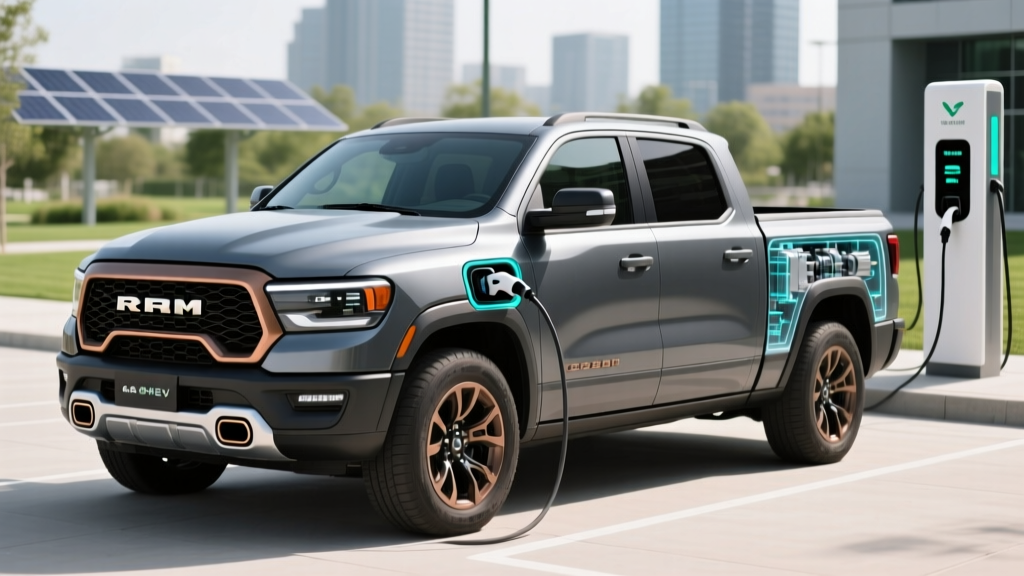
Ram's entry into the electrified SUV space has been one of the most anticipated moves in the truck-and-SUV segment. The upcoming 2028 Ram SUV gas PHEV—a plug-in hybrid variant of Ram's next-generation large SUV platform—promises to bridge the gap between traditional body-on-frame capability and electrified daily commuting. While Ram parent company Stellantis has confirmed a plug-in hybrid SUV in its pipeline, final specifications remain preliminary as of early 2026. This guide breaks down what we know, what's estimated based on the Hurricane inline-six platform and existing Stellantis PHEV architecture, and whether this SUV belongs on your shortlist.
HEV vs PHEV: What the Ram SUV Lineup Will Likely Offer
Ram's SUV strategy is expected to include both a conventional hybrid (HEV) and a plug-in hybrid (PHEV) variant. Understanding the difference is critical before you compare specs or visit a dealer.
Conventional Hybrid (HEV)
- No plug required — regenerates energy via braking and engine
- Small battery (~1.5–2.0 kWh) powers electric motor assist
- Cannot drive on electric-only power at meaningful speeds
- Typically 20–30% better fuel economy than gas-only equivalent
- No federal tax credit eligibility (no plug)
Plug-in Hybrid (PHEV)
- Plug-in capable — charges via Level 1/Level 2 AC or potentially DC fast charge
- Larger battery (~17–25 kWh) enables electric-only driving
- 25–50 miles of EV range before the gas engine engages
- Combined MPGe can exceed 50 when battery is charged
- May qualify for up to $7,500 federal tax credit (subject to §30D rules)
The 2028 Ram SUV gas PHEV is the plug-in variant. If you see "Ram SUV Hybrid" referenced without "PHEV" or "plug-in," it likely refers to the conventional HEV model, which will not offer electric-only range or federal tax credits. This article focuses on the PHEV.
Estimated Powertrain: Hurricane I6 Meets Electrification
Stellantis has been transitioning its powertrain lineup to the Hurricane twin-turbocharged 3.0-liter inline-six engine family, which replaced the legendary 5.7L Hemi V8 across Ram and Jeep products. For the PHEV SUV, expect a pairing of the Hurricane standard-output engine with one or two electric motors integrated into the transmission housing.
| Specification | Estimated Value |
|---|---|
| Engine | 3.0L Hurricane Twin-Turbo I6 (Standard Output) |
| Engine Power (gas only) | ~420 hp / 468 lb-ft torque |
| Electric Motor(s) | 1–2 motors integrated in 8-speed auto (est.) |
| Combined System Output | ~470–510 hp (est.) |
| Battery Chemistry | NMC (nickel-manganese-cobalt) lithium-ion |
| Battery Capacity (usable) | ~20–25 kWh (est.) |
| Transmission | 8-speed automatic with integrated electric motor |
| Drivetrain | 4WD standard (est.) |
| Towing Capacity | ~7,500–8,500 lbs (est.) |
The Jeep Grand Cherokee 4xe, which uses a 2.0L turbo I4 PHEV system, produces 375 combined hp. Ram's larger SUV will likely step up to the Hurricane I6 for the towing and hauling demands buyers expect from the brand. The 8-speed TorqueFlite transmission with an electric motor sandwiched between the engine and gearbox is a proven Stellantis PHEV layout.
Electric-Only Range and Total Driving Range
For PHEV buyers, the electric-only range is the headline number—it determines whether your daily commute can happen without burning a drop of gasoline.
Estimated Range Figures (PHEV)
| Electric-Only Range (EPA est.) | 35–45 miles |
| Total Combined Range | ~500–580 miles (gas + electric) |
| Real-World Electric Range Caveat | Expect 28–38 mi in cold weather (below 40°F); highway speeds above 65 mph reduce EV range by ~15–20% |
The current Jeep Grand Cherokee 4xe delivers 25 miles of EPA-rated electric range from a 17.3 kWh battery. Ram's larger SUV will likely use a bigger pack (~20–25 kWh usable) to push the EV range into the 35–45 mile bracket—critical for a heavier body-on-frame or unibody large SUV. This would cover the average American commute (approximately 37 miles round-trip, per FHWA data) for most drivers.
When the battery is depleted, the Hurricane I6 takes over seamlessly. With a ~26–30 gallon fuel tank (est.) and charge-sustaining fuel economy around 22–25 MPG combined, total range should comfortably exceed 500 miles—a key advantage over pure EVs for road-trip-heavy households.
Fuel Economy: MPG and MPGe Breakdown
PHEV fuel economy is measured two ways: MPGe (miles per gallon equivalent, when running on electricity) and MPG (when the gas engine is running after the battery is depleted). Both numbers matter depending on your driving pattern.
| Mode | City | Highway | Combined |
|---|---|---|---|
| Electric Mode (MPGe) | ~58 (est.) | ~52 (est.) | ~55 MPGe |
| Gas-Only (Charge-Sustaining MPG) | ~21 (est.) | ~25 (est.) | ~23 MPG |
| Comparable Gas-Only Ram SUV (est.) | ~16 | ~22 | ~18 MPG |
Real-world MPG context: PHEVs reward drivers who charge regularly. If you plug in nightly and your commute is under 40 miles, you might use gasoline only on weekend road trips—achieving an effective "real-world" fuel economy of 80–100+ MPGe over a month. Conversely, if you never plug in, you're carrying a heavy battery and getting roughly the same MPG as the conventional hybrid variant (or slightly worse due to weight). The EPA combined figure of ~23 MPG in charge-sustaining mode is what to expect on a long highway trip after the battery is depleted.
Charging: Battery Size, Times, and Connector Type
One of the most practical questions for PHEV buyers: how long does it take to recharge, and do you need special equipment?
| Charging Method | Power (kW) | Time (0–100%) | Notes |
|---|---|---|---|
| Level 1 (120V household outlet) | ~1.4 kW | ~14–18 hours | Overnight top-up only |
| Level 2 (240V home/public) | ~7.2 kW | ~3–3.5 hours | Full charge overnight or during workday |
| DC Fast Charge (if equipped) | ~50 kW (est.) | ~25–30 min (10–80%) | Not confirmed — most Stellantis PHEVs lack DCFC |
Important distinction — kW vs kWh: The battery capacity is measured in kWh (kilowatt-hours, the energy "tank size"), while charging speed is measured in kW (kilowatts, the rate of energy flow). A ~22 kWh battery charging at 7.2 kW takes roughly 3 hours from empty.
Stellantis' current PHEV lineup (Wrangler 4xe, Grand Cherokee 4xe) uses a J1772 connector for Level 1/Level 2 AC charging and does not support DC fast charging. Given the 2028 model year, there is a possibility Ram adopts the NACS (North American Charging Standard) connector for AC charging, but DC fast charging on PHEVs remains uncommon due to battery size and cost trade-offs. Expect Level 2 at 7.2 kW as the primary charging method.
For home charging, a standard 240V Level 2 installation (like a ChargePoint Home Flex or Emporia Level 2) typically costs $500–$1,200 for equipment and $800–$2,500 for professional electrician installation, depending on your panel capacity and run length. Most PHEV owners find a Level 2 charger fully replenishes the battery overnight with room to spare.
Pricing and Federal Tax Credit Eligibility
Ram has not announced official MSRP figures for the 2028 SUV PHEV, but based on the current Grand Cherokee 4xe pricing strategy and the premium Ram will command for a full-size or large SUV, here is a reasonable estimate:
| Trim Level (est.) | Est. MSRP | After Est. Tax Credit |
|---|---|---|
| Base (Big Horn / Laramie PHEV) | $62,000–$67,000 | $55,000–$60,000 |
| Mid (Limited PHEV) | $72,000–$78,000 | $65,000–$71,000 |
| Top (Longhorn / Tungsten PHEV) | $82,000–$90,000 | $75,000–$83,000 |
Federal Tax Credit (§30D) — Eligibility Checklist for PHEVs
Under current IRS §30D rules, PHEVs may qualify for up to $7,500 in federal tax credits. Eligibility depends on all of the following:
- Battery capacity: Must be ≥7 kWh (Ram PHEV est. ~20–25 kWh — ✅ likely qualifies)
- MSRP cap: SUVs/vans/trucks capped at $80,000 MSRP (higher trims may exceed this — ⚠️ check trim pricing)
- Buyer income cap: Modified AGI ≤ $150,000 (single) / $225,000 (head of household) / $300,000 (joint)
- Battery component sourcing: Must meet critical minerals and battery component requirements (phased percentages increase annually through 2029)
- Final assembly: Must be assembled in North America (likely ✅ — Stellantis U.S./Canada plants)
- Point-of-sale transfer: Credit can be applied at purchase to reduce out-of-pocket cost, or claimed on your tax return
Always verify eligibility with a tax professional and the IRS before purchasing. Rules are subject to change, and battery sourcing compliance varies by model year and production batch.
Reliability, Battery Warranty, and Replacement Cost
Hybrid and PHEV battery longevity is the top concern for buyers spending $60,000+ on a new vehicle. Here's what to expect from Ram's PHEV platform.
Estimated Hybrid Battery Warranty
| Federal mandate (minimum): | 8 years / 100,000 miles (emissions-related hybrid components) |
| Stellantis current coverage: | 8 years / 100,000 miles on PHEV battery pack |
| Capacity retention threshold: | Typically 60–70% of original capacity before warranty claim triggers |
| Powertrain warranty: | 5 years / 60,000 miles (Stellantis standard) |
Real-world battery longevity: Modern NMC lithium-ion PHEV batteries from major manufacturers typically retain 85–90% capacity after 8 years of normal use. The Jeep Grand Cherokee 4xe (on sale since 2022) has not shown widespread battery degradation issues as of 2026. PHEV batteries are smaller and cycled less deeply than full EV batteries, which generally works in their favor for longevity.
Battery replacement cost: If the PHEV battery fails out of warranty, expect a replacement cost of $8,000–$14,000 (parts and labor) for a ~20–25 kWh pack. This is significantly less than a full EV battery replacement ($15,000–$25,000+), but still a major expense. The hybrid system's electric motor and power electronics carry separate warranty coverage.
General reliability: Ram and Stellantis have historically scored mid-to-below-average in Consumer Reports reliability rankings, though the Hurricane I6 engine and 8-speed PHEV transmission are proven in the Jeep lineup. The 2028 SUV will benefit from several years of 4xe system refinement by launch.
Who Should Choose the Ram SUV PHEV vs. a Full EV or Gas Car?
The PHEV sits in a specific ownership niche. It's not the right call for everyone—but for the right buyer, it's the most versatile option available.
Decision Framework: Which Powertrain Fits You?
| Choose the Ram SUV PHEV if: | Choose a Full EV (e.g., Rivian R1S, Tesla Model X) if: | Choose Gas/HEV if: |
|
✅ Commute is under 40 miles round-trip ✅ You can charge at home (garage/driveway) ✅ You tow a trailer or take long road trips regularly ✅ You want EV commuting without range anxiety ✅ You live in an area with sparse DC fast-charging infrastructure |
✅ Home charging is available ✅ Most trips are under 250 miles ✅ You want the lowest per-mile fuel cost ✅ You want zero tailpipe emissions ✅ You don't tow heavy loads frequently |
✅ No home charging access (apartment/street parking) ✅ Budget is a primary concern (lower upfront cost) ✅ You rarely drive more than 15 miles/day ✅ You want the simplest ownership experience |
The Ram SUV PHEV's strongest use case: a family that commutes locally on electric power during the week but tows a boat or camper on weekends and takes cross-country road trips during the summer. No full EV can match this flexibility without careful route planning around charging stations. And no gas-only SUV can match the PHEV's weekday fuel savings.
👍 Estimated Pros
- 35–45 miles electric-only for daily commuting
- 500+ mile total range eliminates road-trip range anxiety
- Hurricane I6 provides strong towing (est. 7,500+ lbs)
- Potential $7,500 federal tax credit reduces effective price
- Proven PHEV architecture from Grand Cherokee 4xe
- Level 2 home charging fully replenishes overnight
👎 Estimated Cons
- Likely no DC fast charging (limits public charging utility)
- Higher trims may exceed $80,000 MSRP cap for tax credit
- Charge-sustaining MPG (~23) only modestly better than gas V8
- Premium pricing vs. conventional HEV variant ($8,000–$12,000 more)
- Stellantis reliability track record is middling
- Heavy battery adds weight, affecting handling vs. gas-only model
Competing PHEV SUVs to Cross-Shop
The 2028 Ram SUV gas PHEV won't exist in a vacuum. Several large PHEV SUVs already compete in this space, and more are arriving by 2028:
- Jeep Grand Cherokee 4xe: 25 mi EV range, 56 MPGe combined, ~$60K starting. The closest corporate cousin; proven but smaller and less powerful.
- Toyota Grand Highlander Hybrid (HEV, not PHEV): 35 MPG combined, no plug, no EV range, ~$45K. Better fuel economy when not plugging in, but no electric-only mode.
- BMW X5 xDrive50e: 38 mi EV range, 50 MPGe combined, ~$74K. Premium competitor with excellent PHEV execution but higher pricing.
- Lincoln Aviator Grand Touring (PHEV): 21 mi EV range (discontinued after 2024), limited availability on the used market.
The Ram's differentiator will be its combination of truck-brand capability (towing, payload, ground clearance) with PHEV efficiency—a niche currently underserved in the market.
Frequently Asked Questions
How many MPG does the 2028 Ram SUV PHEV get?
Estimated ~23 MPG combined in gas-only (charge-sustaining) mode, and ~55 MPGe combined when factoring in electric-only driving. Actual results depend heavily on how often you charge. With nightly charging and a short commute, real-world effective economy can exceed 80 MPGe over a month. Without charging, expect ~21 city / 25 highway / 23 combined MPG—better than a gas-only equivalent (~18 combined) but not dramatically so.
How far can the Ram SUV PHEV go on electric only?
Estimated 35–45 miles of EPA-rated electric-only range, based on a ~20–25 kWh usable battery pack. Real-world range drops to approximately 28–38 miles in cold weather (below 40°F) and at sustained highway speeds above 65 mph. This covers most daily commutes but will not suffice for longer trips without the gas engine engaging.
Hybrid vs PHEV vs EV — which fits my lifestyle?
Choose a conventional hybrid (HEV) if you want better fuel economy with zero behavior change (no plugging in). Choose a PHEV if you can charge at home, commute under 40 miles, but also need long-range capability for road trips or towing. Choose a full EV if you have home charging, mostly drive under 250 miles between stops, and want the lowest operating cost and zero tailpipe emissions. The Ram SUV PHEV is ideal for truck-oriented families who need towing range but want EV-like weekday commuting.
Is the Ram PHEV reliable and what does battery replacement cost?
The PHEV system is based on Stellantis' proven 4xe architecture (in use since 2021 in the Wrangler, 2022 in the Grand Cherokee). The hybrid battery carries an estimated 8-year/100,000-mile warranty with a ~60–70% capacity retention threshold. Out-of-warranty battery replacement is estimated at $8,000–$14,000. Overall Stellantis vehicle reliability has been mid-pack; the Hurricane I6 and 8-speed transmission are well-tested. Expect the PHEV components to be more reliable than the infotainment and electrical accessories, historically Stellantis weak points.
Does the 2028 Ram SUV PHEV qualify for a tax credit?
Likely yes, for eligible buyers and trims. Under current IRS §30D rules, new PHEVs with ≥7 kWh batteries assembled in North America can qualify for up to $7,500 in federal tax credits. However, eligibility depends on: (1) MSRP ≤$80,000 for SUVs—higher trims may exceed this; (2) buyer income caps ($150K single / $300K joint); (3) battery component and critical mineral sourcing requirements. The credit can be transferred to the dealer at point of sale to reduce your purchase price. Always verify with IRS guidelines and a tax professional before purchasing.
Can the Ram SUV PHEV DC fast charge?
Unlikely. Current Stellantis PHEVs (Wrangler 4xe, Grand Cherokee 4xe) do not support DC fast charging, using only J1772 AC charging at up to 7.2 kW. While it's possible Ram could add DCFC capability by 2028, the small battery size (~20–25 kWh) and added cost make it less likely. Expect Level 2 AC charging at 7.2 kW to take approximately 3–3.5 hours for a full charge, which is adequate for overnight home charging.
Will the 2028 Ram SUV have a conventional hybrid (non-plug-in) option?
Very likely. Stellantis has deployed mild-hybrid and full-hybrid systems across its lineup, and a conventional HEV variant of the Ram SUV would offer a lower price point (~$5,000–$8,000 less than PHEV) with modest fuel economy gains (est. 20–22 MPG combined) and no plug-in requirement. However, the HEV would not qualify for federal tax credits and would not offer electric-only driving.
This article reflects information available as of early 2026 about an announced but unreleased vehicle. Final EPA-certified specifications, pricing, and tax credit eligibility may differ at the time of sale. Always verify with fueleconomy.gov, the manufacturer, and a tax professional before making a purchase decision.