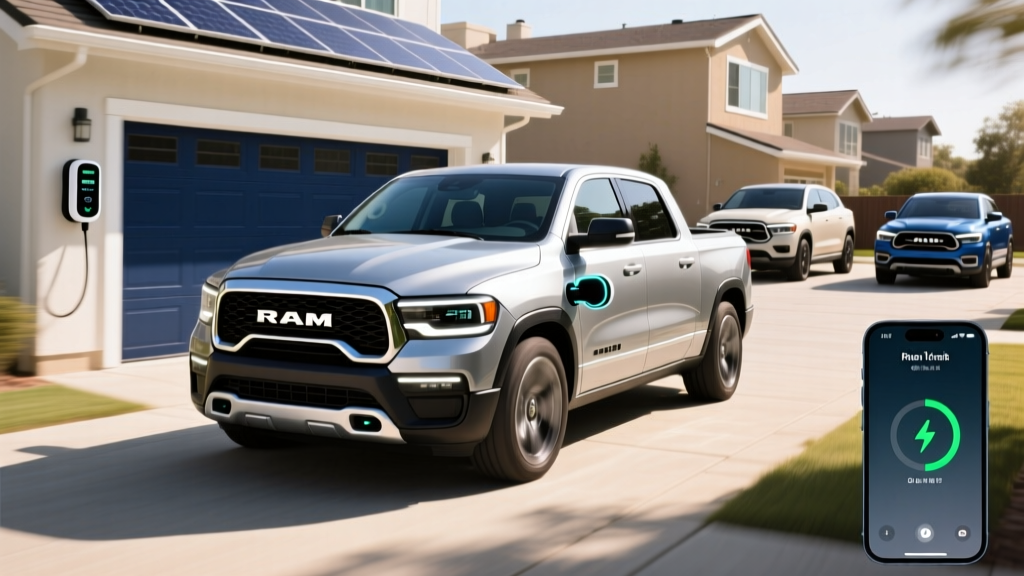
Ram enters the electrified truck market in 2026 with a powertrain strategy no other American automaker has attempted: an extended-range electric vehicle (EREV) that pairs a large traction battery with an onboard gasoline generator. The result is the Ram 1500 Ramcharger, a full-size pickup that drives exclusively on electric motors yet never needs to be plugged in to keep moving. For buyers searching for Ram hybrid models 2026, the Ramcharger is currently the only offering — but it's a substantial one, with up to 145 miles of pure electric range and a total system range exceeding 690 miles.
This guide breaks down the Ramcharger's powertrain, real-world efficiency expectations, charging logistics, tax credit eligibility, and how it stacks up against full EVs, conventional hybrids, and gas trucks for different buyer profiles.
What Is the Ram 1500 Ramcharger? EREV vs Hybrid vs PHEV Explained
The Ramcharger is technically an extended-range electric vehicle (EREV), sometimes called a series hybrid. This is a critical distinction from both conventional hybrids and plug-in hybrids:
| Feature | Conventional Hybrid (HEV) | Plug-in Hybrid (PHEV) | Extended-Range EV (EREV) |
|---|---|---|---|
| Wheels driven by | Engine + motor (parallel) | Engine + motor (parallel) | Electric motors only (series) |
| Engine role | Drives wheels + charges battery | Drives wheels + charges battery | Generator only — never drives wheels |
| Plug-in charging | No | Yes | Yes |
| Electric-only range | 0 miles | 20–50 miles typical | 60–145+ miles |
| Example | Toyota RAV4 Hybrid | Toyota RAV4 Prime | Ram 1500 Ramcharger |
In the Ramcharger, the 3.6-liter Pentastar V6 under the hood never mechanically connects to the wheels. It functions purely as a generator, producing electricity to feed the dual electric motors or recharge the 92 kWh battery pack. The driving experience is that of a battery-electric truck at all times — instant torque, one-pedal regenerative braking, no transmission shift points — with a gas generator as a range-extending safety net.
Ramcharger Powertrain and Performance Specs
| Drivetrain | Dual-motor AWD (series hybrid / EREV) |
| Combined Output | 663 hp / 615 lb-ft torque |
| Front Motor | 250 kW (335 hp) |
| Rear Motor | 238 kW (319 hp) |
| Battery (Usable) | 92 kWh lithium-ion NMC |
| Range Extender Engine | 3.6L Pentastar V6 (generator only) |
| Fuel Tank | 26 gallons |
| EPA Electric-Only Range | 145 miles |
| EPA Total Combined Range | ~690 miles |
| 0–60 mph | 4.4 seconds |
| Max Towing | 14,000 lbs |
| Max Payload | 2,625 lbs |
| Max DC Fast Charge Rate | ~145 kW (peak) |
| Level 2 Charge Rate | ~11.5 kW (48A) |
| 10–80% DC Fast Charge | ~40 minutes (estimated) |
| Base MSRP (Tradesman) | $62,995 |
| Battery/Powertrain Warranty | 8 years / 100,000 miles |
The 663 combined horsepower figure puts the Ramcharger in performance territory that would cost significantly more in a gas-powered Ram 1500. The 4.4-second 0–60 time is remarkable for a full-size truck, and the instant electric torque delivery means passing maneuvers and merging feel effortless regardless of battery state of charge — the V6 generator ramps up to maintain power delivery even when the battery is depleted.
Electric Range, Fuel Economy, and Real-World Efficiency
The Ramcharger's 145 miles of EPA-rated electric-only range is the largest of any plug-in electrified truck currently on the US market. For context, the Ford F-150 Lightning (a full BEV) offers 230–320 miles total, while plug-in hybrid SUVs like the Jeep Wrangler 4xe manage only 22 electric miles.
EPA electric-only range: 145 miles. In practice, expect 120–135 miles of electric range in mixed driving, dropping to approximately 100–115 miles in sustained highway driving at 70+ mph or in cold weather below 35°F. The V6 generator extends total range to roughly 690 miles, but real-world highway towing or heavy-load scenarios will reduce that figure substantially — anticipate 450–550 miles under heavy use.
| Metric | EPA Estimate | Real-World Expectation |
|---|---|---|
| Electric-Only (MPGe combined) | ~58 MPGe | ~50–55 MPGe (highway/cold) |
| Electric-Only (kWh/100mi) | ~58 kWh/100mi | ~62–70 kWh/100mi (highway) |
| Gas Generator Mode (MPG combined) | ~22 MPG | ~18–20 MPG (highway); ~14–16 MPG (towing) |
| Electric-Only Range | 145 miles | 100–135 miles (weather/load dependent) |
| Total System Range | ~690 miles | ~450–600 miles (varies heavily by use) |
For daily commuting under 100 miles round-trip, many Ramcharger owners will operate almost entirely on electricity for weeks at a time, only engaging the V6 generator on longer road trips or when towing. This is where the EREV concept excels: you get EV operating costs for daily driving without range anxiety for weekend hauling.
Charging the Ramcharger: Home and Public Infrastructure
Because the Ramcharger has a 92 kWh battery — comparable to many full EVs — charging logistics matter more than with a typical PHEV's smaller pack.
| Charging Level | Power (kW) | Miles of EV Range Per Hour | Full Charge Time (0–100%) |
|---|---|---|---|
| Level 1 (120V standard outlet) | ~1.4 kW | ~3–4 mi/hr | ~65+ hours |
| Level 2 (240V / 48A home charger) | ~11.5 kW | ~30–35 mi/hr | ~8–9 hours |
| DC Fast Charge (CCS) | ~145 kW peak | ~200+ mi/hr (at peak) | 10–80% in ~40 min |
Home charging is essential for Ramcharger owners who want to maximize electric-only driving. A Level 2 home charger installed on a 240V/60A circuit will replenish the 92 kWh battery overnight. Level 1 trickle charging on a standard 120V outlet is technically possible but impractical — it would take nearly three days to fully recharge from empty.
On the public DC fast-charging network, the Ramcharger uses the CCS connector (or NACS via adapter, depending on trim and production date). At ~145 kW peak, charging speed is moderate by 2026 standards — the Hyundai Ioniq 5 peaks at 240 kW, for comparison — but adequate for road-trip top-ups. Expect the charge curve to taper significantly above 80% state of charge, which is typical for lithium-ion NMC chemistry.
Pricing, Trims, and Federal Tax Credit Eligibility
The 2026 Ram 1500 Ramcharger is available in multiple trims, with pricing reflecting its premium positioning:
- Tradesman: $62,995 MSRP
- Warlock: ~$67,000 MSRP (estimated)
- Laramie: ~$73,000 MSRP (estimated)
- Limited: ~$85,000+ MSRP (estimated)
All prices exclude destination charges. These figures position the Ramcharger against the upper tiers of the F-150 Lightning and well above the conventional Ram 1500 gas lineup.
- Maximum credit: Up to $7,500 for new qualifying PHEVs/EREVs (if battery sourcing requirements are met)
- MSRP cap: Vans, SUVs, and pickups capped at $80,000 MSRP — higher Ramcharger trims may exceed this
- Buyer income limits: AGI ≤ $150,000 (single), $225,000 (head of household), $300,000 (joint)
- Battery sourcing: Critical minerals and battery components must meet escalating domestic-content thresholds per the IRS §30D guidelines
- Point-of-sale transfer: Eligible buyers can transfer the credit to the dealer at purchase, reducing the purchase price directly
Critical note: The Ramcharger's battery sourcing compliance is model-year and production-batch dependent. Consult the fueleconomy.gov tax credit lookup for the specific VIN's eligibility before purchasing. A tax professional should verify your individual qualification.
Battery Longevity, Warranty, and Replacement Cost
Ram covers the Ramcharger's 92 kWh battery pack and electric powertrain for 8 years or 100,000 miles (whichever comes first), consistent with the federal mandate for electrified vehicles. The warranty guarantees the battery will retain a minimum percentage of original capacity (typically 60–70% threshold, per Stellantis terms).
The V6 range-extender engine carries the standard Ram powertrain warranty of 5 years / 60,000 miles.
For buyers concerned about long-term battery health: the 92 kWh NMC pack is engineered with a substantial buffer — Ram does not publish exact gross vs. net capacity, but industry-standard buffers of 5–10% protect against visible degradation over time. NMC chemistry typically loses 10–20% capacity over 150,000–200,000 miles depending on charging habits and climate.
Replacement cost: Out-of-warranty battery replacement for a pack this size is estimated at $15,000–$22,000 based on current NMC module pricing and labor. This is comparable to full-EV truck battery replacements and represents a significant long-term ownership cost to budget for beyond the warranty period.
Practical longevity tips for Ramcharger owners:
- Avoid routinely charging to 100% for daily use — set charge limit to 80–90% for battery health
- Use DC fast charging sparingly (road trips only, not daily)
- Precondition the battery in cold weather before fast charging
- The EREV architecture naturally limits deep cycling, which may extend battery life versus a pure BEV
Who Should Choose the Ramcharger vs. a Full EV or Gas Truck?
- You want EV daily driving (under 145 miles round-trip) but need 500+ mile range for towing or road trips
- You have home Level 2 charging access and can charge nightly
- You want electric torque and refinement without depending on public charging infrastructure
- You tow frequently but want lower fuel costs on unloaded daily driving
- You're not ready to commit to a full BEV due to charging-desert concerns or cold-climate range loss
- Your daily driving is predictable and within 250 miles
- You have reliable home and destination charging
- You want zero gasoline expenses and minimal maintenance (no engine oil, spark plugs, or exhaust system)
- You prioritize the lowest per-mile operating cost
- You cannot install a home Level 2 charger
- Your budget is under $50,000
- You drive very low annual miles and fuel cost savings won't offset the Ramcharger's premium price
- You want maximum simplicity and proven long-term service network familiarity
The Ramcharger occupies a specific niche: buyers who want the EV experience for daily commuting but cannot tolerate any range limitation for work or recreation. If your typical week involves a 40-mile commute Monday through Friday and a 300-mile trailer haul on Saturday, the Ramcharger eliminates the compromise that forces most truck buyers into gas or forces EV buyers into range anxiety.
- 145 miles EV range covers most daily driving on electricity alone
- 663 hp / 615 lb-ft — performance exceeds any gas Ram 1500
- 690-mile total range eliminates range anxiety
- 14,000-lb towing capacity matches gas counterparts
- Electric drivetrain refinement: quiet, instant torque, regen braking
- 8-year / 100,000-mile battery warranty
- $62,995+ starting price — significant premium over gas Ram 1500
- 92 kWh battery requires Level 2 home charging for practical daily use
- ~145 kW peak DC fast charge is slower than leading BEVs
- Higher trims may exceed $80,000 MSRP tax credit cap
- Out-of-warranty battery replacement estimated at $15,000–$22,000
- First-generation product — long-term reliability data not yet available
Frequently Asked Questions
How many MPG does the Ram 1500 Ramcharger get?
In electric-only mode, the Ramcharger achieves approximately 58 MPGe combined (EPA estimate). When the V6 generator is running on depleted battery, expect roughly 22 MPG combined in normal driving, dropping to 14–18 MPG when towing or driving at sustained highway speeds. Real-world efficiency varies significantly based on load, terrain, and temperature.
How far can the Ramcharger go on electric power alone?
The EPA rates the Ramcharger at 145 miles of electric-only range. In real-world conditions — particularly highway speeds above 65 mph or cold weather below freezing — expect 100–135 miles before the V6 generator engages. This is enough to cover the vast majority of daily commutes and errands without using any gasoline.
Does the Ramcharger qualify for the $7,500 federal tax credit?
The Ramcharger may qualify for up to $7,500 under the IRS §30D clean vehicle credit, but eligibility depends on three factors: (1) your adjusted gross income must be below the cap ($150K single / $300K joint), (2) the specific trim's MSRP must not exceed $80,000 for trucks, and (3) the battery's critical minerals and components must meet 2026 domestic-sourcing thresholds. Check fueleconomy.gov for the specific VIN's status and consult a tax professional.
Is the Ramcharger reliable? What about battery replacement cost?
As a first-year product, the Ramcharger lacks long-term reliability data. However, the Pentastar V6 is one of Stellantis's most proven engines, and the electric motor architecture is mechanically simpler than a conventional transmission. The battery is warrantied for 8 years / 100,000 miles. Out-of-warranty replacement is estimated at $15,000–$22,000 — a significant cost to factor into 10+ year ownership plans.
Do I have to plug in the Ramcharger?
No. The Ramcharger will operate indefinitely on gasoline alone via its V6 generator if you never plug it in. However, you'll forfeit the 145 miles of electric-only range and the associated fuel cost savings. To maximize the value proposition, home Level 2 charging is strongly recommended — nightly charging means most daily driving costs only the price of electricity.
Can the Ramcharger DC fast charge?
Yes. The Ramcharger supports DC fast charging at up to approximately 145 kW peak via CCS (or NACS with adapter). A 10–80% charge takes roughly 40 minutes. This is adequate for road-trip top-ups but slower than leading BEVs like the Hyundai Ioniq 5 (240 kW peak) or Tesla Cybertruck (~250 kW peak).
How does the Ramcharger compare to the Ford F-150 Lightning?
The F-150 Lightning is a full battery-electric truck with 230–320 miles of EPA range and no gasoline backup. It offers lower operating costs (no gas engine to maintain) but requires public charging for long trips. The Ramcharger trades some EV purity for unlimited range via its gas generator. If charging infrastructure is reliable in your area and your trips are predictable, the Lightning may save more money. If you tow long distances or drive in charging-sparse regions, the Ramcharger eliminates the risk.
Sources: Ram Trucks official Ramcharger page, fueleconomy.gov, IRS §30D Clean Vehicle Credit guidelines. All specifications reflect 2026 model-year data available at time of publication. Pricing and tax credit eligibility subject to change.