Ram's Electrified Truck Strategy: What's Actually Available
Ram's path to hybrid and electrified trucks has been anything but straightforward. For buyers researching Ram hybrid models 2025, the landscape requires careful parsing because Ram uses several different powertrain technologies — and they are not interchangeable. The headline act is the Ram 1500 Ramcharger, an extended-range electric vehicle (EREV) that pairs a battery-electric drivetrain with an onboard gasoline generator. Meanwhile, the conventional Ram 1500 lineup continues to offer the eTorque mild-hybrid system on certain trims. What Ram does not currently offer is a traditional plug-in hybrid (PHEV) truck in the vein of the Ford F-150 PowerBoost hybrid or the Jeep Wrangler 4xe.
This guide breaks down every electrified Ram option for the 2025 model year, with exact efficiency figures, electric-only range, pricing, tax credit eligibility, and a decision framework for whether a Ram hybrid fits your needs — or whether a full EV or conventional gas truck makes more sense.
HEV vs PHEV vs EREV: What Ram Actually Offers
HEV (Hybrid Electric Vehicle): Uses a small battery and electric motor to assist the gas engine. Never plugs in. Charges via regenerative braking. Ram's eTorque is technically a mild hybrid (MHEV), a subset of HEV with a smaller motor that cannot drive the wheels alone.
PHEV (Plug-In Hybrid): Larger battery (typically 15–30 kWh), plugs in for 20–50 miles of electric-only driving, then operates as a conventional hybrid. Ram does not currently offer a PHEV truck.
EREV (Extended-Range EV): Drives exclusively on electric motors at all times. A gasoline engine acts solely as a generator to recharge the battery — it never drives the wheels. The Ram 1500 Ramcharger is an EREV.
Ram 1500 Ramcharger: The EREV That Dominates the Conversation
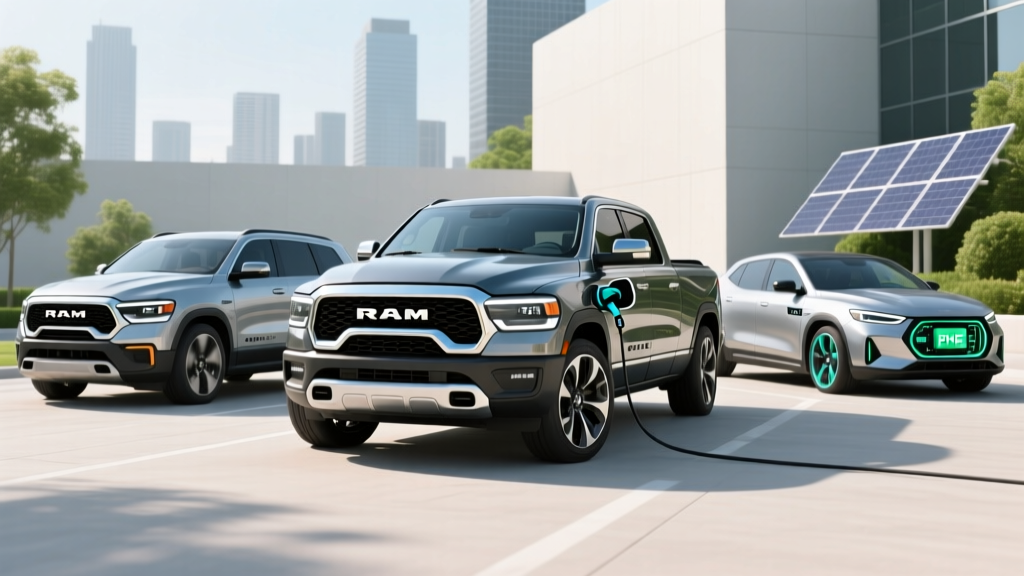
The 2025 Ram 1500 Ramcharger is the most significant electrified vehicle Ram has produced. It is not a hybrid in the traditional sense and not a PHEV — it is an EREV built on the STLA Frame platform. The truck drives 100% electrically via dual motors producing a combined 663 horsepower and 615 lb-ft of torque, while a 3.6-liter Pentastar V6 under the hood functions exclusively as an onboard generator to extend range.
| Spec | Value |
|---|---|
| Powertrain Type | EREV (dual electric motors + V6 generator) |
| Combined Output | 663 hp / 615 lb-ft |
| Battery Capacity | 92 kWh (usable) |
| EPA Electric-Only Range | ~145 miles (estimated, final EPA pending) |
| Total Range (Electric + Generator) | ~690 miles (manufacturer target) |
| Max DC Fast Charge Rate | ~150 kW peak |
| 10–80% DC Charge Time | ~40 minutes (estimated) |
| Level 2 Charging | 11.5 kW onboard charger |
| 0–60 mph | 4.4 seconds |
| Towing Capacity | Up to 14,000 lbs (est.) |
| Starting MSRP | ~$60,000 (base Tradesman est.) |
⚡ Real-World Range vs. Sticker Numbers
EPA electric-only estimate: ~145 miles. Expect in practice: 110–130 miles electric-only on the highway at 70+ mph, and potentially 80–100 miles in cold weather (below 32°F) due to battery chemistry limitations and cabin heating load. The 690-mile total range figure assumes the V6 generator runs continuously with a full 26-gallon fuel tank — realistic highway towing will reduce this substantially, likely to 400–500 miles total under load.
Ramcharger Charging: What You Need to Know
The Ramcharger's 92 kWh battery is large for an EREV and that has direct implications for charging times. On a Level 2 home charger at 11.5 kW, a full charge from empty takes roughly 8 hours — feasible for overnight charging. On DC fast charging, the ~150 kW peak rate means a 10–80% session takes around 40 minutes. This is slower than purpose-built BEVs like the Ford F-150 Lightning (which peaks at ~230 kW on extended-range packs), but acceptable given the Ramcharger's generator backup eliminates range anxiety on road trips.
The Ramcharger uses the CCS1 connector for DC fast charging and the standard J1772 inlet for Level 2. As Stellantis transitions to NACS (Tesla-style) connectors in upcoming model years, adapters will be available for Supercharger access.
Ram 1500 eTorque: The Mild Hybrid You Might Already Own
While the Ramcharger grabs headlines, the more common electrified Ram is the eTorque mild-hybrid system, which has been available on Ram 1500 models since 2019. For 2025, eTorque is paired with the 3.6-liter Pentastar V6 and, on some configurations, the 5.7-liter HEMI V8. This is a conventional mild hybrid — it does not plug in and cannot drive the truck on electric power alone.
The eTorque system uses a 48-volt belt-driven motor-generator with a small 0.43 kWh lithium-ion battery pack. Its functions include:
- Seamless engine stop/start (virtually eliminating the shudder common in older systems)
- Torque assist during initial acceleration (+90 lb-ft of brief electric boost)
- Regenerative braking to recapture energy during deceleration
- Extended engine-off coasting at highway speeds
| Configuration | City MPG | Highway MPG | Combined MPG |
|---|---|---|---|
| 3.6L V6 eTorque, 4x2 | 20 | 25 | 22 |
| 3.6L V6 eTorque, 4x4 | 19 | 24 | 21 |
| 5.7L V8 HEMI eTorque, 4x4 | 15 | 22 | 17 |
Real-world MPG note: Mild hybrids like eTorque often deliver their greatest advantage in city driving, where stop/start and regen braking are most active. Owners frequently report matching or slightly exceeding EPA city estimates. Highway gains are more modest, as the electric assist is minimal at steady cruising speeds. Source: fueleconomy.gov
Does Any Ram Hybrid Qualify for a Federal Tax Credit?
This is where buyers often get confused, so precision matters.
§30D Federal Tax Credit Eligibility — Ram Models
Ram 1500 eTorque (Mild Hybrid): Does NOT qualify. The §30D credit requires a minimum 7 kWh battery and plug-in capability. eTorque's 0.43 kWh pack falls far short.
Ram 1500 Ramcharger (EREV): Expected to qualify for up to $7,500 under §30D, as it meets the battery capacity threshold and plugs in. However, eligibility depends on:
- MSRP cap: Vans/SUVs/trucks must be under $80,000
- Buyer income cap: $150,000 single / $225,000 head of household / $300,000 joint MAGI
- Battery critical mineral and component sourcing requirements (phase-in percentages increase annually)
- Point-of-sale transfer available — you can apply the credit as a down payment reduction at the dealer
Always verify current-year rules at IRS.gov and consult a tax professional before relying on credit eligibility in your purchase decision.
Pricing Breakdown: Ram Electrified Models for 2025
| Model / Trim | MSRP | After Est. $7,500 Credit |
|---|---|---|
| Ram 1500 Tradesman eTorque V6 | ~$42,000 | N/A (no credit) |
| Ram 1500 Laramie eTorque V6 4x4 | ~$55,000 | N/A (no credit) |
| Ramcharger Tradesman (EREV) | ~$60,000 | ~$52,500 |
| Ramcharger Laramie (EREV) | ~$70,000 | ~$62,500 |
| Ramcharger Limited (EREV) | ~$85,000+ | Ineligible (over $80k cap) |
Important caveat: The Ramcharger Limited's MSRP is projected to exceed the $80,000 truck MSRP cap for §30D eligibility. Buyers eyeing top trims should confirm final pricing before counting on the credit. State incentives may apply separately — check AFDC's state incentive database for local rebates.
Battery Warranty, Reliability, and Replacement Costs
🔋 Battery Warranty Coverage
Ram eTorque (48V mild-hybrid battery): Covered under Ram's powertrain warranty — 5 years / 60,000 miles. The 0.43 kWh pack is relatively simple and inexpensive to replace compared to full hybrid or EV batteries. Estimated replacement: $1,500–$3,000 out of warranty.
Ramcharger (92 kWh EREV battery): Expected to carry Stellantis's hybrid/EV component warranty of 8 years / 100,000 miles (10 years / 150,000 miles in CARB states). Federal law mandates minimum 8-year/100,000-mile coverage on emissions-related hybrid components. Full replacement cost for a 92 kWh pack is estimated at $15,000–$25,000 out of warranty, though module-level repairs may be significantly cheaper.
Reliability Track Record
The eTorque system has been in production since 2019 across hundreds of thousands of Ram 1500 trucks. Early models experienced some software-related complaints around the stop/start transition, but these were largely resolved through over-the-air updates and TSBs. The system is mechanically simple — the belt-driven motor-generator has fewer failure points than a full parallel hybrid transaxle.
The Ramcharger is a new product without long-term reliability data. However, its EREV architecture is proven in other vehicles (the Chevrolet Volt pioneered this concept, and the BMW i3 REx used a similar approach). The V6 generator runs at a constant, optimized RPM rather than experiencing the variable loads of a traditional drivetrain, which should favor longevity. Early reliability will depend heavily on the power electronics and battery thermal management system.
Hybrid vs PHEV vs EV: Which Ram (or Competitor) Fits You?
Choose Based on Your Driving Pattern
Choose the Ram 1500 eTorque (mild hybrid) if:
- You want a conventional truck experience with slightly better fuel economy
- You never want to think about plugging in
- Your budget is under $55,000 and you need a truck now
- You tow frequently and need proven V8 availability
Choose the Ramcharger (EREV) if:
- Your daily commute is under 100 miles and you can charge at home
- You want EV-like daily driving but need 600+ mile road trip capability
- You value the $7,500 federal tax credit and instant electric torque
- You want 663 hp without range anxiety on remote job sites
Choose a full EV truck (Ford F-150 Lightning, Rivian R1T, Chevy Silverado EV) if:
- You have reliable home charging and rarely drive beyond 300 miles between charges
- You want the lowest per-mile fuel cost (~$0.04–0.06/mile on home electricity vs. $0.18–0.22/mile on gas)
- You want zero tailpipe emissions and minimal drivetrain maintenance
Choose a conventional gas Ram 1500 (Hurricane I6 turbo) if:
- You tow heavy loads daily and need maximum proven powertrain durability data
- You operate in extreme cold where battery range loss is unacceptable
- You want the lowest upfront purchase price and simplest maintenance
How the Ramcharger Compares to Hybrid Competitors
The Ramcharger occupies a unique niche. Its closest conceptual competitor is not another hybrid truck but rather full EV trucks that offer range-extender-like solutions. Here's how the landscape stacks up:
| Spec | Ram Ramcharger | Ford F-150 Lightning (Ext. Range) | Ford F-150 PowerBoost Hybrid |
|---|---|---|---|
| Type | EREV | BEV | HEV |
| Combined HP | 663 | 580 | 430 |
| Electric-Only Range | ~145 mi | 320 mi (EPA) | 0 mi |
| Total Range | ~690 mi | 320 mi | ~700 mi |
| Combined MPG/MPGe | TBD (MPGe + generator MPG) | 70 MPGe | 23 combined |
| Plugs In? | Yes | Yes | No |
| Starting MSRP | ~$60,000 | ~$60,000 | ~$54,000 |
| §30D Tax Credit | Up to $7,500 (est.) | Varies by sourcing | No |
✓ Ramcharger Pros
- 145 miles electric covers most daily driving gas-free
- 663 hp with instant electric torque
- No range anxiety — generator extends range anywhere
- Likely qualifies for $7,500 federal credit
- V2L capability for job site power
✗ Ramcharger Cons
- Heavier than BEV or gas equivalents (affects tire wear, braking)
- Two systems to maintain (electric + gasoline generator)
- 150 kW DC charging is slower than competing BEVs
- Limited trims may exceed $80k credit cap
- No long-term reliability data yet
Frequently Asked Questions
How many MPG does the Ram hybrid get?
The Ram 1500 with eTorque mild hybrid achieves 20 city / 25 highway / 22 combined MPG with the V6 and 4x2. The V8 eTorque drops to 15/22/17 MPG. The Ramcharger EREV does not use traditional MPG for electric driving — it will carry an MPGe rating for electric mode and a separate MPG figure for generator-assisted driving, both pending final EPA certification.
How far can the Ramcharger go on electric only?
Ram targets approximately 145 miles of electric-only range from the 92 kWh battery pack. In real-world highway driving at 70 mph, expect 110–130 miles. In cold weather (below freezing), plan for 80–100 miles as the battery's internal resistance increases and energy is diverted to cabin heating.
Does the Ram eTorque need to be plugged in?
No. The eTorque system is a conventional mild hybrid. Its 0.43 kWh battery charges exclusively through regenerative braking and engine-driven generation. There is no plug, no charging cable, and no electric-only driving mode.
Is the Ramcharger considered a hybrid or an EV?
Technically, it is an Extended-Range Electric Vehicle (EREV). It drives exclusively on electric motors at all times, which makes it feel like an EV. But it carries a gasoline engine (used only as a generator), which gives it hybrid-like total range. For tax credit purposes, it qualifies as a plug-in electric vehicle under §30D.
What is the battery replacement cost for Ram hybrid models?
For the eTorque mild-hybrid 48V battery, replacement is estimated at $1,500–$3,000 out of warranty. For the Ramcharger's 92 kWh traction battery, full pack replacement is estimated at $15,000–$25,000, though both are covered under warranty for 5–8 years depending on the component and your state.
Will Ram offer a plug-in hybrid (PHEV) truck?
As of early 2025, Ram has not announced a conventional PHEV truck (one with a traditional transmission-driven hybrid system like the F-150 PowerBoost). The Ramcharger EREV serves as Ram's plug-in electrified truck offering. Stellantis has PHEV technology in the Jeep Wrangler 4xe and Chrysler Pacifica Hybrid, so the engineering exists within the parent company, but no Ram PHEV is in the announced product plan.
Can I charge the Ramcharger at home?
Yes. The Ramcharger accepts Level 2 charging at up to 11.5 kW via a standard J1772 connector. A full charge from empty takes approximately 8 hours on a 48-amp Level 2 home charger. Installation of a home Level 2 charger typically costs $800–$2,500 including equipment and electrician labor, depending on your panel capacity and run distance.