The Toyota Prius Prime has evolved from a sensible commuter into a genuinely compelling plug-in hybrid. With its redesigned fifth-generation platform now fully mature for the 2026 model year, the Prius Prime hybrid delivers up to 44 miles of electric-only driving, a combined EPA rating of 48 MPG once the battery depletes, and a total driving range exceeding 440 miles. For buyers who want EV-like daily commuting without the range anxiety of a full battery-electric vehicle, this PHEV occupies a narrow but highly practical sweet spot.
In this guide, we break down the exact numbers — EPA fuel economy, real-world efficiency, charging times, powertrain specs, and federal tax credit eligibility — so you can decide whether the Prius Prime hybrid fits your driving routine and budget.
HEV vs PHEV: What the Prius Prime Hybrid Actually Is
Toyota sells two versions of the Prius: the conventional hybrid electric vehicle (HEV) and the Prius Prime plug-in hybrid (PHEV). Understanding the difference is essential before you shop.
| Attribute | Prius Hybrid (HEV) | Prius Prime (PHEV) |
|---|---|---|
| Plug-in charging required? | No — self-charging via engine and regen | Yes — plug in to unlock EV range |
| Battery capacity (usable) | ~0.9 kWh (small buffer) | 13.6 kWh |
| Electric-only range | < 1 mile at low speed | Up to 44 miles (EPA) |
| Combined MPG (after battery depletes) | 57 MPG | 48 MPG |
| Combined horsepower | 194 hp (FWD) / 196 hp (AWD) | 220 hp |
| Federal tax credit eligible? | No | Up to $3,750 (§30D, income/MSRP rules apply) |
| Starting MSRP (2026) | ~$28,350 | ~$33,675 |
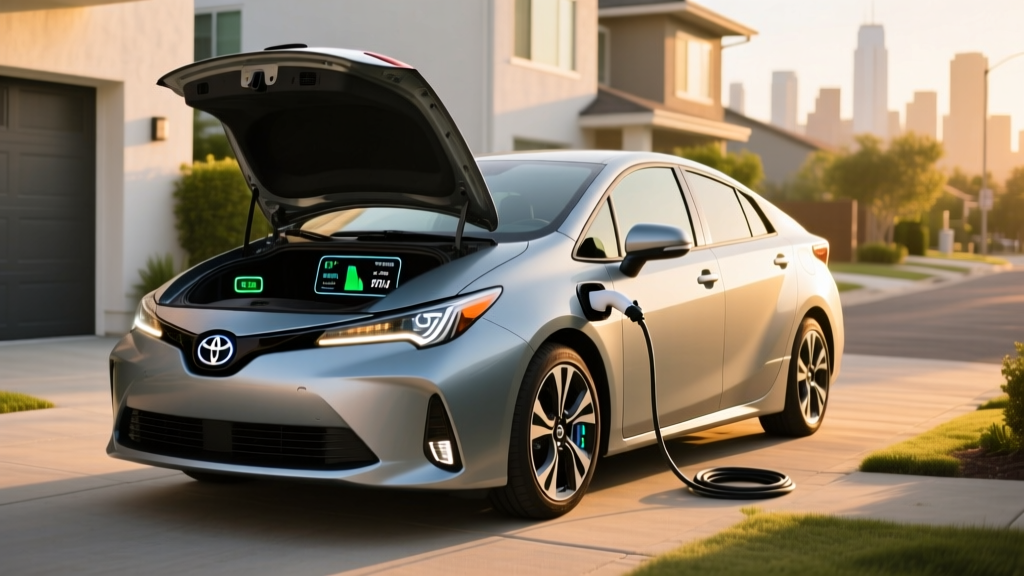
The Prius Prime is a plug-in hybrid, meaning it carries a substantially larger battery than the standard Prius HEV and can be charged from a wall outlet or public charger. When the battery is full, it operates as an EV for roughly 44 miles. Once that electric range is exhausted, it seamlessly transitions into conventional hybrid mode — no range anxiety, no dead battery on the highway.
The standard Prius HEV, by contrast, never needs to be plugged in. It recovers energy through regenerative braking and the gasoline engine, achieving higher MPG in hybrid mode but offering virtually no electric-only range.
EPA Fuel Economy and Real-World MPG
The 2026 Prius Prime hybrid carries an EPA-rated combined fuel economy of 48 MPG in charge-sustaining (hybrid) mode, once the battery is depleted. In charge-depleting (EV) mode, it earns an EPA rating of 127 MPGe.
| Mode | City | Highway | Combined |
|---|---|---|---|
| Hybrid (charge-sustaining) | 50 MPG | 47 MPG | 48 MPG |
| EV (charge-depleting) | 127 MPGe combined | ||
Real-world MPG expectations: Toyota hybrids historically meet or exceed EPA city estimates in stop-and-go traffic, where regenerative braking recaptures the most energy. In our experience with fifth-generation Prius platforms, drivers regularly report 50–54 MPG in city-heavy hybrid-mode driving. Highway MPG tends to land closer to the EPA sticker or slightly below, around 44–47 MPG at sustained 70–75 mph speeds, because aerodynamic drag dominates and regenerative opportunities diminish.
Real-world range reality: The EPA rates the Prius Prime at 44 miles of EV range (38 miles for the XSE Premium trim with 19-inch wheels). Expect 36–42 miles in mixed driving in moderate temperatures. In winter conditions below 30°F, plan on 28–34 miles of electric range due to cabin heating demand and reduced battery efficiency.
The total combined range — EV miles plus a full 10.6-gallon tank in hybrid mode — exceeds 440 miles, making this one of the longest-range passenger vehicles you can buy, electrified or otherwise.
Prius Prime Hybrid Powertrain and Performance Specs
The 2026 Prius Prime pairs a 2.0-liter four-cylinder Atkinson-cycle engine with two front-mounted electric motor-generators and a lithium-ion battery pack mounted under the rear seats.
| Specification | 2026 Prius Prime |
|---|---|
| Combined net horsepower | 220 hp |
| Engine | 2.0L 4-cyl Atkinson (150 hp) |
| Front electric motor | 161 hp / 149 lb-ft |
| Battery (usable capacity) | 13.6 kWh, lithium-ion |
| EV-only range (EPA) | 44 mi (SE) / 38 mi (XSE) |
| Total range (EV + gas) | ~440+ mi |
| 0–60 mph | ~6.6 seconds |
| Drivetrain | FWD (e-CVT) |
| Fuel tank | 10.6 gal |
| Cargo volume (rear seats up) | 20.3 cu ft |
The 220-hp combined output is a dramatic leap from the previous-generation Prius Prime's 121 hp, and it shows: the 0–60 mph sprint drops to roughly 6.6 seconds, making this the quickest mainstream Prius ever sold. The e-CVT delivers smooth, linear acceleration without the rubber-band feeling that plagued earlier Toyota hybrids. Highway merging and passing are confident, not merely adequate.
Charging the Prius Prime: Times, Levels, and Connectors
Unlike a full battery-electric vehicle, the Prius Prime's 13.6 kWh battery is small enough that charging is straightforward and doesn't require a home electrical upgrade in most cases.
| Charging Level | Power (kW) | 0–100% Time | Notes |
|---|---|---|---|
| Level 1 (120V household outlet) | ~1.4 kW | ~11 hours | Standard cord included; overnight top-up |
| Level 2 (240V home/public) | ~3.5 kW | ~4 hours | J1772 connector; wall unit recommended |
| DC Fast Charging | N/A | N/A | Not supported — no DC fast-charge port |
Important note on DC fast charging: The Prius Prime does not support DC fast charging. This is typical for PHEVs — the battery is small enough that Level 2 charging fills it in a few hours, and adding DC fast-charge hardware would increase cost, weight, and complexity for minimal benefit.
For most Prius Prime owners, a standard 120V outlet (Level 1) is sufficient if you drive less than 44 miles per day and can leave the car plugged in overnight. If your daily commute consumes the full EV range or you want faster turnaround between trips, a 240V Level 2 home charger — typically a 16-amp or 32-amp wall-mounted unit — will replenish the battery in about four hours. Installation costs for a Level 2 home charger generally range from $500 to $2,000 depending on your electrical panel and the distance from panel to outlet. Consult a licensed electrician for your specific situation.
The Prius Prime uses the J1772 connector for Level 2 AC charging, which is the North American standard for non-Tesla electrified vehicles. No adapter is needed for ChargePoint, Blink, or most public Level 2 stations.
Pricing, Trims, and Federal Tax Credit Eligibility
The 2026 Toyota Prius Prime is offered in three trims: SE, XSE, and XSE Premium. Pricing starts at approximately $33,675 for the SE and climbs to around $40,670 for the XSE Premium (including destination charges).
| Trim | MSRP (approx.) | EV Range (EPA) | Wheels |
|---|---|---|---|
| SE | $33,675 | 44 miles | 17-inch alloy |
| XSE | $36,675 | 40 miles | 19-inch alloy |
| XSE Premium | $40,670 | 38 miles | 19-inch alloy |
Larger wheels on the XSE and XSE Premium trims reduce EV range slightly due to increased rolling resistance and weight — a 6-mile penalty on the top trim versus the SE.
Federal tax credit (§30D) for the Prius Prime — current rules:
- Credit amount: Up to $3,750 (partial credit — the Prime meets some but not all critical-mineral and battery-component sourcing requirements under current IRS rules)
- MSRP cap: Vehicle must have an MSRP at or below $55,000 (sedan cap) — all Prius Prime trims qualify
- Buyer income cap: Modified AGI must not exceed $150,000 (single), $225,000 (head of household), or $300,000 (joint filers)
- Point-of-sale transfer: Eligible buyers can transfer the credit to the dealer at purchase for an immediate price reduction
- Assembly: Must be assembled in North America — the Prius is built in Japan, which may affect eligibility depending on current-year IRS guidance
Source: IRS §30D Clean Vehicle Credit. Tax credit rules change frequently. Verify eligibility with a tax professional and the official IRS guidance for your purchase year.
The North American final-assembly requirement is the key sticking point. As of the latest IRS guidance, the Prius Prime is manufactured in Japan, which may disqualify it from the §30D credit entirely. Always check the fueleconomy.gov tax credit lookup tool before relying on a credit at purchase. State-level incentives may also be available depending on your jurisdiction — check your state energy office or DMV for current programs.
Battery Warranty, Reliability, and Replacement Costs
Toyota's hybrid system is among the most proven in the industry, with over 25 years of real-world data from millions of vehicles. The Prius Prime's lithium-ion traction battery is covered under Toyota's hybrid battery warranty.
Hybrid battery warranty: 10 years / 150,000 miles (whichever comes first) in all 50 states. The warranty covers battery capacity below 70% of original capacity, as well as defects in the battery management system and related hybrid components.
Powertrain warranty: 5 years / 60,000 miles.
Basic vehicle warranty: 3 years / 36,000 miles.
Is the Prius Prime reliable? Toyota consistently ranks at or near the top of J.D. Power and Consumer Reports reliability surveys, and the Prius nameplate has one of the lowest cost-of-ownership records in the industry. The hybrid synergy drive system has very few wear items compared to a conventional automatic transmission — there's no traditional gearbox, no starter motor, no alternator, and regenerative braking significantly extends brake pad life.
Battery replacement cost: If the hybrid battery fails outside of warranty — which is uncommon before 150,000+ miles based on historical Prius data — a replacement battery pack for the current-generation Prius Prime typically costs between $4,000 and $7,000 including parts and labor at a Toyota dealer. Independent hybrid specialists often offer refurbished or reconditioned packs for $2,500–$4,000. For context, most Prius batteries in earlier generations have lasted well beyond 200,000 miles with gradual capacity loss rather than sudden failure.
Prius Prime vs Full EV vs Gas Car: Which Should You Choose?
The Prius Prime hybrid sits between three distinct ownership models. Here's how to decide:
Choose the Prius Prime PHEV if:
- Your daily commute is under 40 miles round-trip and you can charge at home overnight
- You take road trips several times per year and don't want to plan around charging infrastructure
- You live in a cold climate where EV range loss is a concern
- You don't have reliable access to public DC fast chargers
- You want to reduce fuel consumption by 60–80% on most days without going fully electric
Choose a full EV (like the Hyundai Ioniq 6 or Tesla Model 3) if:
- You have Level 2 home charging and your daily driving is under 250 miles
- You want zero tailpipe emissions and minimal maintenance (no oil changes, no engine)
- You want to access the full $7,500 federal tax credit (on eligible models)
- You're comfortable with route planning on longer road trips
Choose the standard Prius HEV (or a conventional gas car) if:
- You cannot charge at home or at work — an apartment without outlet access, for example
- Your budget is tighter and the $5,000+ PHEV premium isn't justified by your mileage
- You drive mostly highway miles where the EV-range advantage is minimal
The economic case for the Prius Prime is strongest for drivers who can charge at home and whose daily mileage falls within the 38–44 mile EV window. In that scenario, you may go weeks between gas station visits. A driver covering 35 miles per day, five days a week, would use roughly 3 gallons of gasoline per month — compared to about 14 gallons in a 30-MPG gas car. At $3.50 per gallon, that's roughly $38/month in fuel versus $49, plus the electricity cost to charge (typically $15–$25/month at residential rates).
Pros and Cons of the 2026 Prius Prime Hybrid
Pros
- 44 miles of EV range covers most daily commutes entirely on electricity
- 48 MPG combined in hybrid mode — among the best of any PHEV when the battery is depleted
- 220 hp makes it genuinely quick for an efficiency-focused car
- 440+ mile total range eliminates road-trip range anxiety
- Charges on a standard 120V outlet overnight — no electrical upgrade required
- 10-year/150,000-mile hybrid battery warranty
- Toyota reliability and strong resale value
Cons
- No DC fast charging — limits utility of public charging on road trips
- Likely ineligible for federal §30D tax credit due to Japan assembly
- XSE and XSE Premium trims sacrifice 4–6 miles of EV range for larger wheels
- Cargo space (20.3 cu ft) is tighter than some crossover alternatives
- FWD only — no all-wheel-drive option on the Prime (AWD is available on the standard Prius HEV)
- PHEV price premium of ~$5,300 over the standard Prius HEV
Frequently Asked Questions
How many MPG does the 2026 Prius Prime hybrid get?
The EPA rates the Prius Prime at 48 MPG combined (50 city / 47 highway) in hybrid mode after the battery is depleted. In real-world city driving, many owners report 50–54 MPG thanks to aggressive regenerative braking. Highway driving at sustained speeds typically yields 44–47 MPG.
How far can the Prius Prime go on electric only?
The SE trim achieves up to 44 miles of EPA-rated EV range. The XSE gets 40 miles, and the XSE Premium gets 38 miles due to larger wheels. In cold weather, expect a 20–30% reduction — roughly 28–34 miles for the SE.
Does the Prius Prime qualify for a federal tax credit?
Under current IRS §30D rules, the Prius Prime may qualify for up to $3,750 in partial credit, but the North American final-assembly requirement is a significant hurdle — the Prius is built in Japan. Always verify current eligibility on fueleconomy.gov and consult a tax professional before relying on a credit.
Is the Prius Prime reliable, and what does a battery replacement cost?
Toyota's hybrid system is one of the most reliable powertrains in the industry, backed by a 10-year/150,000-mile hybrid battery warranty. Out-of-warranty battery replacement typically costs $4,000–$7,000 at a dealer, or $2,500–$4,000 from an independent hybrid specialist. Most Prius batteries last well beyond 200,000 miles.
Do I need to plug in the Prius Prime every night?
You don't need to, but you should if you want to maximize the EV range benefit. The car operates perfectly as a conventional hybrid even if you never plug it in — you'll just get 48 MPG instead of using electricity for your first 38–44 miles. Plugging into a standard 120V outlet overnight is sufficient for most drivers.
Can the Prius Prime use DC fast chargers?
No. The Prius Prime does not have a DC fast-charge port. It charges via Level 1 (120V) or Level 2 (240V) AC charging using a J1772 connector. This is standard for nearly all plug-in hybrids — the battery is small enough that Level 2 charging fills it in about four hours.
Prius Prime vs standard Prius: which is the better buy?
If you can charge at home and your daily driving is under 40 miles, the Prime's EV range will save you significantly on fuel. If you can't charge at home, the standard Prius HEV delivers 57 MPG combined without ever needing a plug and costs roughly $5,300 less. The HEV also offers an AWD option that the Prime does not.
Sources: EPA fuel economy data via fueleconomy.gov; IRS Clean Vehicle Credit rules via irs.gov; Toyota USA specifications via toyota.com.