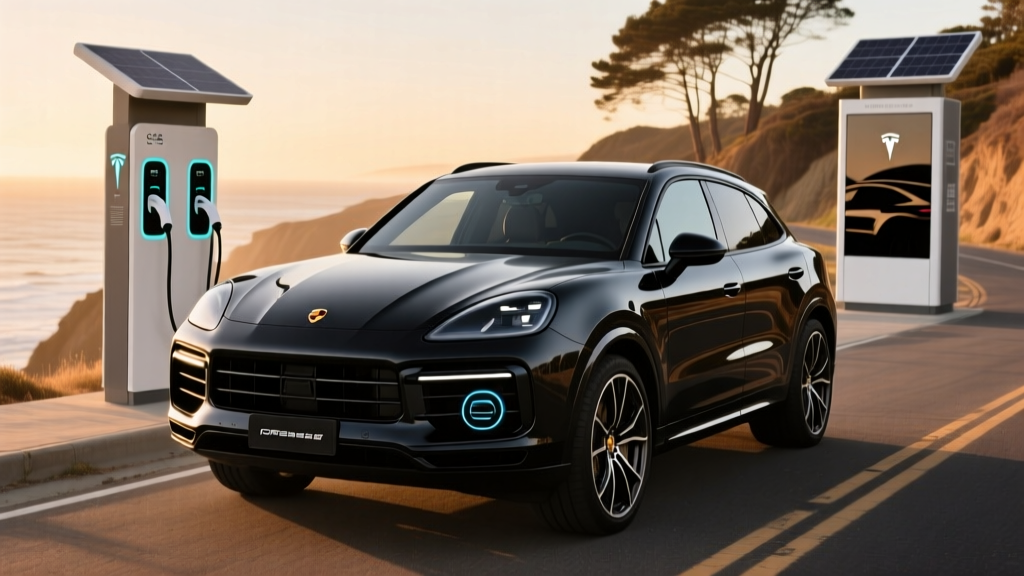
The Porsche Cayenne Turbo E-Hybrid occupies a rare position in the luxury SUV market: it delivers supercar-rivaling acceleration while offering genuine electric-only commuting capability. For 2026, Porsche has refined its flagship plug-in hybrid (PHEV) Cayenne with a larger battery, more electric range, and a twin-turbo V8 paired with a substantially upgraded electric motor. But at a starting price north of $145,000, buyers need to know exactly what they're getting — from real-world MPG to charging logistics to whether any tax incentives apply.
This guide covers every spec that matters for the 2026 Cayenne Turbo E-Hybrid, including the distinctions between conventional hybrids and PHEVs, real-world efficiency expectations, and how this vehicle fits into a broader electrified-garage strategy.
HEV vs PHEV: Where the Cayenne Turbo E-Hybrid Fits
Before diving into specs, it's essential to clarify a common point of confusion. The automotive market uses two distinct hybrid architectures:
Conventional Hybrid (HEV)
- Small battery (~1-2 kWh), charged only by regenerative braking and the engine
- Cannot plug in — no external charging required
- Electric motor assists the engine but provides minimal or zero electric-only driving
- Examples: Toyota RAV4 Hybrid, Honda CR-V Hybrid
Plug-In Hybrid (PHEV)
- Larger battery (typically 15-30 kWh), charges via plug or regenerative braking
- Must plug in to access full electric-only range and efficiency benefits
- Offers 20-50+ miles of electric-only driving before the gas engine engages
- Examples: Porsche Cayenne E-Hybrid, Toyota RAV4 Prime, BMW X5 xDrive50e
The Porsche Cayenne Turbo E-Hybrid is a PHEV. It has a large, externally chargeable battery pack and a dedicated electric-only driving mode. If you never plug it in, you'll still benefit from hybrid assist, but you'll forfeit the majority of its efficiency and cost-saving advantages. This is a vehicle designed for owners who can charge at home or at work.
Powertrain Specs: 729 Horsepower from V8 + Electric Motor
The 2026 Cayenne Turbo E-Hybrid pairs a twin-turbocharged 4.0-liter V8 with a permanently excited synchronous electric motor integrated into the 8-speed Tiptronic S transmission. Here's the full breakdown:
| Specification | Value |
|---|---|
| Engine | 4.0L twin-turbo V8 |
| Engine Output | 591 hp / 590 lb-ft torque |
| Electric Motor Output | 174 hp (130 kW) / 295 lb-ft |
| Combined System Output | 729 hp / 700 lb-ft torque |
| Battery Capacity (Gross / Usable) | 25.9 kWh / ~21.5 kWh (NMC lithium-ion) |
| Transmission | 8-speed Tiptronic S automatic |
| Drivetrain | All-wheel drive (AWD) |
| 0-60 mph | 3.5 seconds (manufacturer est.) |
| Top Speed | 183 mph |
| Curb Weight | ~5,650 lbs |
The electric motor sits between the engine and transmission, enabling seamless transitions between electric-only, hybrid, and combined power delivery. Porsche's energy management system lets drivers select E-Power (electric priority), Hybrid Auto (system-managed), Sport, and Sport Plus modes. In E-Power mode, the Cayenne Turbo E-Hybrid operates as a rear-biased electric vehicle up to highway speeds, with the V8 remaining dormant until the battery depletes or you demand full acceleration.
Electric-Only Range and Charging: What the 25.9 kWh Battery Delivers
For 2026, the Cayenne Turbo E-Hybrid carries a 25.9 kWh gross battery pack (approximately 21.5 kWh usable, as Porsche maintains a buffer to protect long-term battery health). This is a meaningful upgrade from earlier Cayenne E-Hybrid generations.
| Charging Metric | Specification |
|---|---|
| EPA Electric-Only Range | ~30 miles (est. based on Porsche data) |
| Total Combined Range (Electric + Gas) | ~420-440 miles |
| AC Level 2 Charging (Onboard Charger) | 11 kW (standard) |
| Level 2 Charge Time (0-100%) | ~2.5 hours at 11 kW |
| DC Fast Charging | Not available — AC charging only |
| Level 1 (120V) Charge Time | ~10-12 hours (not recommended for daily use) |
| Charging Connector | J1772 (standard for AC PHEV charging in the US) |
Critical note on DC fast charging: The Cayenne Turbo E-Hybrid does not support DC fast charging. This is typical for PHEVs — their smaller batteries make Level 2 AC charging practical for overnight replenishment. With an 11 kW onboard charger, a full charge from empty takes roughly 2.5 hours on a Level 2 home station, which is more than adequate for nightly top-ups.
Real-World Electric Range Expectations
Porsche targets approximately 30 miles of electric-only range under EPA testing conditions. In real-world driving, expect:
- City/suburban commuting (mild weather): 28-32 miles — regenerative braking in stop-and-go traffic extends range
- Highway driving at 70+ mph: 22-26 miles — higher speeds drain the battery faster
- Cold weather (below 40°F): 20-24 miles — battery chemistry is less efficient, and cabin heating draws significant power
For most daily commutes under 25 miles round-trip, this PHEV can operate predominantly on electricity, with the V8 engaging only for longer trips or aggressive acceleration demands.
Fuel Economy: EPA MPG and Real-World Efficiency
Fuel economy for a high-performance PHEV depends heavily on how often you charge. Here's what the EPA and real-world testing indicate:
| Driving Mode | City | Highway | Combined |
|---|---|---|---|
| Charge-Sustaining (Hybrid Mode, Battery Depleted) | ~18 MPG | ~22 MPG | ~20 MPG |
| MPGe (Charge-Depleting, Electric + Gas Combined) | ~46 MPGe (EPA est.) | ||
| Electric-Only Efficiency | ~55 kWh/100mi | ||
How to interpret these numbers: The MPGe (miles per gallon equivalent) figure of ~46 reflects mixed driving where the battery starts fully charged. If you charge nightly and drive fewer than 30 miles per day, your actual gasoline consumption could approach zero for weeks at a time. Conversely, if you never plug in and drive primarily on the hybrid system, you'll see roughly 20 MPG combined — respectable for a 5,650-lb SUV with 729 hp, but not class-leading for efficiency.
Real-world vs. EPA: PHEVs tend to outperform their EPA city estimates when driven in electric-priority mode during urban commuting, since regenerative braking recaptures energy effectively at lower speeds. On long highway road trips with a depleted battery, expect fuel economy closer to 19-21 MPG. Owners who charge consistently report real-world combined figures of 35-45 MPGe during mixed use, with some achieving 50+ MPGe on short, charge-rich commutes.
Pricing, Tax Credits, and Total Cost of Ownership
The 2026 Porsche Cayenne Turbo E-Hybrid is positioned at the apex of the Cayenne lineup:
- Base MSRP: ~$148,500 (including destination charge)
- As-tested with options: $160,000-$175,000+ (Porsche options add quickly — Premium Package, rear-axle steering, Sport Chrono, ceramic brakes)
Federal Tax Credit Eligibility (§30D)
Under current IRS rules for the §30D Clean Vehicle Credit, PHEVs can qualify for up to $7,500 — but several restrictions apply:
- MSRP cap: SUVs must have an MSRP at or below $80,000. The Cayenne Turbo E-Hybrid at ~$148,500 far exceeds this cap — it does not qualify for the federal EV/PHEV tax credit.
- Battery capacity: Must be at least 7 kWh (the Cayenne's 25.9 kWh pack clears this requirement)
- Buyer income limits: AGI must not exceed $150,000 (single) / $300,000 (joint) — irrelevant here due to MSRP disqualification
- Battery sourcing / critical minerals: Must meet phased-in domestic-content requirements — also moot given the price exclusion
Bottom line: No federal tax credit applies to the Cayenne Turbo E-Hybrid. Some states offer their own PHEV incentives (California's CVRP, for example, has its own MSRP and income thresholds that also typically exclude vehicles at this price). Check your state incentive database for specifics, but plan your purchase budget assuming no incentive offsets.
Five-Year Ownership Cost Snapshot
| Cost Category | Estimated 5-Year Total |
|---|---|
| Purchase Price (base) | $148,500 |
| Fuel/Electricity (15,000 mi/yr, 60% electric) | $8,500-$11,000 |
| Insurance (luxury SUV) | $18,000-$24,000 |
| Maintenance (Porsche scheduled service) | $4,500-$6,500 |
| Depreciation (est. 45-50% over 5 years) | $67,000-$74,000 |
| Estimated 5-Year Total Cost | $246,500-$264,000 |
Depreciation is the dominant cost. Porsche Cayennes hold value better than many luxury SUVs, but a $148,000+ PHEV will still lose substantial value in absolute dollars. Fuel savings vs. the gas-only Cayenne Turbo are real but modest relative to the purchase price — this is a performance vehicle first, an efficiency play second.
Battery Warranty, Reliability, and Longevity
Porsche PHEV Battery Warranty
- High-voltage battery warranty: 8 years / 100,000 miles (whichever comes first)
- Capacity retention guarantee: Porsche warrants the battery will retain at least 70% of its original capacity during the warranty period
- Powertrain warranty: 4 years / 50,000 miles (Porsche's standard new-vehicle limited warranty)
- Hybrid-specific components: Electric motor, power electronics, and charging system covered under the 8-year hybrid component warranty
Reliability outlook: Porsche's PHEV powertrain in the Cayenne has been in production since the 2019 model year (with significant updates for 2024+). The twin-turbo V8 is a well-established engine family, and the electric motor integration is mature. Common concerns in earlier model years included 12V auxiliary battery issues and occasional software glitches in the energy management system — both largely addressed in subsequent updates.
Battery replacement cost: Out-of-warranty high-voltage battery replacement for the Cayenne E-Hybrid currently ranges from $12,000 to $18,000 including labor, depending on the module configuration. However, NMC battery packs in PHEVs with active thermal management (which the Cayenne has) typically experience slow degradation — expect 85-90% capacity retention at 100,000 miles under normal use. Most owners will never need a full pack replacement during typical ownership.
For detailed reliability data, consult IIHS crash-test ratings and owner forums for model-year-specific feedback. Porsche's official spec page provides the latest warranty documentation.
Who Should Choose the Cayenne Turbo E-Hybrid vs. a Full EV or Gas SUV?
Choose the Cayenne Turbo E-Hybrid if:
- You want 700+ hp performance with the option of silent, zero-tailpipe-emission commuting under 30 miles
- You have home Level 2 charging access and a daily commute within the electric-only range
- You regularly take long road trips where EV charging infrastructure is still inconsistent
- You value Porsche driving dynamics and don't want to compromise on a fully electric platform (yet)
- You're not eligible for or don't need the federal tax credit to justify the purchase
Choose a Full EV (e.g., Porsche Taycan, BMW iX, Tesla Model X) if:
- Your daily driving is within 250-300 miles and you have reliable home + destination charging
- You want to eliminate gasoline entirely and minimize running costs
- You qualify for the $7,500 federal credit on an EV that meets MSRP and sourcing requirements
- You prefer fewer moving parts and lower long-term maintenance
Choose the Gas-Only Cayenne Turbo if:
- You lack home charging access and cannot conveniently plug in
- You want a lower purchase price (gas Cayenne Turbo starts ~$100,000 less)
- You drive predominantly long highway miles where PHEV advantages diminish
Pros
- 729 hp with 3.5-second 0-60 — genuine supercar acceleration in a family SUV
- ~30 miles electric-only range covers most daily commutes
- No range anxiety on road trips — gas engine provides 400+ mile total range
- Porsche build quality, driving dynamics, and resale value
- 11 kW onboard charger enables fast Level 2 replenishment (~2.5 hours)
Cons
- $148,500+ starting price — no federal tax credit eligibility
- ~20 MPG in charge-sustaining mode — modest for the segment when not plugged in
- No DC fast charging capability
- Heavy curb weight (~5,650 lbs) affects tire wear and braking distances
- Expensive out-of-warranty battery replacement ($12,000-$18,000)
Frequently Asked Questions
How many MPG does the Porsche Cayenne Turbo E-Hybrid get?
In charge-sustaining (hybrid) mode with a depleted battery, the Cayenne Turbo E-Hybrid returns approximately 18 MPG city, 22 MPG highway, and 20 MPG combined. When regularly charged and driven within its electric range, effective efficiency can reach 40-50+ MPGe depending on commute length and charging frequency.
How far can the Cayenne Turbo E-Hybrid go on electric only?
The EPA-estimated electric-only range is approximately 30 miles. Real-world results vary: expect 28-32 miles in mild-weather city driving, 22-26 miles at highway speeds, and 20-24 miles in cold conditions. Total combined range (electric + gasoline) is approximately 420-440 miles.
Hybrid vs PHEV vs EV — which fits my lifestyle?
A conventional hybrid (HEV) like the Toyota RAV4 Hybrid requires no plug-in and offers modest efficiency gains. A PHEV like the Cayenne Turbo E-Hybrid provides meaningful electric-only range but requires home charging to realize its benefits. A full EV eliminates gasoline entirely but demands charging infrastructure and acceptance of range limitations on long trips. If you can charge at home, drive under 30 miles daily, and still want 400+ mile road-trip range, a PHEV is the most flexible option.
Is the Cayenne Turbo E-Hybrid reliable, and what does battery replacement cost?
Porsche's PHEV system is mature, with the high-voltage battery warrantied for 8 years/100,000 miles at a minimum 70% capacity retention. Out-of-warranty battery replacement costs approximately $12,000-$18,000. Most owners report slow degradation thanks to active thermal management, and full pack replacement is uncommon within normal ownership periods.
Does the Porsche Cayenne Turbo E-Hybrid qualify for any tax credit?
No. The federal §30D Clean Vehicle Credit caps eligible SUVs at $80,000 MSRP. At approximately $148,500, the Cayenne Turbo E-Hybrid does not qualify. State incentives vary but generally follow similar MSRP restrictions. Consult a tax professional and check IRS guidelines for your specific situation.
Can the Cayenne Turbo E-Hybrid DC fast charge?
No. Like most PHEVs, it supports only AC charging via J1772 connector. The 11 kW onboard charger delivers a full charge in approximately 2.5 hours on a Level 2 station, which is sufficient for overnight replenishment.
What happens if I never plug it in?
The Cayenne Turbo E-Hybrid will still function as a conventional hybrid, with the V8 and regenerative braking managing the battery. However, you'll see approximately 20 MPG combined and forfeit the electric-only driving experience, lower fuel costs, and reduced tailpipe emissions that justify the PHEV premium.