Quick Verdict: The Hypercar That Pioneered Plug-In Performance
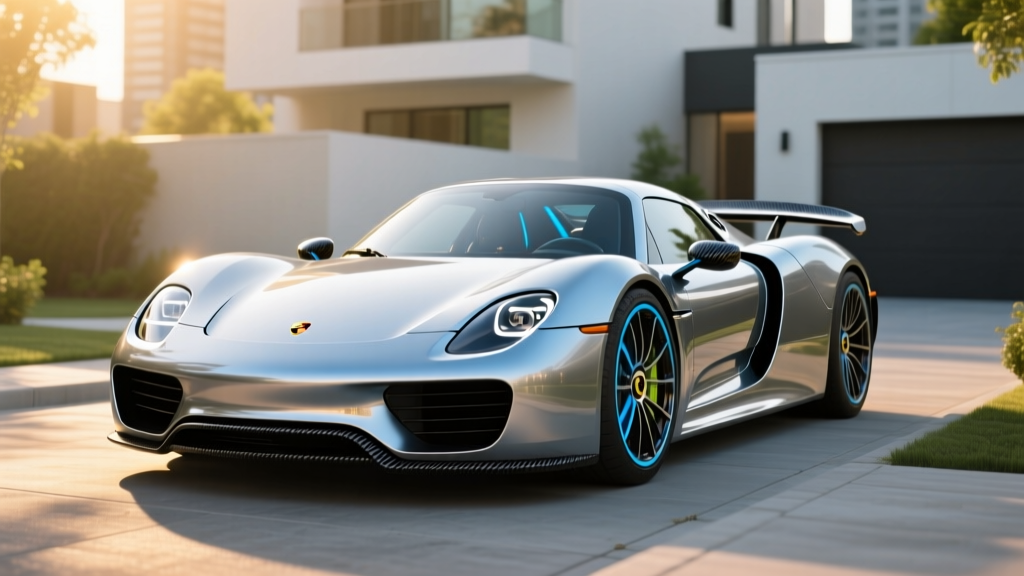
The Porsche 918 Spyder is not a commuter hybrid — it is a $845,000+ limited-production plug-in hybrid hypercar that rewrote the rules for electrified performance when it debuted. Built between 2013 and 2015 (918 units total), the 918 combined a 4.6-liter naturally aspirated V8 with two electric motors for a combined 887 horsepower, a Nürburgring lap record (at the time), and genuine electric-only driving capability. In 2026, it remains one of the most collectible and technically fascinating PHEVs ever built — but ownership demands deep pockets, specialist knowledge, and a clear understanding of its aging high-voltage battery.
This guide breaks down everything a prospective buyer or enthusiast needs: real-world and EPA MPG, electric-only range, battery health expectations, replacement costs, and how the 918's hybrid architecture compares to today's mainstream PHEVs.
HEV vs PHEV: Where the Porsche 918 Fits
Conventional Hybrid (HEV): A small battery (typically 1–2 kWh) recharges only via regenerative braking and the engine. No plug. The Toyota Prius is the archetype.
Plug-In Hybrid (PHEV): A larger battery (6–30+ kWh in 2026 models; 6.8 kWh in the 918) that charges from a wall outlet or charger, enabling meaningful electric-only miles before the engine fires up. The Porsche 918 Spyder is a PHEV.
The 918's 6.8 kWh lithium-ion battery pack sits low in the chassis, behind the driver, and can be recharged from a standard 120V household outlet or a 240V Level 2 source. It cannot accept DC fast charging — a deliberate engineering choice to save weight and complexity in a car that prioritized track capability over convenience charging.
Powertrain: V8 Meets Twin Electric Motors
The 918's hybrid system is a masterpiece of parallel engineering:
| Component | Specification |
|---|---|
| Internal Combustion Engine | 4.6L naturally aspirated V8, 608 hp @ 8,700 rpm |
| Front Electric Motor | 115 kW (154 hp), drives front axle |
| Rear Electric Motor | 115 kW (154 hp), integrated with 7-speed PDK |
| Combined System Output | 887 hp / 944 lb-ft torque |
| Transmission | 7-speed PDK dual-clutch (rear), single-speed (front) |
| Drivetrain | AWD (electric front axle, engine-driven rear) |
| Battery (Usable) | 6.8 kWh lithium-ion (liquid-cooled) |
| 0–60 mph | 2.5 seconds (with launch control) |
| Top Speed | 214 mph (combined); 93 mph (EV mode) |
| Curb Weight | 3,602 lbs (Weissach Package: 3,494 lbs) |
| Production Run | 2013–2015, 918 units total |
The front electric motor gives the 918 torque-vectoring all-wheel drive with zero mechanical linkage between the axles — a setup Porsche called "E-Performance." In E-Power mode, only the front motor drives the car, making it temporarily front-wheel-drive and completely silent up to 93 mph.
Fuel Economy: EPA MPG and MPGe Breakdown
| Metric | EPA Figure |
|---|---|
| MPGe (Combined, EV + Gas) | 67 MPGe |
| Gas-Only Combined MPG | 22 MPG |
| Gas-Only City MPG | 20 MPG |
| Gas-Only Highway MPG | 24 MPG |
| Energy Consumption (EV mode) | 50 kWh/100 mi |
| CO₂ Emissions (Combined) | ~79 g/km (NEDC, European cycle) |
Real-World MPG vs. EPA: Hybrid and PHEV fuel economy is notoriously variable based on how often you charge and how aggressively you drive. The 918's EPA 22 MPG combined (gas-only) assumes you're running the V8 after depleting the battery. In practice:
- Short trips with regular charging: Owners report 30–45 MPG equivalent on commutes under 15 miles, since much of the driving stays in E-Power mode.
- Highway cruising (gas mode): Expect 22–25 MPG. The V8 is efficient for its displacement thanks to direct injection and a high compression ratio, but aerodynamic drag at 80+ mph erodes economy.
- Track or aggressive driving: 8–12 MPG. The 918's hybrid system prioritizes performance over efficiency when you select Sport Hybrid or Race Hybrid mode.
According to fueleconomy.gov, the 918's 67 MPGe combined places it in the same general tier as early BMW i3 REx models — but the 918 was never designed to compete on efficiency. Its hybrid system exists to fill torque gaps and enable all-wheel-drive traction, with fuel economy as a welcome side effect.
Electric-Only Range and Charging
EPA Electric-Only Range: 12 miles
Real-World Expectation: 8–11 miles in mixed driving; up to 14 miles on flat city streets at moderate speed. At highway speeds or in cold weather, expect 6–8 miles before the V8 engages.
Total Combined Range (EV + Gas): Approximately 360–400 miles on a full battery and full 18.5-gallon tank.
The 918 charges via a proprietary Porsche Universal Charger (included with the car) that connects to a standard J1772 inlet for Level 1 (120V) or Level 2 (240V) charging:
- Level 1 (120V, ~1.4 kW): Full charge in approximately 7 hours.
- Level 2 (240V, ~3.6 kW): Full charge in approximately 2–2.5 hours.
- DC Fast Charging: Not supported. No CCS, CHAdeMO, or NACS port.
The 6.8 kWh battery is modest by 2026 PHEV standards — the Toyota RAV4 Prime offers 42 miles on 18.1 kWh, for example — but in 2013, it was groundbreaking for a hypercar. The battery uses a liquid-cooling system to manage thermal loads during aggressive driving and rapid discharge/charge cycles.
Battery Health, Warranty, and Replacement Cost
Original Warranty: Porsche covered the 918's high-voltage battery for 7 years from date of delivery (unlike the standard 8-year/100,000-mile PHEV battery warranty mandated for most consumer vehicles under EPA/CARB rules).
Current Status (2026): All 918 Spyders are now outside their original battery warranty window. Owners are fully responsible for any battery service or replacement.
Battery Degradation Reality: The 918's lithium-ion pack was engineered with conservative charge/discharge buffers — Porsche only allows access to a portion of the total cell capacity to prolong lifespan. That said, these batteries are now 10–13 years old, and chemistry degradation is inevitable regardless of mileage.
Based on owner reports and specialist service centers:
- Typical capacity retention at 10 years: 75–85% of original capacity, depending on climate exposure and charge habits.
- EV range impact: A degraded pack may deliver only 7–9 electric miles instead of the original 12.
- Performance impact: Minimal — the hybrid system compensates by drawing more from the V8. Acceleration figures remain largely intact unless cell failure occurs.
Battery Replacement Cost: A complete high-voltage battery replacement for the 918 Spyder runs between $50,000 and $70,000 through Porsche Classic or authorized specialists, including parts and labor. Some independent hybrid-battery shops offer module-level repairs (replacing individual cell groups rather than the entire pack) for $15,000–$25,000, though this depends on parts availability for a limited-production vehicle.
Reliability: The 918's powertrain is mechanically robust, but the car's complexity — three power sources, liquid cooling loops, power electronics, and the PDK transmission — demands specialist maintenance. Porsche recommends annual high-voltage system inspections. The V8 engine itself has proven reliable, with no widespread failure patterns. The PDK gearbox is shared architecture with the 911 GT3 of the same era and has a strong track record when maintained properly.
Pricing and Tax Credit Eligibility
The 918 Spyder left the factory with an MSRP of $845,000 (base) and $929,000 (Weissach Package, which stripped sound deadening, added magnesium wheels, and reduced weight by ~108 lbs). In 2026, as a collector vehicle:
- Auction values: $1.5M–$2.2M depending on mileage, specification, and provenance (source: Hagerty valuation tools).
- Private sale range: $1.4M–$2.5M for low-mileage, well-documented examples.
Federal Tax Credit (IRS §30D): The 918 Spyder does not qualify for the current federal plug-in hybrid tax credit. Reasons:
- The credit applies to new vehicle purchases only (the 918 is long out of production).
- Even at original sale, the 918 exceeded the MSRP cap ($80,000 for SUVs/vans/pickups; $55,000 for sedans/other body styles).
- Current-year income caps, critical-mineral sourcing, and battery-component rules under IRS §30D guidelines further limit eligibility for any used or collector PHEV purchase.
Bottom line: no tax incentives apply. Buyers should budget for purchase price, specialist insurance ($4,000–$8,000/year), annual maintenance ($5,000–$15,000), and potential battery service.
Porsche 918 vs. Modern PHEVs vs. Full EVs: Decision Framework
Choose the Porsche 918 Spyder if:
- You want a blue-chip collector hypercar with historic significance (the "Holy Trinity" alongside the McLaren P1 and LaFerrari).
- You value analog driving engagement paired with genuine hybrid innovation.
- You have access to a Porsche Classic-certified service center and a climate-controlled garage.
- Budget is not a primary constraint ($1.5M+ purchase, $20K+/year running costs).
Choose a modern PHEV (e.g., Toyota RAV4 Prime, Jeep Wrangler 4xe, Porsche Cayenne E-Hybrid) if:
- You want 30–50 miles of daily electric commuting with a gas backup for road trips.
- You need warranty coverage, dealer service, and daily-driver practicality.
- You want to reduce fuel costs without range anxiety.
- MSRP is $40,000–$90,000 and you may qualify for the §30D federal tax credit (up to $7,500 for eligible new PHEVs meeting sourcing and income rules).
Choose a full EV (BEV) if:
- You have reliable home Level 2 charging and your daily driving is under 250 miles.
- You want the lowest per-mile energy cost (~$0.04–$0.06/mile vs. $0.12–$0.18/mile for gas).
- You want zero tailpipe emissions and minimal maintenance (no oil changes, no engine).
Pros and Cons
Pros
- 887 hp combined with AWD traction — 2.5s to 60 mph remains elite in 2026
- Genuine electric-only mode for silent neighborhood driving (up to 12 mi)
- Limited to 918 units — strong collector appreciation trajectory
- Nürburgring record-holder that proved hybrid tech on the track
- Liquid-cooled battery with conservative buffers promotes longevity
- Weissach Package variants command significant premiums
Cons
- $1.5M+ acquisition cost in 2026; $50K–$70K battery replacement if needed
- Only 12 miles EV range — minimal by current PHEV standards
- No DC fast charging; 2+ hours on Level 2 for a full charge
- Original battery warranty expired on all units — buyer assumes full risk
- Specialist-only maintenance; limited parts availability for hybrid components
- Insurance and storage costs rival the annual budget of a commuter EV
Frequently Asked Questions
How many MPG does the Porsche 918 hybrid get?
The EPA rates the 918 Spyder at 67 MPGe combined (electric + gas) and 22 MPG combined when running on gasoline alone (20 city / 24 highway). Real-world results vary dramatically: short, charged commutes can yield 35–45 MPG equivalent, while track driving drops to single digits.
How far can the Porsche 918 go on electric only?
The EPA-rated electric-only range is 12 miles. In real-world conditions, expect 8–11 miles in mixed driving, up to 14 miles in ideal flat-city conditions, and as little as 6–8 miles at highway speeds or in cold weather. The electric top speed is 93 mph.
Is the Porsche 918 a conventional hybrid or a plug-in hybrid?
The 918 Spyder is a plug-in hybrid (PHEV). Its 6.8 kWh battery charges from a wall outlet via the included Porsche Universal Charger (J1772 connector, Level 1 or Level 2). It does not charge via DC fast charging.
Is the Porsche 918 reliable, and what does battery replacement cost?
The V8 engine and PDK transmission have proven mechanically reliable with proper specialist maintenance. The high-voltage battery, now 10–13 years old, typically retains 75–85% capacity. A full battery replacement costs $50,000–$70,000 through Porsche; module-level repairs may cost $15,000–$25,000 at independent hybrid specialists. All units are outside the original 7-year battery warranty.
Does the Porsche 918 qualify for any tax credit?
No. The 918 Spyder does not qualify for the current IRS §30D federal clean vehicle tax credit. It is no longer sold new, it exceeded the MSRP cap, and current battery-sourcing and buyer-income rules further preclude eligibility. No state-level PHEV incentives apply to used collector vehicles either.
Should I buy a Porsche 918 or a modern PHEV?
These are fundamentally different purchases. The 918 is a collector hypercar — you buy it for historic significance, driving experience, and asset appreciation. A modern PHEV like the RAV4 Prime or Cayenne E-Hybrid is a daily-driver efficiency tool with warranty coverage, 30–50 miles of EV range, and potential tax credit eligibility. They solve different problems.
Can the 918's battery be upgraded to a larger pack?
No factory or aftermarket upgrade path exists to increase the 918's battery capacity. The pack is physically and electronically integrated into the chassis and hybrid control system. Any replacement must match the original 6.8 kWh specification.