The 911 GTS T-Hybrid: A Performance Hybrid, Not a Fuel Saver
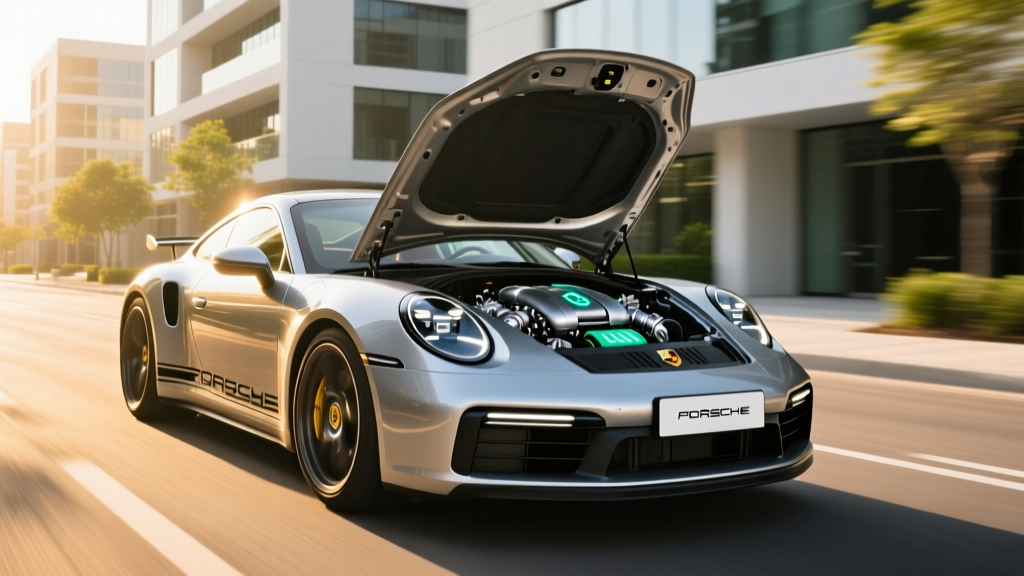
Porsche's 2025 911 GTS T-Hybrid is not a Prius in a sports car body. The "T-Hybrid" badge denotes a performance-oriented conventional hybrid (HEV) system engineered to eliminate turbo lag, sharpen throttle response, and push the 911's powertrain into territory previously reserved for full race-bred systems. With a combined output of 541 horsepower and a 0–60 mph time of 2.9 seconds, this is a hybrid built for the Nürburgring, not the school run.
But buyers researching the 911 GTS T-Hybrid still want the practical data: What MPG does it actually deliver? How does the hybrid system work without a plug? What does battery replacement cost? And does any federal tax credit apply? This guide answers every question with exact figures, not marketing copy.
Powertrain Deep Dive: How the T-Hybrid System Works
The 911 GTS T-Hybrid replaces the outgoing 3.0-liter twin-turbo flat-six with a revised 3.6-liter single-turbocharged flat-six paired with an electric motor integrated directly into the eight-speed PDK dual-clutch transmission housing. This is not a mild-hybrid belt-starter system — it's a full parallel hybrid architecture derived from Porsche's 919 LMP1 and 963 LMDh endurance racing programs.
| Component | Specification |
|---|---|
| Engine | 3.6L turbocharged flat-six (single turbo) |
| Electric Motor | Integrated in PDK housing, ~54 hp (40 kW) |
| Combined Output | 541 hp / 450 lb-ft torque |
| High-Voltage Battery | 1.9 kWh usable (lithium-ion) |
| Transmission | 8-speed PDK dual-clutch |
| Drivetrain | RWD (Coupé) / AWD (Targa 4 GTS) |
| 0–60 mph | 2.9 seconds (Coupé) |
| Top Speed | 196 mph |
The 1.9 kWh battery is deliberately small. Porsche's engineering goal was never electric-only range — it was torque fill. The electric motor spools the turbocharger electrically (an e-turbo), eliminating the lag inherent to conventional exhaust-driven turbos. Simultaneously, the motor provides instant torque at the transmission input shaft during gear changes and low-RPM acceleration. The result: throttle response that feels closer to a naturally aspirated engine than any turbocharged 911 before it.
Fuel Economy: EPA MPG and Real-World Expectations
For a 541-hp sports car, the T-Hybrid's efficiency is genuinely impressive — but context matters. This is not a hybrid you buy to save at the pump. You buy it because the hybrid system makes the car faster and more responsive, and the fuel economy improvement over the prior non-hybrid GTS is a welcome bonus.
| Configuration | City MPG | Highway MPG | Combined MPG |
|---|---|---|---|
| 911 Carrera GTS Coupé (RWD) | 19 | 25 | 21 |
| 911 Carrera 4 GTS (AWD) | 18 | 24 | 20 |
| 911 Targa 4 GTS (AWD) | 18 | 24 | 20 |
Source: EPA / fueleconomy.gov
For comparison, the outgoing 2024 911 GTS (3.0L twin-turbo, no hybrid) was rated at 18 city / 24 highway / 20 combined. The T-Hybrid's 1-MPG combined improvement is modest on paper, but the power increase is massive: 541 hp vs. the prior car's 473 hp. That's a 14% power bump with essentially flat fuel consumption — a genuine engineering achievement in thermal efficiency.
Hybrid vs. PHEV vs. Full EV: Which 911 Buyer Are You?
The 911 GTS T-Hybrid occupies a specific niche. Understanding where it sits in the electrification spectrum helps clarify whether it's the right choice — or whether a different approach to performance electrification suits your needs better.
| Factor | 911 GTS T-Hybrid (HEV) | PHEV Sports Car (e.g., BMW XM) | Full EV Performance (e.g., Taycan Turbo GT) |
|---|---|---|---|
| Plug-in Charging | No — self-charging | Yes — Level 2 home / DC fast | Yes — required |
| Electric-Only Range | None | 25–40 miles typical | 250–300+ miles total |
| Federal Tax Credit (§30D) | Not eligible | Up to $7,500 (if eligible) | Up to $7,500 (if eligible) |
| Fuel/Charge Needed | Gasoline only | Gas + electricity | Electricity only |
| Weight Penalty | ~100 lbs over non-hybrid | 400–700 lbs | Heavy (battery mass) |
| Track Capability | Excellent — no range concern | Limited — battery depletes fast | Thermal-limited in sustained use |
Choose the 911 GTS T-Hybrid if: You want a daily-drivable 911 that is the fastest, most responsive GTS ever built, you have no interest in plugging in a car, you track occasionally, and you value the 911's heritage and driving dynamics above all else.
Look elsewhere if: You want electric-only commuting (no PHEV 911 exists), you need a federal tax credit to offset cost, or you're committed to zero tailpipe emissions. In that case, Porsche's own Taycan lineup or a competitor like the Lucid Air Sapphire delivers EV performance — just not in a 911 package.
Pricing, Tax Credits, and Total Cost of Ownership
The 2025 Porsche 911 GTS T-Hybrid carries a significant premium over the outgoing non-hybrid GTS, reflecting both the new powertrain technology and Porsche's positioning of the GTS as the sweet spot in the 911 lineup.
| Model | Base MSRP | Federal Tax Credit |
|---|---|---|
| 911 Carrera GTS Coupé | $164,900 | $0 — Not eligible |
| 911 Carrera 4 GTS Cabriolet | $179,200 | $0 — Not eligible |
| 911 Targa 4 GTS | $186,400 | $0 — Not eligible |
Source: Porsche USA. Prices exclude $1,650 destination charge and dealer options.
Regarding total cost of ownership: at 21 MPG combined and $3.80/gallon premium fuel (91 octane required), annual fuel cost for 12,000 miles is approximately $2,170. A non-hybrid sports car at 18 MPG would cost ~$2,530 annually — a $360/year savings that does not meaningfully offset the T-Hybrid's purchase premium. The financial case for this car rests on performance, not fuel savings.
Battery Longevity, Warranty, and Replacement Costs
Every hybrid buyer asks about the battery. Porsche engineers designed the 911 GTS T-Hybrid's 1.9 kWh high-voltage pack for high power throughput (rapid charge/discharge cycles), not energy storage. This is a fundamentally different use case than a PHEV or BEV battery, and it affects longevity projections.
• Hybrid battery: 8 years / 100,000 miles (whichever comes first)
• Hybrid system components (e-motor, power electronics, e-turbo): 8 years / 100,000 miles
• New vehicle limited warranty: 4 years / 50,000 miles
• Porsche also offers extended warranty packages through its dealer network for additional coverage.
The 8-year/100,000-mile hybrid battery warranty is standard across the industry — Toyota, Honda, Hyundai, and BMW all offer similar terms. This warranty typically guarantees the battery will retain a minimum percentage of its original capacity (Porsche has not published a specific degradation threshold for the T-Hybrid, but industry standard is 60–70% capacity retention for warranty claims).
Regarding battery replacement cost: the 1.9 kWh pack is compact and purpose-built. While Porsche has not published an out-of-warranty replacement figure, comparable small high-voltage hybrid batteries from other manufacturers range from $2,500 to $5,000 for the battery module alone, plus labor. This is far less than a PHEV or BEV battery replacement ($10,000–$25,000+) because the T-Hybrid's pack stores very little energy. The e-turbocharger and integrated PDK electric motor are more complex and potentially costlier components if they fail outside warranty — expect $4,000–$8,000 for e-turbo replacement based on Porsche specialist estimates.
Who Should Buy the 911 GTS T-Hybrid?
✓ This Car Is For You If:
- You want the most responsive, fastest-accelerating GTS-generation 911 ever produced
- You prefer a car that requires zero behavior change — no plugs, no charging apps, no route planning
- You track your car occasionally and need a powertrain that won't thermally derate after 3 laps
- You value instant torque fill and e-turbo spool-up as driving experiences
- You're upgrading from a 992.1 GTS and want a meaningful generational leap
✗ Look Elsewhere If:
- You need electric-only commuting capability (no PHEV 911 exists)
- You're counting on a $7,500 federal tax credit to justify the purchase
- Your primary motivation is fuel cost savings (savings over non-hybrid GTS: ~$360/year)
- You want a back seat that adults can use (it's still a 2+2 sports car)
- You're cross-shopping luxury grand tourers — the GTS is a driver's car first
Pros, Cons, and the Bottom Line
Pros
- 541 hp with virtually zero turbo lag thanks to e-turbo and electric motor
- 2.9-second 0–60 mph — fastest GTS ever
- No plug-in needed — zero lifestyle compromise
- Improved fuel economy over prior GTS despite 68 more horsepower
- 8-year/100,000-mile hybrid battery warranty
- Lightweight for a hybrid — only ~100 lbs added vs. non-hybrid
- Track-capable without range or thermal anxiety
Cons
- $164,900+ starting price — a steep premium over the outgoing GTS
- No federal tax credit eligibility (HEV, not PHEV/BEV)
- 1.9 kWh battery means zero electric-only driving
- 21 MPG combined — not a meaningful fuel-cost saver
- First model year for this powertrain — long-term reliability unproven
- Premium 91-octane fuel required
- Complex e-turbo system may carry high out-of-warranty repair costs
Frequently Asked Questions
How many MPG does the 911 GTS T-Hybrid get?
The EPA rates the 2025 911 Carrera GTS T-Hybrid Coupé at 19 city / 25 highway / 21 combined MPG. AWD variants (Carrera 4 GTS and Targa 4 GTS) drop to 18/24/20. Real-world reports cluster around 20–23 MPG in mixed driving, with lower figures during aggressive or track use.
Can the 911 GTS T-Hybrid drive on electric power alone?
No. The T-Hybrid is a conventional HEV with a 1.9 kWh battery and no electric-only driving mode. The electric motor assists the gasoline engine for torque fill, turbo spooling, and regenerative braking — it cannot propel the car independently. If you need electric-only miles, you need a PHEV or BEV.
Does the 911 GTS T-Hybrid qualify for any tax credit?
No. The federal §30D Clean Vehicle Credit applies only to plug-in electric vehicles (BEVs and PHEVs) meeting specific battery capacity, sourcing, MSRP, and income requirements. As a non-plug-in HEV, the T-Hybrid is ineligible. Check with your state's environmental agency for any local hybrid incentives, though these are rare and typically small.
Is the T-Hybrid system reliable? What about battery replacement cost?
Porsche's hybrid technology is proven through years of motorsport use (919 Hybrid, 963 LMDh). The road-car system carries an 8-year/100,000-mile hybrid battery warranty. The 1.9 kWh battery is small and less stressed than a PHEV/BEV pack, suggesting favorable longevity. Estimated out-of-warranty battery replacement is $2,500–$5,000 based on comparable systems, though the e-turbo component may cost more ($4,000–$8,000 estimate). As a first-year powertrain, long-term consumer reliability data is not yet available.
How is the T-Hybrid different from a mild hybrid?
A mild hybrid (like a 48-volt belt-starter system) cannot drive the wheels electrically and provides only marginal assistance. The 911 GTS T-Hybrid uses a full parallel hybrid system with a high-voltage battery, an electric motor inside the PDK transmission housing, and an electric turbocharger. It produces 541 combined horsepower with substantial electric torque contribution — this is a fundamentally more capable and complex system than any mild hybrid on the market.
Should I wait for a hybrid 911 PHEV or go with the T-Hybrid now?
Porsche has not announced a plug-in hybrid 911. The T-Hybrid architecture could theoretically support a larger battery and plug-in capability in a future generation, but no timeline exists. If you want a hybrid 911 today, the T-Hybrid is the only option — and its performance credentials are formidable enough that waiting for a hypothetical PHEV variant may not be justified unless electric-only commuting is a hard requirement for you.