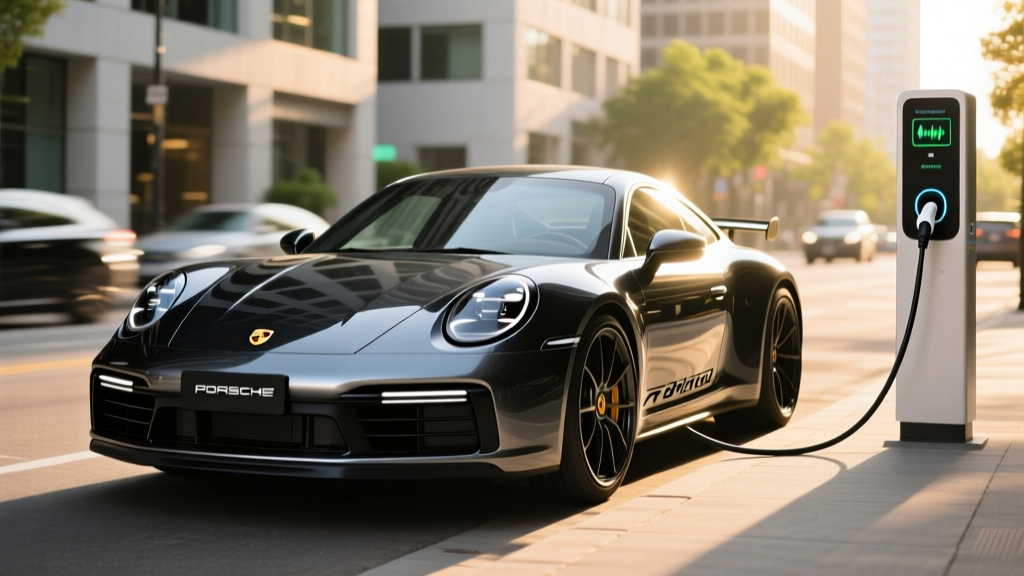
The 2026 Porsche 911 GTS Hybrid — officially the 992.2-generation 911 Carrera GTS — marks a pivotal moment for Porsche's sports car lineup. It is the first 911 to pair a turbocharged flat-six with an electric motor integrated directly into the powertrain, a system Porsche calls T-Hybrid. This is not a plug-in hybrid chasing electric-only commuting range. It is a conventional performance hybrid (HEV) engineered to sharpen throttle response, fill turbo lag, and improve efficiency without adding the weight penalty of a large battery pack.
For buyers researching the 911 GTS hybrid, the critical distinction is this: Porsche's T-Hybrid system prioritizes performance augmentation over electric driving. If you are shopping for a PHEV that plugs in and drives 30 miles on electricity alone, this is not it. If you want a 911 that hits 60 mph in 2.9 seconds while returning meaningfully better fuel economy than its predecessor, read on.
What Is the 911 GTS T-Hybrid System?
Porsche's T-Hybrid architecture centers on a newly developed 3.6-liter twin-turbocharged flat-six engine. Between the engine and the eight-speed PDK dual-clutch transmission sits a compact electric motor — roughly 40 kW (54 hp) — that acts as both a torque-fill device and a generator. A small high-voltage battery, rated at 1.9 kWh (gross), stores energy recovered during braking and deceleration.
This is a conventional hybrid (HEV), not a plug-in hybrid (PHEV). The battery charges exclusively through regenerative braking and engine-driven generation. There is no charge port, no plug, and no electric-only driving mode designed for zero-emission commuting. The system's entire purpose is to make the 911 GTS faster, more responsive, and marginally more efficient.
HEV vs PHEV: Where the 911 GTS Fits
| Feature | 911 GTS T-Hybrid (HEV) | Typical PHEV (e.g., Cayenne E-Hybrid) |
|---|---|---|
| Plug-in charging | No — self-charging | Yes — Level 2 AC |
| Electric-only range | Not applicable | 20–45 miles typical |
| Battery capacity | 1.9 kWh | 17–25 kWh |
| Primary benefit | Performance boost, throttle response | Emission-free commuting |
| Added weight | ~110 lbs | 500–800 lbs |
| Federal tax credit (§30D) | Not eligible | Potentially eligible |
911 GTS Hybrid Powertrain and Performance Specs
The combined output of the 3.6L flat-six and integrated electric motor is 532 horsepower (397 kW) and 449 lb-ft of torque. Porsche rates the 0–60 mph sprint at 2.9 seconds for the coupe with rear-wheel drive, and 2.8 seconds for the all-wheel-drive 911 Carrera 4 GTS. Top speed is electronically limited to 196 mph.
| Specification | 2026 Porsche 911 Carrera GTS (T-Hybrid) |
|---|---|
| Engine | 3.6L twin-turbo flat-six + integrated e-motor |
| Combined Output | 532 hp / 449 lb-ft |
| Electric Motor | ~40 kW (54 hp) |
| Battery | 1.9 kWh (gross), lithium-ion |
| Transmission | 8-speed PDK dual-clutch |
| 0–60 mph | 2.9 sec (RWD) / 2.8 sec (AWD 4 GTS) |
| Top Speed | 196 mph |
| Drivetrain | RWD standard, AWD available (4 GTS) |
| Curb Weight | ~3,460 lbs (coupe RWD) |
| Body Styles | Coupe, Cabriolet |
The electric motor's contribution is not about raw power — 54 hp is modest in this context. Its value lies in torque fill. Turbocharged engines inherently suffer from a delay between throttle input and boost delivery. The e-motor provides instant torque at the exact moment the turbos are spooling, effectively eliminating perceptible lag. Porsche engineers have described the result as "the responsiveness of a naturally aspirated engine with the thrust of a turbo."
Fuel Economy: EPA MPG and Real-World Expectations
The EPA rates the 2026 911 Carrera GTS coupe at approximately 19 mpg city / 25 mpg highway / 21 mpg combined. The T-Hybrid system contributes to a modest improvement over the outgoing 992.1 GTS (rated 17/24/20 mpg combined). In European WLTP testing, Porsche claims up to a 13% reduction in CO₂ emissions compared to the prior generation, though WLTP figures are typically more optimistic than EPA cycles.
| Driving Scenario | EPA Estimate | Real-World Expectation |
|---|---|---|
| City | 19 mpg | 18–21 mpg (regen benefits stop-and-go) |
| Highway | 25 mpg | 22–26 mpg (steady cruising, less e-motor assist) |
| Combined | 21 mpg | 20–23 mpg |
| Track / Aggressive | Not rated | 12–15 mpg (expected) |
Conventional hybrids tend to exceed EPA city estimates in stop-and-go driving because regenerative braking recaptures energy that a pure ICE car wastes as heat. Expect the 911 GTS hybrid to deliver its best real-world MPG in urban environments, though "best" for a 532-hp sports car remains relative. On highway road trips at sustained 75–80 mph, the electric motor contributes less, and fuel economy tracks closer to the non-hybrid predecessor.
According to fueleconomy.gov, the 911 GTS T-Hybrid's combined rating positions it roughly 1–2 mpg above comparable non-hybrid sports cars in its class, with the primary advantage being responsiveness rather than economy.
Does the 911 GTS Hybrid Qualify for a Tax Credit?
No. The 2026 Porsche 911 GTS T-Hybrid does not qualify for the federal §30D clean vehicle tax credit (up to $7,500). That credit requires a vehicle to be a plug-in electric vehicle (BEV) or plug-in hybrid (PHEV) with a battery capacity of at least 7 kWh, among other criteria. The 911 GTS's 1.9 kWh battery and lack of a charge port place it firmly outside IRS §30D eligibility.
At a starting MSRP of approximately $164,900 for the coupe (before destination and options), buyers should also note that even if the car were a PHEV, it would exceed the §30D MSRP cap of $55,000 for sedans/sports cars. There is no federal incentive pathway for this vehicle. Some states offer registration or HOV-lane perks for hybrids, but these vary by jurisdiction — check your local DMV for specifics.
Battery Warranty, Reliability, and Replacement Cost
Porsche covers the 911 GTS T-Hybrid's high-voltage battery and hybrid components under its standard new-vehicle limited warranty of 4 years / 50,000 miles. Unlike dedicated hybrid manufacturers (Toyota, Hyundai) that offer 8–10 year / 100,000–150,000 mile hybrid battery warranties, Porsche's coverage aligns with its standard bumper-to-bumper term.
Hybrid Battery Warranty at a Glance
- Warranty coverage: 4 years / 50,000 miles (Porsche new-vehicle limited)
- Battery capacity: 1.9 kWh — small by hybrid standards, reducing degradation risk
- Chemistry: Lithium-ion (pouch cells, optimized for power density over energy density)
- Estimated replacement cost: $3,000–$6,000 (battery module), plus labor — based on comparable Porsche hybrid service estimates
- Degradation concern: Minimal — the 1.9 kWh pack operates within a narrow state-of-charge window, managed by Porsche's thermal and BMS systems to minimize cycle wear
The small battery size is actually a reliability advantage. Porsche's hybrid system keeps the battery within a conservative state-of-charge band (never fully depleted, never fully saturated), which dramatically reduces chemical degradation compared to a PHEV or BEV that cycles through 0–100% SoC regularly. The e-motor itself is a brushless unit with no wearable consumables. Based on Porsche's track record with the Panamera and Cayenne hybrid systems (introduced over a decade ago), long-term hybrid component reliability has been strong, though the 992.2 T-Hybrid's specific architecture is new and lacks multi-year field data as of 2026.
For owners concerned about out-of-warranty costs, Porsche offers extended warranty plans (Vehicle Service Protection) that can cover hybrid components up to 10 years / 100,000 miles for an additional premium at purchase.
Pricing, Trims, and What the Competition Costs
The 2026 911 Carrera GTS starts at approximately $164,900 (coupe, RWD) including destination. The all-wheel-drive 911 Carrera 4 GTS starts around $170,100. Cabriolet variants add roughly $13,000. Options — carbon ceramic brakes (PCCB), rear-axle steering, Sport Chrono, exclusive interior packages — can push a well-equipped GTS past $200,000.
At this price point, the GTS sits between the 911 Carrera S (~$135,000) and the 911 Turbo (~$195,000). The T-Hybrid system is standard on the GTS trim; there is no non-hybrid GTS option for 2026.
| Trim | MSRP (approx.) | Powertrain | 0–60 mph |
|---|---|---|---|
| 911 Carrera S | $135,200 | 3.0L twin-turbo flat-six (ICE) | 3.3 sec |
| 911 Carrera GTS (T-Hybrid) | $164,900 | 3.6L twin-turbo + e-motor (HEV) | 2.9 sec |
| 911 Carrera 4 GTS (T-Hybrid) | $170,100 | 3.6L twin-turbo + e-motor (HEV, AWD) | 2.8 sec |
| 911 Turbo | $195,400 | 3.7L twin-turbo flat-six (ICE) | 2.7 sec |
| 911 Turbo S | $230,400 | 3.7L twin-turbo flat-six (ICE) | 2.4 sec |
Compared to the outgoing non-hybrid GTS (502 hp, 3.1 sec to 60), the T-Hybrid GTS delivers 30 additional horsepower, shaves 0.2 seconds off the 0–60 time, and returns slightly better fuel economy — all for a price increase of roughly $8,000–$10,000 over the previous generation's final MSRP.
911 GTS Hybrid vs Full EV vs Gas: Which Fits You?
Choose the 911 GTS T-Hybrid If:
- You want a 911 with the sharpest possible throttle response and zero perceptible turbo lag
- You prioritize driving dynamics over fuel economy or electric-only commuting
- You do not have access to home or workplace charging infrastructure
- You value the 911's mechanical heritage and are comfortable with a performance-oriented hybrid that does not plug in
- Your budget accommodates a $165,000+ sports car without expecting tax incentives
Consider a Full EV (e.g., Porsche Taycan, Tesla Model S Plaid) If:
- You want instant torque with zero lag — EVs deliver maximum torque from 0 rpm, outperforming even hybrid-assisted turbos off the line
- You have reliable home Level 2 charging and want $0.04–$0.06/mile "fuel" costs vs the GTS's ~$0.22/mile at 21 mpg
- You qualify for the §30D tax credit (income and MSRP permitting), which can reduce a Taycan's effective cost
- You prioritize daily-driver practicality and lower operating costs over sports-car heritage
Stick with a Gas 911 (Carrera S) If:
- The $30,000 price gap between the Carrera S and GTS matters
- You prefer the simplest possible powertrain with no hybrid components to service
- You plan to track the car frequently and want to minimize weight (the Carrera S is ~110 lbs lighter without the hybrid system)
The honest assessment: the 911 GTS T-Hybrid exists because Porsche needed to meet increasingly strict European CO₂ fleet targets without diluting the 911's performance character. For the buyer, the result is a better-driving 911 GTS — but not a greener one in any transformative sense. This is a performance hybrid, not an efficiency play.
Pros
- Eliminates turbo lag with instant electric torque fill
- 532 hp and 2.9-sec 0–60 make it the quickest GTS ever
- Only ~110 lbs added vs non-hybrid — negligible weight penalty
- Marginally improved fuel economy (21 mpg combined)
- No charging infrastructure required — self-charging HEV
- Retains the 911's iconic driving feel and engagement
Cons
- $164,900 starting price; options push past $200K
- No federal tax credit eligibility
- Only 4-year/50,000-mile hybrid warranty (shorter than Toyota/Hyundai)
- 1.9 kWh battery offers no electric-only driving capability
- Fuel economy improvement over predecessor is modest (~1 mpg combined)
- New architecture — limited long-term reliability data as of 2026
Frequently Asked Questions
How many MPG does the 911 GTS hybrid get?
The EPA rates the 2026 911 Carrera GTS at 19 mpg city, 25 mpg highway, and 21 mpg combined. Real-world figures vary: expect 20–23 mpg in mixed driving, with city driving benefiting most from regenerative braking. Aggressive or track driving will drop economy to the low teens.
Can the 911 GTS hybrid drive on electric power only?
Not in any practical sense. The T-Hybrid system uses its 1.9 kWh battery and 40 kW e-motor for torque assist and turbo-lag elimination, not for sustained electric-only propulsion. There is no EV mode, no charge port, and no plug. This is a conventional self-charging hybrid (HEV), not a PHEV.
Does the 911 GTS hybrid qualify for any tax credit?
No. The federal §30D clean vehicle credit requires plug-in capability and a minimum 7 kWh battery. The 911 GTS has neither. At $164,900+ MSRP, it would also exceed the §30D MSRP cap for non-SUVs ($55,000). No federal incentive applies. Check your state's DMV for any local hybrid perks, though these are rare for performance vehicles.
Is the 911 GTS hybrid reliable, and what does battery replacement cost?
Porsche's hybrid systems in the Panamera and Cayenne have demonstrated strong reliability over 10+ years of production. The 992.2 T-Hybrid's small 1.9 kWh battery operates in a narrow, thermally managed SoC window, minimizing degradation risk. Porsche covers the hybrid system for 4 years/50,000 miles. Estimated out-of-warranty battery module replacement is $3,000–$6,000, significantly less than a BEV or large PHEV battery due to the small pack size.
How does the 911 GTS hybrid compare to the Porsche Taycan?
They serve different purposes. The Taycan is a full EV (BEV) with up to 318 miles of EPA range (Taycan 4S), DC fast charging up to 320 kW, and eligibility for potential tax incentives. The 911 GTS is a hybrid sports car optimized for driving engagement, track capability, and heritage. The Taycan is a daily-driver EV; the GTS is an enthusiast's 911 that happens to have a small electric assist.
Why did Porsche make the 911 GTS a hybrid?
Two factors: European CO₂ fleet emissions regulations require Porsche to reduce average emissions across its lineup, and the electric motor delivers a measurable performance benefit — specifically, instant torque fill that eliminates turbo lag. The T-Hybrid system achieves both goals without the weight penalty of a large PHEV battery or the range/charging compromises of a full EV sports car.
What is the total driving range of the 911 GTS hybrid?
With a 16.9-gallon fuel tank and 21 mpg combined EPA rating, the 911 GTS delivers approximately 355 miles of total range on a full tank. This is entirely gasoline-powered range — the hybrid system does not add electric-only miles but does contribute to marginally improved fuel consumption.
Sources: fueleconomy.gov (EPA ratings), Porsche Newsroom (992.2 GTS T-Hybrid specifications), IRS.gov (§30D credit eligibility rules).