Truck buyers in 2026 face a three-way decision at the dealership: stick with a conventional gas engine, jump to a full battery-electric pickup, or split the difference with a plugin hybrid truck. That middle option — a plug-in hybrid electric vehicle (PHEV) — promises electric-only commuting paired with a gas engine for towing and long hauls. But the PHEV truck segment remains surprisingly thin, with only a handful of nameplates offering true plug-in capability in a pickup body style.
This guide breaks down every 2026 plug-in hybrid truck available in the US market, explains how PHEV powertrains differ from conventional hybrids (HEVs), and gives you the exact numbers — EPA MPG, electric-only range, battery capacity, charge times, and tax credit eligibility — needed to make an informed purchase.
HEV vs. PHEV: What's the Difference in a Hybrid Truck?
Before comparing specific models, it's critical to understand the two hybrid architectures available in trucks. Manufacturers and marketers sometimes blur these together, but the distinction determines whether you plug in, how far you drive on electricity, and whether you qualify for federal incentives.
| Attribute | Conventional Hybrid (HEV) | Plug-in Hybrid (PHEV) |
|---|---|---|
| Plug-in charging? | No — charges via regen & engine | Yes — plug in to charge battery |
| Electric-only range | 0–2 miles at low speed | 15–40+ miles (model dependent) |
| Battery size | 1–2 kWh | 12–20+ kWh |
| Federal tax credit (§30D) | Not eligible | Up to $7,500 if requirements met |
| Level 1/2 charging | Not applicable | Yes (Level 1 overnight, Level 2 ~2–4 hr) |
| DC fast charging | Not applicable | Rare — most PHEV trucks lack DCFC |
| Best for | Drivers who can't charge at home | Drivers with home/work charging + commute under electric range |
Key takeaway: A conventional hybrid like the Ford F-150 PowerBoost (HEV version) never plugs in. It recovers energy through regenerative braking and the gasoline engine. A PHEV truck has a larger battery you charge from the grid, giving meaningful electric-only miles before the engine engages.
2026 Plug-in Hybrid Trucks Available in the US
As of the 2026 model year, the plug-in hybrid truck market in the United States is limited but growing. Here are the primary contenders buyers can actually purchase or order:
Ford F-150 PowerBoost PHEV (Pro/Extended Range)
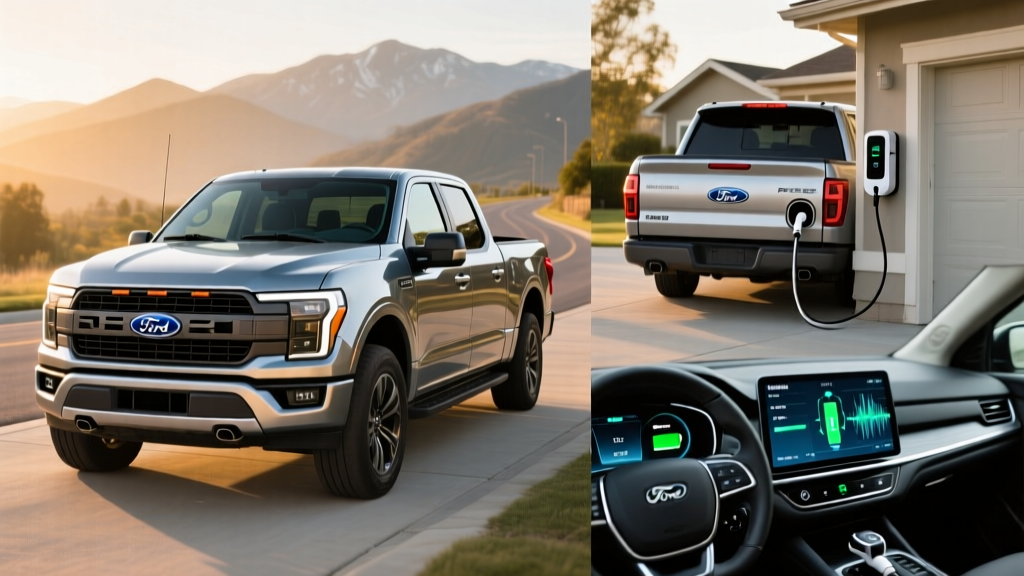
Ford introduced a plug-in variant of its PowerBoost hybrid system for the F-150, pairing the 3.5L twin-turbo V6 with a larger battery pack and more powerful electric motor integrated into the 10-speed automatic transmission. This is the most widely available PHEV truck in America.
| Spec | F-150 PowerBoost PHEV (2026) |
|---|---|
| Powertrain | 3.5L EcoBoost V6 + electric motor (10-speed auto) |
| Combined output | ~430 hp / 570 lb-ft torque |
| Battery (usable) | ~18.0 kWh (NMC chemistry) |
| EPA electric-only range | ~30 miles |
| Total combined range | ~550+ miles (electric + gas) |
| EPA MPG (charge-sustaining) | ~24 city / 22 hwy / 23 combined |
| MPGe (electric + gas combined) | ~55 MPGe |
| Level 1 charging (120V) | ~14 hours (0–100%) |
| Level 2 charging (240V, 32A) | ~3.5 hours (0–100%) |
| DC fast charging | Not available |
| Max towing | ~10,800 lbs (properly equipped) |
| Pro Power Onboard | 7.2 kW (exportable 240V) |
| Base MSRP | ~$62,500 (Pro trim PHEV package) |
Real-world range note: The EPA's 30-mile electric estimate assumes moderate temperatures and mixed driving. Expect 22–26 miles of electric range in highway driving or cold weather (below 40°F), and up to 32–34 miles in warm, low-speed city conditions. Once the battery depletes, the truck operates as a conventional hybrid at approximately 23 MPG combined.
Other PHEV Truck Contenders (2026)
Ram 1500 REV / Ramcharger: Stellantis positions the Ramcharger as an extended-range electric vehicle (EREV) rather than a traditional PHEV. It uses a 3.6L V6 as a generator only — it never mechanically drives the wheels. With ~145 miles of electric range and a ~690-mile total range, it sits between a PHEV and a full EV. Base MSRP starts around $69,995. The Ramcharger qualifies for partial §30D credit consideration depending on battery sourcing.
Chevrolet Silverado PHEV: As of early 2026, GM has not released a plug-in hybrid Silverado. The Silverado EV is a full battery-electric truck. No PHEV variant is available or announced.
Toyota Tundra i-FORCE MAX: This is a conventional hybrid (HEV), not a PHEV. It does not plug in. EPA-rated at approximately 20 city / 24 hwy / 22 combined MPG. No electric-only range. Not eligible for §30D credits.
Fuel Economy Breakdown: EPA MPG and Real-World Results
PHEV trucks have two fuel economy ratings: an MPGe figure that accounts for electric driving, and a charge-sustaining MPG figure for when the battery is depleted. Both matter — MPGe reflects your commute if you charge daily, while charge-sustaining MPG is what you'll see on road trips or if you forget to plug in.
| Truck | Type | EPA City | EPA Hwy | EPA Combined | MPGe (if PHEV) |
|---|---|---|---|---|---|
| Ford F-150 PowerBoost PHEV | PHEV | 24 | 22 | 23 | 55 MPGe |
| Ford F-150 PowerBoost (HEV) | HEV | 25 | 22 | 23 | N/A |
| Toyota Tundra i-FORCE MAX | HEV | 20 | 24 | 22 | N/A |
| Ram 1500 HEMI (5.7L V8) | Gas | 15 | 22 | 17 | N/A |
| Ramcharger (EREV) | EREV | — | — | ~28 (CS) | ~70 MPGe |
Real-world MPG observations: Hybrid trucks, like all hybrids, tend to exceed their EPA city rating in stop-and-go traffic where regenerative braking recovers the most energy. Highway MPG is often 1–3 MPG below the sticker. For the F-150 PowerBoost PHEV, owners who charge nightly report using almost zero gasoline on commutes under 25 miles. On a 400-mile highway trip with no charging, expect 21–22 MPG — consistent with the EPA's charge-sustaining number. Source: fueleconomy.gov.
Charging a Plug-in Hybrid Truck: What You Need to Know
One advantage of a PHEV truck over a full EV: the smaller battery means shorter charge times and less infrastructure investment. Most PHEV truck owners charge exclusively on Level 1 (standard 120V household outlet) overnight, which is sufficient to refill the pack in roughly 12–14 hours.
| Charging Level | Power (kW) | Time (0–100%) | Equipment Needed |
|---|---|---|---|
| Level 1 (120V, 12A) | ~1.4 kW | ~14 hours | Included portable cordset |
| Level 2 (240V, 32A) | ~7.7 kW | ~3.5 hours | Home wall charger or public L2 |
| DC Fast Charge | N/A | N/A | Most PHEV trucks lack DCFC capability |
kW vs. kWh reminder: kW (kilowatts) measures the rate of power flow — how fast you're charging. kWh (kilowatt-hours) measures the battery's energy capacity — how much it holds. The F-150 PHEV's ~18 kWh battery charging at 7.7 kW takes roughly 18 ÷ 7.7 ≈ 2.3 hours from empty, plus taper time above 80%, bringing the total to about 3.5 hours.
Home charging cost: If you already have a 240V outlet (like a dryer outlet), a Level 2 EVSE costs $300–$600 for the equipment. A dedicated 240V/40A circuit installation by a licensed electrician typically runs $500–$1,500 depending on panel proximity. For PHEV trucks with smaller batteries, many owners find Level 1 adequate and skip the installation cost entirely.
Federal Tax Credit Eligibility for PHEV Trucks (§30D)
Plug-in hybrid trucks may qualify for the federal §30D clean vehicle credit — up to $7,500 — but eligibility is far from automatic. The rules for 2026 include several requirements that disqualify many vehicles and buyers:
- MSRP cap: Trucks (vans, SUVs, pickups) must have an MSRP at or below $80,000.
- Buyer income cap: Modified adjusted gross income must not exceed $150,000 (single) / $300,000 (joint filing).
- Battery sourcing: A percentage of critical minerals and battery components must be sourced from the US or free-trade-agreement countries. This requirement tightens annually.
- FEOC exclusion: Vehicles with battery components from Foreign Entities of Concern (primarily Chinese suppliers) are ineligible.
- Point-of-sale transfer: Buyers can transfer the credit to the dealer at purchase, reducing the sale price directly — or claim it on their tax return.
- Battery capacity: PHEVs must have a battery of at least 7 kWh to qualify.
For the F-150 PowerBoost PHEV at ~$62,500 MSRP, the truck clears the price cap. However, battery component sourcing rules have tightened significantly by 2026, and some trims or build configurations may not meet the critical-mineral threshold. Always verify current eligibility on fueleconomy.gov and consult a tax professional before relying on the credit.
The Ramcharger, as an EREV with a larger battery, may qualify for a partial credit ($3,750) if it meets the critical-mineral requirement but not the battery-component requirement. Check the IRS's updated list at irs.gov.
Battery Warranty, Reliability, and Replacement Cost
Ford F-150 PowerBoost PHEV Hybrid Battery Warranty: 8 years / 100,000 miles (whichever comes first), covering defects and capacity loss below 70% of original capacity. This is the federal minimum standard for hybrid and PHEV components, and most manufacturers match or exceed it.
Reliability: Toyota's hybrid systems (Tundra i-FORCE MAX) have the longest track record — the company has produced millions of hybrids since 1997, and hybrid battery failures before 150,000 miles are uncommon. Ford's PowerBoost system is newer (introduced for the 2021 model year) but has proven robust in fleet and consumer use. The PHEV variant's larger battery adds complexity but also operates within a conservative state-of-charge window (typically 15–95%) to reduce degradation.
Battery replacement cost: If the hybrid battery fails outside warranty, replacement costs for PHEV truck batteries typically range from $8,000 to $14,000 including labor, depending on the model and battery size. Conventional HEV batteries (smaller, 1–2 kWh) are cheaper to replace — generally $3,000–$5,000. These are worst-case scenarios; most hybrid batteries outlast the vehicle's useful life.
Who Should Buy a Plugin Hybrid Truck — and Who Shouldn't?
Choose a PHEV truck if:
- You have home or workplace charging (even a 120V outlet works)
- Your daily commute is under 30 miles round-trip
- You tow or haul regularly and can't risk EV range limitations on long trips
- You want to reduce gasoline consumption without committing to full electrification
- You live in an area with limited DC fast-charging infrastructure
Choose a full EV truck (F-150 Lightning, Silverado EV, Rivian R1T) if:
- You have reliable Level 2 home charging
- Your daily driving is under 250 miles and you rarely tow over long distances
- You want zero tailpipe emissions and minimal maintenance (no oil changes, no spark plugs)
- You want the lowest per-mile fuel cost (electricity is cheaper than gasoline in most states)
Choose a conventional HEV truck (Tundra Hybrid, F-150 PowerBoost HEV) if:
- You cannot charge at home or work
- You want better fuel economy than a gas truck without any plug-in behavior
- You drive in heavy stop-and-go traffic where regenerative braking maximizes efficiency
Stick with a gas truck if:
- You drive fewer than 8,000 miles per year (the fuel savings won't offset the PHEV premium)
- You regularly tow at max capacity in extreme heat or cold (simpler powertrain, proven cooling)
- Your budget prioritizes lowest upfront cost above all else
Pros and Cons: The Plugin Hybrid Truck Verdict
Pros
- Electric-only commuting eliminates most daily gasoline use (30 miles covers ~70% of US commutes)
- No range anxiety — gas engine provides 550+ total miles
- Towing and payload capability comparable to gas counterparts
- Pro Power Onboard (F-150) provides 7.2 kW of exportable power for job sites or camping
- Lower operating cost than gas trucks when charged regularly
- Regenerative braking extends brake life
Cons
- Higher upfront cost — PHEV package adds $5,000–$8,000 over gas equivalent
- Electric-only range of ~30 miles is modest; longer commutes still burn gas
- No DC fast charging — public charging is slow (Level 2 only)
- Added weight from battery reduces payload by ~200–400 lbs vs. gas models
- Tax credit eligibility uncertain due to evolving sourcing rules
- Maintenance complexity: two powertrains (engine + electric motor) to service
Frequently Asked Questions
How many MPG does a plug-in hybrid truck get?
The 2026 Ford F-150 PowerBoost PHEV achieves approximately 55 MPGe when combining electric and gasoline driving, and 23 MPG combined (24 city / 22 highway) when operating on gasoline alone after the battery is depleted. Real-world results vary: city drivers often see 24–26 MPG in charge-sustaining mode thanks to regenerative braking, while highway-heavy driving drops to 21–22 MPG.
How far can a PHEV truck go on electric only?
The F-150 PowerBoost PHEV delivers approximately 30 miles of EPA-rated electric-only range. In real-world conditions, expect 22–26 miles on the highway or in cold weather, and up to 32–34 miles in warm city driving. The Ramcharger EREV offers significantly more — approximately 145 miles electric-only — because it uses a much larger battery and the gas engine only generates electricity.
Is a plug-in hybrid truck reliable? What about battery replacement?
PHEV trucks from major manufacturers carry an 8-year/100,000-mile hybrid battery warranty (10 years/150,000 miles in CARB states). Ford's PowerBoost system has been in production since 2021 with no widespread battery failure reports. Out-of-warranty battery replacement costs $8,000–$14,000, but most hybrid batteries last 150,000+ miles without significant degradation.
Does a plug-in hybrid truck qualify for the $7,500 federal tax credit?
It depends. The §30D credit requires the truck to have an MSRP under $80,000, the buyer to meet income caps ($150K single / $300K joint), and the battery to meet critical-mineral and component-sourcing thresholds that tighten each year. Some PHEV truck configurations qualify for the full $7,500, some for $3,750, and some for nothing — depending on the specific build and model year. Always verify on fueleconomy.gov before purchasing.
Do I need to install a home charger for a PHEV truck?
Not necessarily. PHEV truck batteries are small enough (12–18 kWh) that a standard 120V household outlet can fully recharge the pack overnight in 12–14 hours. A Level 2 (240V) charger reduces this to about 3.5 hours but requires professional installation costing $500–$1,500. Many PHEV truck owners never install a dedicated charger.
Hybrid vs. PHEV vs. EV truck — which should I choose?
If you have home charging and a commute under 30 miles, a PHEV truck gives you electric daily driving plus gas-engine flexibility for towing and road trips. If you can charge at home and rarely tow long distances, a full EV truck offers the lowest operating cost and zero tailpipe emissions. If you can't charge at all, a conventional HEV truck improves fuel economy over a gas truck without any plug-in requirement. Your charging access is the single biggest factor in this decision.
Sources: EPA fuel economy data via fueleconomy.gov; Ford Motor Company specifications; IRS §30D clean vehicle credit guidance at irs.gov. All specifications reflect 2026 model year data available at time of publication and are subject to change.