Toyota's plug-in hybrid lineup in 2026 boils down to two compelling options: the RAV4 Prime (a compact SUV) and the Prius Prime (a sleek hatchback). Both let you drive 40+ miles on electricity alone before seamlessly switching to hybrid mode — making them practical for commuters who want EV-like daily driving without range anxiety on road trips. But which one fits your life, and do either qualify for federal tax credits? Here's the data-driven breakdown.
HEV vs PHEV: What's the Difference Before You Plug In?
Before diving into Toyota's plug-in models, it's critical to understand the difference between a conventional hybrid (HEV) and a plug-in hybrid (PHEV). A standard Toyota Hybrid — like the base RAV4 Hybrid or Prius — uses a small battery charged solely by regenerative braking and the gas engine. You never plug it in, and electric-only driving is limited to low-speed crawling.
A plug-in hybrid has a much larger battery (13.6–18.1 kWh in Toyota's case) that you charge from a wall outlet or Level 2 charger. This gives you genuine electric-only range for daily commutes, after which the car operates as a conventional hybrid. Think of a PHEV as an EV for your commute and a hybrid for your road trips.
| Feature | Toyota Hybrid (HEV) | Toyota Plug-In Hybrid (PHEV) |
|---|---|---|
| Battery Size | ~1.0–1.6 kWh | 13.6–18.1 kWh |
| Electric-Only Range | ~1 mile at low speed | 40–44 miles |
| Plug In to Charge? | No | Yes (120V or 240V) |
| Federal Tax Credit | No | Up to $3,750* |
| Best For | No home charging access | Daily commute under 40 mi |
*Credit eligibility depends on income, MSRP caps, and battery sourcing — see tax credit section below.
2026 Toyota RAV4 Prime: Specs, Range & Fuel Economy
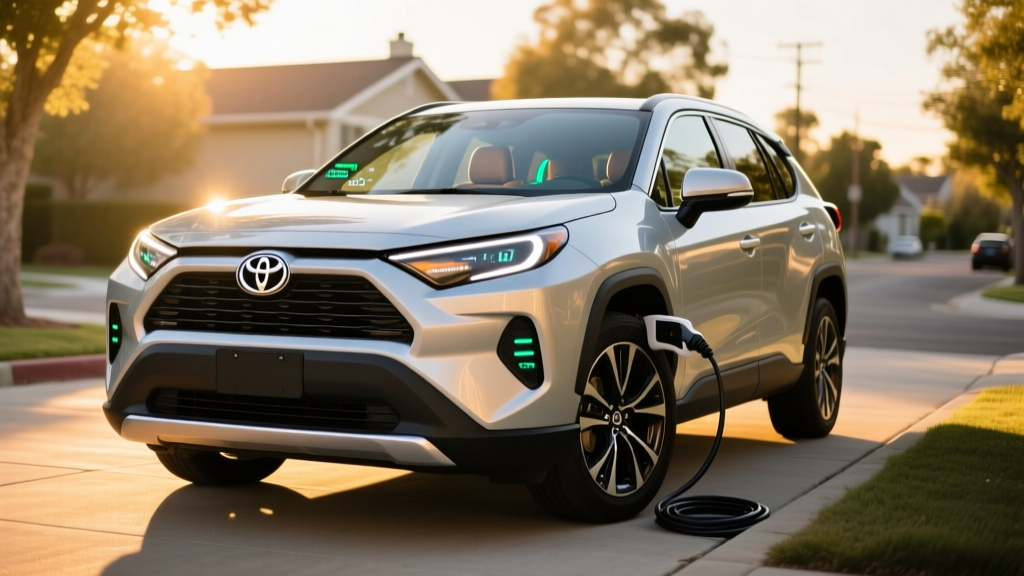
The RAV4 Prime remains Toyota's most powerful RAV4 and one of the quickest compact SUVs in its class. It pairs a 2.5-liter four-cylinder engine with front and rear electric motors for standard all-wheel drive.
| Specification | 2026 RAV4 Prime |
|---|---|
| Combined Horsepower | 302 hp |
| 0–60 mph | 5.7 seconds |
| Battery (Usable) | 18.1 kWh (lithium-ion) |
| EPA Electric-Only Range | 42 miles |
| EPA MPGe (Electric+Gas) | 94 MPGe |
| EPA MPG (Hybrid Mode) | 38 city / 35 hwy / 36 combined |
| Total Combined Range | ~600 miles |
| Level 1 Charging (120V) | ~12 hours (full) |
| Level 2 Charging (240V) | ~2.5 hours (full) |
| DC Fast Charging | Not available |
| Drivetrain | AWD (standard) |
| Base MSRP | $44,985 (SE trim) |
Real-World Range Reality: The EPA rates the RAV4 Prime at 42 miles electric-only, and most owners report 38–45 miles in mild weather at city speeds. Highway driving at 70+ mph reduces this to roughly 30–34 miles. In freezing temperatures, expect 25–30 miles as the battery's usable capacity shrinks and cabin heating draws energy. In hybrid mode after the battery depletes, real-world MPG typically lands between 33–37 combined — slightly below the EPA sticker in cold climates or heavy cargo loads.
2026 Toyota Prius Prime: The Efficiency Champion
Redesigned for the 2023 model year and carried forward into 2026, the Prius Prime is dramatically more appealing than its predecessors — with striking styling, 220 combined horsepower, and class-leading efficiency.
| Specification | 2026 Prius Prime |
|---|---|
| Combined Horsepower | 220 hp |
| 0–60 mph | 6.6 seconds |
| Battery (Usable) | 13.6 kWh (lithium-ion) |
| EPA Electric-Only Range | 44 miles (SE trim) / 39 mi (XSE) |
| EPA MPGe (Electric+Gas) | 127 MPGe (SE) |
| EPA MPG (Hybrid Mode) | 50 city / 47 hwy / 48 combined (SE) |
| Total Combined Range | ~510 miles |
| Level 1 Charging (120V) | ~11 hours (full) |
| Level 2 Charging (240V) | ~4 hours (full) |
| DC Fast Charging | Not available |
| Drivetrain | FWD |
| Base MSRP | $34,385 (SE trim) |
Real-World MPG Note: Toyota hybrids often exceed their EPA ratings in city driving because regenerative braking recaptures more energy in stop-and-go traffic. Many Prius Prime owners report 52–55 MPG in urban commuting after the battery depletes. Highway cruising at 75 mph typically yields 44–47 MPG. The SE trim's lighter weight and smaller wheels deliver the 44-mile electric range; the heavier XSE with 19-inch wheels drops to 39 miles.
Side-by-Side: RAV4 Prime vs Prius Prime
| Category | RAV4 Prime | Prius Prime |
|---|---|---|
| Electric Range | 42 mi | 44 mi (SE) |
| MPGe | 94 | 127 |
| Hybrid MPG (Combined) | 36 | 48 |
| Horsepower | 302 hp | 220 hp |
| 0–60 mph | 5.7 sec | 6.6 sec |
| AWD Available? | Standard | No |
| Cargo (behind rear seats) | 33.5 cu ft | 20.3 cu ft |
| Base MSRP | $44,985 | $34,385 |
| §30D Tax Credit Eligible? | Up to $3,750* | Up to $3,750* |
Charging Your Toyota PHEV: What You Need to Know
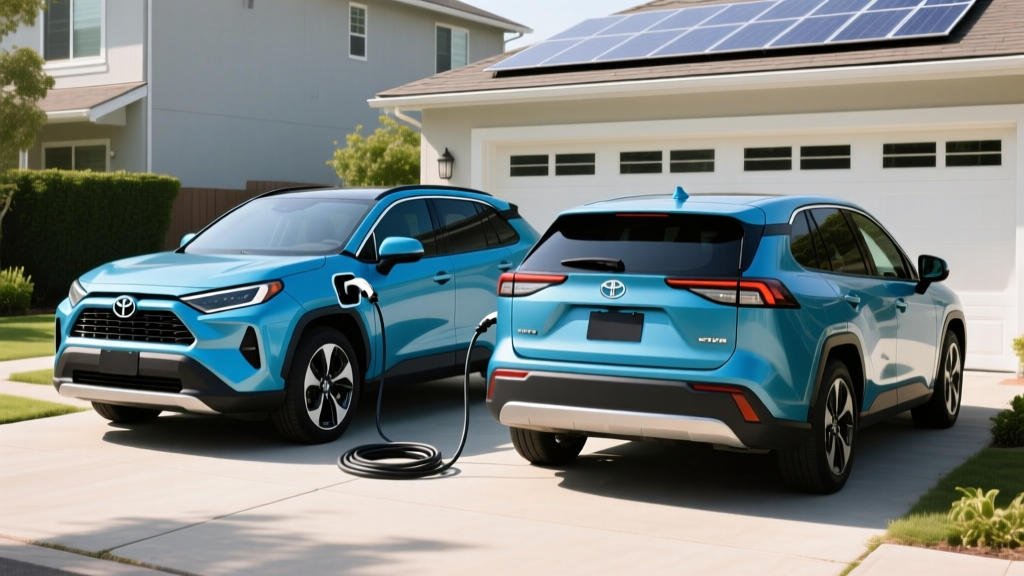
Neither Toyota PHEV supports DC fast charging — this is typical for plug-in hybrids, whose smaller batteries aren't designed for 150+ kW charging speeds. You'll charge at home using either a standard 120V outlet (Level 1) or a 240V Level 2 charger.
| Charging Level | Power | Miles Added per Hour | Full Charge Time |
|---|---|---|---|
| Level 1 (120V outlet) | ~1.4 kW | ~4 miles/hr | 11–12 hours |
| Level 2 (240V, 16A) | ~3.3 kW | ~13 miles/hr | 2.5–4 hours |
Practical tip: Most PHEV owners find Level 1 charging sufficient if they park for 10+ hours overnight — that's enough to fully replenish the 13.6–18.1 kWh battery. A Level 2 home charger is convenient but not essential the way it is for a full EV. Installation for a basic 240V outlet typically runs $300–$800 if your electrical panel has capacity; a hardwired Level 2 station with a dedicated circuit can cost $800–$2,000 installed.
Federal Tax Credit: Do Toyota Plug-In Hybrids Qualify?
Under the current IRS §30D rules, both the RAV4 Prime and Prius Prime may qualify for a federal tax credit — but the amount and eligibility depend on several factors that change periodically.
- Credit Amount: Up to $3,750 for PHEVs meeting battery component and critical mineral sourcing thresholds. (Full $7,500 requires meeting both thresholds; most Toyota PHEVs currently qualify for the partial credit.)
- MSRP Cap: Vans/SUVs/pickups must be under $80,000 MSRP; sedans/hatchbacks under $55,000. Both Toyota PHEVs clear these caps.
- Buyer Income Cap: Modified AGI must not exceed $150,000 (single), $225,000 (head of household), or $300,000 (joint filing).
- Point-of-Sale Transfer: As of 2024+, you can transfer the credit to the dealer at purchase for an immediate price reduction rather than waiting to claim it on your tax return.
- Battery Sourcing: Critical mineral and battery component requirements tighten annually. Verify current eligibility at IRS.gov's qualified vehicle list before purchasing.
Important: Tax credit eligibility shifts as sourcing rules tighten. Always confirm with your tax professional and the IRS qualified vehicle list before relying on a specific credit amount.
Reliability, Battery Warranty & Replacement Cost
Toyota Hybrid Battery Warranty: All 2026 Toyota hybrids and plug-in hybrids carry a 10-year / 150,000-mile hybrid battery warranty (whichever comes first). This covers battery capacity loss below a defined threshold and defects.
Toyota's hybrid battery track record is among the best in the industry. The original Prius, launched in the US in 2000, demonstrated that nickel-metal hydride and later lithium-ion hybrid batteries can last 200,000+ miles with minimal degradation. PHEV batteries are larger and experience deeper cycling, but Toyota's conservative charge buffer (the car never uses 100% of the battery's capacity) protects longevity.
Replacement cost if out of warranty: A RAV4 Prime or Prius Prime traction battery replacement runs approximately $4,000–$7,000 including labor at a Toyota dealer. Independent hybrid specialists often offer refurbished batteries for $2,500–$4,000. However, given Toyota's reliability history and the 10-year warranty, most owners will sell the vehicle before facing this expense.
Who Should Choose a Toyota PHEV vs a Full EV or Gas Car?
Choose a Toyota PHEV if:
- Your daily commute is under 40 miles round-trip and you can charge at home overnight
- You take road trips where charging infrastructure is sparse or unreliable
- You want EV-like commuting without committing to a full EV
- You live in a cold climate where EV range loss is a concern
- You need the flexibility of gas for towing or long drives
Choose a full EV (like a Tesla Model Y or Hyundai Ioniq 5) if:
- Your daily driving is under 250 miles and you rarely road-trip beyond charger coverage
- You want zero tailpipe emissions and minimal maintenance (no oil changes, no gas engine)
- You qualify for the full $7,500 federal credit on an eligible EV
- You have reliable home Level 2 charging
Choose a conventional Toyota Hybrid (HEV) if:
- You cannot charge at home (apartment, street parking, no garage)
- You want maximum simplicity — no plug, no charging routine
- Your budget is tighter (base RAV4 Hybrid starts ~$13,000 less than the Prime)
✅ Toyota PHEV Pros
- 40+ miles electric for gas-free commuting
- No range anxiety — gas engine for road trips
- 302 hp (RAV4 Prime) is genuinely quick
- 10-year/150,000-mile battery warranty
- Proven Toyota reliability and resale value
- Level 1 overnight charging is often sufficient
❌ Toyota PHEV Cons
- No DC fast charging
- Premium pricing over non-plug-in hybrids
- Tax credit may only be $3,750 (not $7,500)
- RAV4 Prime availability can be limited — dealer markups common
- FWD only on Prius Prime (no AWD option)
Frequently Asked Questions
How many MPG does the RAV4 Prime get?
The EPA rates the 2026 RAV4 Prime at 38 city / 35 highway / 36 combined MPG in hybrid mode after the battery is depleted. In real-world mixed driving, expect 33–37 MPG combined depending on climate, terrain, and driving style. When using electric-only mode, it achieves 94 MPGe.
How far can the Prius Prime go on electric only?
The EPA rates the 2026 Prius Prime SE at 44 miles of electric-only range and the XSE trim at 39 miles (due to larger wheels and added weight). Real-world electric range is typically 38–45 miles in mild weather, dropping to 28–35 miles in freezing temperatures.
Do I need to plug in a Toyota hybrid?
No — only Toyota's Prime (PHEV) models need to be plugged in to access their electric-only range. Standard Toyota Hybrids (HEVs) like the base RAV4 Hybrid, Camry Hybrid, and Prius charge their small batteries through regenerative braking and the gas engine. You never plug them in.
Is the RAV4 Prime reliable, and what does battery replacement cost?
Toyota's hybrid system has an outstanding reliability record spanning over two decades. The 2026 RAV4 Prime's hybrid battery is covered by a 10-year/150,000-mile warranty. Out-of-warranty replacement costs approximately $4,000–$7,000 at a dealer, though most owners never need this service. According to NHTSA data and long-term owner surveys, Toyota's hybrid powertrains routinely exceed 200,000 miles.
Does the RAV4 Prime or Prius Prime qualify for a tax credit?
Both may qualify for up to $3,750 under the IRS §30D clean vehicle credit, depending on current battery sourcing requirements, your income, and the vehicle's MSRP. The credit can now be transferred to the dealer at the point of sale for an immediate price reduction. Always verify current eligibility on the IRS qualified vehicles page before purchasing, as sourcing rules tighten annually.
Can I DC fast charge a Toyota PHEV?
No. Neither the RAV4 Prime nor the Prius Prime supports DC fast charging. The largest charging input they accept is Level 2 AC at roughly 3.3 kW, which fully charges the battery in 2.5–4 hours. This is standard for plug-in hybrids — their smaller batteries don't require (or benefit from) DC fast charging infrastructure.
Hybrid vs PHEV vs EV — which is right for me?
If you can charge at home and your commute is under 40 miles, a PHEV like the RAV4 Prime or Prius Prime gives you electric daily driving with gas-engine flexibility. If you can't charge at home, a conventional hybrid (HEV) offers excellent MPG with zero behavior change. If you have home charging, rarely drive over 250 miles in a day, and want minimal maintenance, a full EV eliminates gas entirely. Check fueleconomy.gov to compare specific models side by side.