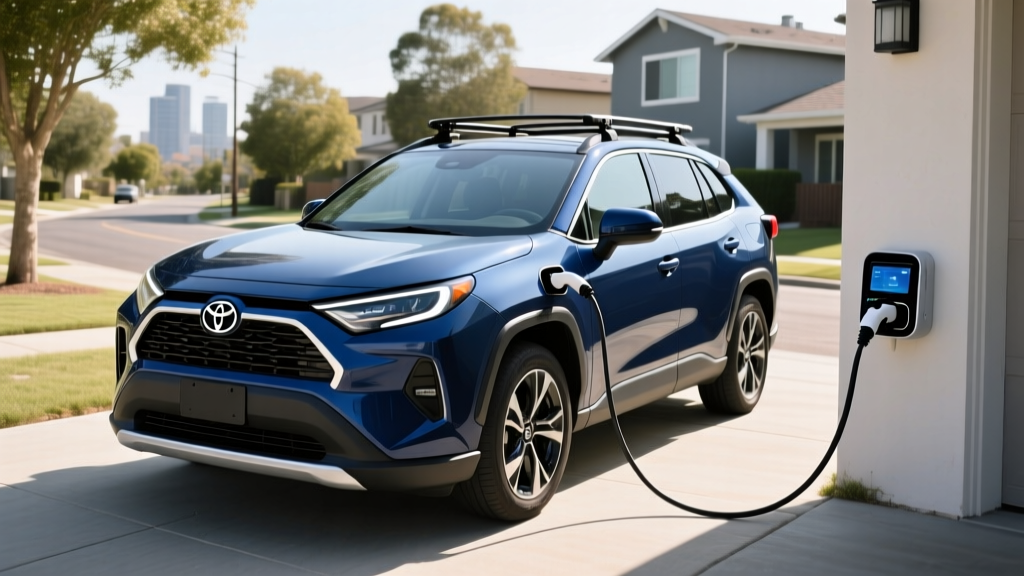
If you have searched for a plug in RAV4, you are likely looking at the Toyota RAV4 Plug-In Hybrid — historically badged as the RAV4 Prime and now integrated into Toyota's broader plug-in lineup for the 2026 model year. It occupies a specific niche: a compact SUV that can handle daily commutes on electricity alone while retaining a gasoline engine for longer trips, eliminating the range limitations of a full battery-electric vehicle.
This guide covers the 2026 RAV4 Plug-In Hybrid's efficiency, electric range, powertrain, charging logistics, pricing, tax credit status, and long-term battery reliability — with the exact numbers you need to decide if it fits your driving pattern.
HEV vs PHEV: Which RAV4 Is Right for You?
Toyota sells two electrified RAV4 variants. Understanding the difference is essential before evaluating specs.
| Attribute | RAV4 Hybrid (HEV) | RAV4 Plug-In Hybrid (PHEV) |
|---|---|---|
| Plug-in charging required? | No — self-charging via engine and regen | Yes — plug in to access full EV range |
| Electric-only driving | Brief low-speed EV mode only | Up to 42 miles EPA on battery alone |
| Combined horsepower | 219 hp | 302 hp |
| EPA combined MPG (gas) | 39 MPG | 38 MPG (charge-sustaining) |
| MPGe (electric + gas) | N/A | 94 MPGe |
| Battery capacity | ~1.6 kWh (small buffer) | 18.1 kWh usable |
| Starting MSRP (2026) | ~$33,500 | ~$44,500 |
The practical distinction: The conventional HEV never needs a plug — it captures energy through regenerative braking and the gasoline engine. The PHEV has a much larger battery that you charge from a wall outlet or public charger, enabling genuine zero-tailpipe-emission commuting. If you never plug in the PHEV, it still functions as a hybrid, but you forfeit the efficiency and performance advantages you paid extra for.
Electric Range, MPGe, and Fuel Economy Breakdown
The 2026 RAV4 Plug-In Hybrid's headline figure is its EPA-estimated 42 miles of electric-only range. That covers the average American's one-way commute with margin to spare, according to fueleconomy.gov data.
| Metric | EPA Estimate | Real-World Expectation |
|---|---|---|
| EV-only range | 42 miles | 35–40 mi (highway/cold); up to 45 mi (city, mild weather) |
| MPGe (combined, EV mode) | 94 MPGe | 85–100 MPGe depending on climate and driving style |
| MPG combined (gas, charge-sustaining) | 38 MPG | 34–38 MPG highway; 36–40 MPG city |
| MPG city (gas only) | 40 MPG | 38–42 MPG (regen-heavy city driving favors hybrids) |
| MPG highway (gas only) | 36 MPG | 32–36 MPG at 70+ mph |
| Total combined range (EV + gas) | ~520 miles | ~460–520 miles |
Once the battery depletes, the RAV4 Plug-In Hybrid operates as a conventional hybrid with the 2.5-liter four-cylinder engine and electric motors. The 38 MPG combined figure in charge-sustaining mode is competitive with the standard RAV4 Hybrid's 39 MPG — a testament to Toyota's hybrid synergy drive system efficiency.
Powertrain and Performance Specs
| Specification | 2026 RAV4 Plug-In Hybrid |
|---|---|
| Engine | 2.5L inline-4 Atkinson cycle |
| Engine output | 177 hp / 165 lb-ft torque |
| Front electric motor | 134 kW (180 hp) |
| Rear electric motor | 40 kW (54 hp) |
| Combined system horsepower | 302 hp |
| 0–60 mph | 5.5 seconds |
| Drivetrain | Electronic AWD (eAWD) |
| Transmission | eCVT (planetary gearset, no belt) |
| Towing capacity | 1,500 lbs |
| Battery chemistry | Lithium-ion (NMC) |
| Usable battery capacity | 18.1 kWh |
The 302 combined horsepower makes this the quickest RAV4 variant Toyota sells — faster than the gas-only model and significantly more potent than the standard hybrid's 219 hp. The eAWD system uses the rear electric motor to power the rear axle without a mechanical driveshaft, providing confident traction in rain and light snow.
Charging: Level 1, Level 2, and the DC Fast-Charging Question
The RAV4 Plug-In Hybrid charges via a J1772 inlet on the driver's side rear quarter panel. Here is what charging looks like in practice:
| Charging Level | Power (kW) | Time (0–100%) | Practical Notes |
|---|---|---|---|
| Level 1 (120V household) | ~1.4 kW | ~12–14 hours | Overnight top-up only; insufficient for daily full recharge |
| Level 2 (240V, 16A) | 3.3 kW (onboard charger limit) | ~5.5 hours | Standard Level 2 circuit; full charge overnight |
| Level 2 (240V, 32A+) | 3.3 kW (still capped by vehicle) | ~5.5 hours | Higher-amperage chargers won't speed this up |
| DC Fast Charging | Not supported | N/A | No DC fast-charge capability on the RAV4 PHEV |
Critical detail for buyers: The onboard charger is limited to 3.3 kW. Even if you connect to a 48-amp Level 2 home charger capable of delivering 11.5 kW, the RAV4 PHEV will only accept 3.3 kW. This means a full charge takes roughly 5.5 hours regardless of your Level 2 hardware investment. For a 42-mile EV range, however, most owners only need to replenish 10–15 kWh overnight — easily achievable in 3–5 hours on any Level 2 circuit.
The absence of DC fast charging is typical for PHEVs in this class. The battery is small enough that Level 2 charging suffices for overnight replenishment, and PHEV buyers rarely rely on public charging infrastructure.
Pricing, Trims, and Tax Credit Eligibility
The 2026 RAV4 Plug-In Hybrid is available in SE and XSE trims:
- SE: Starting MSRP approximately $44,500 (including destination)
- XSE: Starting MSRP approximately $47,500 (including destination)
- XSE Premium: Starting MSRP approximately $51,000 (including destination)
The RAV4 Plug-In Hybrid's eligibility for the federal plug-in vehicle tax credit depends on several IRS requirements that have tightened significantly since the Inflation Reduction Act provisions took effect. Key criteria include:
- MSRP cap: SUVs must be under $80,000 — the RAV4 PHEV qualifies on price
- Buyer income cap: AGI must not exceed $150K (single) / $300K (joint)
- Battery sourcing: Critical minerals and battery components must meet phased-in domestic/free-trade requirements per IRS guidelines
- Assembly: Final assembly must occur in North America
Current status: Due to battery component and critical mineral sourcing requirements, the RAV4 Plug-In Hybrid's federal credit eligibility has been inconsistent across model years. Check the latest fueleconomy.gov tax credit listing for the current 2026 determination before purchasing. The credit, if available, can be transferred to the dealer at point of sale as a purchase-price reduction.
Many states offer additional rebates for PHEVs. California's CVRP program, for example, has historically offered up to $1,000–$1,500 for qualifying PHEVs, though funding and eligibility change frequently. Check your state energy office or DMV for current programs.
Battery Reliability, Warranty, and Replacement Cost
- Coverage: 10 years / 150,000 miles (whichever comes first)
- Capacity threshold: Warranty covers defects and excessive capacity loss below 70% of original capacity
- Transferable: Yes — warranty transfers to subsequent owners
Toyota's hybrid battery track record is among the strongest in the industry. The Prius, which debuted in the U.S. in 2000, has demonstrated that Toyota's hybrid battery management systems — conservative charge buffers, active thermal management, and cell balancing — yield exceptional longevity. Many first-generation Prius batteries lasted well beyond 150,000 miles before requiring replacement.
For the RAV4 Plug-In Hybrid's larger 18.1 kWh lithium-ion pack, real-world degradation data from earlier model years suggests approximately 5–8% capacity loss over the first 100,000 miles under normal use. This means the 42-mile EV range might settle to roughly 38–40 miles after several years — a modest reduction that preserves the vehicle's commuting utility.
Replacement cost if out of warranty: A full hybrid battery replacement runs approximately $4,000–$6,000 including parts and labor at a Toyota dealer. Independent hybrid specialists may offer refurbished packs for $2,500–$4,000. Given the 10-year/150,000-mile warranty coverage, most original owners will never face this expense.
Who Should Buy the Plug-In RAV4 — and Who Shouldn't
- Your daily round-trip commute is under 40 miles and you have Level 2 home charging access
- You want electric commuting without committing to a full EV's range limitations on road trips
- You need AWD capability and compact-SUV practicality with strong performance (302 hp, 5.5s 0–60)
- You want to reduce fuel consumption but live in an area with unreliable public charging infrastructure
- You value Toyota's long-term reliability reputation and 10-year battery warranty
- You have reliable home and workplace charging and rarely drive more than 250 miles between charges
- You want to eliminate gasoline purchases and oil changes entirely
- You want access to DC fast charging for road trips (20–30 minute stops vs. hours on Level 2)
- You want maximum federal and state EV incentives (full EVs often qualify for larger credits)
- You cannot install a Level 2 charger at home (apartment, street parking, no garage)
- Your daily mileage regularly exceeds 50 miles, reducing the PHEV's electric-range advantage
- The ~$11,000 price premium over the HEV doesn't pencil out given your fuel savings timeline
Ownership Economics: Does the PHEV Premium Pay Off?
The RAV4 Plug-In Hybrid costs roughly $11,000 more than the equivalent RAV4 Hybrid. Whether that premium is justified depends on your electricity cost, gasoline price, and daily mileage.
| Cost Factor (5-year estimate) | RAV4 Hybrid (HEV) | RAV4 Plug-In Hybrid |
|---|---|---|
| Purchase price (base MSRP) | $33,500 | $44,500 |
| Federal tax credit (est.) | $0 | $0–$7,500 (sourcing-dependent) |
| Fuel cost (15K mi/yr, $3.50/gal avg) | ~$9,600 | ~$5,200 (assuming 70% EV driving) |
| Electricity cost (est.) | $0 | ~$1,800 |
| Maintenance (oil, filters) | ~$3,000 | ~$2,200 (less engine runtime) |
| Estimated 5-year energy + maintenance | ~$12,600 | ~$9,200 |
The energy and maintenance savings over five years total roughly $3,400 for the PHEV. Even with a full $7,500 tax credit (which is not guaranteed given current sourcing rules), the net cost gap narrows but does not fully close for most buyers. The PHEV makes strongest financial sense when gasoline prices are high, electricity is cheap, and your commute falls within the EV range — maximizing the fuel-cost differential.
Pros and Cons at a Glance
- 42-mile EPA EV range covers most daily commutes gasoline-free
- 302 hp and 5.5-second 0–60 — the quickest RAV4 available
- Standard eAWD with no mechanical linkage complexity
- 38 MPG combined even after battery depletion
- 10-year/150,000-mile hybrid battery warranty
- Proven Toyota reliability and strong resale value
- No range anxiety — gas engine provides 520+ total miles
- ~$11,000 premium over the standard RAV4 Hybrid
- 3.3 kW onboard charger limits Level 2 speed — no faster on 48A circuits
- No DC fast charging capability
- Federal tax credit eligibility uncertain due to battery sourcing rules
- Cargo space slightly reduced vs. gas RAV4 (battery under floor)
- EV range drops to 30–35 miles in freezing temperatures
- Towing limited to 1,500 lbs
Frequently Asked Questions
How many MPG does the plug-in RAV4 get?
The EPA rates the 2026 RAV4 Plug-In Hybrid at 40 MPG city / 36 MPG highway / 38 MPG combined when operating on gasoline after battery depletion. In EV mode, it achieves 94 MPGe combined. Real-world results typically match or slightly exceed EPA city figures thanks to regenerative braking, while highway driving at 70+ mph may yield 32–36 MPG.
How far can the RAV4 Plug-In Hybrid go on electric only?
The EPA estimates 42 miles of all-electric range. Real-world results vary: expect 35–40 miles in cold weather or sustained highway driving, and potentially 44+ miles in mild-weather city commuting with frequent regen braking. Total combined range (EV + gas tank) is approximately 520 miles.
Do I need to plug in the RAV4 Plug-In Hybrid every day?
You don't need to — the vehicle operates as a conventional hybrid if the battery is depleted. However, to capture the fuel-cost savings and EV driving experience you paid a premium for, plugging in nightly on a Level 2 (240V) charger is recommended. A full charge takes about 5.5 hours.
Is the RAV4 Plug-In Hybrid reliable?
Toyota's hybrid powertrains have demonstrated exceptional longevity since the Prius launched in 2000. The eCVT transmission has no belts or traditional friction components to wear. The hybrid battery is warrantied for 10 years/150,000 miles. According to IIHS and long-term owner data, the RAV4 platform ranks among the most dependable compact SUVs. Battery replacement, if needed out of warranty, costs approximately $4,000–$6,000.
Does the plug-in RAV4 qualify for a federal tax credit?
Eligibility for the §30D federal clean vehicle credit (up to $7,500) depends on current-year battery sourcing and critical mineral requirements set by the IRS. The RAV4 PHEV meets the MSRP cap (under $80,000 for SUVs) and North American assembly requirements, but battery component sourcing has caused eligibility to fluctuate. Verify current status on fueleconomy.gov and consult a tax professional before relying on the credit in your purchase decision.
Can the RAV4 Plug-In Hybrid DC fast charge?
No. The RAV4 PHEV only supports Level 1 (120V) and Level 2 (240V) AC charging via its J1772 inlet. The onboard charger is capped at 3.3 kW. This is standard for PHEVs — the smaller battery makes overnight Level 2 charging sufficient for daily use.
Hybrid vs PHEV vs EV — which fits my lifestyle?
Choose a conventional hybrid (HEV) if you have no home charging access and want maximum simplicity. Choose a PHEV like the RAV4 Plug-In if you can charge at home, commute under 40 miles daily, but need gas-engine flexibility for road trips. Choose a full EV if you want zero gasoline use, have reliable charging access, and your longest regular trips fall within 250 miles or you're willing to plan DC fast-charge stops.