Lexus has quietly built one of the most practical plug-in hybrid strategies in the luxury segment. Rather than chasing maximum electric range or radical new platforms, the brand has focused on two PHEVs that solve a specific problem: drivers who want electric commuting without giving up the flexibility (or the reliability reputation) of a Toyota-family hybrid. If you're searching for a plug in Lexus hybrid, you're looking at two main options for the 2026 model year — the compact NX 450h+ and the midsize RX 500h+ — plus the conventional (non-plug-in) hybrid variants that share their nameplates. Understanding the difference between these powertrains, and what the real-world numbers actually look like, is the key to making the right call.
HEV vs PHEV: What Lexus Actually Sells
Before diving into specs, the distinction matters. Lexus sells two flavors of electrified SUV, and they serve different buyers:
Conventional Hybrid (HEV) — NX 350h, RX 350h, RX 500h
- No plug. The battery recharges via regenerative braking and the engine.
- Small traction battery (~1-2 kWh usable).
- No electric-only highway driving; the motor assists the gas engine.
- Lower MSRP, no charging infrastructure needed.
- No federal PHEV tax credit eligibility.
Plug-In Hybrid (PHEV) — NX 450h+, RX 500h+ (PHEV variant)
- Plugs into a wall or Level 2 charger to fill a larger battery.
- Larger traction battery (~18 kWh usable) enabling true EV-mode commuting.
- Can drive 30+ miles on electricity alone before the engine starts.
- Higher MSRP, but potential tax credit and fuel savings for commuters.
If you never want to think about charging, the HEV is your answer. If you have home or workplace charging and a commute under ~35 miles, the PHEV variant can operate as an EV most weekdays and a hybrid on road trips.
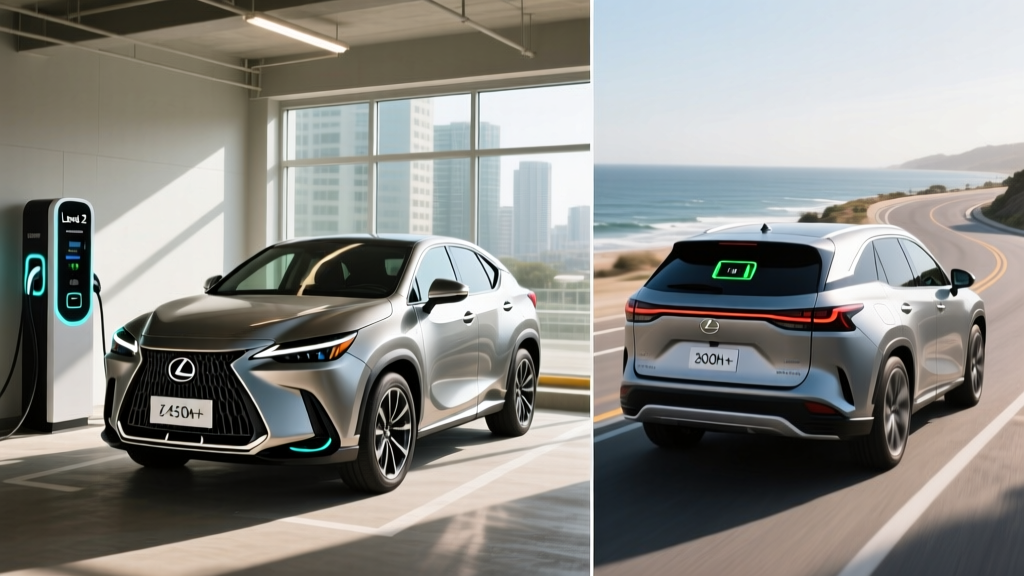
2026 Lexus NX 450h+: The Compact Plug in Lexus Hybrid
The NX 450h+ remains the entry point into Lexus plug-in ownership. Built on the TNGA-K platform shared with the Toyota RAV4 Prime, it pairs a 2.5-liter inline-4 with front and rear electric motors for a combined 304 horsepower. That's enough for a 0-60 mph time of approximately 6.0 seconds — genuinely quick for a compact luxury crossover.
| Spec | Value |
|---|---|
| Powertrain | 2.5L I4 + dual electric motors (AWD) |
| Combined Horsepower | 304 hp |
| 0-60 mph | ~6.0 sec |
| Battery (usable) | ~18.1 kWh lithium-ion |
| EPA Electric-Only Range | 37 miles |
| EPA Combined MPGe (EV mode) | 84 MPGe |
| EPA MPG (hybrid mode, combined) | 36 MPG |
| Total Combined Range | ~470 miles |
| Level 2 Charge Time (0-100%) | ~3.0 hours (at 6.6 kW) |
| DC Fast Charging | Not available |
| Base MSRP (Luxury trim) | ~$60,540 |
Electric Range and Real-World Commuting
The EPA rates the NX 450h+ at 37 miles of electric-only range. In real-world testing, drivers consistently report 33-38 miles depending on temperature and driving style. In mild weather with city speeds (under 45 mph), hitting 40 miles is achievable. In winter at 30°F or below, expect that figure to drop to roughly 27-30 miles due to cabin heating loads and reduced battery efficiency.
Charging the NX 450h+
The NX 450h+ accepts up to 6.6 kW on Level 2 (240V). A full charge takes roughly 3 hours on a Level 2 home charger, which means an overnight top-up is effortless. On a standard 120V household outlet (Level 1), a full charge takes approximately 10-12 hours — usable for overnight replenishment if your commute is modest.
Notably, the NX 450h+ does not support DC fast charging. This is typical for PHEVs in this class — the battery is small enough that Level 2 fills it quickly, and the added cost/weight of DC hardware isn't justified. For road trips, you simply drive it as a hybrid.
2026 Lexus RX 500h+ (PHEV): The Midsize Option
For buyers who need more cargo space and rear-seat room, Lexus offers a plug-in variant of its best-selling RX. The RX PHEV uses a turbocharged 2.4-liter inline-4 paired with electric motors, producing a combined ~366 horsepower in the F SPORT Performance variant (note: the RX 500h+ branding and availability vary by market and model year; confirm with your dealer which PHEV trim is offered for 2026).
| Spec | Value |
|---|---|
| Powertrain | 2.4L Turbo I4 + electric motors (AWD) |
| Combined Horsepower | ~366 hp (F SPORT Perf.) |
| 0-60 mph | ~6.0 sec |
| Battery (usable) | ~18.1 kWh lithium-ion |
| EPA Electric-Only Range | ~35 miles (est.) |
| EPA MPG (hybrid mode, combined) | ~33 MPG (est.) |
| Total Combined Range | ~460 miles (est.) |
| Level 2 Charge Time | ~3.0 hours (at 6.6 kW) |
| DC Fast Charging | Not available |
| Base MSRP | ~$68,000 (est.) |
The RX PHEV trades slightly less electric range and MPG for substantially more interior volume — ~30 cu ft of cargo space behind the second row versus ~23 cu ft in the NX. If you regularly carry passengers or gear, the RX is the more practical plug in Lexus hybrid.
Fuel Economy: EPA vs Real-World MPG
One of the best-kept secrets about Toyota/Lexus hybrids is that they frequently exceed their EPA city ratings in real-world driving. The regenerative braking system recaptures energy in stop-and-go traffic, meaning urban commuters often see better numbers than the sticker suggests.
| Model | City MPG | Highway MPG | Combined MPG | EV-Only Range |
|---|---|---|---|---|
| NX 450h+ (PHEV, hybrid mode) | 38 | 33 | 36 | 37 mi |
| NX 350h (HEV) | 41 | 37 | 39 | N/A |
| RX 350h (HEV) | 37 | 34 | 36 | N/A |
| RX 500h (HEV, turbo hybrid) | 27 | 28 | 28 | N/A |
Real-world notes: In city driving, NX 450h+ owners report 38-42 MPG once the battery is depleted, thanks to aggressive regen. Highway cruising at 75+ mph drops to roughly 30-32 MPG (aerodynamic drag reduces hybrid advantage at speed). For the RX PHEV, expect similar patterns with slightly lower absolute numbers due to weight and frontal area. Source: fueleconomy.gov and owner-reported data.
Pricing, Trims, and Tax Credit Eligibility
The NX 450h+ starts around $60,540 for the Luxury trim, with Premium and F SPORT Handling packages pushing the price toward $65,000-$67,000. The RX PHEV is expected to start near $68,000 when equipped comparably.
Federal Tax Credit (§30D)
Here's where PHEV buyers need to pay close attention. Under the current IRS §30D rules, the $7,500 federal tax credit has strict requirements:
- MSRP Cap: SUVs must have an MSRP at or below $80,000 (both NX and RX PHEV qualify).
- Income Cap: Adjusted gross income must not exceed $150,000 (single), $225,000 (head of household), or $300,000 (joint).
- Battery Sourcing: Critical minerals and battery components must meet phased-in percentage thresholds from US or FTA-partner countries. These thresholds increase annually.
- Point-of-Sale Transfer: Eligible buyers can transfer the credit to the dealer at purchase, reducing the purchase price directly rather than waiting for a tax refund.
- FEOC Restriction: Vehicles with battery components from a "foreign entity of concern" (e.g., certain Chinese suppliers) may be disqualified.
The NX 450h+ has historically qualified for a partial credit (often $3,750) due to battery component sourcing rules. The exact credit amount changes as sourcing requirements tighten each year. Always verify current eligibility on IRS.gov or via the fueleconomy.gov tax credit lookup tool before purchasing.
State incentives vary widely — California's CVRP, Colorado's state credit, and utility rebates can add $1,000-$5,000+ depending on your location. Check your state energy office and local utility for current programs.
Battery Longevity, Warranty, and Replacement Cost
Lexus Hybrid Battery Warranty
Coverage: 10 years / 150,000 miles (whichever comes first) on the hybrid battery and related components, transferable to subsequent owners.
Capacity Threshold: Lexus warrants the battery against abnormal capacity loss. In practice, Toyota/Lexus PHEV batteries are engineered with conservative charge buffers (typically using only ~65-70% of total cell capacity) to minimize degradation.
Expected Lifespan: Based on over two decades of Toyota hybrid data, most hybrid batteries last 150,000-200,000+ miles before needing attention. Failure before 100,000 miles is rare.
Battery Replacement Cost
If a replacement is needed outside warranty, a Lexus PHEV traction battery currently costs approximately $8,000-$12,000 (parts and labor), depending on the model and dealership. This is significantly less than a full EV battery replacement ($15,000-$25,000+) because the PHEV battery is smaller. Third-party hybrid battery specialists can sometimes rebuild or replace individual modules for $3,000-$5,000.
For most buyers, the 10-year/150,000-mile warranty covers the ownership period. Lexus's hybrid reliability track record — inherited from Toyota's pioneering work with the Prius — is among the best in the industry. IIHS and consumer reliability surveys consistently rank Lexus at or near the top for long-term dependability.
Hybrid vs PHEV vs EV: Which Fits You?
Choose the Lexus HEV (NX 350h / RX 350h) if:
- You have no access to home or workplace charging.
- You want maximum simplicity — no plugs, no apps, no charging planning.
- Your budget is tighter (HEV trims start ~$8,000-$10,000 less than PHEV).
- You drive a mix of city and highway without a predictable short commute.
Choose the Lexus PHEV (NX 450h+ / RX PHEV) if:
- You can install a Level 2 charger at home (or have reliable workplace charging).
- Your daily commute is under ~35 miles round-trip (you'll rarely use gas on weekdays).
- You want to reduce fuel consumption without range anxiety on road trips.
- You qualify for the federal or state tax credit, narrowing the price gap with the HEV.
Choose a Full EV (e.g., Tesla Model Y, BMW iX, Genesis GV60) if:
- You want zero tailpipe emissions and minimal maintenance (no oil changes, no engine).
- Your daily driving is under 250 miles and you're comfortable with DC fast charging on road trips.
- You want access to the full $7,500 federal credit (many EVs qualify more readily than PHEVs).
- You have reliable home charging and live in an area with decent public charging infrastructure.
Pros and Cons of the Plug in Lexus Hybrid
Pros
- 37 miles of EV range covers most commutes gas-free
- Excellent real-world city MPG (38-42) once battery depletes
- Proven Toyota/Lexus hybrid reliability with 10yr/150k battery warranty
- No range anxiety — 470+ miles total range with gas engine
- Luxury interior, quiet ride, strong resale value
- AWD standard via rear electric motor
Cons
- No DC fast charging (limits road-trip EV utility)
- MSRP above $60K — premium over non-plug-in hybrid trims
- Federal tax credit may be partial ($3,750) depending on sourcing rules
- EV range drops noticeably in cold weather (~20% loss)
- Cargo space slightly reduced vs HEV variants due to battery placement
- Infotainment system learning curve for some users
Frequently Asked Questions
How many MPG does the plug in Lexus hybrid get?
The NX 450h+ achieves an EPA-rated 36 MPG combined (38 city / 33 highway) when operating as a hybrid after the battery is depleted. In real-world city driving, many owners report 38-42 MPG thanks to regenerative braking. Highway driving at 75+ mph typically yields 30-32 MPG.
How far can the Lexus NX 450h+ go on electric only?
The EPA rates it at 37 miles of electric-only range. Real-world results range from about 28 miles (cold weather, highway speeds) to 40 miles (mild weather, city driving). For a commute under 35 miles round-trip with home charging, you may use gasoline only on weekends and road trips.
Does the Lexus PHEV qualify for a tax credit?
The NX 450h+ has historically qualified for a partial federal tax credit (typically $3,750 of the maximum $7,500), depending on battery component sourcing rules that tighten each year. Eligibility also depends on your income (must be under $150K single / $300K joint) and the vehicle's MSRP (must be under $80K for SUVs). Always verify on IRS.gov before purchasing.
Is the Lexus hybrid battery reliable? What does replacement cost?
Lexus hybrid batteries carry a 10-year/150,000-mile warranty and are engineered with conservative charge buffers that promote longevity. Toyota/Lexus has over 25 years of hybrid data showing most batteries last 150,000-200,000+ miles. Out-of-warranty replacement costs approximately $8,000-$12,000, though third-party rebuild options exist for less.
Can I charge the Lexus PHEV at home on a regular outlet?
Yes. Level 1 charging on a standard 120V outlet takes approximately 10-12 hours for a full charge, which works if you park overnight and your daily driving is under 30 miles. For faster replenishment (~3 hours), a 240V Level 2 home charger is recommended. Home Level 2 installation typically costs $500-$2,000 depending on your electrical panel and wiring run.
Hybrid vs PHEV vs EV — which Lexus should I buy?
If you can't charge at home, choose the HEV (NX 350h or RX 350h). If you can charge at home and commute under 35 miles, the PHEV (NX 450h+) gives you EV-like weekday driving with hybrid flexibility for road trips. If you want zero emissions and are comfortable with DC fast charging, consider a full EV from Lexus's parent company (Toyota bZ series) or competitors like the BMW iX or Genesis GV60.
Does the Lexus PHEV have DC fast charging?
No. Neither the NX 450h+ nor the RX PHEV supports DC fast charging. The battery is small enough (~18 kWh) that Level 2 charging fills it in about 3 hours, making DC hardware unnecessary for most PHEV use cases. On road trips, you simply drive in hybrid mode.
The Bottom Line
The plug in Lexus hybrid lineup — anchored by the NX 450h+ — occupies a pragmatic sweet spot. You get genuine EV commuting for most daily driving, proven hybrid efficiency when the battery runs dry, and the reliability and resale value Lexus is known for. The trade-offs are real: no DC fast charging, a premium price, and a tax credit that may be partial. But for buyers who want to reduce fuel consumption without committing fully to a battery-electric vehicle, the NX 450h+ is one of the most rational choices in the luxury compact SUV segment. If you need more space, the RX PHEV extends the same formula to a midsize package. Either way, install a Level 2 charger at home, verify your tax credit eligibility, and you'll likely spend far less time (and money) at gas stations than you expect.