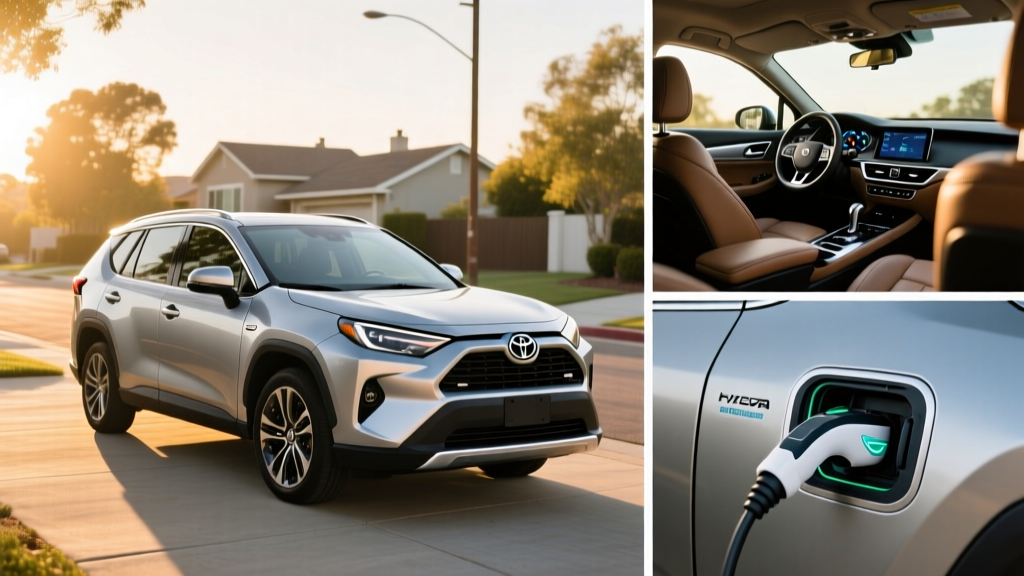
The Core Difference: Hybrid (HEV) vs Plug-In Hybrid (PHEV)
Before comparing specs, it is critical to define the two architectures. A conventional hybrid (HEV) pairs a gasoline engine with a small electric motor and a battery typically under 2 kWh. The battery recharges exclusively through regenerative braking and the engine — you never plug it in. Examples include the Toyota Prius and Honda CR-V Hybrid.
A plug-in hybrid (PHEV) carries a much larger battery (typically 12–25 kWh), a more powerful electric motor, and a charge port. You can plug it into a wall outlet or Level 2 charger to unlock 25–45 miles of pure electric driving before the gasoline engine takes over. The Toyota RAV4 Prime and Jeep Wrangler 4xe are popular PHEVs.
HEV vs PHEV at a Glance
| Attribute | Conventional Hybrid (HEV) | Plug-In Hybrid (PHEV) |
|---|---|---|
| Battery capacity | 0.6–2.0 kWh | 12–25 kWh |
| Plug-in required? | No | Yes (to unlock electric range) |
| Electric-only range | 0–1 mile (low speed) | 25–45 miles (EPA) |
| Typical EPA combined MPG | 40–57 MPG | 30–42 MPG (hybrid mode) + 80–100 MPGe |
| Federal tax credit (§30D) | No | Up to $7,500 (if eligible) |
| Added vehicle cost vs gas | +$1,000–$3,000 | +$4,000–$9,000 |
Fuel Economy Breakdown: Real MPG Numbers
Fuel economy is where the plug in hybrids vs hybrids debate gets nuanced. HEVs often deliver superior highway MPG because they carry less weight (no large battery). PHEVs shine when most driving falls within their electric-only range.
2026 EPA Fuel Economy: Popular HEVs and PHEVs
| Model | Type | City MPG | Highway MPG | Combined MPG | EV Range / MPGe |
|---|---|---|---|---|---|
| Toyota Prius | HEV | 57 | 56 | 57 | N/A |
| Honda CR-V Hybrid | HEV | 43 | 36 | 40 | N/A |
| Toyota RAV4 Hybrid | HEV | 41 | 38 | 40 | N/A |
| Toyota RAV4 Prime | PHEV | 40 (hybrid) | 36 (hybrid) | 38 | 42 mi / 94 MPGe |
| Chrysler Pacifica Hybrid | PHEV | 30 (hybrid) | 31 (hybrid) | 30 | 32 mi / 82 MPGe |
| Hyundai Tucson PHEV | PHEV | 35 (hybrid) | 33 (hybrid) | 34 | 33 mi / 80 MPGe |
Source: fueleconomy.gov (EPA estimates). Real-world MPG varies with driving style, temperature, and terrain.
Real-World MPG vs EPA Sticker
Conventional hybrids frequently exceed EPA city estimates because stop-and-go traffic maximizes regenerative braking and electric motor use. The Prius, for example, routinely returns 60+ MPG in urban driving. Highway driving, however, often falls 3–5 MPG below EPA estimates since the engine bears most of the load at sustained speed.
PHEVs are more variable. If your commute is 20 miles round-trip and you charge nightly, you may burn zero gasoline for weeks. But on a 300-mile road trip with no charging, a PHEV operates solely in hybrid mode — and the extra battery weight can mean 2–4 MPG less than an equivalent HEV.
PHEV Electric-Only Range and Charging Details
The defining advantage of a PHEV is its ability to drive on electricity alone. Here is what that looks like in practice for popular 2026 models:
| Model | Battery (kWh usable) | EPA EV Range | Level 1 (120V) Charge | Level 2 (240V) Charge | DC Fast Charge? |
|---|---|---|---|---|---|
| Toyota RAV4 Prime | 14.9 kWh | 42 mi | ~12 hours | ~2.5 hours (6.6 kW) | No |
| Hyundai Tucson PHEV | 13.8 kWh | 33 mi | ~11 hours | ~2 hours (7.2 kW) | No |
| Chrysler Pacifica Hybrid | 16.0 kWh | 32 mi | ~14 hours | ~2 hours (7.2 kW) | No |
| Jeep Grand Cherokee 4xe | 17.3 kWh | 26 mi | ~12 hours | ~2.5 hours (7.2 kW) | No |
Critical note on charging: Most PHEVs do not support DC fast charging. Their batteries are small enough that Level 2 (240V, 6.6–7.2 kW) fully replenishes them in 2–3 hours. Level 1 (standard 120V household outlet) works overnight for most commutes but is slow. If you lack access to any plug, a PHEV's electric range advantage disappears, and you are paying a premium to carry dead battery weight.
Battery Warranty and Replacement Cost
Federal law mandates that hybrid and PHEV batteries carry a minimum warranty of 8 years / 100,000 miles (10 years / 150,000 miles in CARB states including California, New York, and Massachusetts). Toyota extends this to 10 years / 150,000 miles nationwide on most hybrids.
If a battery fails out of warranty, replacement costs typically range from $2,000–$4,000 for HEVs and $5,000–$9,000 for PHEVs (parts + labor). However, modern hybrid batteries routinely last 150,000–200,000+ miles before significant degradation. Data from Consumer Reports shows hybrid battery failure rates under 5% within the warranty period for major manufacturers.
Powertrain and Performance Specs
PHEVs generally deliver more combined horsepower than their HEV counterparts because the electric motor is substantially more powerful. Here is how popular models stack up:
| Model | Engine | Combined HP | 0–60 mph | Drivetrain |
|---|---|---|---|---|
| Toyota Prius (HEV) | 2.0L 4-cyl + motor | 196 hp | 7.0 sec | FWD / AWD |
| Toyota RAV4 Hybrid | 2.5L 4-cyl + 3 motors | 219 hp | 7.4 sec | AWD (e-AWD) |
| Toyota RAV4 Prime (PHEV) | 2.5L 4-cyl + 2 motors | 302 hp | 5.7 sec | AWD (e-AWD) |
| Hyundai Tucson PHEV | 1.6L turbo + motor | 261 hp | 7.1 sec | AWD |
| Jeep Wrangler 4xe (PHEV) | 2.0L turbo + 2 motors | 375 hp | 6.0 sec | 4WD |
The RAV4 Prime's 302 hp output makes it one of the quickest vehicles in Toyota's lineup — a performance bonus that comes with electrification.
Pricing and Tax Credit Eligibility
PHEVs carry a significant price premium over HEVs, but the federal tax credit can narrow the gap substantially.
| Model | Base MSRP (2026) | Type | Federal §30D Credit Eligibility |
|---|---|---|---|
| Toyota Prius | ~$28,350 | HEV | Not eligible (no plug) |
| Toyota RAV4 Hybrid | ~$33,425 | HEV | Not eligible |
| Toyota RAV4 Prime | ~$44,665 | PHEV | Up to $7,500 (subject to sourcing rules) |
| Hyundai Tucson PHEV | ~$39,900 | PHEV | Up to $7,500 (subject to sourcing rules) |
| Chrysler Pacifica Hybrid | ~$50,995 | PHEV | Up to $7,500 (subject to sourcing rules) |
Federal Tax Credit Rules for PHEVs (§30D)
Under current IRS §30D rules, qualifying PHEVs may be eligible for up to $7,500 in federal tax credits. However, eligibility depends on multiple factors:
- MSRP caps: Vans, SUVs, and pickups must be under $80,000; sedans under $55,000
- Buyer income limits: AGI ≤ $150,000 (single), ≤ $225,000 (head of household), ≤ $300,000 (joint)
- Battery sourcing: Critical minerals and battery components must meet escalating domestic-content thresholds (consult the IRS for current-year percentages)
- Point-of-sale transfer: Eligible buyers can transfer the credit to the dealer for an immediate price reduction
Conventional hybrids (HEVs) do not qualify for the §30D credit because they lack plug-in capability. Some states offer separate rebates for HEVs, but these are typically $500–$1,500. Always verify current rules with a tax professional and the IRS before purchasing.
Hybrid vs PHEV vs Full EV: Which Fits You?
The plug in hybrids vs hybrids question ultimately resolves into a lifestyle assessment. Here is a decision framework based on driving patterns, charging access, and budget.
Choose a Conventional Hybrid (HEV) If:
- You have no access to plug-in charging at home or work
- Your driving is mostly highway miles (where HEVs match or beat PHEVs)
- You want maximum MPG without behavioral changes
- Budget is a priority — HEVs carry a smaller price premium over gas models
- You drive 15,000+ miles/year and want proven, low-maintenance efficiency
Choose a Plug-In Hybrid (PHEV) If:
- You can charge at home or work (Level 1 or Level 2)
- Your daily commute is under 30–40 miles round-trip (fits within EV range)
- You want electric daily driving but need gas flexibility for road trips
- You qualify for the federal §30D tax credit (offsets the PHEV premium)
- You want extra performance (PHEVs often have significantly more HP)
Choose a Full EV (BEV) If:
- You have reliable home Level 2 charging
- Most trips fall within 200–300 miles (or you are comfortable with DC fast charging on road trips)
- You want the lowest per-mile fuel cost and zero tailpipe emissions
- You want minimal maintenance (no oil changes, fewer moving parts)
Conventional Hybrid (HEV) Pros & Cons
Pros:
- No plug required — works with existing habits
- 40–57 MPG combined (EPA)
- Lower upfront cost than PHEV
- Proven reliability over 25+ years (Toyota Prius since 1997)
- Lighter weight = better highway MPG
Cons:
- No electric-only driving (except minimal low-speed assist)
- No federal tax credit
- Still burns gasoline for every mile
Plug-In Hybrid (PHEV) Pros & Cons
Pros:
- 25–45 miles electric-only = zero gas for short commutes
- Federal tax credit up to $7,500 (if eligible)
- More combined horsepower (performance bonus)
- No range anxiety — gas engine for long trips
- Preconditions cabin on grid power (saves fuel)
Cons:
- $4,000–$9,000 price premium over HEV equivalent
- Requires charging access to realize EV benefits
- Heavier = lower MPG in hybrid mode vs HEV
- Most lack DC fast charging
- Higher battery replacement cost if out of warranty
Reliability: What the Data Shows
Hybrid reliability is among the highest in the industry. Toyota's Hybrid Synergy Drive, now in its fifth generation, has accumulated billions of real-world miles. The Prius taxi fleet in cities like New York routinely exceeds 300,000 miles on the original hybrid battery.
PHEV reliability is strong but slightly more complex due to the larger battery, onboard charger, and more powerful electric motor. Early-generation PHEVs (2012–2016) saw some battery degradation complaints, but modern systems with advanced thermal management have largely addressed this. J.D. Power's Vehicle Dependability Study consistently ranks hybrid models among the top in their segments.
Key reliability points:
- HEV battery replacement: $2,000–$4,000; rarely needed before 150,000 miles
- PHEV battery replacement: $5,000–$9,000; warranty covers 8–10 years / 100,000–150,000 miles
- Brake wear: Both HEVs and PHEVs use regenerative braking, which extends pad life significantly — expect 80,000–120,000 miles on original brake pads
- Engine longevity: Hybrid engines often last longer than conventional engines because the electric motor reduces engine load and start-stop cycling is smoother
Total Cost of Ownership: 5-Year Comparison
Numbers matter more than marketing. Here is an estimated 5-year / 75,000-mile cost comparison for a midsize SUV buyer choosing between gas, HEV, PHEV, and BEV:
| Cost Factor | Gas SUV (25 MPG) | HEV (40 MPG) | PHEV (33 mi EV + 35 MPG) | BEV (250 mi range) |
|---|---|---|---|---|
| Purchase price (base) | $32,000 | $34,500 | $42,000 | $42,000 |
| Federal tax credit | $0 | $0 | −$7,500* | −$7,500* |
| Effective purchase price | $32,000 | $34,500 | $34,500 | $34,500 |
| Fuel / electricity (5 yr) | $10,500 | $6,560 | $3,200 | $3,000 |
| Maintenance (5 yr) | $4,500 | $3,800 | $3,500 | $2,200 |
| 5-year total cost | $47,000 | $44,860 | $41,200 | $39,700 |
*Assumes full §30D credit eligibility. Gas at $3.50/gal, electricity at $0.14/kWh. PHEV assumes 70% of miles driven on electricity. Actual costs vary by region, driving pattern, and incentive availability.
The PHEV and BEV can reach cost parity with the gas SUV when the federal credit applies — and the PHEV retains the safety net of gasoline for long trips.
Frequently Asked Questions
Do conventional hybrids need to be plugged in?
No. Conventional hybrids (HEVs) recharge their small battery entirely through regenerative braking and the gasoline engine. You fuel them like any gas car. Only PHEVs require (or benefit from) plugging in.
How many MPG does a hybrid get in real-world driving?
Real-world MPG depends heavily on driving conditions. City driving with frequent stops often exceeds EPA estimates by 3–8 MPG because regenerative braking recovers energy. Highway driving at 75+ mph typically falls 3–5 MPG below EPA estimates. Cold weather (below 32°F) can reduce MPG by 10–15% in both HEVs and PHEVs due to reduced battery efficiency and increased engine warm-up time.
How far can a PHEV go on electric only?
Current PHEVs offer 25–45 miles of EPA-rated electric-only range. In practice, expect 20–40 miles depending on speed, temperature, and climate control use. Highway driving at 70 mph with air conditioning will consume the battery faster than the EPA estimate. In cold weather (below 40°F), electric range drops 15–30%.
Is a hybrid or PHEV battery expensive to replace?
HEV battery replacement runs $2,000–$4,000 and PHEV replacement runs $5,000–$9,000 including labor. However, modern hybrid batteries are designed to last the life of the vehicle. Most failures occur within the 8–10 year / 100,000–150,000-mile warranty period and are covered. Out-of-warranty failures after 150,000+ miles are uncommon. Refurbished/remanufactured batteries are also available at 30–50% less than new OEM units.
Do PHEVs qualify for the $7,500 federal tax credit?
Many PHEVs qualify for up to $7,500 under IRS §30D, but eligibility is not universal. The vehicle must meet MSRP caps (under $80,000 for SUVs), the buyer must fall under income limits ($150K single / $300K joint), and the battery must meet critical-mineral and component sourcing thresholds. Eligibility changes as supply chains shift. Always check the IRS Clean Vehicle Credit list and consult a tax professional before relying on the credit in your purchase decision.
Should I buy a hybrid, PHEV, or full EV?
If you cannot charge at home, buy an HEV. If you can charge at home and your commute is under 40 miles, a PHEV gives you electric daily driving with gas road-trip flexibility. If you have home charging and rarely exceed 250 miles between stops (or are comfortable using DC fast chargers on road trips), a full BEV delivers the lowest operating cost and simplest drivetrain. There is no universally "best" choice — the right answer depends on your charging access, commute distance, and road-trip frequency.
Can a PHEV charge at a DC fast charging station?
Most PHEVs cannot. Their batteries are too small to justify the added cost and weight of DC fast-charge hardware. The Mitsubishi Outlander PHEV is a rare exception, supporting CHAdeMO DC fast charging. For most PHEV owners, Level 2 (240V) charging at home is sufficient — a full charge takes 2–3 hours, easily completed during evening hours or overnight.