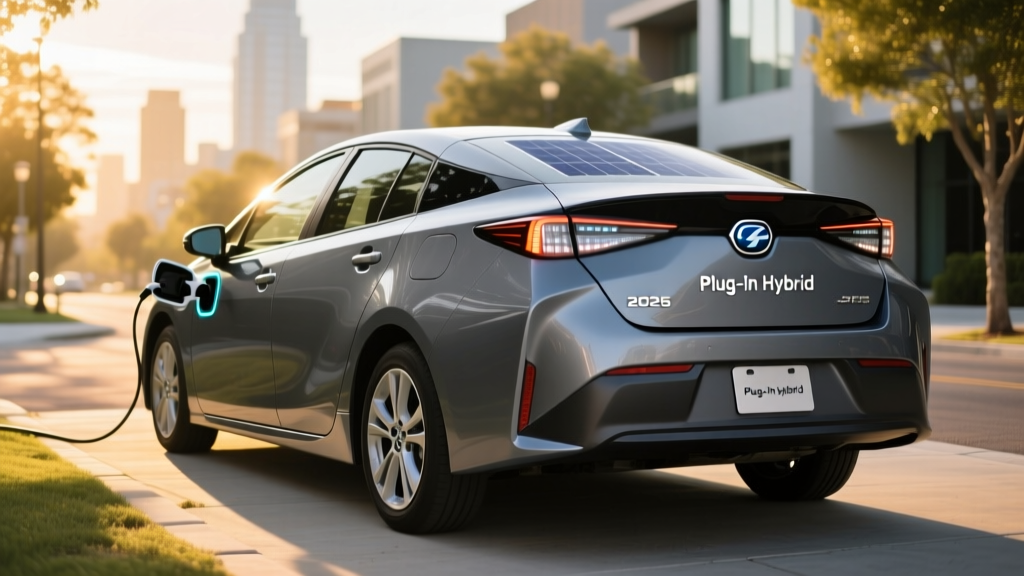
The Toyota Prius Prime has spent the last few years quietly rewriting what a plug-in hybrid can be. Once the punchline of eco-car jokes, the current-generation Prius Prime pairs a genuinely attractive design with a powertrain that lets most commuters drive on electricity alone all week — while keeping a gas engine ready for any road trip. For 2026, Toyota continues the formula that made the redesign a hit: a 13.6 kWh battery pack, up to 44 miles of EPA-rated electric-only range, and a combined 220 horsepower from its hybrid system.
If you've been searching for a plug-in hybrid Prius, this guide covers every number that matters — from real-world MPG and charging times to federal tax credit eligibility under current IRS §30D rules. We'll also clarify the difference between the standard Prius hybrid (HEV) and the Prime (PHEV), so you can pick the right version for your driving habits.
Prius HEV vs Prius Prime PHEV: What's the Difference?
Toyota sells two distinct Prius models, and confusing them is the most common buyer mistake:
| Feature | Prius (HEV) | Prius Prime (PHEV) |
|---|---|---|
| Powertrain type | Conventional hybrid — no plug | Plug-in hybrid — charges from outlet |
| Battery capacity | ~1.0 kWh (small buffer) | 13.6 kWh usable |
| Electric-only range | None (EV assist only) | Up to 44 miles (EPA) |
| Combined horsepower | 194 hp (FWD) / 196 hp (AWD) | 220 hp |
| EPA combined MPG (hybrid mode) | 57 MPG (FWD) | 52 MPG |
| DC fast charging | N/A | No — Level 2 AC only |
| Starting MSRP (2026) | ~$28,350 | ~$33,675 |
| Federal tax credit (§30D) | Not eligible | Up to $3,750* |
*Credit amount depends on critical-mineral and battery-component sourcing requirements. See IRS §30D details below.
The core distinction: The standard Prius HEV never plugs in. It recovers energy through regenerative braking and the engine, storing it in a small battery that assists the gas engine. The Prius Prime PHEV has a much larger battery you can charge at home or at public Level 2 stations, enabling genuine electric-only driving before the hybrid system takes over.
Electric-Only Range and Total Range: The Numbers
The 2026 Prius Prime carries a 13.6 kWh lithium-ion battery pack. Here's what that delivers in practice:
| Metric | EPA Rating | Real-World Expectation |
|---|---|---|
| Electric-only range | 44 miles (SE trim, 17" wheels) | 35–42 miles in mixed driving; ~30–35 miles at sustained highway speed or in cold weather |
| Electric range (XSE/XSE Premium, 19" wheels) | 39 miles | 32–37 miles mixed |
| MPGe (electric mode) | 127 MPGe combined | Varies with driving style and temperature |
| Total range (EV + gas) | ~440 miles | ~400–430 miles depending on conditions |
| Gas-only combined MPG | 52 MPG | 48–55 MPG — hybrids often exceed EPA in city driving |
Real-world range reality check: The EPA's 44-mile electric range is achievable in moderate temperatures at city speeds. Expect a 15–25% reduction in freezing weather (battery chemistry loses efficiency below 40°F) and at sustained 70+ mph highway speeds. In our experience, 35–40 miles is a reliable daily expectation in most conditions for the SE trim.
For most commuters with a sub-40-mile round trip, the Prius Prime can operate as a pure electric vehicle Monday through Friday, only engaging the 2.0-liter engine on longer weekend drives. That's the PHEV value proposition: EV-like daily running costs without range anxiety on road trips.
Fuel Economy: EPA MPG Breakdown and Real-World Results
When the battery is depleted and the Prius Prime operates as a conventional hybrid, fuel economy remains strong:
| Trim | City MPG | Highway MPG | Combined MPG |
|---|---|---|---|
| Prius Prime SE (17" wheels) | 53 | 51 | 52 |
| Prius Prime XSE (19" wheels) | 50 | 47 | 48 |
| Prius Prime XSE Premium (19" wheels) | 50 | 47 | 48 |
Toyota's hybrid system excels in stop-and-go city traffic, where regenerative braking recaptures energy that conventional cars waste as heat. Many owners report exceeding the EPA city rating in urban driving — 55–60 MPG is common in warm-weather city commutes. Highway fuel economy tends to track closer to or slightly below the EPA estimate, especially at speeds above 70 mph where aerodynamic drag increases.
Compared to the standard Prius HEV (rated at 57 MPG combined for FWD), the Prime sacrifices a few MPG due to the heavier battery pack. But if you charge regularly and drive within the electric range, your actual gasoline consumption drops dramatically — potentially to zero on weekdays.
Charging: What to Expect at Home and in Public
The Prius Prime charges exclusively via AC — there is no DC fast charging capability. This is typical for PHEVs with smaller battery packs, where the cost and weight of DC hardware aren't justified.
| Charging Level | Power (kW) | 0–100% Time | Notes |
|---|---|---|---|
| Level 1 (120V household outlet) | ~1.4 kW | ~11 hours | Included portable cord; adequate for overnight top-ups |
| Level 2 (240V home/public station) | ~3.3 kW (vehicle-limited) | ~4 hours | Recommended for daily full charges |
The onboard charger is limited to approximately 3.3 kW, meaning even a 48-amp Level 2 home charger won't speed things up beyond that rate. A dedicated 240V Level 2 circuit (NEMA 14-50 or hardwired wall connector) is the ideal home setup — you'll start each morning with a full battery in about four hours.
Home charging cost estimate: At the US average residential electricity rate of ~$0.16/kWh, fully charging the 13.6 kWh battery costs roughly $2.18. That's about 5–6 cents per electric mile — compared to roughly 12–15 cents per mile for a 30 MPG gas car at $3.50/gallon.
Powertrain and Performance Specs
| Specification | 2026 Prius Prime |
|---|---|
| Engine | 2.0L 4-cylinder Atkinson-cycle |
| Engine output | 150 hp / 139 lb-ft torque |
| Electric motor output | 161 hp (front) |
| Combined net horsepower | 220 hp |
| 0–60 mph | 6.6 seconds |
| Drivetrain | Front-wheel drive (AWD not available on Prime) |
| Transmission | Electronically controlled CVT (eCVT) |
| Battery chemistry | Lithium-ion |
| Battery capacity | 13.6 kWh |
| EV top speed | ~84 mph |
The 220 hp combined output represents a major upgrade from the previous-generation Prime's 121 hp. The 0–60 time of 6.6 seconds makes the Prius Prime genuinely quick for a fuel-economy champion — it'll merge onto highways and pass without drama. The eCVT delivers seamless, gearless acceleration, and Toyota's hybrid system transitions between electric and gas power almost imperceptibly.
Pricing, Trims, and Federal Tax Credit Eligibility
The 2026 Prius Prime is offered in three trims:
- SE: ~$33,675 MSRP — 17" alloy wheels, 44-mile EV range, 8" touchscreen, Toyota Safety Sense 3.0
- XSE: ~$36,675 MSRP — 19" wheels, 39-mile EV range, synthetic leather seats, 12.3" touchscreen
- XSE Premium: ~$39,675 MSRP — adds panoramic fixed glass roof, JBL premium audio, heated/ventilated front seats
Federal Tax Credit (§30D) — Key Rules for 2026:
- The Prius Prime qualifies as a new clean vehicle under IRS §30D, but the credit amount depends on battery sourcing compliance.
- Credit amount: Up to $3,750 (partial credit based on critical-mineral or battery-component requirements met).
- MSRP cap: Vehicle MSRP must not exceed $55,000 (sedans) — all Prime trims qualify.
- Buyer income cap: Modified AGI must not exceed $150,000 (single), $225,000 (head of household), or $300,000 (married filing jointly).
- Point-of-sale transfer: Eligible buyers can transfer the credit to the dealer at purchase, reducing the purchase price directly rather than waiting for a tax refund.
- Assembly: Must be assembled in North America (Prius Prime is assembled in Japan — this may affect eligibility; confirm with your dealer and IRS approved vehicle list).
Tax credit rules change frequently. Consult a tax professional and verify current eligibility at irs.gov before purchasing.
Important note on assembly: Under current §30D rules, the vehicle must undergo final assembly in North America. The Prius Prime is manufactured in Japan, which has historically affected its eligibility for the full federal credit. Toyota's US-built hybrids (like the Camry Hybrid) may have different eligibility. Always check the DOE/FuelEconomy tax credit tracker for the latest qualifying vehicle list before making a purchase decision.
Battery Warranty, Reliability, and Replacement Cost
Toyota Hybrid Battery Warranty:
- Coverage: 10 years / 150,000 miles (whichever comes first) for the hybrid/EV battery pack
- What's covered: Defects and capacity loss below a specified threshold (typically ~70% state of health)
- Transferability: Fully transferable to subsequent owners
Toyota's hybrid battery track record is among the best in the industry. The Prius has been in production since 1997, and real-world data shows hybrid batteries routinely lasting 150,000–200,000+ miles before significant degradation. The larger PHEV battery in the Prime experiences more charge cycles than a standard HEV pack, but Toyota's thermal management and conservative state-of-charge buffering (the car never uses 100% or drops to true 0%) protect longevity.
Battery replacement cost: If the Prime's battery pack does need replacement out of warranty, expect a cost in the range of $3,500–$5,500 including parts and labor at a Toyota dealer. Third-party hybrid battery specialists often offer refurbished packs for $2,000–$3,500. For context, this is significantly less than the $10,000–$20,000+ replacement cost for full EV battery packs.
Overall reliability: Toyota consistently ranks at or near the top in long-term reliability surveys from Consumer Reports and J.D. Power. The hybrid powertrain has fewer wear components than a conventional gas car — no traditional starter motor, no alternator, and regenerative braking reduces brake pad wear significantly.
Who Should Choose the Plug-In Hybrid Prius?
Choose the Prius Prime PHEV if:
- Your daily round-trip commute is under 40 miles and you can charge at home overnight
- You want EV-like daily costs but take road trips where charging infrastructure is uncertain
- You live in an apartment or area where reliable public DC fast charging isn't available
- You want to reduce gasoline consumption without committing to a full EV
Choose the standard Prius HEV if:
- You cannot charge at home (no garage, no outlet access)
- You want the lowest purchase price and don't need electric-only driving
- Your daily mileage regularly exceeds 50+ miles (the PHEV advantage shrinks)
Choose a full EV (like a Tesla Model 3 or Hyundai Ioniq 6) if:
- You have reliable home Level 2 charging and your daily driving is under 250 miles
- You want to eliminate gasoline entirely and minimize maintenance
- You qualify for the full $7,500 federal EV tax credit on a qualifying model
Pros
- 44-mile EV range covers most daily commutes gas-free
- 52 MPG combined when operating as a hybrid
- 220 hp makes it genuinely quick (6.6 sec 0–60)
- Excellent Toyota reliability and 10-year battery warranty
- Attractive design — no longer the "boring eco-car"
- Total range over 400 miles eliminates road-trip anxiety
Cons
- No DC fast charging — long road trips rely on gas only
- 3.3 kW AC charging is slow compared to some PHEV rivals
- Japan assembly may limit federal tax credit eligibility
- XSE trims with 19" wheels lose 5 miles of EV range
- Rear seat and cargo space tighter than crossover alternatives
- AWD not available on Prime (only on standard Prius HEV)
Frequently Asked Questions
How many MPG does the plug-in hybrid Prius get?
The 2026 Prius Prime SE achieves 52 MPG combined (53 city / 51 highway) when operating in hybrid mode after the battery is depleted. The XSE and XSE Premium trims with larger 19" wheels are rated at 48 MPG combined. In real-world city driving, many owners report exceeding these EPA estimates — 55+ MPG is common in warm-weather urban commuting.
How far can the Prius Prime go on electric only?
The EPA rates the Prius Prime SE at 44 miles of electric-only range, while XSE trims with 19" wheels achieve 39 miles. In real-world conditions, expect 35–42 miles from the SE in moderate temperatures, and 15–25% less in freezing weather or at sustained highway speeds above 70 mph.
Does the Prius Prime qualify for a federal tax credit?
The Prius Prime may qualify for a partial federal tax credit of up to $3,750 under IRS §30D, depending on battery component and critical-mineral sourcing compliance. However, because the Prius Prime is assembled in Japan, it must meet the North American final assembly requirement to be eligible. Always verify current eligibility on the IRS clean vehicle list before purchasing. Income caps apply: $150K single / $300K married filing jointly.
Is the Prius Prime reliable, and what does a battery replacement cost?
Toyota's hybrid powertrains have an industry-leading reliability record spanning nearly three decades of Prius production. The hybrid battery is warranted for 10 years / 150,000 miles. Out-of-warranty replacement costs approximately $3,500–$5,500 at a dealer, or $2,000–$3,500 through third-party hybrid specialists. Most hybrid batteries last well beyond the warranty period.
Can I charge the Prius Prime at a DC fast charger?
No. The Prius Prime does not have DC fast charging hardware. It charges via AC only — at up to 3.3 kW on a Level 2 (240V) station or ~1.4 kW on a standard 120V household outlet. A full Level 2 charge takes approximately 4 hours. This is standard for most PHEVs with smaller battery packs.
Hybrid vs PHEV vs EV — which is right for me?
If you can charge at home and your daily driving is under 40 miles, the Prius Prime PHEV gives you the best of both worlds: electric-only commuting with a gas backup for road trips. If you can't charge at home, the standard Prius HEV delivers outstanding MPG with no behavior change. If you have home charging and rarely drive over 250 miles in a day, a full EV eliminates gas entirely and typically qualifies for a larger federal tax credit.