The Plug in Hybrid Pickup Truck Landscape in 2026
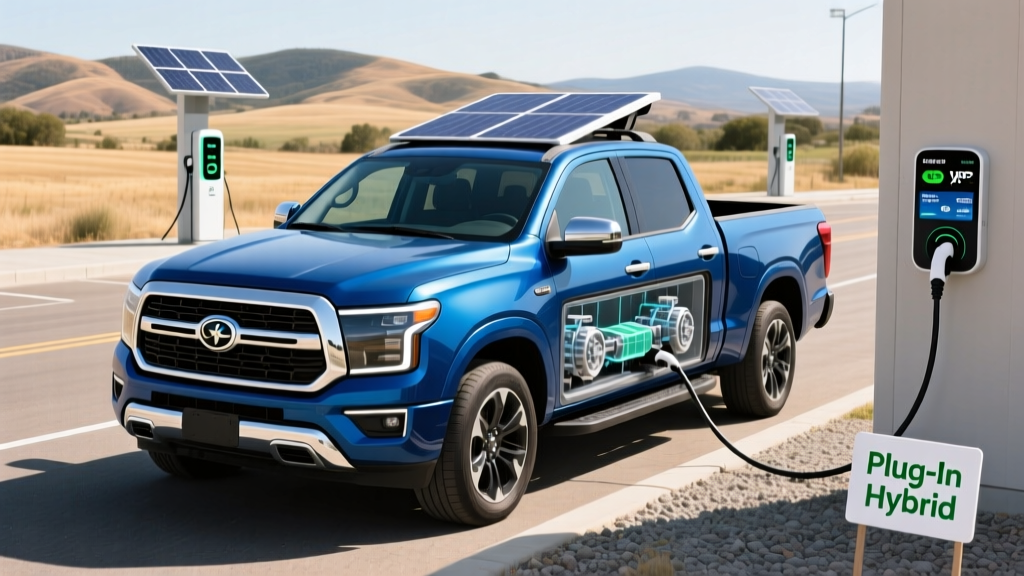
If you need a truck that can tow on weekends, commute on electrons during the week, and never strand you in a charging desert, a plug in hybrid pickup truck occupies a compelling middle ground. Unlike a conventional hybrid (HEV) that recovers energy solely through regenerative braking and never plugs in, a plug-in hybrid (PHEV) pairs a larger battery pack with a gas engine, giving you a meaningful electric-only driving range before the gasoline engine kicks in.
As of the 2026 model year, there are two serious contenders in this niche: the Ford F-150 PowerBoost Hybrid (a conventional HEV, included for comparison) and the Jeep Gladiator 4xe (a true PHEV). Below, we break down exactly what each delivers — EPA MPG, electric-only miles, battery capacity, charging speed, towing, and federal tax credit eligibility — so you can decide whether a PHEV truck, a conventional hybrid truck, or a full battery-electric vehicle (BEV) fits your life.
HEV vs. PHEV: What's the Difference?
Conventional Hybrid (HEV): Small battery (typically 1–2 kWh). Charges via regenerative braking and the gas engine. Never plugs in. Improves city MPG but has no electric-only range. Example: Ford F-150 PowerBoost.
Plug-in Hybrid (PHEV): Larger battery (typically 12–25 kWh). Plugs into a wall outlet or Level 2 charger. Delivers 20–40+ miles of electric-only driving before the gas engine engages. Example: Jeep Gladiator 4xe.
Spec Comparison: Every Electrified Pickup Truck for 2026
| Spec | Jeep Gladiator 4xe (PHEV) | Ford F-150 PowerBoost (HEV) |
|---|---|---|
| Powertrain Type | Plug-in Hybrid (PHEV) | Conventional Hybrid (HEV) |
| Engine | 2.0L turbo I-4 + electric motor | 3.5L twin-turbo V6 + electric motor |
| Combined Horsepower | ~375 hp | 430 hp |
| Combined Torque | ~470 lb-ft | 570 lb-ft |
| Battery Capacity | 17.3 kWh (NMC) | 1.5 kWh (lithium-ion) |
| Electric-Only Range (EPA) | ~22 miles | N/A (no EV mode) |
| Total Combined Range | ~380 miles | ~650 miles |
| EPA MPG (Combined / City / Hwy) | ~20 / 21 / 20 (hybrid mode) | 25 / 25 / 24 |
| MPGe (Electric + Gas) | ~49 MPGe | N/A |
| Level 2 Charge Time (0–100%) | ~2.5 hours at 7.2 kW | N/A (no plug) |
| DC Fast Charging | No | No |
| Max Towing Capacity | ~5,500 lbs | ~12,700 lbs |
| 0–60 mph | ~6.5 sec | ~5.8 sec |
| Base MSRP | ~$55,495 | ~$58,535 |
| Federal §30D Tax Credit | Up to $3,750* | Not eligible |
| Hybrid Battery Warranty | 8 yr / 100,000 mi | 8 yr / 100,000 mi |
*Tax credit amount and eligibility depend on critical-mineral and battery-component sourcing requirements under current IRS §30D rules. See the tax credit section below for full details.
Electric-Only Range: How Far Can a PHEV Truck Go Without Gas?
The Jeep Gladiator 4xe delivers an EPA-rated 22 miles of electric-only range. In real-world driving, expect roughly 18–20 miles if you're driving at highway speeds or in cold weather (below 40°F), where cabin heating and battery inefficiency reduce usable range. In mild conditions with light city driving and frequent regenerative braking, some owners report squeezing out 24–25 miles.
EPA Electric-Only Range: 22 miles
Real-World Expectation: 18–25 miles depending on temperature, terrain, and driving style. Highway speeds and cold weather reduce range; city driving with regen maximizes it.
For a commuter with a sub-20-mile round trip and home charging access, this means near-zero gasoline use during the workweek. Once the battery depletes, the Gladiator 4xe operates as a conventional hybrid — you're never stranded. The total combined range (electric + gasoline) sits around 380 miles, which is less than the F-150 PowerBoost's 650-mile range due to the Gladiator's smaller fuel tank and lower hybrid-mode efficiency.
Fuel Economy: EPA MPG and Real-World Numbers
| Model | City MPG | Highway MPG | Combined MPG | MPGe (if PHEV) |
|---|---|---|---|---|
| Jeep Gladiator 4xe (hybrid mode, battery depleted) | 21 | 20 | 20 | 49 MPGe |
| Ford F-150 PowerBoost Hybrid | 25 | 24 | 25 | N/A |
These numbers require context. The Gladiator 4xe's 20 MPG combined (hybrid mode) is unimpressive for a hybrid — but that figure only applies once the battery is depleted. If you charge daily and drive within the 22-mile electric window, your effective fuel consumption is dramatically lower. The 49 MPGe figure reflects combined electric and gasoline energy use over the first portion of a trip.
The F-150 PowerBoost, by contrast, delivers a consistent 25 MPG combined without ever needing to plug in. In real-world city driving, conventional hybrids often exceed their EPA city rating because regenerative braking recovers energy that a gas-only truck wastes as heat. On the highway, where regen is less useful and aerodynamic drag dominates, expect the PowerBoost to deliver closer to 22–23 MPG at 75 mph — slightly under its EPA highway number. Source: fueleconomy.gov.
Charging: What It Takes to Plug In a PHEV Truck
The Gladiator 4xe uses a 17.3 kWh NMC (nickel-manganese-cobalt) battery pack. Of that, approximately 14–15 kWh is usable — the rest is a buffer to protect battery longevity.
| Charging Level | Power (kW) | Time (0–100%) | Miles of EV Range per Hour |
|---|---|---|---|
| Level 1 (120V household outlet) | ~1.4 kW | ~12 hours | ~2 miles/hr |
| Level 2 (240V home/public charger) | 7.2 kW | ~2.5 hours | ~9 miles/hr |
| DC Fast Charging | N/A | N/A | N/A |
Most PHEV truck owners charge overnight on a standard 120V outlet — it's slow but sufficient if your daily electric need is under 20 miles. A Level 2 home charger (240V) cuts charge time to about 2.5 hours, which is useful if you want to top up between trips during the day.
A critical limitation: the Gladiator 4xe does not support DC fast charging. This is typical for PHEVs — their smaller batteries and onboard charger designs aren't built for high-power DC input. You won't find yourself at a Electrify America or Tesla Supercharger station with this truck, which simplifies the ownership experience but means no quick top-ups on road trips.
Performance, Towing, and Payload
The Gladiator 4xe produces roughly 375 combined horsepower and 470 lb-ft of torque, delivered through an 8-speed automatic transmission. The electric motor provides instant torque off the line, giving the truck a responsive feel in city driving and a 0–60 mph time of approximately 6.5 seconds.
Towing capacity is where the PHEV truck shows a compromise: the Gladiator 4xe is rated for approximately 5,500 lbs — adequate for a small boat, utility trailer, or a couple of ATVs, but well short of what the F-150 PowerBoost can handle at 12,700 lbs. If heavy towing is a regular requirement, a PHEV truck in its current form is not the right tool.
The F-150 PowerBoost's 430 hp and 570 lb-ft of torque make it one of the most powerful half-ton trucks available, and its hybrid system adds low-end electric torque without sacrificing payload or towing. It's the clear choice if you need maximum utility.
Pricing, Tax Credits, and Total Cost of Ownership
The 2026 Jeep Gladiator 4xe starts at approximately $55,495 (including destination). Fully loaded Rubicon or Mojave trims can push past $68,000. The Ford F-150 PowerBoost starts around $58,535 for the XLT trim with the PowerBoost package.
Federal Tax Credit Eligibility (§30D)
The Gladiator 4xe may qualify for a partial federal tax credit under IRS §30D rules. Because PHEVs have smaller batteries than full BEVs, and because the credit amount is tied to battery capacity and critical-mineral/battery-component sourcing requirements, the maximum credit for qualifying PHEV trucks is typically $3,750 (half of the full $7,500). Eligibility depends on:
- MSRP cap: Vans, SUVs, and pickup trucks must have an MSRP at or below $80,000.
- Buyer income cap: Modified adjusted gross income must not exceed $150,000 (single), $225,000 (head of household), or $300,000 (joint filers).
- Critical minerals requirement: A specified percentage of critical minerals must be sourced from the U.S. or a free-trade-agreement country (for half the credit).
- Battery components requirement: A specified percentage of battery components must be manufactured or assembled in North America (for the other half).
- Point-of-sale transfer: As of 2024, you can transfer the credit to the dealer at purchase for an immediate price reduction, rather than waiting to claim it on your tax return.
The F-150 PowerBoost, as a conventional HEV, does not qualify for any federal EV tax credit — it has no plug and doesn't meet the definition of a qualified plug-in electric vehicle.
Always verify current-year eligibility on IRS.gov before purchasing, as sourcing requirements tighten annually.
Hybrid Battery Warranty & Replacement Cost
Warranty: Both the Gladiator 4xe and F-150 PowerBoost carry a hybrid battery warranty of 8 years or 100,000 miles, whichever comes first. In California and states that follow CARB emissions standards, the warranty extends to 10 years or 150,000 miles.
Replacement cost (out of warranty): A PHEV battery replacement (Gladiator 4xe, 17.3 kWh) typically ranges from $8,000 to $12,000 including labor. A conventional HEV battery (F-150 PowerBoost, 1.5 kWh) is significantly cheaper, typically $2,000 to $4,000.
Real-world longevity: Hybrid and PHEV batteries from major automakers have demonstrated strong longevity. Toyota's hybrid batteries routinely last 150,000+ miles with minimal degradation. Ford and Stellantis (Jeep's parent) use similar NMC chemistries with active thermal management. Degradation in the 10–15% range over 100,000 miles is typical — meaning a Gladiator 4xe that started with 22 miles of EV range might deliver 19–20 miles after a decade of use.
Who Should Choose a Plug in Hybrid Pickup Truck?
Pros of a PHEV Truck
- Electric-only commuting eliminates gasoline use for short daily trips
- No range anxiety — the gas engine provides unlimited range for road trips and towing
- Lower home charging cost vs. a full BEV (smaller battery = less electricity per charge)
- Eligible for partial federal tax credit (up to $3,750)
- Instant electric torque improves off-the-line responsiveness
Cons of a PHEV Truck
- Limited electric-only range (18–25 miles real-world)
- No DC fast charging — road trips run entirely on gasoline
- Reduced towing capacity vs. conventional hybrid or gas trucks
- Higher base price than comparable gas-only trucks
- Two systems to maintain (engine + electric powertrain)
- Hybrid-mode MPG can be lower than a conventional HEV due to added battery weight
Decision Framework: PHEV Truck vs. HEV Truck vs. Full EV Truck
Choose a PHEV truck (Gladiator 4xe) if:
- Your daily commute is under 25 miles round-trip and you can charge at home
- You want to reduce fuel consumption without committing to full electric
- You need a truck for occasional utility but heavy towing isn't routine
- You live in an area with sparse DC fast-charging infrastructure
Choose a conventional hybrid truck (F-150 PowerBoost) if:
- You want better overall MPG without plugging in
- Heavy towing (10,000+ lbs) is a regular requirement
- You don't have access to home or workplace charging
- You want maximum range (650+ miles) between fill-ups
Choose a full EV truck (e.g., Ford F-150 Lightning, Rivian R1T) if:
- You want zero tailpipe emissions and the lowest per-mile fuel cost
- You have reliable home Level 2 charging
- Your daily driving is within the truck's EPA range (230–350+ miles)
- You qualify for the full $7,500 federal tax credit
- You're comfortable planning charging stops on longer road trips
Reliability: What to Expect from PHEV and Hybrid Trucks
Hybrid and PHEV powertrains from established automakers have proven highly reliable. The electric motor in a hybrid system actually reduces wear on the gasoline engine and brakes (regenerative braking extends brake pad life). Consumer Reports data consistently shows that hybrids have lower long-term maintenance costs than their gas-only counterparts.
The Gladiator 4xe shares its 2.0L turbo engine and 8-speed transmission with other Stellantis vehicles that have been on the road for years. The PHEV system adds complexity — an electric motor integrated into the transmission, high-voltage wiring, and a larger battery — but the components are well-understood and covered by the 8-year/100,000-mile warranty.
The F-150 PowerBoost's 3.5L PowerBoost hybrid system has been in production since the 2021 model year. Early units saw some transmission-related recalls, but subsequent model years have addressed these issues. The small 1.5 kWh battery is under minimal stress compared to a PHEV or BEV battery, contributing to its longevity.
Frequently Asked Questions
How many MPG does a plug in hybrid pickup truck get?
The 2026 Jeep Gladiator 4xe achieves an EPA-rated 21 city / 20 highway / 20 combined MPG in hybrid mode (after the battery is depleted). When factoring in electric-only driving, it earns a combined 49 MPGe. The conventional hybrid Ford F-150 PowerBoost achieves 25/24/25 MPG (city/highway/combined) without plugging in.
How far can a PHEV truck go on electric only?
The Gladiator 4xe delivers 22 miles of EPA-rated electric-only range. In real-world conditions, expect 18–25 miles depending on temperature, speed, and terrain. This covers most daily commutes, after which the truck seamlessly switches to hybrid mode.
Does a plug in hybrid pickup truck qualify for a tax credit?
The Gladiator 4xe may qualify for up to $3,750 under the federal §30D clean vehicle credit, subject to MSRP caps (under $80,000 for trucks), buyer income limits, and battery-sourcing requirements. Conventional hybrids like the F-150 PowerBoost do not qualify. Always check IRS.gov for current-year eligibility.
Is a hybrid truck reliable, and what does battery replacement cost?
Hybrid trucks from Ford and Jeep carry 8-year/100,000-mile battery warranties (10 years/150,000 miles in CARB states). Out-of-warranty PHEV battery replacement runs $8,000–$12,000; conventional HEV battery replacement is $2,000–$4,000. Real-world data shows hybrid batteries lasting 150,000+ miles with 10–15% capacity loss.
Can I tow with a plug in hybrid truck?
Yes, but with reduced capacity. The Gladiator 4xe is rated for approximately 5,500 lbs — enough for a small trailer or boat, but significantly less than the F-150 PowerBoost's 12,700-lb rating. If heavy towing is routine, a conventional hybrid or gas truck is the better choice.
Do I need to install a home charger for a PHEV truck?
Not necessarily. A standard 120V household outlet (Level 1) will fully charge the Gladiator 4xe overnight in about 12 hours, which is sufficient for daily electric commuting. A Level 2 (240V) home charger reduces that to ~2.5 hours and is recommended if you want to charge between trips during the day. Expect Level 2 installation to cost $500–$2,000 depending on your electrical panel and run length.
Hybrid vs. PHEV vs. EV — which truck is right for me?
If you can charge at home and your daily driving is under 25 miles, a PHEV truck gives you electric commuting with gas-engine backup. If you can't charge at home or need maximum towing, a conventional hybrid truck gives you better MPG without plugging in. If you want the lowest operating cost and have charging access, a full EV truck (F-150 Lightning, Rivian R1T) delivers 230–350+ miles of range and qualifies for up to $7,500 in federal credits.