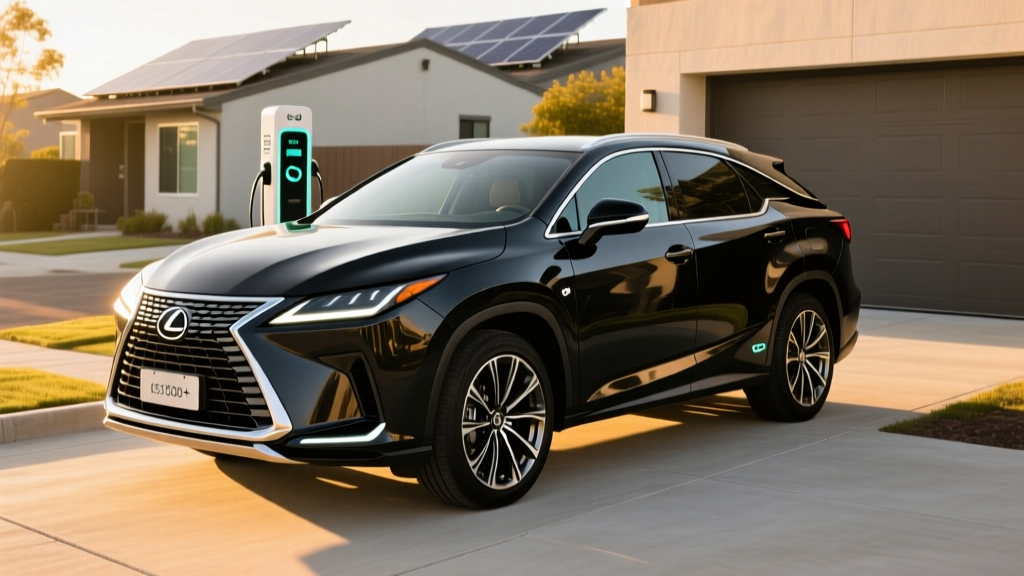
The Lexus RX has been the default luxury midsize SUV for two decades. The current-generation plug-in hybrid variant, the RX 500h+, gives buyers a bridge between a conventional hybrid and a full battery-electric vehicle — 37 miles of electric-only driving for the daily commute, with a gas engine ready for road trips. For 2026, the RX 500h+ remains Lexus's only plug-in hybrid SUV in the U.S. market, competing against the BMW X5 xDrive50e, Volvo XC60 Recharge, and Lincoln Corsair Grand Touring.
This guide covers the RX 500h+ powertrain, real-world efficiency, charging logistics, battery longevity, and whether it qualifies for the federal EV tax credit — everything a buyer needs before signing a lease or purchase agreement.
What Is the Lexus RX 500h+ and How Does It Differ from the RX 350h?
Lexus sells two electrified RX models. The distinction matters because the badging is similar but the powertrains are fundamentally different:
RX 350h — Conventional Hybrid (HEV)
- No plug — the battery charges from regenerative braking and the engine
- 2.5L 4-cylinder + two electric motors, 246 combined hp
- EPA 36 MPG combined (37 city / 34 highway)
- No electric-only driving beyond brief low-speed creep
- Base MSRP: ~$52,700 (2026)
RX 500h+ — Plug-In Hybrid (PHEV)
- Plug-in capable — charge at home or on public Level 2 stations
- 2.5L 4-cylinder + two electric motors, 304 combined hp
- 37 miles EPA electric-only range, 64 MPGe combined
- 36 MPG combined once the battery is depleted (charge-sustaining mode)
- Base MSRP: ~$61,650 (2026)
The RX 350h never needs a charging cable. It behaves like a very efficient gas car. The RX 500h+ rewards owners who plug in regularly — if you charge nightly, most daily driving happens on electricity alone, and the gas engine might not fire for weeks.
EPA Efficiency: MPG, MPGe, and Electric-Only Range
The EPA rates the 2026 RX 500h+ at 64 MPGe combined when operating as a plug-in hybrid (electricity + gasoline blended over the test cycle). Once the 37-mile electric range is depleted, the vehicle switches to charge-sustaining hybrid mode and returns 36 MPG combined — identical to the conventional RX 350h's highway-heavy driving.
| Metric | RX 500h+ (PHEV) | RX 350h (HEV) |
|---|---|---|
| EPA Electric-Only Range | 37 miles | N/A |
| MPGe (Charge-Depleting) | 64 MPGe combined | N/A |
| MPG (Charge-Sustaining) | 36 combined (35 city / 37 hwy) | 36 combined (37 city / 34 hwy) |
| Total Combined Range | ~420 miles (37 EV + 383 gas) | ~470 miles |
| Fuel Tank | 14.5 gal | 14.5 gal |
| Battery (Usable) | 18.1 kWh (lithium-ion) | 1.6 kWh (NiMH) |
Real-World MPG vs. EPA Sticker
Plug-in hybrids are the most variable vehicles on the road for real-world efficiency because the result depends entirely on charging behavior:
- If you charge nightly and drive <35 miles/day: You may use 0.5–1.0 gallons per week, effectively achieving 100+ MPGe on your commute. The gas engine fires occasionally for cabin heat in winter or hard acceleration.
- If you never plug in: The RX 500h+ becomes a 304-hp hybrid SUV that returns roughly 33–36 MPG combined. Owners who buy a PHEV and never charge it are paying a $9,000 premium for a heavier vehicle with the same fuel economy as the cheaper RX 350h.
- Cold-weather electric range: Expect 25–30 miles of EV range in sub-40°F weather. The RX 500h+ uses a resistive heater (PTC) rather than a heat pump, so cabin heating draws heavily from the 18.1 kWh battery.
- Highway road trips: Once the battery depletes, sustained 70-mph highway driving yields approximately 33–35 MPG. This is competitive with a BMW X5 xDrive40i (24 MPG) or a Mercedes GLE 350 (22 MPG) but trails the conventional RX 350h's city-biased 37 MPG city rating.
Source: fueleconomy.gov — 2026 Lexus RX 500h+
Powertrain and Performance Specs
| Specification | 2026 Lexus RX 500h+ |
|---|---|
| Engine | 2.5L inline-4 (181 hp) |
| Front Electric Motor | 134 kW (180 hp) |
| Rear Electric Motor | 40 kW (54 hp) |
| Combined System Output | 304 hp |
| Drivetrain | AWD (E-FOUR electronic rear axle) |
| Transmission | eCVT (planetary gearset) |
| 0–60 mph | 6.5 seconds |
| Towing Capacity | 3,500 lbs |
| Battery Chemistry | Lithium-ion (NMC) |
| Usable Battery Capacity | 18.1 kWh |
| Curb Weight | ~4,750 lbs |
The 304-hp combined output makes the RX 500h+ the most powerful non-F Sport Performance RX variant. The electric motors deliver instant torque from 0 rpm, which gives it noticeably quicker off-the-line acceleration than the RX 350h (246 hp, 7.4 seconds to 60). The E-FOUR rear axle is motor-driven — there is no mechanical driveshaft to the rear wheels, which frees up interior packaging and provides confident traction in rain and light snow.
Charging: Level 2 at Home, No DC Fast Charge
This is the most important logistical detail for prospective RX 500h+ buyers: the vehicle does not support DC fast charging. There is no CCS or CHAdeMO port. The only charging inlet is a J1772 connector for AC Level 1 and Level 2 charging.
| Charging Level | Power | 0–100% Time | Notes |
|---|---|---|---|
| Level 1 (120V household) | ~1.4 kW | ~13 hours | Emergency/trickle only; not practical for daily use |
| Level 2 (240V, 16A) | 3.3 kW (vehicle-limited) | ~5.5 hours | Standard home wall charger or public Level 2 |
| DC Fast Charge | N/A | N/A | Not supported — no DC inlet |
The onboard charger is limited to 3.3 kW, meaning even if you plug into a 7.2 kW or 11.5 kW public Level 2 station, the RX 500h+ will only draw 3.3 kW. A full charge from empty takes approximately 5.5 hours. In practice, most owners arrive home with 10–15 miles of range remaining, so a typical overnight top-up takes 3–4 hours.
Home Level 2 Charging Setup
Because the RX 500h+ only needs 3.3 kW, you do not need a 48-amp hardwired charger. A 16-amp or 24-amp Level 2 unit on a 20A or 30A 240V circuit is sufficient. Budget approximately:
- Level 2 EVSE (ChargePoint Home Flex, Emporia Vue): $350–$700
- Electrician install (240V outlet or hardwire, 10–30 ft run): $500–$1,500
- Electrical panel upgrade (if needed, 200A service): $1,500–$3,000
- Permit and inspection: $50–$200
- Total typical: $900–$2,400 (without panel upgrade)
Always consult a licensed electrician for final specifications. The IRS also offers a 30C tax credit of up to $1,000 for home charging equipment installation (subject to income caps and census-tract eligibility).
Why no DC fast charging? Most PHEVs with sub-20 kWh batteries omit DCFC because the small battery cannot absorb high charge rates efficiently, and the added hardware (heavier wiring, larger inlet, thermal management) would increase cost and weight. For a 37-mile-range vehicle, overnight Level 2 charging is the intended use case. If you need to charge in 20 minutes on a road trip, you are shopping in the wrong vehicle category — consider a full BEV like the Tesla Model Y or Hyundai Ioniq 5.
Pricing, Trims, and Tax Credit Eligibility
The 2026 Lexus RX 500h+ is offered in three trims, all with AWD:
| Trim | MSRP (incl. destination) | Key Features |
|---|---|---|
| Luxury | $61,650 | 14" touchscreen, heated/ventilated front seats, 21" wheels |
| Premium | $63,150 | Panoramic roof, head-up display, Mark Levinson audio |
| Premium+ | $65,650 | Semi-aniline leather, advanced park, 10.2" digital cluster |
Federal Tax Credit (§30D) — Does the RX 500h+ Qualify?
Under current IRS rules, the Lexus RX 500h+ is classified as a plug-in hybrid electric vehicle and may be eligible for the §30D Clean Vehicle Credit. However, eligibility is not guaranteed and depends on multiple criteria:
- MSRP cap: SUVs must have an MSRP at or below $80,000. All RX 500h+ trims qualify.
- Buyer income cap: Modified AGI must not exceed $150,000 (single), $225,000 (head of household), or $300,000 (joint). Income is checked against either the current or prior tax year, whichever is lower.
- Battery sourcing: The vehicle's battery must meet critical-mineral and component sourcing thresholds that tighten annually. For 2026, 80% of critical minerals and 100% of battery components must be sourced from the U.S. or free-trade-agreement partners. Lexus has not publicly confirmed the RX 500h+ battery supply chain meets 2026 thresholds.
- Point-of-sale transfer: If eligible, the credit can be transferred to the dealer at purchase, reducing the purchase price by up to $3,718 (the maximum credit the RX 500h+ qualifies for based on its 18.1 kWh battery — PHEVs receive a base $2,500 plus $417 for each kWh above 5 kWh, capped at $7,500).
Bottom line: The RX 500h+ qualifies for a maximum of $3,718 in federal tax credit — not the full $7,500, because the credit formula for PHEVs is battery-size-dependent. Confirm eligibility with your tax professional and check the latest fueleconomy.gov tax credit database before purchasing, as sourcing rules change throughout the year.
Battery Warranty, Reliability, and Replacement Cost
Lexus Hybrid Battery Warranty
- Hybrid battery coverage: 10 years / 150,000 miles (whichever comes first)
- Capacity retention guarantee: Lexus warrants the PHEV battery against defects and abnormal degradation. There is no published minimum SoH percentage (unlike some BEV warranties that guarantee 70% capacity). Claims are evaluated case-by-case.
- Powertrain warranty: 6 years / 70,000 miles
- Basic vehicle warranty: 4 years / 50,000 miles
Long-Term Reliability
Toyota/Lexus hybrid powertrains have the longest track record in the industry — the Prius hybrid system has been in production since 1997. The 2.5L A25A-FXS engine used in the RX 500h+ is a proven, naturally aspirated unit with no turbocharger complexity. The eCVT planetary gearset has no clutch packs or bands to wear out, and Lexus hybrid transaxles routinely exceed 200,000 miles with basic fluid changes.
The main reliability variable is the 18.1 kWh lithium-ion traction battery. Based on data from Toyota RAV4 Prime owners (which uses a similar-size battery), degradation over 5 years / 60,000 miles typically ranges from 5–10%, meaning the 37-mile EV range might drop to 33–35 miles. Cold-weather degradation is more pronounced in years 7–10.
Battery replacement cost: If the hybrid battery fails out of warranty, a replacement pack for the RX 500h+ is estimated at $6,000–$9,000 (parts and labor), based on current Toyota PHEV battery pricing. This is significantly less than a full-BEV battery replacement ($15,000–$25,000) because the pack is smaller.
Driving Impressions: EV Mode, Hybrid Mode, and Refinement
In EV mode, the RX 500h+ is whisper-quiet up to approximately 84 mph (the electric-only top speed). The 180-hp front motor provides adequate acceleration for merging and passing without waking the gas engine. The transition from EV to hybrid mode is nearly imperceptible — the 2.5L engine starts smoothly and the eCVT keeps revs low during moderate acceleration.
One frustration: the RX 500h+ does not offer a dedicated "EV lock" mode that prevents the engine from starting. In cold weather (below ~40°F), the engine will fire automatically to provide cabin heat, even if the battery is fully charged. This is common among PHEVs without heat pumps (the Toyota RAV4 Prime behaves identically). Preconditioning the cabin while plugged in mitigates this — the car draws power from the wall outlet to warm the interior before you depart, preserving EV range.
Ride quality is Lexus-calibrated: soft, well-damped, and isolated from road imperfections. The 4,750-lb curb weight (roughly 400 lbs heavier than the RX 350h) is noticeable through corners but not objectionable. Steering is light and precise, and the regenerative braking offers four levels of intensity selectable via paddle shifters — though it does not achieve true one-pedal driving to a full stop like a BEV.
Who Should Buy the RX 500h+ — and Who Should Look Elsewhere?
Choose the Lexus RX 500h+ (PHEV) if:
- You can charge at home (garage or driveway with 240V access)
- Your daily commute is under 35 miles round-trip
- You want electric commuting but take 3+ road trips per year where charging infrastructure is sparse
- You value Lexus reliability, resale value, and dealership service
- You are not ready to commit to a full BEV due to apartment living, unreliable local charging, or towing needs
Choose the Lexus RX 350h (HEV) if:
- You cannot install a home charger (apartment, street parking, HOA restrictions)
- Your daily driving exceeds 50 miles and you do not want to manage charging
- You want to minimize purchase price — the 350h starts $9,000 lower
- You primarily drive in city traffic where the HEV already achieves 37 MPG
Choose a Full BEV (Tesla Model Y, BMW iX, Genesis GV60) if:
- You want zero gasoline purchases and zero oil changes
- You have reliable home and workplace charging
- You want DC fast charging for road trips (150–250 kW capability)
- You want the maximum federal tax credit ($7,500 on eligible models)
Pros
- 37 miles EV range covers most commutes engine-free
- 304 hp provides confident acceleration (6.5s 0–60)
- Lexus reliability and 10-year hybrid battery warranty
- 36 MPG hybrid mode once battery depletes
- No range anxiety — 420+ miles total range
- Premium interior with 14" touchscreen standard
Cons
- No DC fast charging — Level 2 only, 5.5-hour full charge
- 3.3 kW onboard charger is slow for public Level 2 stations
- $9,000 premium over RX 350h with modest EV range payoff
- No heat pump — EV range drops significantly in cold weather
- Federal tax credit limited to ~$3,718 max (not $7,500)
- Engine fires automatically in cold weather despite EV charge
Frequently Asked Questions
How many MPG does the Lexus RX 500h+ plug-in hybrid get?
The EPA rates the RX 500h+ at 64 MPGe combined when using both electric and gas power. Once the 37-mile EV range is depleted, it returns 36 MPG combined (35 city / 37 highway) as a conventional hybrid. Real-world results depend heavily on charging frequency — owners who charge nightly may use less than 1 gallon per week on a 30-mile commute.
How far can the RX 500h+ go on electric only?
The EPA rates the RX 500h+ at 37 miles of electric-only range on a full charge. In warm weather (60–80°F) with moderate speeds, expect 35–40 miles. In cold weather (below 40°F) or at sustained highway speeds above 70 mph, expect 25–32 miles. The engine will start automatically for cabin heat in cold temperatures.
Does the Lexus RX 500h+ qualify for a federal tax credit?
It may qualify for a partial §30D Clean Vehicle Credit of up to $3,718, based on its 18.1 kWh battery size. The full $7,500 credit is not available because the PHEV credit formula is battery-capacity-dependent. Eligibility also requires the buyer to meet income caps ($150K single / $300K joint) and the vehicle must meet 2026 battery-sourcing requirements. Confirm with a tax professional before purchasing.
Is the Lexus RX hybrid reliable and what does battery replacement cost?
Lexus/Toyota hybrid powertrains have the strongest long-term reliability record in the industry. The hybrid battery is warranted for 10 years / 150,000 miles. Based on similar Toyota PHEV platforms, expect 5–10% battery degradation over 5 years. Out-of-warranty battery replacement is estimated at $6,000–$9,000. The eCVT transmission and 2.5L engine are proven to exceed 200,000 miles with routine maintenance.
Can the RX 500h+ DC fast charge?
No. The RX 500h+ only supports AC charging via a J1772 connector at up to 3.3 kW (Level 2). A full charge takes approximately 5.5 hours. There is no CCS or CHAdeMO DC fast-charge port. This is typical for plug-in hybrids with small batteries — overnight home charging is the intended use case.
Do I need to plug in the RX 500h+ every night?
You do not have to — the car operates as a 36-MPG hybrid if you never plug it in. However, to realize the value of the PHEV premium, nightly charging is strongly recommended. A standard 240V Level 2 home charger replenishes the battery in about 5.5 hours from empty, or 3–4 hours from a typical day's use.
How does the RX 500h+ compare to the BMW X5 xDrive50e?
The BMW X5 xDrive50e offers 38 miles of EV range, 50 MPGe, 483 hp, and a 5.5-second 0–60 — but starts at ~$74,000 (nearly $13,000 more than the RX 500h+). The BMW also supports DC fast charging at 7.4 kW (AC only, no DCFC either). The RX 500h+ wins on price and reliability reputation; the X5 wins on performance and cargo space. Neither qualifies for the full $7,500 federal credit under current sourcing rules.
Specs and pricing reflect 2026 model-year data available at time of publication. Tax credit rules under IRS §30D are subject to change. Always verify eligibility at irs.gov and confirm vehicle specifications with your local Lexus dealer.