For drivers who want electric commuting without range anxiety, a PHEV vehicle (plug-in hybrid electric vehicle) offers a compelling middle ground. You get 20–45 miles of pure electric range for daily driving, plus a gasoline engine for longer trips. But with conventional hybrids (HEVs) achieving 50+ MPG and full EVs now offering 300+ miles of range, where does a PHEV fit in 2026?
This guide breaks down the mechanics, economics, and real-world ownership experience of plug-in hybrids — with exact specs, tax credit rules, and a decision framework to help you choose.
HEV vs PHEV: What's the Actual Difference?
Before diving into specs, let's clarify the terminology. Both are hybrids, but they operate very differently:
| Feature | Conventional Hybrid (HEV) | Plug-In Hybrid (PHEV) |
|---|---|---|
| Battery Size | 1–2 kWh | 10–25 kWh (usable) |
| Plug In to Charge? | No — charges via regen & engine | Yes — Level 1/2 charging |
| Electric-Only Range | 0–2 miles at low speed | 20–45 miles at highway speed |
| Gas Engine Role | Primary power, assisted by motor | Backup after battery depletes |
| Federal Tax Credit | None | Up to $7,500 (§30D, if eligible) |
| Ideal For | Drivers without home charging | Commuters with home Level 2 |
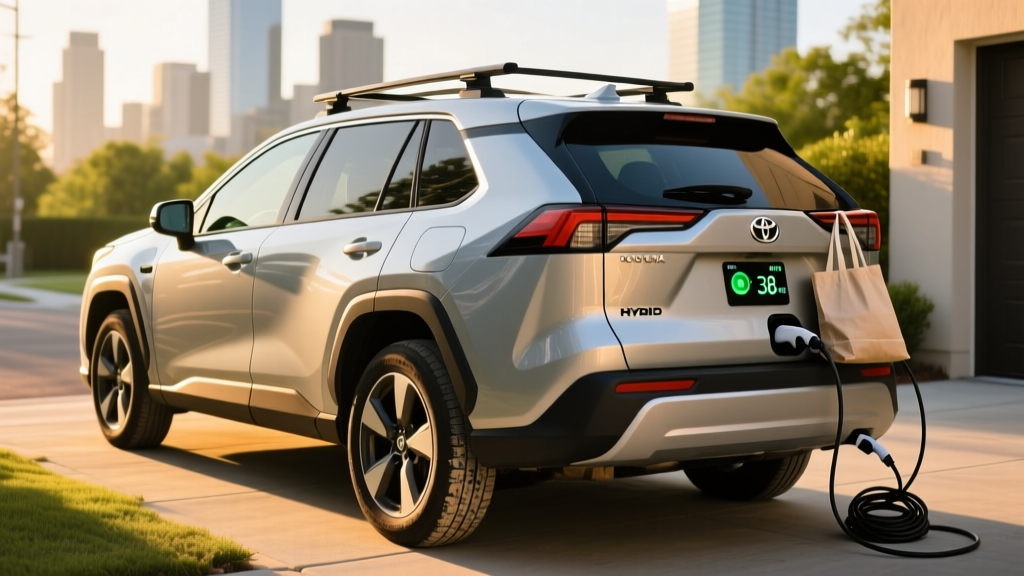
Key distinction: A conventional hybrid like the Toyota Prius never plugs in — its small battery recovers energy from braking and the engine. A PHEV like the Toyota RAV4 Prime has a much larger battery you charge from a wall outlet, enabling genuine electric-only commuting.
Top PHEV Vehicles in 2026: Specs at a Glance
Here's how the most popular 2026 PHEV models stack up on the metrics that matter:
| Model | EV Range | Combined MPG (after depletion) | Battery (kWh) | Combined HP | 0–60 mph | Base MSRP |
|---|---|---|---|---|---|---|
| Toyota RAV4 Prime | 42 mi | 38 MPG | 18.1 kWh | 302 hp | 5.7s | $44,900 |
| Jeep Wrangler 4xe | 22 mi | 20 MPG | 17.3 kWh | 375 hp | 6.0s | $51,795 |
| Hyundai Tucson PHEV | 33 mi | 35 MPG | 13.8 kWh | 261 hp | 7.1s | $38,750 |
| Chrysler Pacifica PHEV | 32 mi | 30 MPG | 16.0 kWh | 260 hp | 7.5s | $51,095 |
| BMW X5 xDrive50e | 38 mi | 27 MPG | 25.7 kWh | 483 hp | 4.6s | $75,900 |
Sources: EPA fueleconomy.gov, manufacturer spec sheets. EV range and MPG are EPA estimates; real-world results vary with temperature, terrain, and driving style.
How Far Can a PHEV Go on Electric Only?
The EPA-rated electric range tells part of the story. In real-world driving, expect variation:
- City commuting (stop-and-go): Regenerative braking extends range. A RAV4 Prime rated at 42 miles EPA may deliver 44–48 miles in mild weather urban driving.
- Highway driving (65–75 mph): Aerodynamic drag cuts range 15–20%. That same 42-mile rating drops to roughly 34–36 miles at sustained highway speed.
- Cold weather (below 32°F): Battery chemistry slows and cabin heating draws power. Expect 25–35% range loss, meaning a 42-mile PHEV might deliver 27–32 electric miles in winter.
DC fast charging: Most PHEVs charge only via Level 1 (120V, ~3–5 miles/hour) or Level 2 (240V, full charge in 2–3 hours). The Mitsubishi Outlander PHEV is a rare exception, supporting CHAdeMO DC fast charging to 80% in ~25 minutes — but at 50 kW peak, it's far slower than a full EV.
Fuel Economy: EPA Numbers vs Real-World MPG
Once the battery depletes, a PHEV operates as a conventional hybrid. Here's what to expect:
| Model | EPA City | EPA Highway | EPA Combined | Real-World Note |
|---|---|---|---|---|
| RAV4 Prime (charge-depleted) | 40 MPG | 36 MPG | 38 MPG | Owners report 36–42 MPG in mixed driving |
| Wrangler 4xe (charge-depleted) | — | — | 20 MPG | Heavy, boxy — expect 17–19 MPG highway |
| Tucson PHEV (charge-depleted) | 33 MPG | 37 MPG | 35 MPG | Highway-biased; city may see 30–32 MPG |
| Pacifica PHEV (charge-depleted) | 30 MPG | 31 MPG | 30 MPG | Minivan weight; 27–29 MPG loaded |
| BMW X5 xDrive50e (depleted) | 26 MPG | 28 MPG | 27 MPG | Luxury-weight penalty; 24–26 real-world |
The PHEV math advantage: If your daily commute is 30 miles round-trip and you charge nightly, you may burn zero gasoline on weekdays. A RAV4 Prime owner who charges daily and drives 12,000 miles/year might use only 100–150 gallons annually — versus 400 gallons for a 30 MPG gas-only SUV.
Pricing, Tax Credits, and Total Cost
PHEVs carry a price premium over their gas-only counterparts — typically $5,000–$10,000 more. The federal §30D tax credit can offset this, but eligibility is strict in 2026:
- Credit amount: Up to $7,500, based on battery capacity and critical-mineral/battery-component sourcing requirements.
- MSRP caps: Vans/SUVs/pickups ≤ $80,000; sedans ≤ $55,000.
- Income caps: AGI ≤ $300,000 (joint), $225,000 (head of household), $150,000 (single).
- Point-of-sale transfer: You can apply the credit as a down-payment reduction at the dealer, rather than waiting for tax filing.
- Battery sourcing: Increasing percentages of critical minerals and battery components must come from the U.S. or free-trade-agreement countries. This disqualifies some models.
Check current eligibility at IRS.gov before purchasing — rules tighten annually, and a model that qualified in 2025 may not in 2026.
Battery Warranty: What's Covered?
Federal law mandates that hybrid and PHEV batteries carry a minimum warranty of 8 years / 100,000 miles (10 years / 150,000 miles in CARB states like California, New York, and others). This covers capacity loss below a threshold (typically 60–70% of original). Out-of-warranty replacement costs range from $4,000–$8,000 depending on the model — but real-world data shows most hybrid batteries last 150,000–200,000+ miles with gradual degradation, not sudden failure.
Hybrid vs PHEV vs EV: Which Fits Your Life?
Choose a conventional hybrid (HEV) if:
- You lack home or workplace charging access
- You want maximum simplicity — no plugs, no behavior change
- Your budget is under $35,000
- You drive mostly highway miles (where HEV efficiency shines)
Choose a PHEV vehicle if:
- You have Level 2 home charging and a commute under 40 miles
- You take regular road trips where EV charging infrastructure is sparse
- You want electric daily driving but aren't ready to commit to a full EV
- You qualify for the §30D tax credit, narrowing the price gap
Choose a full EV (BEV) if:
- You have reliable home Level 2 charging
- Your daily driving is under 250 miles (covering 95%+ of trips)
- You want the lowest operating cost (electricity vs gas + zero oil changes)
- You're comfortable planning road-trip charging stops
Reliability and Long-Term Ownership
PHEV powertrains are mature technology. Toyota's hybrid system, in particular, has decades of proven reliability — the Prius fleet has demonstrated battery longevity exceeding 200,000 miles routinely. The addition of a plug-in system adds complexity (larger battery, onboard charger, charge port), but failure rates remain low.
Maintenance advantage: Because the electric motor handles low-speed and stop-and-go driving, the gas engine runs less often. This means fewer oil changes (every 7,500–10,000 miles vs 5,000), less brake wear (regen braking saves pads), and reduced engine wear over time.
Insurance note: PHEVs typically cost 10–15% more to insure than gas equivalents due to higher repair costs for battery and power electronics. Get a quote before buying.
PHEV Pros
- Electric commuting with gas backup — no range anxiety
- Eligible for up to $7,500 federal tax credit (if qualified)
- Lower fuel costs for short-trip drivers who charge daily
- Proven reliability, 8–10 year battery warranties
- No dependence on public charging networks
PHEV Cons
- $5,000–$10,000 premium over gas-only equivalent
- Heavier than gas or HEV (hurts highway MPG when depleted)
- Maintenance of both gas engine AND electric system
- Most cannot DC fast charge — Level 2 only
- Tax credit eligibility uncertain; changes annually
Frequently Asked Questions
How many MPG does a PHEV get?
After the battery depletes, PHEVs operate as conventional hybrids. EPA combined ratings range from 20 MPG (Jeep Wrangler 4xe) to 38 MPG (Toyota RAV4 Prime). If you charge daily and commute within the electric range, your effective "MPG" can exceed 100 MPGe.
How far can a PHEV go on electric only?
EPA ratings span 22–45 miles depending on the model. Real-world range drops 15–20% at highway speeds and 25–35% in freezing temperatures. For a 42-mile rated RAV4 Prime, plan on 34 highway miles or 28 winter miles.
Do I need to plug in a PHEV?
You don't have to — the gas engine will power the car indefinitely. But if you never plug in, you're carrying 300–500 lbs of dead battery weight and paying a premium for technology you aren't using. A PHEV only makes financial sense if you charge regularly.
Is a PHEV reliable, and what does battery replacement cost?
PHEV reliability is strong, especially from Toyota, Hyundai, and established luxury brands. Battery warranties cover 8–10 years / 100,000–150,000 miles. Out-of-warranty replacement runs $4,000–$8,000, but most batteries last well beyond warranty with gradual capacity loss, not sudden failure.
Does a PHEV qualify for the federal tax credit?
Some do, but eligibility depends on the §30D rules: MSRP caps ($80K SUVs, $55K sedans), buyer income limits, and battery-sourcing requirements. The credit can be up to $7,500 and is available as a point-of-sale transfer. Always verify current eligibility at IRS.gov before purchasing.
Can a PHEV charge at a DC fast charger?
Almost no. The Mitsubishi Outlander PHEV supports CHAdeMO DC charging (~50 kW), but nearly all other PHEVs are limited to Level 2 (240V, 3.3–7.2 kW), meaning a full charge takes 2–4 hours. This is fine for overnight home charging but impractical for road-trip top-ups.