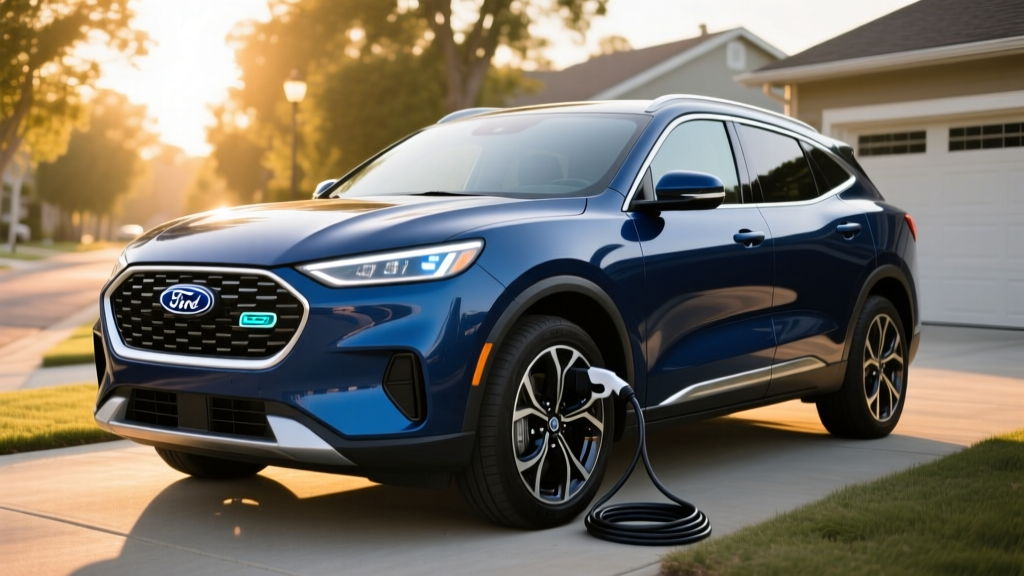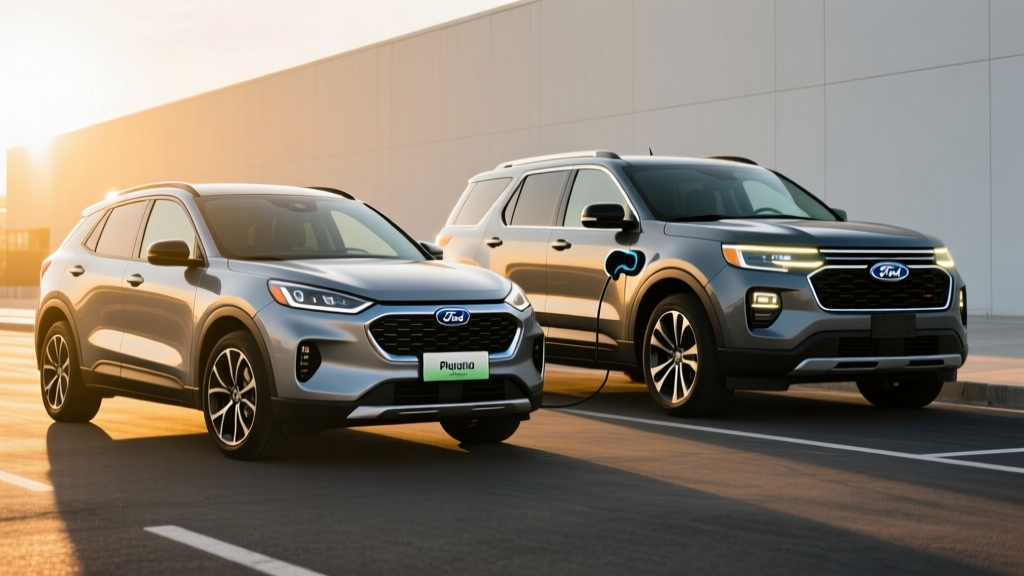
Ford's plug-in hybrid strategy in 2026 comes down to two vehicles: the compact Escape PHEV and the three-row Explorer PHEV. Both pair a gasoline engine with a larger battery and electric motor than a conventional hybrid, giving you 30-40 miles of electric-only driving before the gas engine kicks in. But they serve very different buyers, and the ownership math changes dramatically depending on your commute, charging access, and family size.
This guide breaks down every number that matters — EPA MPG, real-world electric range, battery capacity in kWh, charging times, powertrain output, and whether either qualifies for a federal tax credit under current IRS §30D rules.
HEV vs PHEV: What Ford Actually Sells
Before comparing models, it's worth clarifying the distinction, because Ford sells both types and the badges don't always make it obvious.
Conventional Hybrid (HEV)
- No plug. The battery recharges from regenerative braking and the engine.
- Battery: Typically 1.1–1.5 kWh — enough to assist acceleration and enable brief low-speed electric driving.
- Example: Ford Maverick Hybrid, Ford F-150 PowerBoost Hybrid.
- Best for: Drivers who want better MPG without changing their fueling routine.
Plug-In Hybrid (PHEV)
- Plugs in. A larger battery charges from a wall outlet or Level 2 charger.
- Battery: 14–22 kWh usable — enough for 30–40 miles of electric-only driving.
- Example: Ford Escape PHEV, Ford Explorer PHEV.
- Best for: Drivers with short commutes who can charge at home but need gas flexibility for road trips.
If you never plug in a PHEV, it still works — it just operates as a heavier, less efficient conventional hybrid. The value proposition only makes sense if you charge regularly.
2026 Ford Escape PHEV: Range, MPG, and Specs
The Escape PHEV remains Ford's most accessible plug-in, starting under $40,000 and delivering class-competitive electric range. It uses a 2.5-liter Atkinson-cycle four-cylinder paired with an electric motor and a lithium-ion battery pack.
| Specification | Value |
|---|---|
| Combined Horsepower | 210 hp |
| Engine | 2.5L iVCT Atkinson-cycle I4 |
| Electric Motor | Permanent-magnet synchronous, integrated into eCVT |
| Battery Capacity (Usable) | 14.4 kWh (NMC lithium-ion) |
| EPA Electric-Only Range | 37 miles |
| EPA Combined MPGe (Electric + Gas) | 105 MPGe |
| EPA MPG (Gas Only, Charge-Sustaining) | 40 city / 37 highway / 39 combined |
| Total Combined Range | ~430 miles |
| Level 1 Charging (120V, 12A) | ~10–11 hours (0–100%) |
| Level 2 Charging (240V, 32A) | ~3.5 hours (0–100%) |
| DC Fast Charging | Not supported |
| 0–60 mph | ~7.5 seconds |
| Cargo Volume (Behind 2nd Row) | 34.4 cu ft |
| Base MSRP (SE Trim) | $38,400 |
Real-World Electric Range
The EPA rates the Escape PHEV at 37 miles electric-only. In mixed suburban driving at 65–75°F, expect 33–36 miles. Highway driving at 70+ mph drops this to roughly 28–30 miles. In freezing weather (below 32°F), plan on 24–28 miles due to cabin heating load and reduced battery efficiency. Once the battery depletes, the 39 MPG combined gas mode kicks in seamlessly.
How Many MPG Does the Escape PHEV Get?
| Mode | City | Highway | Combined |
|---|---|---|---|
| Charge-Sustaining (Gas Only) | 40 MPG | 37 MPG | 39 MPG |
| Charge-Depleting (Electric) | 105 MPGe combined | ||
Real-world note: Hybrids and PHEVs in gas mode often exceed their EPA city rating in stop-and-go traffic because regenerative braking recovers energy that a gas car wastes as heat. Owners who do mostly city driving after battery depletion report 41–43 MPG. Highway driving at sustained 75+ mph tends to land closer to 35–36 MPG.
2026 Ford Explorer PHEV: Range, MPG, and Specs
The Explorer PHEV is a larger proposition — three rows, standard AWD, and a turbocharged powertrain that trades some efficiency for towing capability and passenger space. It targets families who want electric commuting during the week and 400+ mile road trip range on weekends.
| Specification | Value |
|---|---|
| Combined Horsepower | 318 hp (est.) |
| Engine | 2.3L EcoBoost I4 turbocharged |
| Electric Motor | Permanent-magnet synchronous, integrated |
| Battery Capacity (Usable) | ~18.6 kWh (NMC lithium-ion) |
| EPA Electric-Only Range | ~35 miles (est.) |
| EPA Combined MPGe | ~80 MPGe (est.) |
| EPA MPG (Gas Only, Charge-Sustaining) | ~27 city / 28 highway / 27 combined (est.) |
| Total Combined Range | ~440 miles (est.) |
| Level 1 Charging (120V) | ~12–14 hours (0–100%) |
| Level 2 Charging (240V, 32A) | ~4.5 hours (0–100%) |
| DC Fast Charging | Not supported |
| 0–60 mph | ~6.5 seconds (est.) |
| Towing Capacity | 5,000 lbs (with tow package) |
| Base MSRP | $54,995 (est.) |
Note: Explorer PHEV specs marked (est.) are based on Ford's announced 2026 model-year data and prior-year EPA filings. Final EPA certification figures may vary. Verify at fueleconomy.gov before purchasing.
How Far Can the Explorer PHEV Go on Electric Only?
The Explorer PHEV targets roughly 35 miles of electric-only range, which covers the average American one-way commute (16 miles each way, per the U.S. Census Bureau). Real-world expectation: 30–33 miles in mild weather with mixed driving, and 25–28 miles in cold weather or at sustained highway speeds. The larger vehicle mass and standard AWD system consume more energy per mile than the Escape.
Side-by-Side: Escape PHEV vs Explorer PHEV
| Attribute | Escape PHEV | Explorer PHEV |
|---|---|---|
| Electric-Only Range (EPA) | 37 miles | ~35 miles (est.) |
| Gas-Only MPG (Combined) | 39 MPG | ~27 MPG (est.) |
| Combined HP | 210 hp | 318 hp (est.) |
| Battery (Usable kWh) | 14.4 kWh | ~18.6 kWh (est.) |
| Level 2 Charge Time (0–100%) | ~3.5 hours | ~4.5 hours |
| DC Fast Charge | No | No |
| Rows / Seats | 2 rows / 5 seats | 3 rows / 6–7 seats |
| Cargo (Max) | 60.8 cu ft | ~85 cu ft (est.) |
| Drivetrain | FWD | AWD (standard) |
| Towing | 1,500 lbs | 5,000 lbs |
| Starting MSRP | $38,400 | ~$54,995 |
Charging a Ford PHEV at Home: What You Need
Neither the Escape PHEV nor the Explorer PHEV supports DC fast charging. This is standard for PHEVs — the battery is small enough that Level 2 (240V) charging fills it in a few hours, making DC infrastructure unnecessary.
| Charging Level | Power (kW) | Escape PHEV (0–100%) | Explorer PHEV (0–100%) |
|---|---|---|---|
| Level 1 (120V, 12A) | ~1.4 kW | 10–11 hours | 12–14 hours |
| Level 2 (240V, 32A) | ~7.7 kW | ~3.5 hours | ~4.5 hours |
| DC Fast Charge | N/A | Not supported | Not supported |
Practical charging reality: Most PHEV owners charge overnight on Level 1 (a standard 120V outlet) and wake up to a full battery every morning. At 1.4 kW, you add roughly 5–6 miles of range per hour of charging — enough to refill the Escape's 37-mile battery in about 7 hours if you arrive home with 20% remaining. A Level 2 home charger is a luxury for PHEV owners, not a necessity, but it's worth installing if you share the garage circuit with another EV.
The Escape PHEV and Explorer PHEV both use the J1772 connector for AC charging, which is the North American standard for non-Tesla plug-in vehicles. No adapter is needed for home or public Level 2 stations.
Federal Tax Credit Eligibility for Ford PHEVs
This is where the math gets complicated. Under current IRS §30D rules, the federal plug-in vehicle tax credit is available for qualifying PHEVs, but several conditions must be met. The credit amount depends on battery capacity and compliance with critical-mineral and battery-component sourcing requirements.
- Battery capacity: Must be at least 7 kWh (both Ford PHEVs qualify).
- MSRP cap: SUVs/vans/pickups capped at $80,000; sedans/other vehicles capped at $55,000. The Escape PHEV (classed as an SUV) and Explorer PHEV both fall under their respective caps.
- Buyer income cap: Modified AGI must not exceed $150,000 (single), $225,000 (head of household), or $300,000 (married filing jointly).
- Battery sourcing: The critical-minerals and battery-component requirements phase in annually. Check current-year compliance on IRS.gov §30D guidance before purchasing — a vehicle that qualified last year may not qualify this year if sourcing rules tighten.
- Point-of-sale transfer: As of 2024, you can transfer the credit to the dealer at purchase and receive it as an immediate price reduction rather than waiting for tax filing.
- Assembly: Vehicle must undergo final assembly in North America (both Ford PHEVs qualify).
Federal Credit Reality Check
The maximum credit for qualifying PHEVs is up to $7,500, but the actual amount depends on whether the vehicle meets the critical-minerals requirement ($3,750) and the battery-components requirement ($3,750) independently. Some PHEVs qualify for only $3,750 or none at all depending on supply-chain compliance in the purchase year. Always verify eligibility at the point of sale and consult a tax professional. State incentives (California, Colorado, New York, etc.) may stack on top — check your state's energy office for current programs.
Battery Warranty, Lifespan, and Replacement Cost
Ford covers the high-voltage hybrid battery in both the Escape PHEV and Explorer PHEV with an 8-year / 100,000-mile warranty (10 years / 150,000 miles in California Air Resources Board states, which include CA, CO, CT, MA, MD, ME, MN, NJ, NY, OR, RI, VT, and WA). The warranty guarantees the battery will retain a minimum percentage of its original capacity — typically 70% — during the coverage period.
Hybrid Battery Longevity Data
PHEV batteries experience less stress than full EV batteries because they operate in a narrower state-of-charge window (roughly 15–95%) and are smaller, meaning each cycle covers fewer miles. Ford's hybrid battery packs from the previous-generation Escape PHEV (2020–2024) have shown minimal degradation in owner reports, with most retaining 90%+ capacity after 60,000 miles. Out-of-warranty replacement cost for the Escape PHEV battery is estimated at $4,000–$6,000 (parts and labor), though this is rarely needed within the vehicle's typical 15-year lifespan.
For context, the conventional hybrid battery in the Ford Maverick Hybrid is much smaller (1.5 kWh) and has shown near-zero degradation in fleet use. The PHEV battery is larger but benefits from the same thermal management and charge-buffer engineering.
Who Should Buy a Ford PHEV — And Who Shouldn't
Pros: Ford PHEV Ownership
- 30–37 miles electric covers most daily commutes without burning gas
- No range anxiety — gas engine provides 400+ mile total range
- Home charging on a standard 120V outlet is sufficient
- 39 MPG (Escape) in gas mode beats most gas-only SUVs
- Federal tax credit may reduce effective price by $3,750–$7,500
- 8-year / 100,000-mile battery warranty (10/150k in CARB states)
- No behavioral change needed for road trips — just fill up with gas
Cons: Ford PHEV Limitations
- No DC fast charging — irrelevant for PHEV use but limits flexibility
- Premium over conventional hybrid: ~$5,000–$7,000 more than gas Escape
- Explorer PHEV fuel economy (27 MPG gas mode) is modest for its price
- FWD only on Escape PHEV — no AWD option
- Electric range drops 20–30% in freezing temperatures
- Tax credit eligibility is not guaranteed and changes annually
- Resale value uncertainty as the market shifts toward full BEVs
Which Electrified Ford Fits You?
Choose the Escape PHEV if: Your daily round-trip commute is under 35 miles, you have access to a 120V or 240V outlet at home, you want to minimize gas spending on weekdays, and you don't need AWD or three rows.
Choose the Explorer PHEV if: You need three rows and 5,000-lb towing, your commute is under 30 miles, you want electric weekday driving with weekend road-trip range, and the ~$55,000 starting price fits your budget.
Choose a conventional Ford hybrid (Maverick, F-150 PowerBoost) if: You can't charge at home, you don't want to think about plugging in, or you primarily drive long highway routes where the PHEV battery adds dead weight.
Choose a full EV (Ford Mustang Mach-E, F-150 Lightning) if: You can install a Level 2 home charger, your daily driving exceeds 35 miles (making PHEV electric range insufficient), you want zero tailpipe emissions, and you're ready to plan road-trip charging stops.
Reliability and Real-World Ownership Notes
Ford's eCVT-based hybrid powertrain (used in the Escape PHEV) has been in production since 2020 and is mechanically simpler than a conventional automatic transmission — there are no gear shifts, torque converters, or clutch packs to wear out. The planetary gearset that blends engine and motor power has very few moving parts. IIHS has rated the Escape well in crashworthiness tests, and the PHEV variant shares the same structure.
Common owner-reported considerations:
- Brake feel: The transition between regenerative braking and friction braking can feel slightly abrupt at low speeds. This is normal for PHEVs and improves with familiarity.
- Engine noise: When the 2.5L Atkinson-cycle engine engages after electric-only driving, it's noticeably louder than a turbocharged engine. The Atkinson cycle prioritizes efficiency over refinement.
- Cold-weather MPG: In gas mode below freezing, expect 35–36 MPG combined (Escape) rather than the EPA's 39 MPG, because the engine runs richer during warmup and cabin heating draws additional load.
- Tire wear: PHEVs are 200–400 lbs heavier than their gas counterparts due to the battery. Budget for tire replacement 5,000–10,000 miles sooner than a gas-only model.
Frequently Asked Questions
How many MPG does the Ford Escape PHEV get?
The EPA rates the 2026 Escape PHEV at 40 city / 37 highway / 39 combined MPG in charge-sustaining (gas-only) mode. Real-world city driving often yields 41–43 MPG thanks to regenerative braking, while sustained highway driving at 75+ mph may drop to 35–36 MPG. In electric mode, it achieves 105 MPGe combined.
How far can the Ford Explorer PHEV go on electric only?
The Explorer PHEV targets approximately 35 miles of EPA-rated electric-only range. In real-world mixed driving at moderate temperatures, expect 30–33 miles. Cold weather and highway speeds reduce this to 25–28 miles. After depletion, the turbocharged engine provides roughly 27 MPG combined and 440+ miles of total range.
Does a Ford PHEV qualify for the federal tax credit?
Both the Escape PHEV and Explorer PHEV may qualify for a federal tax credit of up to $7,500 under IRS §30D, but eligibility depends on current-year battery-sourcing and critical-mineral requirements, buyer income limits ($150K single / $300K joint), and MSRP caps. The credit can be transferred to the dealer at point of sale. Always verify eligibility at IRS.gov and consult a tax professional before relying on the credit in your purchase decision.
Is the Ford PHEV battery reliable, and what does replacement cost?
Ford covers the high-voltage battery with an 8-year / 100,000-mile warranty (10 years / 150,000 miles in CARB states). PHEV batteries experience moderate stress due to charge-buffer engineering and typically retain 90%+ capacity after 60,000 miles. Out-of-warranty replacement for the Escape PHEV battery is estimated at $4,000–$6,000 including labor, though failure before 150,000 miles is uncommon based on current data.
Do I need to install a Level 2 charger for a Ford PHEV?
No. Both Ford PHEVs can fully charge overnight on a standard 120V household outlet (Level 1), which is how most PHEV owners charge. A Level 2 (240V) charger reduces charge time to 3.5–4.5 hours and is worth considering if you share the circuit with a full EV or want mid-day top-ups. Neither Ford PHEV supports DC fast charging.
Hybrid vs PHEV vs EV — which is right for me?
A conventional hybrid (HEV) is best if you can't charge at home and want better MPG with zero routine change. A PHEV is ideal if you have home charging and a sub-35-mile commute but need gas-engine flexibility for road trips or towing. A full EV (BEV) makes sense if you can install Level 2 charging, drive more than 35 miles daily (where a PHEV's electric range falls short), and want the lowest per-mile energy cost and zero tailpipe emissions. Use the fueleconomy.gov comparison tool to model your specific commute and fuel costs.