What Is a PHEV? The Plug-In Hybrid Definition Buyers Need
A PHEV — plug-in hybrid electric vehicle — pairs a conventional gasoline engine with a larger battery and electric motor that can be recharged from an external power source. Unlike a standard hybrid (HEV), which generates all its electricity from the engine and regenerative braking, a PHEV can operate on electricity alone for a meaningful distance before the gas engine takes over.
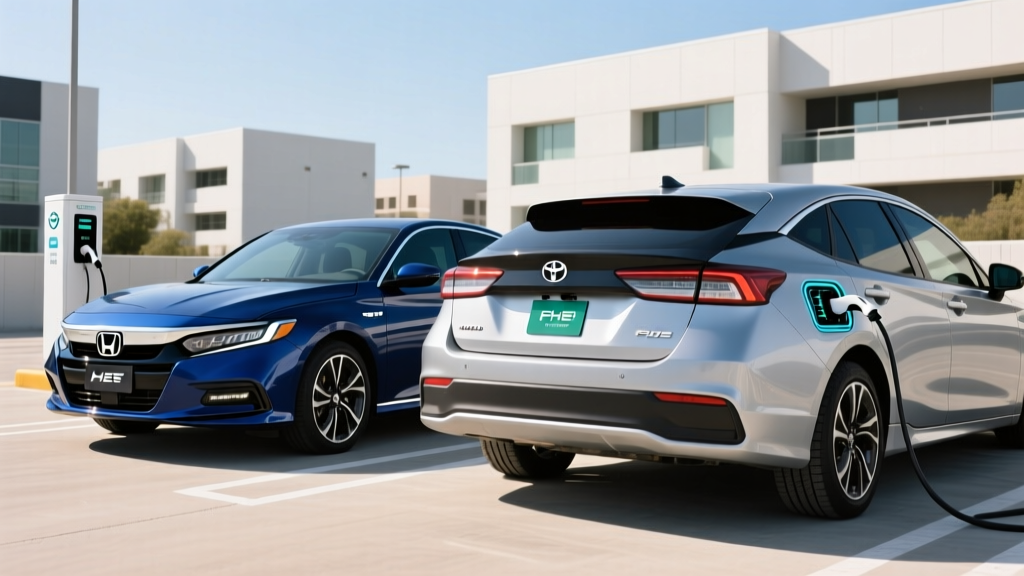
If you have searched "phev define" or "what does PHEV mean," the short answer is this: a plug-in hybrid gives you the electric-only commuting of a battery-electric vehicle (BEV) with the gasoline backup of a conventional car, eliminating range anxiety entirely. You plug it in at home or at a public charger, drive 25 to 50 miles on electricity, and then the vehicle seamlessly transitions to hybrid mode for the rest of your trip.
The key mechanical difference is battery capacity. A conventional hybrid like the Toyota Camry Hybrid carries roughly 1.1 to 1.6 kWh of battery — enough to assist acceleration but not to drive on electricity alone at highway speeds. A modern PHEV like the 2026 Toyota RAV4 Prime packs an 18.1 kWh battery, enabling 42 miles of EPA-rated electric-only range before the 2.5-liter four-cylinder engine engages.
HEV vs. PHEV: Core Differences
| Attribute | Conventional Hybrid (HEV) | Plug-In Hybrid (PHEV) |
|---|---|---|
| Battery size | 1–2 kWh | 12–25 kWh |
| External charging | No — self-charging only | Yes — plug in at home or public charger |
| Electric-only range | Less than 1 mile at low speed | 25–50 miles (EPA) |
| Federal tax credit (§30D) | Not eligible | Up to $7,500 (if eligible) |
| Fuel economy (combined) | 40–55 MPG | 35–45 MPG (charge-sustaining) + 80–110 MPGe (electric mode) |
| Upfront cost premium | +$1,000–$3,000 over gas | +$4,000–$10,000 over HEV |
How Far Can a PHEV Go on Electric Only?
Electric-only range is the defining metric of a plug-in hybrid. For 2026 models, EPA-rated EV ranges cluster in the 25-to-50-mile band:
- 2026 Toyota RAV4 Prime: 42 miles EV-only (18.1 kWh battery)
- 2026 Jeep Wrangler 4xe: 22 miles EV-only (17.3 kWh battery)
- 2026 Chrysler Pacifica PHEV: 32 miles EV-only (16.0 kWh battery)
- 2026 Hyundai Tucson PHEV: 33 miles EV-only (13.8 kWh battery)
- 2026 Toyota Prius Prime: 44 miles EV-only (13.6 kWh battery, SE trim)
Real-World EV Range vs. EPA Sticker
EPA electric-range figures assume moderate temperatures and mixed driving. Expect 10–20% less EV range in cold weather (below 40°F) because battery chemistry slows and cabin heating draws from the pack. Highway-speed driving (70+ mph) also reduces electric range by roughly 15% compared to city use, where regenerative braking recaptures energy. A RAV4 Prime rated at 42 miles may deliver 35–38 miles in summer city driving but only 28–32 miles on a cold winter highway commute.
Once the battery depletes to its charge-sustaining threshold (typically around 15–20% state of charge), the gasoline engine starts and the vehicle operates as a conventional hybrid. Total combined range — electric plus gasoline — typically exceeds 500 miles, limited only by fuel tank size.
PHEV Fuel Economy: MPG and MPGe Explained
PHEV fuel economy is reported two ways by the EPA:
- MPGe (miles per gallon equivalent): Measures efficiency while running on electricity, converting kWh consumed into a gasoline-equivalent figure. Higher is better.
- Charge-sustaining MPG: Standard miles-per-gallon once the battery is depleted and the vehicle runs as a hybrid.
| 2026 PHEV Model | EV Range | MPGe (Electric) | MPG (Gas-Only) | Total Range |
|---|---|---|---|---|
| Toyota Prius Prime SE | 44 mi | 127 MPGe | 52 MPG | ~610 mi |
| Toyota RAV4 Prime | 42 mi | 94 MPGe | 38 MPG | ~600 mi |
| Hyundai Tucson PHEV | 33 mi | 84 MPGe | 35 MPG | ~430 mi |
| Chrysler Pacifica PHEV | 32 mi | 82 MPGe | 30 MPG | ~520 mi |
| Jeep Wrangler 4xe | 22 mi | 49 MPGe | 20 MPG | ~370 mi |
Real-world MPG note: Hybrids and PHEVs in charge-sustaining mode often exceed their EPA city ratings in stop-and-go traffic because regenerative braking recovers energy that a gas car wastes as heat. Highway MPG tends to run 2–5 MPG below the EPA combined figure for most PHEVs due to aerodynamic drag and the added weight of the battery pack.
PHEV Powertrain and Battery Specs
A PHEV powertrain combines three elements: a gasoline engine, one or more electric motors, and a high-voltage battery pack. Total system horsepower reflects the combined output, which is often substantially more than the gas engine alone.
| Spec | Prius Prime | RAV4 Prime | Tucson PHEV |
|---|---|---|---|
| Engine | 2.0L I-4 | 2.5L I-4 | 1.6L turbo I-4 |
| Combined HP | 220 hp | 302 hp | 261 hp |
| Battery (usable kWh) | 13.6 kWh (LFP) | 18.1 kWh (NMC) | 13.8 kWh (NMC) |
| Level 2 charge time (0–100%) | ~4 hours (3.3 kW) | ~2.5 hours (6.6 kW) | ~2 hours (7.2 kW) |
| DC fast charging | No | No | No |
| 0–60 mph | 6.6 sec | 5.7 sec | 7.1 sec |
Charging reality check: Most PHEVs do not support DC fast charging. Their batteries are small enough that Level 2 charging (240V, 3.3 to 7.2 kW) fully replenishes the pack in 2 to 5 hours — fast enough for overnight home charging or a workday top-up. Level 1 charging (120V household outlet) takes 8 to 14 hours, which still works for overnight replenishment for drivers with shorter commutes.
PHEV Pricing and Federal Tax Credit Eligibility
PHEVs carry a price premium over their gas and conventional-hybrid siblings, but the federal §30D clean vehicle credit can offset a significant portion of that cost — if the vehicle and buyer qualify.
§30D Tax Credit Checklist for PHEVs (2026 Rules)
- Battery capacity: Must be at least 7 kWh — nearly all current PHEVs qualify.
- MSRP caps: Vans/SUVs/pickups ≤ $80,000; sedans ≤ $55,000.
- Buyer income caps (modified AGI): $300K joint / $225K head of household / $150K single.
- Battery component sourcing: Increasing percentages of battery components and critical minerals must be sourced from the U.S. or FTA partners. This requirement tightens annually and disqualifies some models mid-year.
- Point-of-sale transfer: Eligible buyers can transfer the credit to the dealer at purchase, reducing the sale price directly rather than waiting for a tax refund.
- Credit amount: Up to $7,500, split between a $3,750 battery-component requirement and a $3,750 critical-minerals requirement. Some PHEVs qualify for only $3,750 if they meet one requirement but not the other.
Rules change frequently. Always verify current eligibility on fueleconomy.gov and consult a tax professional before relying on the credit.
| 2026 PHEV | Base MSRP | Est. §30D Credit | Effective Price |
|---|---|---|---|
| Toyota Prius Prime SE | $34,595 | $3,750 | ~$30,845 |
| Toyota RAV4 Prime SE | $44,515 | $7,500 | ~$37,015 |
| Hyundai Tucson PHEV SEL | $40,350 | $3,750 | ~$36,600 |
| Chrysler Pacifica PHEV | $51,490 | $7,500 | ~$43,990 |
Hybrid Battery Reliability and Replacement Cost
PHEV Battery Warranty Standard
Federal law mandates that hybrid and PHEV batteries carry a minimum warranty of 8 years / 100,000 miles. In California Air Resources Board (CARB) states — which include CA, NY, MA, WA, CO, and others — that warranty extends to 10 years / 150,000 miles. The warranty covers capacity loss below a defined threshold, typically 60–70% of original capacity.
Real-world data from millions of Toyota, Hyundai, and Chrysler hybrids on the road shows that PHEV batteries routinely last well beyond their warranty periods. Toyota's hybrid synergy drive system has accumulated over two decades of field data, with many Prius batteries exceeding 200,000 miles before significant degradation.
If replacement is needed out of warranty, expect these approximate costs for a PHEV battery pack in 2026:
- Toyota Prius Prime: $3,500–$5,000 (parts + labor)
- Toyota RAV4 Prime: $5,000–$7,500
- Chrysler Pacifica PHEV: $6,000–$9,000
- Hyundai Tucson PHEV: $4,500–$6,500
These figures are lower than full BEV battery replacements because PHEV packs are smaller (13–18 kWh vs. 60–100+ kWh). Refurbished and aftermarket options are increasingly available at 30–50% below OEM pricing.
Who Should Buy a PHEV vs. a Full EV or Gas Car?
Decision Framework: PHEV, BEV, or Gas/HEV?
Choose a PHEV if:
- Your daily commute is under 40 miles round-trip and you can charge at home (Level 1 or Level 2).
- You take road trips of 200+ miles several times a year and don't want to plan around charging infrastructure.
- You live in an apartment or area where reliable public DC fast charging is scarce.
- You want to reduce gasoline consumption by 60–80% without committing to a fully electric vehicle.
Choose a full BEV if:
- You have reliable home Level 2 charging and your daily driving is under 250 miles.
- You want the lowest per-mile fuel cost and minimal maintenance (no oil changes, no exhaust system).
- You qualify for the full $7,500 federal credit and any applicable state rebates.
Choose a conventional HEV (gas hybrid) if:
- You cannot charge at home or at work — no garage, no accessible outlet, no workplace chargers.
- Your budget is tight and the PHEV premium ($4,000–$10,000 over HEV) doesn't pencil out in fuel savings.
- You drive high annual miles mostly on highways where the electric-only advantage is minimal.
The economic case for a PHEV is strongest for drivers who charge nightly at home and commute within the electric range most days. A driver who covers 30 round-trip miles daily, charges at home for $0.14/kWh, and only uses gasoline on weekend trips might spend $400–$600 per year on electricity and $300–$500 on gasoline — roughly $700–$1,100 total. A comparable gas-only vehicle at 28 MPG combined with $3.40/gallon fuel would cost $2,200+ annually for the same mileage.
Frequently Asked Questions
How many MPG does a PHEV get?
It depends on how you use it. In electric mode, PHEVs achieve 80–130 MPGe. Once the battery depletes, charge-sustaining MPG ranges from 20 MPG (Jeep Wrangler 4xe) to 52 MPG (Prius Prime). If you charge daily and commute within the EV range, you may use gasoline only a few times per month.
How far can a PHEV go on electric only?
Current 2026 PHEVs deliver 22 to 44 miles of EPA-rated electric-only range. Real-world range varies with temperature, speed, and terrain — expect 15–20% less in cold weather or sustained highway driving. The Prius Prime SE leads the segment at 44 miles.
Does a PHEV qualify for a tax credit?
Many PHEVs qualify for up to $7,500 under the federal §30D clean vehicle credit, subject to MSRP caps, buyer income limits, and battery-sourcing requirements. The credit can be transferred to the dealer at point of sale, reducing your purchase price directly. Verify current eligibility on irs.gov before purchasing.
Do I have to plug in a PHEV?
No — a PHEV will operate as a conventional hybrid if you never plug it in. However, you forfeit the electric-only range and the fuel-cost savings that justify the PHEV price premium. If you cannot plug in, a conventional HEV is a more cost-effective choice.
Is a PHEV battery reliable, and what does replacement cost?
PHEV batteries are warranted for at least 8 years/100,000 miles (10 years/150,000 miles in CARB states) and routinely outlast those periods based on two decades of Toyota and Hyundai hybrid data. Out-of-warranty replacement costs range from $3,500 to $9,000 depending on the model — substantially less than a full BEV battery replacement.
Can a PHEV use DC fast charging?
Most PHEVs do not support DC fast charging. Their batteries are small enough that Level 2 charging (240V) replenishes the pack in 2–5 hours, which is sufficient for overnight or workday charging. The Mitsubishi Outlander PHEV is a rare exception that has offered DC fast charging capability in prior model years.
PHEV Pros
- 25–44 miles of zero-gasoline commuting
- No range anxiety — gas engine provides 500+ mile total range
- Up to $7,500 federal tax credit reduces effective price
- Stronger acceleration than gas-only counterparts (electric torque fill)
- Regenerative braking reduces brake wear
PHEV Cons
- $4,000–$10,000 price premium over conventional hybrid
- Must charge regularly to realize fuel savings — uncharged PHEVs are just heavier hybrids
- No DC fast charging on most models limits road-trip electric driving
- Added weight of battery reduces gas-only MPG vs. a lighter HEV
- Tax credit eligibility varies by model, sourcing, and buyer income