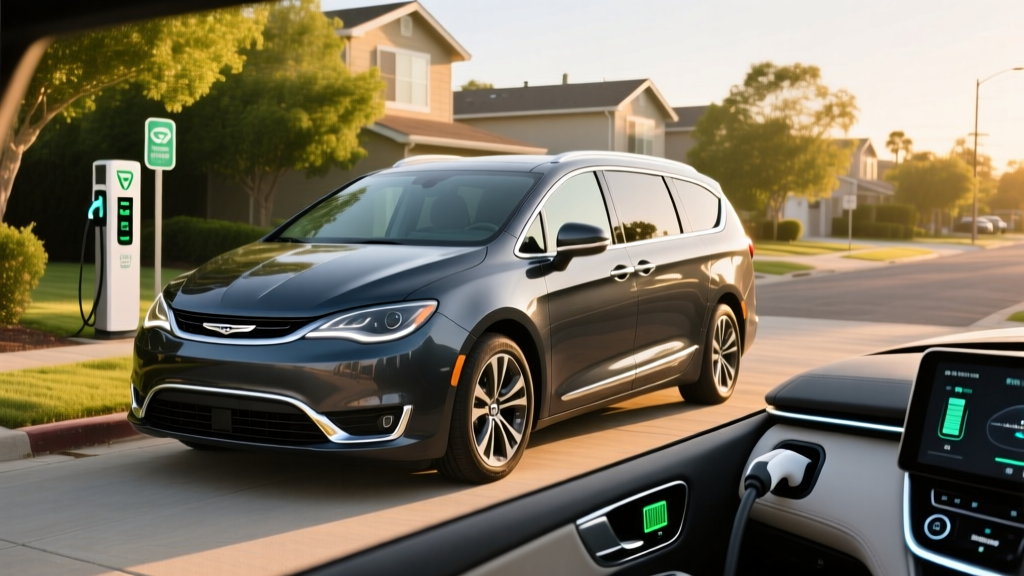
If you're researching the Chrysler Pacifica Hybrid MPG, you're likely weighing whether a plug-in hybrid minivan makes financial and practical sense for your family. The Pacifica Hybrid holds a unique position in the market: it remains the only plug-in hybrid minivan sold in the United States, blending an electric-only commute mode with the range and flexibility of a gasoline engine for longer trips.
Below, we break down the official EPA numbers, real-world efficiency expectations, powertrain specs, charging logistics, battery longevity, and tax credit eligibility — everything you need to decide if the Pacifica PHEV fits your garage.
Chrysler Pacifica Hybrid MPG: EPA Numbers and Real-World Results
The Pacifica Hybrid operates in two distinct modes: charge-depleting (electric-first) and charge-sustaining (hybrid gas). The EPA rates each separately, and understanding both is critical to evaluating whether this van saves you fuel.
| Metric | EPA Rating | Notes |
|---|---|---|
| Combined MPGe (electric + gas) | 82 MPGe | Blended driving on a full charge |
| Electric-only range | 32 miles | Before gas engine engages |
| Charge-sustaining MPG (city) | 30 mpg | After battery is depleted |
| Charge-sustaining MPG (highway) | 31 mpg | After battery is depleted |
| Charge-sustaining MPG (combined) | 30 mpg | Gas-only hybrid mode |
| Total combined range | ~430 miles | Full tank + full battery |
HEV vs. PHEV: Why the Pacifica Is a Plug-In Hybrid
The Pacifica Hybrid is a plug-in hybrid electric vehicle (PHEV), not a conventional hybrid (HEV). The distinction matters for your daily routine and fuel savings.
Conventional Hybrid (HEV)
- Small battery (~1-2 kWh)
- Cannot plug in — charges via regen and engine
- Electric assist only at low speeds
- No electric-only commuting range
- Example: Toyota Sienna Hybrid (36 mpg combined)
Plug-In Hybrid (PHEV)
- Larger battery (16 kWh in Pacifica)
- Plugs in to charge at home or public stations
- Genuine electric-only driving range (32 mi)
- Gas engine for longer trips — no range anxiety
- Pacifica Hybrid: this vehicle
If you never plug in the Pacifica Hybrid, it still functions as a conventional hybrid at 30 mpg combined — respectable for a minivan, but you'd be carrying around 800+ lbs of battery you're not leveraging. The PHEV value proposition only works if you charge regularly.
Powertrain Specs: Engine, Motors, and Combined Output
| Component | Specification |
|---|---|
| Engine | 3.6L Atkinson-cycle V6 |
| Electric motors | Dual-motor eFlite EVT (electrically variable transmission) |
| Combined system horsepower | 260 hp |
| Battery pack | 16 kWh lithium-ion (NMC chemistry) |
| Usable battery capacity | ~13 kWh (buffer protects longevity) |
| Transmission | eFlite EVT — no traditional gears |
| Drivetrain | Front-wheel drive (FWD only) |
| 0-60 mph | ~7.1 seconds |
| Fuel tank | 13.4 gallons |
The Atkinson-cycle V6 sacrifices some low-end torque for thermal efficiency — a common hybrid strategy. The dual electric motors fill in the torque gap off the line, and the eFlite transmission seamlessly blends power sources. You won't notice gear shifts because there aren't any in the traditional sense. Acceleration is adequate for merging and passing, though the Pacifica Hybrid is tuned for efficiency, not sportiness.
Charging the Pacifica Hybrid: Times, Levels, and Connector
One of the most common questions from new PHEV owners is how long charging takes and what equipment is needed. The Pacifica Hybrid uses a standard J1772 connector for AC charging. It does not support DC fast charging — a deliberate engineering choice given the relatively small battery.
| Charging Level | Power (kW) | Time (0-100%) | Setup |
|---|---|---|---|
| Level 1 (120V outlet) | ~1.4 kW | ~14 hours | Standard household outlet; included cord |
| Level 2 (240V, 16A) | ~3.6 kW | ~5 hours | Home wall charger or public Level 2 |
| Level 2 (240V, 32A) | ~7.2 kW (capped at ~6.6 kW onboard) | ~2.5 hours | Higher-amperage Level 2 station |
| DC Fast Charging | N/A | N/A | Not supported |
For most owners, overnight Level 2 charging at home is the sweet spot. A 240V/16A circuit replenishes the 16 kWh pack in about 5 hours — more than enough for a nightly top-up. If you install a 32A Level 2 charger (common for EV-ready homes), the Pacifica's onboard charger caps at approximately 6.6 kW, so you'll see about 2.5 hours for a full charge. Level 1 on a standard 120V outlet works but is slow enough that it's best reserved for occasional use or overnight top-ups when a full charge isn't critical.
Because the battery is only 16 kWh, the lack of DC fast charging is rarely a practical limitation. You're not road-tripping on electrons — the gas engine handles that. For a primer on home Level 2 installation costs, see our EPA PHEV comparison tool for efficiency data across models.
Pricing, Trims, and Federal Tax Credit Eligibility
The 2026 Chrysler Pacifica Hybrid is offered in three trims, all sharing the same powertrain:
| Trim | MSRP (est.) | Key Features |
|---|---|---|
| Plug-In Hybrid (base) | $51,095 | Leatherette seats, 10.1" Uconnect, power sliding doors |
| Plug-In Hybrid Limited | $55,095 | Nappa leather, hands-free liftgate, premium audio |
| Plug-In Hybrid Pinnacle | $58,095 | Quilted leather, SRT-style grille, rear-seat entertainment |
- MSRP cap: Vans/minivans must be under $80,000 — the Pacifica qualifies.
- Buyer income cap: Modified AGI must not exceed $150,000 (single) or $300,000 (joint).
- Battery sourcing: Critical minerals and battery component requirements phase in annually. Check the latest IRS clean vehicle credit page for current-year sourcing compliance — Stellantis has historically qualified for partial or full credits, but this can change mid-year.
- Point-of-sale transfer: You can transfer the credit to the dealer at purchase for an upfront price reduction, rather than waiting for tax filing.
Always confirm eligibility with a tax professional and check the EPA tax credit database before purchasing. State incentives (California, Colorado, Massachusetts, and others) may stack on top.
Battery Longevity, Warranty, and Replacement Cost
Pacifica Hybrid Battery Warranty
Coverage: 10 years / 100,000 miles (whichever comes first) in CARB states and states that follow California emissions standards. In all other states: 8 years / 100,000 miles.
Capacity threshold: Stellantis warrants the battery against falling below 70% of original capacity during the warranty period.
What's covered: Battery cell defects, module failures, battery management system faults. Normal degradation below 70% within the warranty window triggers a repair or replacement at no cost.
The 16 kWh NMC (nickel-manganese-cobalt) pack in the Pacifica Hybrid is far smaller than a full EV battery, which means replacement costs are proportionally lower. Current out-of-warranty replacement estimates range from $5,500 to $7,500 including labor and programming — significant, but nowhere near the $15,000-$20,000+ seen in long-range EVs.
Real-world degradation data from Pacifica Hybrid owners suggests the pack holds up well under normal use. Because PHEV batteries cycle daily but over a shallow depth of discharge (you're using ~13 kWh of the 16 kWh total, with top and bottom buffers), the chemistry degrades more slowly than a full EV battery cycled to 100% regularly. Many high-mileage Pacifica Hybrids report 90%+ battery capacity retention after 5 years and 80,000 miles.
Reliability: What Owners and Data Show
The Pacifica Hybrid's powertrain has been in production since the 2017 model year, giving it one of the longest track records of any PHEV on the market. The V6 engine and eFlite transmission are well-proven. Common trouble spots reported by owners and tracked by NHTSA include:
- Early-model (2017-2019) battery recall: A small number of early packs were recalled for potential fire risk when parked with a full charge. This was addressed via software updates and module replacements. Later model years are not affected.
- 12V auxiliary battery: Like many modern vehicles, the 12V battery can drain if the vehicle sits unplugged for extended periods. Keep the Pacifica plugged in or use a 12V maintainer if storing.
- Infotainment glitches: Uconnect software updates have largely resolved early complaints, but keep firmware current.
Overall, the Pacifica Hybrid's reliability is average to above-average for the minivan segment. The hybrid system itself — motors, inverter, eFlite transmission — has proven durable. The battery warranty provides strong long-term protection.
Pacifica Hybrid vs. Sienna Hybrid vs. Full EV: Which Fits Your Family?
✅ Choose the Pacifica Hybrid If:
- Your daily commute is under 30 miles and you can charge at home
- You take regular road trips and don't want to plan around charging stops
- You want a minivan with stowable second-row seats (PHEV battery eliminates the Stow 'n Go third row, but second row still folds)
- You want to reduce fuel consumption without committing to a full EV
- You qualify for the federal tax credit, bringing effective price closer to a gas Pacifica
❌ Look Elsewhere If:
- You can't charge at home or work — the PHEV premium is wasted without regular plug-in charging
- You want AWD — the Pacifica Hybrid is FWD only (the gas Pacifica offers AWD)
- You want third-row Stow 'n Go — the PHEV battery occupies that space; third-row seats fold but don't stow into the floor
- Your daily driving exceeds 30 miles and you want maximum electric savings — consider a full EV like the Kia EV9 or Tesla Model X
- You want the lowest possible maintenance — a Toyota Sienna HEV has no plug and fewer drivetrain components
The closest competitor is the Toyota Sienna Hybrid, which is a conventional HEV (no plug). The Sienna delivers 36 mpg combined across all trims with available AWD, but offers zero electric-only range. If you can't charge at home, the Sienna is the smarter buy. If you can charge and most of your driving is under 32 miles, the Pacifica Hybrid's ability to burn zero gasoline on daily errands gives it a decisive cost-per-mile advantage.
Frequently Asked Questions
How many MPG does the Chrysler Pacifica Hybrid get?
The EPA rates the Pacifica Hybrid at 30 mpg combined (30 city / 31 highway) once the battery is depleted and it operates as a conventional hybrid. When factoring in electric-only driving on a full charge, the combined rating is 82 MPGe. Real-world results vary: city drivers with regular charging may burn very little gasoline, while highway-heavy drivers with a depleted battery should expect 27-29 mpg.
How far can the Pacifica Hybrid go on electric only?
The EPA rates the Pacifica Hybrid at 32 miles of electric-only range. In warm weather with moderate speeds (under 45 mph), some owners report 34-36 miles. In cold weather or at highway speeds, expect 22-26 miles before the gas engine activates. Once the battery is depleted, the van seamlessly switches to hybrid mode — you never need to intervene.
Does the Pacifica Hybrid qualify for a tax credit?
Under current IRS §30D rules, the Pacifica Hybrid may qualify for up to $7,500 in federal tax credits, subject to buyer income limits ($150K single / $300K joint), the $80,000 MSRP cap for vans (which it clears), and battery component/critical mineral sourcing requirements that update annually. The credit can be transferred to the dealer at point of sale for an immediate price reduction. Always verify current eligibility at irs.gov and consult a tax professional.
Is the Pacifica Hybrid reliable, and what does battery replacement cost?
The Pacifica Hybrid has been in production since 2017 with generally solid reliability. The hybrid powertrain is well-proven, and early battery recall issues have been resolved. The battery is warranted for 8-10 years / 100,000 miles depending on your state. Out-of-warranty replacement costs approximately $5,500-$7,500. Most owners report strong capacity retention (90%+) through the first 5 years.
Can the Pacifica Hybrid DC fast charge?
No. The Pacifica Hybrid supports only AC charging via a J1772 connector at up to approximately 6.6 kW on Level 2 (240V). A full charge takes about 2.5 hours on a 32A Level 2 charger or about 5 hours on a 16A circuit. DC fast charging is not available — but with only 16 kWh to fill, overnight home charging is more than sufficient.
Hybrid vs. PHEV vs. EV — which is right for my family?
If you can charge at home and your daily driving is under 35 miles, a PHEV like the Pacifica Hybrid gives you electric commuting with gas flexibility for road trips — the best of both worlds. If you can't charge at home, a conventional hybrid like the Toyota Sienna HEV offers strong MPG with no plug-in hassle. If you have reliable home charging and want the lowest operating cost, a full EV eliminates gasoline entirely but requires planning for longer trips. The right answer depends entirely on your charging access and driving patterns.