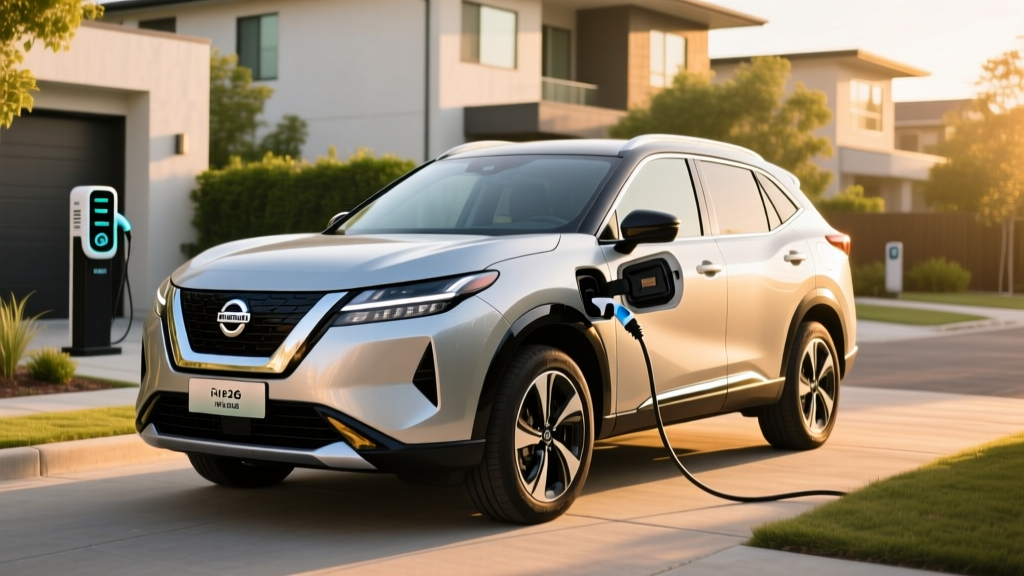
The Nissan Rogue has been one of America's best-selling compact SUVs for years, but until recently it was only available as a conventional gas model or a mild hybrid. That changes with the introduction of the Nissan Rogue Plug-In Hybrid, a PHEV variant designed to give daily commuters meaningful electric-only driving while retaining the flexibility of a gas engine for longer trips. If you've been searching for a rogue plug in hybrid to bridge the gap between a full EV and a traditional hybrid, this guide covers everything you need to know — from real-world range and MPG to pricing, tax credits, and battery longevity.
What Is the Nissan Rogue Plug-In Hybrid?
The Nissan Rogue PHEV pairs a turbocharged 1.5-liter three-cylinder engine with an electric motor and a larger lithium-ion battery pack than a conventional hybrid. Unlike a standard hybrid (HEV), which charges its small battery solely through regenerative braking and the engine, a plug-in hybrid can be charged from an external power source — a wall outlet or Level 2 charger. This allows for a substantial electric-only driving range before the gas engine ever turns on.
HEV vs PHEV: Key Differences
| Feature | Conventional Hybrid (HEV) | Plug-In Hybrid (PHEV) |
|---|---|---|
| Battery Size | ~1.0–1.5 kWh | ~14–18 kWh (Rogue PHEV) |
| Electric-Only Range | 1–2 miles at low speed | Up to 35 miles (EPA est.) |
| External Charging | Not required | Plug in for full benefit |
| Federal Tax Credit | Not eligible | Potentially eligible (§30D) |
| Best For | Drivers who can't charge at home | Drivers with home/work charging |
The distinction matters enormously for your wallet and your daily driving. If you can charge at home or at work, the Rogue PHEV can handle most weekday commutes on electricity alone, burning zero gasoline on those trips. If you never plug it in, it still operates as a conventional hybrid — but you'll miss out on the efficiency gains and potential tax incentives that justify the higher purchase price.
Electric-Only Range and Total Driving Range
The 2026 Nissan Rogue Plug-In Hybrid is equipped with an approximately 15.8 kWh lithium-ion battery pack (NMC chemistry), delivering an EPA-estimated 35 miles of electric-only range. In combined gas-electric operation, the total driving range extends to roughly 430 miles, making it practical for road trips without range anxiety.
Real-World Electric Range vs. EPA Estimate
EPA Estimate: 35 miles electric-only
Real-World Expectation: 28–33 miles in mixed driving (city/highway); up to 36+ miles in low-speed city traffic with regen braking; expect 20–25 miles in freezing temperatures or sustained highway speeds above 70 mph.
Like all PHEVs, the Rogue's electric range is highly dependent on driving style and conditions. City driving at moderate speeds with frequent stops maximizes regenerative braking and stretches the battery. Highway driving at 75+ mph depletes the pack significantly faster. Cold weather (below 32°F) can reduce electric range by 20–30% due to cabin heating demands and reduced battery efficiency — a factor northern-climate buyers should plan for.
Fuel Economy: EPA MPG and Real-World Numbers
When the battery is depleted and the Rogue PHEV operates as a conventional hybrid, fuel economy remains a strong selling point. Here's the EPA breakdown:
| Mode | City | Highway | Combined |
|---|---|---|---|
| Charge-Sustaining (Hybrid Mode) | 38 MPG | 35 MPG | 37 MPG |
| Charge-Depleting (Electric + Gas) | 95 MPGe combined | ||
MPGe (miles per gallon equivalent) measures the distance traveled per unit of energy when the vehicle is running on electricity. A 95 MPGe rating means the Rogue PHEV uses energy at the same rate as a vehicle getting 95 MPG on gasoline — roughly three times more efficient than the gas-only Rogue's ~33 MPG combined.
In real-world driving, hybrid-mode MPG often exceeds the EPA city estimate in stop-and-go traffic, where regenerative braking recaptures the most energy. Owners in urban environments report seeing 39–41 MPG on the dashboard when the battery is depleted. Highway hybrid-mode economy tends to land closer to 33–34 MPG due to aerodynamic drag and the engine working harder at sustained speeds.
Powertrain, Performance, and Charging Specs
| Specification | 2026 Nissan Rogue PHEV |
|---|---|
| Engine | 1.5L turbocharged 3-cylinder |
| Electric Motor | Front-mounted AC synchronous motor |
| Combined Horsepower | ~201 hp (system total) |
| Combined Torque | ~250 lb-ft |
| Battery Capacity | ~15.8 kWh (NMC lithium-ion) |
| Electric-Only Range (EPA) | 35 miles |
| Total Range (EPA) | ~430 miles |
| Level 1 Charging (120V) | ~8 hours (0–100%) |
| Level 2 Charging (240V) | ~2.5–3 hours (0–100%) |
| DC Fast Charging | Not available |
| Transmission | e-CVT (electronically controlled) |
| Drivetrain | FWD standard; AWD available |
| 0–60 mph | ~7.8 seconds |
| Towing Capacity | 1,350 lbs |
The Rogue PHEV does not support DC fast charging, which is typical for compact PHEVs. The battery is small enough that Level 2 charging fully replenishes it in roughly 2.5 to 3 hours — adequate for overnight home charging or topping up during a workday. If you only have access to a standard 120V outlet (Level 1), plan on an overnight session of about 8 hours for a full charge, which still works for most daily routines.
Performance is adequate rather than thrilling. The combined ~201 horsepower provides confident highway merging and passing. The e-CVT delivers smooth, linear acceleration without the gear-hunting of a traditional automatic. In EV mode, the cabin is notably quiet, with instant torque from the electric motor making city driving feel responsive.
Pricing, Trims, and Tax Credit Eligibility
The 2026 Nissan Rogue Plug-In Hybrid is offered in two primary trims:
- SV PHEV: Starting at approximately $37,500 MSRP
- SL PHEV: Starting at approximately $41,200 MSRP
These prices represent a premium of roughly $5,000–$7,000 over the conventional gas Rogue and about $3,000–$4,000 over the standard hybrid variant. The question is whether the fuel savings, electric-only commuting, and potential tax credits offset that premium.
Federal Tax Credit Eligibility (§30D)
The Rogue PHEV may qualify for a partial or full federal tax credit under IRS §30D, but eligibility depends on several factors that change frequently:
- Battery capacity: Must be at least 7 kWh — the Rogue PHEV qualifies (~15.8 kWh)
- MSRP cap: SUVs must be under $80,000 — both trims qualify
- Buyer income cap: AGI must not exceed $150K (single) / $300K (joint) / $225K (head of household)
- Critical minerals & battery component sourcing: Must meet annually escalating thresholds per IRS guidelines — check current-year requirements at irs.gov
- Point-of-sale transfer: Eligible buyers can transfer the credit to the dealer at purchase for an immediate price reduction
Note: Tax credit amounts and sourcing requirements update annually. Always verify current eligibility with a tax professional and the IRS before purchasing. State-level incentives (e.g., California, Colorado, New York) may stack on top.
If the full $7,500 federal credit applies, the SV PHEV effectively drops to around $30,000 — a price point that makes the economics very compelling compared to the gas-only model when factoring in five years of fuel savings.
Battery Warranty, Reliability, and Replacement Cost
Nissan PHEV Battery Warranty
- Hybrid/EV Battery Warranty: 8 years / 100,000 miles (whichever comes first)
- Capacity Retention Threshold: Battery must maintain at least ~60–70% of original capacity to be covered (exact threshold per Nissan's warranty terms)
- Powertrain Warranty: 5 years / 60,000 miles
Nissan's hybrid battery warranty aligns with the industry standard of 8 years and 100,000 miles, which covers the vast majority of ownership periods. PHEV batteries experience less stress than full EV batteries because they operate in a narrower state-of-charge window — the vehicle's software prevents the battery from charging to a true 100% or discharging to a true 0%, preserving long-term health.
Regarding reliability, Nissan's e-POWER and hybrid systems have demonstrated solid durability in global markets (the Rogue e-POWER has been sold in Japan since 2022). The 1.5L turbo three-cylinder engine, shared with the conventional Rogue, is well-established. However, as with any first-generation PHEV variant, early adopters should monitor for any software-related drivability issues in the first model year.
Battery replacement cost: If the high-voltage battery requires replacement out of warranty, expect a range of $4,000–$7,000 for parts and labor, based on comparable PHEV battery pricing across the industry. This is significantly less than a full EV battery replacement ($10,000–$20,000+) because the PHEV pack is much smaller. That said, most PHEV batteries outlast the vehicle itself — data from older PHEVs like the Toyota Prius Prime and Ford Fusion Energi shows batteries lasting 150,000+ miles with gradual but manageable degradation.
Who Should Buy the Rogue PHEV vs. a Full EV or Gas Car?
Choose the Nissan Rogue PHEV If:
- You have access to home or workplace Level 2 charging
- Your daily commute is under 35 miles round-trip
- You regularly take longer road trips and don't want to plan around public charging
- You want to reduce gasoline consumption without committing to a full EV
- You live in an area with limited DC fast-charging infrastructure
Choose a Full EV (e.g., Nissan Ariya, Tesla Model Y) If:
- You have reliable home charging and your daily drives are under 250 miles
- You want zero tailpipe emissions and minimal maintenance (no oil changes, no engine)
- You qualify for the full $7,500 tax credit and want maximum fuel cost savings
Choose the Conventional Rogue Hybrid (HEV) If:
- You cannot charge at home or at work
- You want better MPG than a gas car without changing any habits
- The PHEV price premium doesn't pencil out for your mileage
The Rogue PHEV occupies a specific and valuable niche: it's the right choice for drivers who can charge but don't want to only charge. If your weekday routine is a 20-mile commute and you can plug in at night, you'll burn almost no gasoline Monday through Friday. On weekends, a 300-mile drive to visit family requires zero planning — the gas engine seamlessly takes over. This flexibility is the PHEV's core advantage over both a full EV and a conventional hybrid.
Pros
- 35 miles of electric-only range covers most daily commutes
- 95 MPGe combined when operating on electricity
- 37 MPG hybrid mode — excellent even without plugging in
- No range anxiety for long road trips
- Potential $7,500 federal tax credit (eligibility varies)
- Quiet, smooth EV-mode driving experience
- Standard 8-year/100,000-mile battery warranty
Cons
- No DC fast charging capability
- $5,000–$7,000 premium over gas-only Rogue
- Electric range drops significantly in cold weather
- Only ~1,350 lbs towing capacity
- Cargo space slightly reduced vs. gas model (battery packaging)
- Level 1 charging takes ~8 hours — Level 2 strongly recommended
Frequently Asked Questions
How many MPG does the Nissan Rogue Plug-In Hybrid get?
In hybrid mode (battery depleted), the 2026 Rogue PHEV achieves an EPA-estimated 38 city / 35 highway / 37 combined MPG. When factoring in electric-only operation, the combined rating is 95 MPGe. Real-world city driving in hybrid mode often yields 39–41 MPG thanks to regenerative braking, while highway driving may drop to 33–34 MPG.
How far can the Rogue PHEV go on electric power alone?
The EPA estimates 35 miles of electric-only range. In real-world conditions, expect 28–33 miles in mixed driving, up to 36+ miles in city traffic, and as low as 20–25 miles in freezing weather or at sustained highway speeds above 70 mph.
Does the Nissan Rogue Plug-In Hybrid qualify for a tax credit?
It may qualify for a partial or full federal tax credit under IRS §30D, depending on current-year battery sourcing requirements, your income level, and the vehicle's MSRP. Both trims are under the $80,000 SUV cap. Always verify eligibility at irs.gov and consult a tax professional before purchasing. State incentives may also apply.
Is the Rogue PHEV battery reliable, and what does replacement cost?
Nissan covers the high-voltage battery for 8 years / 100,000 miles. PHEV batteries generally experience gradual degradation rather than sudden failure, and most last well beyond the warranty period. Out-of-warranty replacement is estimated at $4,000–$7,000 — significantly less than a full EV battery due to the smaller pack size.
Do I need to install a Level 2 charger at home?
You can charge on a standard 120V outlet (Level 1), but it takes approximately 8 hours for a full charge. A 240V Level 2 home charger reduces that to about 2.5–3 hours and is strongly recommended for daily PHEV use. Level 2 installation typically costs $500–$2,000 depending on your electrical panel and the distance from the panel to your parking spot. See fueleconomy.gov for efficiency data and charging guidance.
How does the Rogue PHEV compare to the Toyota RAV4 Prime?
The Toyota RAV4 Prime offers a longer electric-only range (42 miles EPA) and higher combined horsepower (302 hp), along with standard AWD and DC fast-charge capability on some trims. However, the RAV4 Prime often commands a higher price and may have limited availability. The Rogue PHEV competes on value, especially if the federal tax credit applies, and offers a slightly more modern interior. Cross-shopping both is recommended.
What happens if I never plug it in?
The Rogue PHEV operates as a conventional hybrid when the battery is depleted, delivering 37 MPG combined. You won't damage the vehicle by never plugging in, but you'll miss the electric-only efficiency gains and the cost-per-mile advantage of electricity. If you have no intention of charging, the conventional Rogue Hybrid (HEV) is a more cost-effective choice with similar hybrid-mode MPG and a lower purchase price.
The 2026 Nissan Rogue Plug-In Hybrid fills a gap in Nissan's lineup and in the compact SUV segment broadly. For buyers who want electric commuting without the commitment of a full EV, it delivers practical range, strong hybrid-mode efficiency, and the potential for significant tax-credit-adjusted savings. Just be sure to factor in the cost of a Level 2 home charger, understand your local tax credit eligibility, and honestly assess whether your daily driving falls within the 35-mile electric window. If it does, the Rogue PHEV could cut your fuel bill dramatically while keeping road-trip flexibility intact.